- 624 pages
- English
- ePUB (mobile friendly)
- Available on iOS & Android
eBook - ePub
About this book
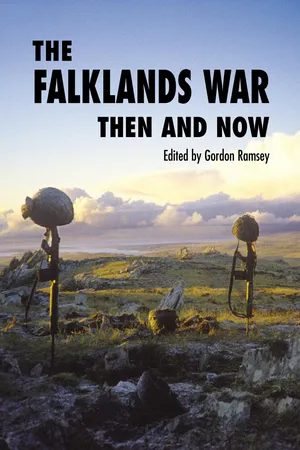
In 1982, Argentina rashly gambled that a full-scale invasion of the Falkland Islands — ownership of which had been disputed with Great Britain for over a century — would put an end to years of political wrangling. However Britain's response was to immediately dispatch a task force to recover the islands, by force if necessary. The 'conflict' which followed (a formal declaration of war was never given) lasted ten weeks from Argentine invasion to British liberation, the white heat of battle using 20th century technology contrasting with bitter hand-to-hand bayonet fighting in inhospitable conditions. Eyewitness accounts by the participants of both sides, and islanders, leave us in no doubt as to the ferocity of the combat on land, sea, and in the air. Comparison photography in color of all the battlefields, the crash sites of the aircraft shot down, the relics and the remains, together with portraits of those who lost their lives and the battlefield memorials, serve as a graphic testimony to their endeavors, 25 years after the battle. A Roll of Honour lists the casualties of both sides and, for the first time, the graves of all the British fallen — both on the islands and in the United Kingdom — have been visited and photographed as a lasting record of all those who made the supreme sacrifice.
Information
Index
HistorySATURDAY, MAY 1

A critical pre-requisite for offensive land operations by the British was the neutralisation of Stanley airport which, it was feared, could be adapted for use by Argentine fast jets. In its existing form only Italian-built Aeromacchi MB339A two-seat trainer jets and Argentine-built FMA IA58A Pucara twin-turbo prop twin-seat light attack aircraft could use the runway. Thus, the RAF put together an ambitious plan to use Avro Vulcan B Mk 2 bombers, refuelled by Handley Page Victor K2 tankers flying from Ascension Island, to bomb the runway. It would require two Vulcans (one flying as back-up); one Nimrod and 13 Victors, with 19 separate in-flight refuellings of 1.5 million pounds of aviation fuel to deliver 21 1,000lb HE General Purpose bombs. Another 21 were carried in the second Vulcan in case the first had to abort. In the event, when the raid was carried out on the night of April 30/May 1, this is precisely what happened when a rubber cockpit window seal disintegrated on the lead Vulcan XM598, resulting in a lack of pressurisation in the cabin. The crew, (above left) (Flight Lieutenant Mick Cooper; Squadron Leader John Reeve; Flight Lieutenant Barry Masefield; Flying Officer Don Dibbens; Flight Lieutenant Jim Vinales and Flight Lieutenant Pete Standing) were forced to abort. This left the secondary crew in XM607 to complete the mission. (above right) L-R: Flying Officer Pete Taylor; Flight Lieutenant Bob Wright; Flight Lieutenant Martin Withers; Flight Lieutenant Hugh Prior and Flight Lieutenant Gordon Graham. Missing from this picture taken a few months before the war is Flight Lieutenant Dick Russell, an air-to-air refuelling instructor from the Victor OCU at RAF Marham. Vulcans had not carried out air-to-air refuelling for 20 years as a near-fatal accident had occurred in 1962 when a heavy link-up with a tanker had snapped the Vulcan’s fuel probe which was injested into one of its Olympus engines causing it to explode! The discipline had then rapidly been scrubbed from Vulcan operations with the result that in 1982, despite an intensive training programme, instructors were carried on all the bombing raids which were dubbed ‘Black Buck’ missions.

XM598 arrives at Ascension Island’s Wideawake airfield on April 29 and taxies to dispersal with Green Mountain in the background. Below: Our fellow passengers disembark for the two-hour stopover on the way to Stanley on October 20, 1996.

A bombing raid was now being planned on Stanley airfield. To reach the target with one Vulcan needed about eighteen Victor tanker sorties, but the in-flight refuelling equipment on the Vulcan had not been used for ten years and the aircrew were barely practised — the aircraft having sufficient range on its own for NATO purposes. That it reached the target area must have signalled a strong message to the Argentines, that their mainland targets were also vulnerable and after the war I believe there was evidence to show that these raids had obliged the Argentinians to deploy their Mirage III air defence fighters around their northern bases and cities and, probably, give up short-term ideas of extending the Stanley runway to take their jets. Life was therefore made far easier for our Sea Harriers and ourselves in San Carlos as a result.
Damaging a runway with a conventional bomb is far less easy than one might imagine. Bombs fall in sticks and only one or possibly two have a chance of hitting the runway itself, since, to improve the odds, they must be dropped across the length of the runway to reduce line error and by a large number of aircraft, if more than one crater is required. I was a little surprised, therefore, to see emanating from Sandy’s force claims that Sea Harriers with fewer bombs could ‘take out the airfield in one strike’. Perhaps, unknown to me, we had a runway penetrating bomb, but I thought not.
COMMODORE
MICHAEL CLAPP, CB, RN
AMPHIBIOUS TASK FORCE
COMMANDER

Black Buck 1 concludes with the return of Vulcan XM607 to Wideawake, some 15 hours and 45 minutes after take-off the previous night. Right: She taxied back to her dispersal in front of the same flat-topped hill seen in our comparison at the bottom of the opposite page, to a tumultuous welcome for the weary crew.
It was one of the little triangular side windows. I must have closed that thing a thousand times during my RAF career without any problems but as soon as we got airborne, the noise went up and up and up as we accelerated away till we could hardly speak on the intercom. The rubber seal had come loose from the frame. We tried to fix it with a polythene bag out of the ration box. Then I opened and closed it several times, to try and get it to seal. We were climbing all the time and, by the time we got to about 16,000 feet, it was clear that the aircraft wasn’t going to pressurize. It was about the one fault — decompression — that we couldn’t carry on with. I had no option but to declare ourselves unserviceable and Martin Withers took over.
SQUADRON LEADER
JOHN REEVE
50 SQUADRON
ROYAL AIR FORCE
At 6 p.m. on Saturday evening, ships of the Royal Navy went into action off the Falkland Islands. They bombarded the coast with their 4½-inch guns, a follow-up to the morning’s bombing runs. As the ships moved in, Mirage fighters of the Argentine Air Force moved out to attack. The Sea Harriers, which had been continually patrolling overhead, swooped to intercept. The planes cartwheeled across the sky in a fierce dog-fight. At the end two Argentine planes had been shot down; others were believed to have been damaged. Captain Lin Middleton of HMS Hermes said the British aircraft had all returned safely, their pilots uninjured. This was the end of a day in which the Task Force defences had been probed continually by Argentine aircraft. But until the naval bombardment started, each time the aircraft had turned away.

XM607 touches down, (centre) close to where XM598 was parked forlornly. (above) As the airfield has fairly high security as an operational staging post and intelligence-gathering base, we were fortunate to get comparisons, (below) grabbed surreptitiously on our way to the visitors’ lounge.


The naval Task Force had entered the exclusion zone around the Falklands at 7 a.m. Greenwich Mean Time in the morning. Within an hour, the air strike had begun. HMS Hermes, on its radar, tracked a Vulcan bomber in to shed its load of twenty-one 1000-pound bombs across Stanley airport. The night was an ideal one for surprise: dark and overcast, no moon, just an occasional star breaking through the clouds. As the big bomber turned back to base, we monitored its radio code-word: the mission was successful.

A few hours after the Vulcan attack, it was Hermes’ turn. At dawn the Navy’s Sea Harriers took off, each carrying three 1,000-pound bombs. They wheeled in the sky before heading for the islands — at that stage just ninety miles away. Some of the planes went to create more havoc at Stanley, the others to a small airstrip called Goose Green, near Darwin, 120 miles to the west. There they found and bombed a number of grounded aircraft mixed in with decoys. At Stanley the planes went in low, in waves just seconds apart. They glimpsed the bomb craters left by the Vulcan and they left behind them more fire and destruction. The pilots said there had been smoke and dust everywhere, punctuated by the flash of explosions. They faced a barrage of return fire, heavy but apparently ineffective. I’m not allowed to say how many planes joined the raid, but I counted them all out, and I counted them all back. Their pilots were all unhurt, cheerful and jubilant, giving thumbs-up signs. One plane had a single bullet hole through the tail; it’s already been repaired.
After studying the reconnaissance photographs, the Admiral’s staff pronounced both raids a success — aircraft had been damaged and the airfields cratered. The intention of the attack was threefold: to damage radar and missiles that could threaten the Harriers; to deny Stanley as a base to Argentine aircraft; and to cut off the Falklands by air, enforcing Britain’s blockade of the islands. The bombing pattern was designed to strike only at the airport, not at the town which is several miles away. There were intended to be no civilian casualties. At the end of the day Rear-Admiral Sandy Woodward, the Task Force Commander, said: ‘We didn’t want this fight. I’d hoped we could put it off, but we’ve shown our colours and it’s been our day.’
BRIAN HANRAHAN
BBC CORRESPONDENT
HMS HERMES

This Task Force reconnaissance photo (top) of Stanley airfield was taken later during the day on May 1. It clearly shows the line of bomb craters from the Vulcan raid, starting with the all-important one in the runway. No other bombing raid was to achieve as much damage to the runway itself as this. In the post-war oblique (above) the crater has been filled in, together with some of its fellows but the sub-surface has collapsed and the concrete repair has sunk. The control tower is away towards the top left of the photo, to the left of the square apron. All the wrecked and disabled Argentine aircraft have been moved to the rough ground by the shoreline to the right of the wreck of the Lady Elizabeth, visible in Whalebone Cove at top centre.


A group of Argentinian officers survey the damage beside the control tower after the May 1 raids (above and right) — the sign above the entrance being quickly claimed by RAF personnel from 1 Squadron in the immediate aftermath of the war. The sign then became the target of a night raid by 29 Squadron and was pictured by Sergeant Norman Hood outside their tents (centre right) but it was subsequently re-captured by 1 Squadron and taken to their home at RAF Wittering where it was erected in one of the hangars. Top right: The tower today is little-altered save for double glazing. XM607 was preserved at RAF Waddington, Lincolnshire, and XM598 at the RAF Museum’s Cosford site in Shropshire. Specific relics from the Vulcan bombing raids are few. Bottom left: An unexploded British 1,000lb Mk13 HE General Purpose bomb, possibly from one of the May 1 raids (there were also Harrier bombing attacks) was unearthed at the airport in October 2003. Bottom right: The casing was saved and is now in the EOD museum in Stanley, although somewhat mishapen after being rendered safe! Centre right: Another relic which came our way was this piece of 1,000lb bomb casing recovered from a crater near ...
Table of contents
- Cover
- Title
- Copyright
- Content
- INTRODUCTION
- FOREWORD
- INVASION AND OCCUPATION
- Friday, April 2: Operation ‘Rosario’
- THE TASK FORCE SAILS
- ORDERS OF BATTLE
- THE FALKANDS WAR BEGINS
- Saturday, May 1: Stanley and Goose Green bombed
- Sunday, May 2: The ARA General Belgrano torpedoed
- Monday, May 3: The ARA Alfrérez Sobral attacked
- Tuesday, May 4: HMS Sheffield sunk, Stanley and Goose Green bombed, the first Sea Harrier lost
- Thursday, May 6: More Sea Harrier losses
- Sunday, May 9: The Narwal incident
- Monday, May 10: The only ship-versus-ship action
- Wednesday, May 12: HMS Glasgow attacked, the Queen Elizabeth 2 departs from Southampton
- Saturday, May 15: The Pebble Island raid
- Sunday, May 16: The Bahia Buen Suceso attacked
- Tuesday, May 18: Two Sea Kings lost
- Wednesday, May 19: First SAS casualties
- THE BRITISH LANDINGS — D-DAY
- Friday, May 21: Ashore at San Carlos, first British casualties ashore, British airman taken prisoner, HMS Argonaut and Ardent hit, air battles over the beach-head
- Saturday, May 22: The Rio Iguazu affair, Ajax Bay field hospital set up
- Sunday, May 23: Three Argentine helicopters destroyed in one air combat, HMS Antelope bombed
- Monday, May 24: Dagger v Harrier combats over Ajax Bay
- Tuesday, May 25: Argentina’s National Day, HMS Coventry sunk, SS Atlantic Conveyor hit and fatally damaged
- Wednesday, May 26: 2 Para begin the advance on Goose Green
- Thursday, May 27: Harrier shot down at Goose Green, beach-head at Ajax Bay bombed
- THE BATTLE FOR GOOSE GREEN
- Friday, May 28: First British casualty of the battle, death of Lieutenant-Colonel ‘H’ Jones, attack on the schoolhouse, surrender at Goose Green, the burial of the dead.
- THE MARCH ON STANLEY
- Saturday, May 29: The last Dagger shot down, 3 Para leave San Carlos
- Sunday, May 30: Argentine and British Special Forces clash, attack on HMS Avenger
- Monday, May 31: Mount Kent occupied, combat at Top Malo House, Estancia reached by 3 Para
- Tuesday, June 1: Argentine Hercules shot down
- Wednesday, June 2: 2 Para move forward to Teal Inlet, 5 Brigade arrive at San Carlos
- Thursday, June 3: 45 Commando leave Teal
- Saturday, June 5: Port San Carlos Harrier airstrip completed
- Sunday, June 6: Friendly-fire incident
- Monday, June 7: Argentine Learjet shot down
- Tuesday, June 8: HMS Plymouth hit, RFA Sir Galahad and Sir Tristram bombed, Foxtrot 4 hit, three Skyhawks shot down
- Thursday June 10: The death of Captain John Hamilton
- Friday, June 11: 45 Commando ‘blue on ‘blue’ during Two Sisters recce patrol, British rocket attack on Stanley Town Hall, civilians killed in shelling of Stanley
- Friday, June 11-Saturday, June 12: Battle of Mount Longdon, Sergeant Ian McKay awarded posthumous VC
- The night battles of June 11-12 continue: Two Sisters and Mount Harriet are captured, HMS Glamorgan damaged by land-launched Exocet
- Sunday, June 13: British casualties on captured Outer Defence Zone hills caused by Argentine shell-fire, 3 Commando Brigade Headquarters comes under air attack
- Sunday, June 14: The last air loss of the war, the Inner Defence Zone is assaulted in 5 Infantry Brigade’s first attack of the war, Mounts Tumbledown and William captured, Wireless Ridge is captured by 2 Para
- SURRENDER: The Argentines in Stanley surrender, the British forces reoccupy the town, West Falkland’s garrison surrenders, trophies for the victors, the clear up begins, the Task Force returns
- THE AFTERWORD
- ROLL OF HONOUR: The Falkland Islands Memorial Chapel: The National Armed Forces Memorial
- PHOTOGRAPHIC CREDITS
Trusted by 375,005 students
Access to over 1.5 million titles for a fair monthly price.
Study more efficiently using our study tools.
Frequently asked questions
Yes, you can cancel anytime from the Subscription tab in your account settings on the Perlego website. Your subscription will stay active until the end of your current billing period. Learn how to cancel your subscription
No, books cannot be downloaded as external files, such as PDFs, for use outside of Perlego. However, you can download books within the Perlego app for offline reading on mobile or tablet. Learn how to download books offline
Perlego offers two plans: Essential and Complete
- Essential is ideal for learners and professionals who enjoy exploring a wide range of subjects. Access the Essential Library with 800,000+ trusted titles and best-sellers across business, personal growth, and the humanities. Includes unlimited reading time and Standard Read Aloud voice.
- Complete: Perfect for advanced learners and researchers needing full, unrestricted access. Unlock 1.5M+ books across hundreds of subjects, including academic and specialized titles. The Complete Plan also includes advanced features like Premium Read Aloud and Research Assistant.
We are an online textbook subscription service, where you can get access to an entire online library for less than the price of a single book per month. With over 1.5 million books across 990+ topics, we’ve got you covered! Learn about our mission
Look out for the read-aloud symbol on your next book to see if you can listen to it. The read-aloud tool reads text aloud for you, highlighting the text as it is being read. You can pause it, speed it up and slow it down. Learn more about Read Aloud
Yes! You can use the Perlego app on both iOS and Android devices to read anytime, anywhere — even offline. Perfect for commutes or when you’re on the go.
Please note we cannot support devices running on iOS 13 and Android 7 or earlier. Learn more about using the app
Please note we cannot support devices running on iOS 13 and Android 7 or earlier. Learn more about using the app
Yes, you can access The Falklands War by Gordon Ramsey in PDF and/or ePUB format, as well as other popular books in History & Latin American & Caribbean History. We have over 1.5 million books available in our catalogue for you to explore.