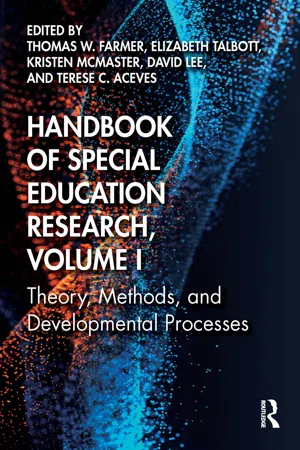
Divided into two volumes, Handbook of Special Education Research provides a comprehensive overview of critical issues in special education research. This first volume addresses key topics in theory, methods, and development, exploring how these three domains interconnect to build effective special education research. Each chapter features considerations for future research and implications for fostering continuous improvement and innovation. Essential reading for researchers and students of special education, this handbook brings together diverse and complementary perspectives to help move the field forward.
eBook - ePub
Handbook of Special Education Research, Volume I
Theory, Methods, and Developmental Processes
- 376 pages
- English
- ePUB (mobile friendly)
- Available on iOS & Android
eBook - ePub
Handbook of Special Education Research, Volume I
Theory, Methods, and Developmental Processes
About this book
Information
SECTION 1 Theoretical Foundations of Special Education Research
1 TAKING STOCK OF SPECIAL EDUCATION RESEARCHCurrent Perspectives and Future Directions
DOI: 10.4324/9781003156857-2
From time to time, it is instructive for a scientific discipline to step back, reflect on its progress, consider the impact the field is having on constituent stakeholders and society more broadly, and contemplate next steps forward. In the past few decades, the world has changed in many ways that affect the lives of children with exceptionalities and their families. From increasing diversity, enhanced technology, innovations in communications and social media, and changing educational and work structures, the landscape for working with and supporting individuals with exceptionalities has become more complex and also potentially more powerful as we have more resources and opportunities to make a difference. Likewise, for children and youth with exceptionalities, the increased complexity in their developmental experiences and circumstances means they have to negotiate new challenges that also present new possibilities in their learning, growth, and outcomes.
With the backdrop of the recent pandemic; forced adaptations; and inequities compounded as different groups and communities were differentially affected by the resulting health, social, economic, and political turmoil, we are now positioned to better see the adversity experienced by the youth we serve. On one hand, there is more innovation and promise than ever to support the unique needs of students with exceptionalities. On the other hand, disparities in resources and experiences and constraints in opportunities and services are reflected in growing gaps in educational performance and outcomes of youth from different backgrounds (Fuchs et al., 2018; NCES, 2019; Spencer, 2019).
As the Council for Exceptional Children, Division for Research (CEC-DR), it is important to elucidate, disseminate, and build upon advances in the field. It is equally critical to illuminate imbalances and disproportionate challenges experienced by subgroups of students and identify needed intervention and service delivery adaptations to respond to the differential needs of each child and the families, communities, and cultures that are central to their learning and growth. Accordingly, the goal of this two-volume handbook on special education research is to summarize advances in research while simultaneously addressing critical issues and needs in our efforts to support each student with exceptionalities across different abilities, backgrounds, cultures, and ecologies.
In the first volume, our aim is to meet this goal in three complementary ways. First, we provide an overview of key concepts and theories that undergird research in special education and the intervention and service delivery strategies we use to support students with exceptionalities and the ecological systems (e.g., families, peer groups, classrooms, schools, neighborhoods, cultures, sociopolitical structures) in which they live and that shape their opportunities and development. Second, we present methodological and analytical approaches that are used in special education research to clarify information; answer theoretical and conceptual questions; make inferences from data; evaluate programs and services; aggregate and distill information across studies; and utilize the evidence base to guide efforts to tailor interventions to students, teachers, schools, and communities. Third, we examine a variety of developmental processes and ecological factors that differentially influence the opportunities and experiences of students with exceptionalities and the special education services they need.
In the second volume, the authors highlight critical areas of special education research and outline what we currently know about effective systems, interventions, assessments, and efforts to support educators. They also provide ideas about where special education researchers should go next to enhance the effectiveness of our efforts. Topics span academic, behavioral, and social interventions; assessment; tiered systems of support; the educator workforce; technology; and the needs of our most vulnerable populations. Our hope is that these chapters inspire the next generation of special education researchers to push the field forward in new and innovative ways.
Foundations of Research in Special Education
By its very nature, special education grew out of the understanding that all children have different characteristics and abilities, and each student can learn and develop skills to contribute to their own self-determined pathways, careers, and lifestyles when they are provided educational supports and related services that are responsive to their own strengths, needs, and ecological circumstances. Although students with exceptionalities differ somewhat from the majority of their same-age classmates in terms of their characteristics, development, and learning needs, their capacity to grow, adapt, and be successful in school and life can be nurtured and enhanced when supports are centered on what they need rather than on what works for others who are different from them. The following three foundational concepts of special education are central to conducting research to create effective interventions and service delivery frameworks that are responsive to students with exceptionalities with diverse needs.
Individualized
First, it is critical to individualize strategies and supports for youth with exceptionalities. Special education recognizes that what works for others is likely to not work in the same way for the students we serve. Students with exceptionalities can be highly successful. It is incumbent upon researchers to realize that teachers and other service providers will need to tailor strategies and supports to specific students, circumstances, and contexts. Youth with exceptionalities, like all youth, are dynamic in their growth and functioning. This means a strategy that works now may not work tomorrow or that additional factors may need to be considered to foster the success for a specific child. Therefore, as we conduct research, we need to develop frameworks that provide interventionists (e.g., teachers, other related service providers) with conceptual guides, data use tools, and decision trees to monitor each student’s progress and to make ongoing adaptations in the supports and strategies they use for individual students.
Interdisciplinary
Second, special education is necessarily interdisciplinary. Across the various special education categories, individual characteristics and needs vary broadly across physical or sensory factors; cognitive and learning processes; emotional, social, and behavioral functioning and adjustment; and health and developmental adaptation. Therefore, as a field, special education involves an array of specialties and specialists. But the need for different disciplines working together extends beyond services for different categories of exceptionalities. Rather, individual children, themselves, develop as an integrated whole (Farmer et al., 2016). Although a child may be identified for services for a particular exceptionality classification (autism spectrum disorder, deaf-blindness, deafness, early childhood, emotional disturbance, giftedness, hearing impairment, intellectual disability, multiple disabilities, orthopedic impairment, other health impairment, specific learning disability, speech or language impairment, visual impairment including blindness), many of these classifications may be comorbid, and students may need services in other related domains. As children develop, their functioning in one domain is likely to influence and be influenced by their functioning in other domains (Darling-Hammond et al., 2020; Sameroff, 2020). Therefore, it is necessary to provide services and supports that extend beyond the primary area of exceptionality and include a focus on the other domains that may affect or be affected by the child’s exceptionality. That is why we have mandates for multidisciplinary teams and services in our special education policy. As we conduct research in special education, we need to ensure that we are considering the whole child and the interplay of an array of services and supports they need rather than focusing exclusively on a discrete domain or skill in isolation.
Contextualized
Third, it is necessary to understand and support the student in context. In addition to focusing on the whole child and how different domains operate together as a dynamic system, we must consider how the various settings in which children are embedded contribute to their functioning and growth (Bronfenbrenner, 1996). Children learn and develop, in large part, by how they engage with multilayered ecologies (e.g., families, peer groups, classroom, schools, neighborhoods, cultures, sociopolitical structures) that collectively shape their experiences (Bronfenbrenner, 1977; Smith & Thelen, 2003). This means that development is experiential, as opposed to universal, and involves continuous adaptation between the characteristics of the child and the affordances and constraints of their ecological systems (Bronfenbrenner, 1996; Cairns, 2000; Nasir, 2018). Two children who are together in the same classroom may experience the context very differently both because of their different characteristics and because of different ecological factors that they experience in their daily living (Cairns & Cairns, 1994; Farmer et al., 2016; Sameroff, 2020).
For example, consider a setting in which the school district mandates a 20-minute silent reading activity in middle school with everyone reading the same assigned book in homeroom each day. This activity is an evidence-based universal program required by the district as an opportunity to foster independent leisure reading skills while helping students transition into a learning mindset to start the school day. Two students who are from the same neighborhood and the same general background experience this activity in very different ways. One student is a strong reader, enjoys the content of the assigned books, has been reading books with a parent at home, and finds this activity to be a relaxing way to transition into the start of instructional activities. The second student has dyslexia, struggles to read independently, and reads at home with parents with books that are adapted to their reading needs. During this activity, the student is not sure they are even on the correct page and spends the time acting like they are reading and hoping to go unnoticed by classmates. At the completion of this routine morning activity, one student is emotionally and behaviorally prepared to succeed throughout the day while the other receives no adaptive supports, struggles with their disability, and starts the day acutely aware of their reading difficulties and feeling socially vulnerable and thinking they do ...
Table of contents
- Cover
- Half Title
- Title
- Copyright
- Contents
- Acknowledgements
- Section 1 Theoretical Foundations of Special Education Research
- Section 2 Methods, Design, and Analysis in Special Education Research
- Section 3 Leveraging Developmental Processes and Contexts in Intervention
- Index
Trusted by 375,005 students
Access to over 1.5 million titles for a fair monthly price.
Study more efficiently using our study tools.
Frequently asked questions
Yes, you can cancel anytime from the Subscription tab in your account settings on the Perlego website. Your subscription will stay active until the end of your current billing period. Learn how to cancel your subscription
No, books cannot be downloaded as external files, such as PDFs, for use outside of Perlego. However, you can download books within the Perlego app for offline reading on mobile or tablet. Learn how to download books offline
Perlego offers two plans: Essential and Complete
- Essential is ideal for learners and professionals who enjoy exploring a wide range of subjects. Access the Essential Library with 800,000+ trusted titles and best-sellers across business, personal growth, and the humanities. Includes unlimited reading time and Standard Read Aloud voice.
- Complete: Perfect for advanced learners and researchers needing full, unrestricted access. Unlock 1.5M+ books across hundreds of subjects, including academic and specialized titles. The Complete Plan also includes advanced features like Premium Read Aloud and Research Assistant.
We are an online textbook subscription service, where you can get access to an entire online library for less than the price of a single book per month. With over 1.5 million books across 990+ topics, we’ve got you covered! Learn about our mission
Look out for the read-aloud symbol on your next book to see if you can listen to it. The read-aloud tool reads text aloud for you, highlighting the text as it is being read. You can pause it, speed it up and slow it down. Learn more about Read Aloud
Yes! You can use the Perlego app on both iOS and Android devices to read anytime, anywhere — even offline. Perfect for commutes or when you’re on the go.
Please note we cannot support devices running on iOS 13 and Android 7 or earlier. Learn more about using the app
Please note we cannot support devices running on iOS 13 and Android 7 or earlier. Learn more about using the app
Yes, you can access Handbook of Special Education Research, Volume I by Thomas W. Farmer, Elizabeth Talbott, Kristen McMaster, David Lee, Terese C. Aceves, Thomas W. Farmer,Elizabeth Talbott,Kristen McMaster,David Lee,Terese C. Aceves in PDF and/or ePUB format, as well as other popular books in Pedagogía & Educación general. We have over 1.5 million books available in our catalogue for you to explore.