This volume explores mindfulness and other contemplative approaches as strategic tools for cultivating anti-oppressive pedagogies in higher education.
Research confirms that simply providing students with evidence and narratives of economic, social, and environmental injustices proves insufficient in developing awareness and eliciting responses of empathy, solidarity, and a desire to act for change. From the environmental humanities to the environmental sciences, legal studies, psychology, and counseling, educators from a range of geographical and disciplinary standpoints describe their research-based mindfulness pedagogies. Chapters explore how to interrupt and interrogate oppression through contemplative teaching tools, assignments, and strategies that create greater awareness and facilitate deeper engagement with learning contents, contexts, and communities.
Providing a framework that facilitates awareness of the links between historic and current oppression, self-identity, and trauma, and creating a transformative learning experience through mindfulness, this book is a must-read for faculty and educators interested in intersections of mindfulness, contemplative pedagogies, and anti-oppression.
1Introduction to Contemplative Practices and Anti-Oppressive Pedagogies for Higher Education
Greta Gaard and Bengü Ergüner-Tekinalp
DOI: 10.4324/9781003201854-2
How do we bring together the different parts of our lives, using their synergy to create a greater whole? Contemplative practitioners in higher education have wondered at various times whether or how to use the tools of their own mindfulness practice in their college courses: could these practices help students calm their own minds and bodies? Connect their cognitive and affective responses to course materials, and form more complete analyses? Could these practices support students in bringing different parts of their own lives together—their values and compassion, sense of justice, and inquiry into course materials? Motivated by these and other questions investigating the uses of mindfulness practices as a liberatory pedagogy, over 200 educators convened at the 2017 summer session on Contemplative Learning in Higher Education, sponsored by the Center for Contemplative Mind in Higher Education (CMind)—and that’s where this volume began.
In large presentations and small group discussions, mindfulness leaders and educators such as Steven Murphy-Shigematsu, Katja Hahn D’Errico, Beth Berila, Kakali Bhattacharya, Arthur Zajonc, and many others provided inspiration, resources, and examples of contemplative pedagogies. While Berila’s Mindfulness as Anti-Oppressive Pedagogy (2016) provided a foundation and inspiration for seeking ways to link course content, contemplative practice, and resources for investigating and unlearning oppression, D’Errico’s workshop gave participants the strategies for integrating these three areas (see Table 1.1 at the end of this chapter).
Several contributors to this volume met at CMind 2017 and began a more serious study and approach to developing their own uses of contemplative pedagogies. Other contributors attended a Mind and Life-grant funded Think Tank on “Mindfulness Pedagogy,” held at the Aldo Leopold Center in 2018. And still others responded to an open call for proposals shared through the Association for the Study of Literature and Environment (ASLE) discussion board, the 2019 convention panel dedicated to exploring “Contemplative Pedagogies for the Environmental Humanities,” or were contacted by one of the co-editors. Through each of these channels, faculty were excited to discover peers who were seeking ways to offer the benefits of mindfulness to students struggling with academic, personal, and social issues such as reading comprehension and anxiety, and noticing, experiencing, and responding to social injustices.
Higher Education’s Student Profiles of Stress
Multiple studies over the last decade have explored college students’ mental health (Bauer-Wolf, 2018; Eva, 2019; Oswalt et al., 2020). An international survey of nearly 14,000 first-year college students across eight countries found that “35 percent struggled with mental illness, particularly depression or anxiety”—in the United States, anxiety is students’ primary reported concern (Eva, 2019). Depression and anxiety are associated with lower academic performance, increased alcohol and drug use, self-injurious behaviors, suicidal ideation and suicide—with one-third of undergraduates exhibiting symptoms of mental health problems (Oswalt et al., 2020). Where do these mental health challenges originate? Reportedly, about one-quarter of U.S. residents ages 18 and older live with a mental health disorder each year, and half of all serious adult mental health disorders—notably major depression, anxiety disorder, and substance use—start by age 14 and present by age 25 (Kessler et al., 2005). While there has been an increase in the number of students seeking mental health and counseling services, at least 50% of college students who have struggled with mental health issues did not seek help (Oswald et al., 2020). What visible or invisible barriers prevented those students from help-seeking behaviors?
Perhaps the data is in plain view. The National Alliance on Mental Illness (NAMI) Survey Report on Mental Health, “College Students Speak Out” (Gruttadaro & Crudo, 2012), describes a national survey of “college students living with mental health conditions” administered between August and November 2011, and obtaining 765 survey responses. The report describes survey methodology and participant demographics—“individuals diagnosed with a mental health condition, who are currently or were enrolled in college in the last five years”—but omits using the demographics in data analysis. A search of terms used for identifying racial demographics in this NAMI report shows that groupings such as “African American,” “Asian American,” “Hispanics/Latinos,” “American Indians,” and “Pacific Islander” appear only once in the entire study—on the page where demographic data is provided. In contrast, LGBT students were mentioned three times, most notably in disclosing their mental health concerns (62%, a surprisingly high number for disclosure, given the combined stigma of queer identities and mental health). What’s not evident from the NAMI survey is how many of those queer students were students of color, or how many of the overall survey population—beyond the 82% Caucasian and 82% female—were struggling with other challenges, such as economic stress, violence, race-based discrimination, harassment, or sexual assault.
In another study, analysis of 165 research sources on college students’ mental health published from 2010 to 2015 indicates both “increasing demand for student services provided by campus counseling centers (113/165, 68.5%) and the increased mental health risks faced by racial and ethnic minorities (30/165, 18.2%)” (Payton et al., 2018). The study found six significant factors in mental health experiences—“age, race, crime, student services, aftermath, victim”—and two themes: again, the increased demand for campus counseling center services, but also the “increased mental health risks faced by racial and ethnic minorities” (p. 1). Presently, various stressors and traumatizing experiences prompt students to seek counseling services, and these stressors are not what mainstream mental health, DSM-V-trained counselors are expecting “sexual assault, food scarcity, violence, and racism” (p. 8). These data suggest there is an opportunity for contemplative educators to link our practices of mindful awareness with our social justice values by using contemplative pedagogies to teach students tools for more immediate well-being and simultaneously raising discussions of racial, economic, environmental, and gender justice in our courses.
Contemplative Pedagogies in Higher Education
Faculty and administrators in higher education have become increasingly aware of student mental health needs, the persistence of oppressive ideologies across the disciplines, and the immanent environmental challenges we face as a planet. Although application in higher education is relatively new, contemplative practices, including mindfulness, have been demonstrated to have a positive impact on mental health and wellness (i.e., Brown & Ryan, 2003; Hick & Bien, 2008; Rodríguez-Carvajal et al., 2016; Trautwein et al., 2016), as well as promoting social justice awareness and exploring differences with curiosity and compassion (i.e., Berila, 2016; Burgess et al., 2016; King, 2018; Forbes, 2019). The integration of mindfulness in higher education has benefits across the institution, including creating positive learning environments, promoting administration and faculty functioning, enhancing student life, and connecting with the larger community (i.e., Barbezat & Bush, 2014; Bush, 2011; Davis, 2014). Specifically, contemplative teaching practices enable deep engaged learning and promote a campus climate that enhances deeper personal and social awareness, encouraging critical inquiry (Barbezat & Bush, 2014; Rechtschaffen, 2014). Contemplative practices encourage us to move away from the “banking model of education” (Freire, 1993), which is a mechanical narration from the teacher, to a more holistic and liberatory education, where teacher and learner bring their whole selves to the learning process and engage deeply with the material, co-creating knowledge with their bodies, minds, and emotions.
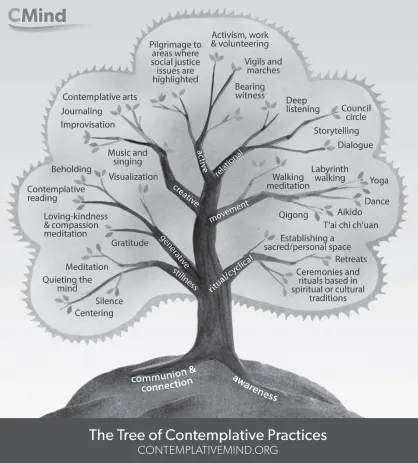
As “The Tree of Contemplative Practices” (Figure 1.1; CMind, 2021) suggests, contemplative pedagogies are used to bridge course content with students’ embodied awareness through a variety of practices: poetry-writing, qigong, yoga, art-making, walking meditation, mindful self-compassion, and mindfulness of breath, sounds, thoughts, sensations. Mindfulness practices, in particular, are shown to enhance concentration and memory, reduce anxiety and depression, and improve general health and well-being. Mindfulness is also used as an anti-oppression pedagogy (Berila, 2016), strategic in helping students expose and examine deeply held prejudices around race, gender, sexuality, species, and more.
FIGURE 1.1 The Tree of Contemplative Practices (CMind)
Although the scholarship on integrating contemplative practices in higher education in general and specifically anti-oppressive pedagogy and racial healing is growing, a multidisciplinary book that provides guidance and the contemplative methods for creating inclusive and transformative learning spaces has not appeared. In short, there is no edited volume that builds upon the work launched by Barbezat and Bush (2014), advances Berila’s (2016) work in anti-oppressive contemplative pedagogy, and applies Forbes’s (2019) vision for a “counter-program” that transcends the secular-religious divide.
Our volume aims to fill this gap in the scholarship. In this book, we define oppression as beliefs that (1) construct a self that is separate from others, (2) value one’s selfhood and group identity while ignoring or devaluing others, and (3) legitimate uses of power, privilege, and control over devalued others. Oppression is systemic and simultaneously sociocultural, institutional, interpersonal, and intrapersonal. It manifests through distinctions of race, ethnicity, gender, class, sexuality, age, ability, religion, nation, species, and more; it is variously articulated as hyper-achievement, perfectionism, overwork, and/or low self-worth, self-harm, and aggression (toward other humans and/or the community of life). Oppression produces trauma that may be stored in the body, repressed or “forgotten”; it is widely recognized that traum...
Table of contents
Cover
Half Title
Title
Copyright
Contents
Foreword
Preface
Acknowledgments
Part I Contemplative Theoretical Frameworks
Part II Contemplative Pedagogies for Environmental Justice
Part III Contemplative Pedagogies Across the Disciplines
Part IV Contemplative Practices for Community and Institutional Change
Editor Bios
Contributor Bios
Index
Trusted by 375,005 students
Access to over 1.5 million titles for a fair monthly price.
Study more efficiently using our study tools.
Frequently asked questions
Yes, you can cancel anytime from the Subscription tab in your account settings on the Perlego website. Your subscription will stay active until the end of your current billing period. Learn how to cancel your subscription
No, books cannot be downloaded as external files, such as PDFs, for use outside of Perlego. However, you can download books within the Perlego app for offline reading on mobile or tablet. Learn how to download books offline
Perlego offers two plans: Essential and Complete
Essential is ideal for learners and professionals who enjoy exploring a wide range of subjects. Access the Essential Library with 800,000+ trusted titles and best-sellers across business, personal growth, and the humanities. Includes unlimited reading time and Standard Read Aloud voice.
Complete: Perfect for advanced learners and researchers needing full, unrestricted access. Unlock 1.5M+ books across hundreds of subjects, including academic and specialized titles. The Complete Plan also includes advanced features like Premium Read Aloud and Research Assistant.
Both plans are available with monthly, semester, or annual billing cycles.
We are an online textbook subscription service, where you can get access to an entire online library for less than the price of a single book per month. With over 1.5 million books across 990+ topics, we’ve got you covered! Learn about our mission
Look out for the read-aloud symbol on your next book to see if you can listen to it. The read-aloud tool reads text aloud for you, highlighting the text as it is being read. You can pause it, speed it up and slow it down. Learn more about Read Aloud
Yes! You can use the Perlego app on both iOS and Android devices to read anytime, anywhere — even offline. Perfect for commutes or when you’re on the go. Please note we cannot support devices running on iOS 13 and Android 7 or earlier. Learn more about using the app
Yes, you can access Contemplative Practices and Anti-Oppressive Pedagogies for Higher Education by Greta Gaard, Bengü Ergüner-Tekinalp, Greta Gaard,Bengü Ergüner-Tekinalp in PDF and/or ePUB format, as well as other popular books in Education & Education General. We have over 1.5 million books available in our catalogue for you to explore.