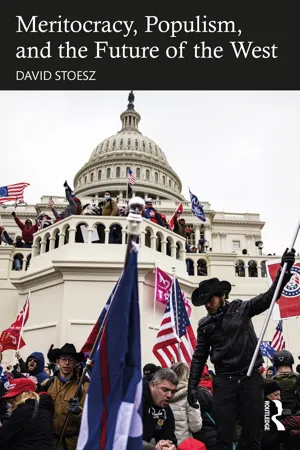
For philosophers, human progress evolves over centuries, T.H. Marshall identifying the 18th with the guarantee of civil rights, the 19th with political rights, and the 20th with social rights;1 in parallel John Micklethwait and Adrian Wooldridge marked the 18th with the emergence of the nation-state, the 19th with the liberal state, and the 20th with the welfare state.2 These chronologies share an implied faith in democracy, the gradual expansion of suffrage coupled with representative government, the revolutionary idea that citizens are sovereign asserting authority against the caprices of monarchy and capital. Early in the industrial era, incipient labor movements fought against rapacious capital to afford a measure of dignity, opportunity, and stability for workers and their families, the welfare state, envisaged by the Fabians in Britain and Progressives in America, evolving as an institutional buffer between adversaries. As had been the case during industrialization, ideology justified the claims of competing parties, no less the case during the Information Age, pitting an insurgent populism against an entrenched meritocracy, which has become a disruptive force evident in the January 6, 2021, storming of the U.S. Capitol, and Brexit in the UK. As tensions escalated, the populist-meritocracy conflict not only transcended national borders, becoming a conundrum in other developed nations, but also challenged democratic governance, threatening to impose an alternative regime: illiberal democracy.
The 21st century, then, poses the prospect of retro-revolution, with populism challenging meritocracy. Unlike earlier revolutions, which expanded political and social rights associated with rising mass prosperity, insurgent populism grows in response to economic decline associated with globalization, financialization, and information technology, raising the specter of derogation of democratic capitalism as the default political economy. The implications are not only broad and deep, but also unanticipated given increasing prosperity among developed nations as well as the developing world during the 20th century. How this dispute should transpire is of some urgency, given the political and economic stakes in the balance, and “institutional drift” that is already evident.3 For our purposes, 1958 would prove an inflection point, regarding developments tying the UK to the US.
BRITS
In May 1958, American journalist, Mike Wallace, interviewed British polymath, Aldous Huxley (1894-1963), whose antipathy toward totalizing states was evident in Brave New World, his 1932 dystopian novel focusing on psychological programming employed to pacify the citizenry. Paired with George Orwell's 1949 novel, 1984, British intellectuals attained international acclaim for anticipating structural failures of modern societies. For Huxley, democracy was necessary to mitigate the centralizing tendencies of contemporary institutions: “democracy depends on the individual voter making an intelligent and rational choice in what he regards as his enlightened self-interest in any given circumstance,” Huxley said, essential to correct the manipulation of corporate advertisers and government propogandists.4 Long interested in mysticism and Eastern religion, on his deathbed, Huxley asked his pharmacist wife to inject him with hallucinogens to facilitate his passing from this world to some other.
Also, in 1958 Isaiah Berlin's “Two Concepts of Liberty” appeared. Berlin (1909-1997), whose family fled post-revolutionary Russia, borrowed from John Stuart Mill's On Liberty, which appeared a century earlier, establishing what would become a European understanding of liberalism, later morphing into American libertarianism: “The only purpose for which power can rightfully be exercised over any member of a civilized community, against his will, is to prevent harm to others,” Mill argued.5 “I am normally said to be free to the degree to which no man or body of men interferes with my activity,” as Berlin put it. “Political liberty in this sense is simply the area within which a man can act unobstructed by others. If I am prevented by others from doing what I could otherwise do, I am to that degree unfree; and if this area is contracted by other men beyond a certain minimum, I can be described as being coerced, or, it may be, enslaved.”6 In distinguishing “negative” from “positive” liberty, Berlin contributed to political philosophy by recognizing the aggregate implications of individual freedom, as his biographer summarized.
Negative liberty was the core of a properly liberal political creed: leaving individuals alone to do what they want, provided their actions did not interfere with the liberty of others. Positive liberty was the core of all emancipatory theories of politics, from socialist to communist: for all such doctrines wish to use political power to free human beings to realize some hidden, blocked or repressed potential.7
Positive liberty not only complemented American designs for social engineering, begun with Franklin Delano Roosevelt's New Deal of the 1930s, expanding exponentially with Lyndon Johnson's Great Society during the 1960s, but provided the philosophical justification of welfare states in Europe as well as Britain.
Then, in 1958 Michael Young's satire The Rise of the Meritocracy appeared. A Labour Party and Fabian leader preoccupied with increasing distance between politicians and citizens, Young (1915-2002) was skeptical about a society predicated on scientific criteria of efficacy. Coining the term “meritocracy,” Young anticipated social cleavage exacerbated by education predicated on IQ tests. “No longer is it just the brilliant individual who shines forth; the world beholds for the first time the spectacle of a brilliant class, the five percent of the nation who know what five percent means,” Young quipped, “Every member is a tried specialist. In his own sphere.”8 To that end, Young offered an equation: “Intelligence and effort together make up merit (I+E=M).”9 As a sequel to elites previously justified by monarchy and heredity, meritocracy introduced its own mischief into the polity: a new caste, an educated elite. Sixty years later, a British ex-pat, Richard Reeves, chronicled how the meritocracy had flourished in America by rigging opportunity through entrance tests and legacy preferences for admission to college, assortative mating, zoning, and tax rebates, effectively excluding the masses from upward mobility.10
YANKS
Thus, well before the Beatles invaded America with Rock ‘n Roll, British intellectuals were influencing philosophy and social science in the US. At the same time, American scholars were expressing concern about the consolidation of power during the Cold War. Unique among American thinkers was Eric Hoffer (1902-1983), a longshoreman who rose from immigrant obscurity to national acclaim. Blinded at youth until puberty, Hoffer developed a voracious appetite for books on philosophy, an awkward disposition as he labored as a farmworker, moving among migrant camps in California’s Central Valley, until he finally settled as a dock worker in San Francisco.11 Hoffer's ruminations, sent to a New York publisher, resulted in the 1951 publication of The True Believer, an insightful analysis of mass movements upon which totalitarian leaders depended, referencing Adolf Hitler, Benito Mussolini, and Juan Peron. Hoffer had an intuitive grasp of how tyrants manipulated the working masses, subtly degrading truth into propaganda to attain and sustain leadership. “The quality of ideas seems to play a minor role in mass movement leadership. What counts is the arrogant gesture, the complete disregard of the opinion of others, the singlehanded defiance of the world,” he wrote. “Charlatanism of some degree is indispensable to effective leadership. There can be no mass movement without some deliberate misrepresentation of facts.”12
Having captured the public's imagination, Hoffer was offered an office at the University of California, Berkeley, where he met weekly with students just as the Free Speech Movement was unfolding. Of college students marching for freedom of expression in America, a nation founded on the First Amendment, Hoffer had little patience, suspecting dilettantes as opposed to serious thinkers. A mass movement of American college students reprised revolutions that had suborned democracy for tyranny, representing a promiscuous intellectualism. “The intellectual will feel at home where an exclusive elite is in charge of affairs, and it matters not whether it be an elite of aristocrats soldiers, merchants, or intellectuals,” Hoffer wrote. “What he cannot endure is a society dominated by common people. There is nothing he loathes more than government of and by the people.”13
Meanwhile, American intellectuals were laying the foundation for liberalism that would dominate the middle of the 20th century. Lionel Trilling (1905-1975) was a New York literary critic who sensed experimentation of American culture in the arts, blossoming with the end of World War II and contrasting with Soviet regimentation, would distinguish American liberalism. In his 1950 book, The Liberal Imagination, Trilling made an iconic claim: “In the United States at this time liberalism is not only the dominant but even the sole intellectual tradition. For it is the plain fact that nowadays there are no conservative or reactionary ideas in general circulation.” Trilling continued, “the conservative impulse and the reactionary impulse do not, with some isolated and ecclesiastical exceptions, express themselves in ideas but only in actions or in irritable gestures which seek to resemble ideas.”14 But Trilling's transition from conceit to contempt also contained an astute observation: “So far as liberalism is active and positive, so far, that is, as it moves toward organization, it tends to select the emotions and qualities that are most susceptible to organization.”15 Presciently, Trilling anticipated the bureaucratic straight jacket that liberalism required,
organization means delegation, and agencies, and bureaus, and technicians, and that the ideas that can survive delegation, that can be passed on to agencies and bureaus and technicians, incline toward ideas of a certain kind and of a certain simplicity: they give up something of their largeness and modulation and complexity in order to survive. The lively sense of contingency and possibility, and of those exceptions to the rule which may be the beginning of the end of the rule—this sense does not suit well with the impulse toward organization.16
Liberalism, Trilling suggested, could be the victim of its own success, openness and creativity strangled by bureaucracy.
The Cold War provided fodder for sociologist, C. Wright Mills (1916-1962), an academic radical of unusual flair, who commuted by motorcycle and dressed in bespoke attire.17 Mills inveighed against the Military Industrial Complex, an iron triangle consisting of military contractors, the Pentagon, and legislators. Subsequently, critics would employ “industrial complex” as a suffix, preceded by “medical,” “prison,” and “education” to signify their opposition to government aligning with various interests, often with an unstated subtext: preference for the public utility model of social policy. In The Power Elite, published in 1956, Mills identified the “interlocking directorate” as a byproduct of the modern state, the convergence of powerful actors determined to craft policy at the expense of “mass society.”18 A Weberian, Mills painted on a large canvas, including a seminal analysis of the evolution of professional associations in consort with American pragmatism, which would be institutionalized through higher education.19 Even a beneficent welfare state was suspect for Mills, providing the opportunity for business elites to impose their will on the public: “During the New Deal the corporate chieftains joined the political directorate; as of World War II they have come to dominate it.”20
More conventional in comportment if no less broad in interest, Richard Hofstadter (1916-1970) chronicled New Deal reform, the rise of expertise, anti-intellectualism in America, and paranoia in politics. Subscribing to the value of institutionalized intelligence, as might be expected of a Pulitzer Prize winning professor, Hofstadter nevertheless lamented the inferior minds populating American universities, especially educator training programs: “Professional education is still largely staffed, at the administrative levels and in its centers of training, by people who are far from enthusiastic about the new demand for academic excellence.”21 Substandard training of teachers ...