Behind Architectural Filters: Phenomena of Interference explores the active role of architectural filters in generating physically and sensory charged spatial experiences. The book addresses how the material and the psychological strategies of permeable physical boundaries determine our perceptual experiences of the spaces we occupy.
This book explores architectural filters as connecting mechanisms capable of conjuring unique atmospheres that integrate the participation of several agents. The text analyzes ten case studies, grouped under five generative parameters: origin, density, thickness, function, and message. Each study investigates the main aspects of the filters' internal genesis and the character of the spaces informed by them. The cases illustrate a broad geographic, cultural, and historical scope, and connect past tradition with contemporary design. This methodology considers a historical and philosophical standpoint addressing vernacular, constructive, sustainable, and sensory considerations.
Written for students and scholars of architectural history, theory, art, design, and philosophy, Behind Architectural Filters: Phenomena of Interference offers an unprecedented perspective on the production of spatial atmospheres, bridging past and present while connecting thought and practice in a highly visual study.
Chapter 3 of this book is available for free in PDF format as Open Access from the individual product page at www.routledge.com. It has been made available under a Creative Commons Attribution-Non Commercial-No Derivatives 4.0 license.
Architectural filters connect and divide two sides, mediating light and gaze. They perform as boundaries that materialize physical compositions. In doing so, filters activate the connections between interiority and exteriority, imbuing interior space with a depth and an evocative projection rarely seen in other architectural strategies. Light is a basic component of architecture. Every space manifests itself through the direct manipulation of light. Externally, a building’s interaction with light may manifest in an ever shifting perception of massings and penetrations, conditioned from the vantage of the observer. From the outside, light articulates form. It is only internally that architecture is capable of giving form to light. The admittance and modulation of light that takes place in the interior are conditioned by the penetration of the mass of the architectural enclosure, which acts as an interstitial space that is itself neither interior nor exterior. The configurations of openings in the architectural envelope follow a pattern of relations and scales and can be seen as a first stage in the production of a filtering condition.
We could define a filtering boundary as a structure determined by a geometric pattern that mediates the gaze from an interior vantage point to the exterior and modulates light passing from outside to an interior space. A filtering boundary is as much about construction and structure, as it is about light and matter. These elements define architectural space and architectural emotion. The hypothesis developed in this text approaches filtering boundaries as the construction of a transitory space that facilitates a connection, through its permeable body, where gaze and light become instruments that produce new perceptions of space.
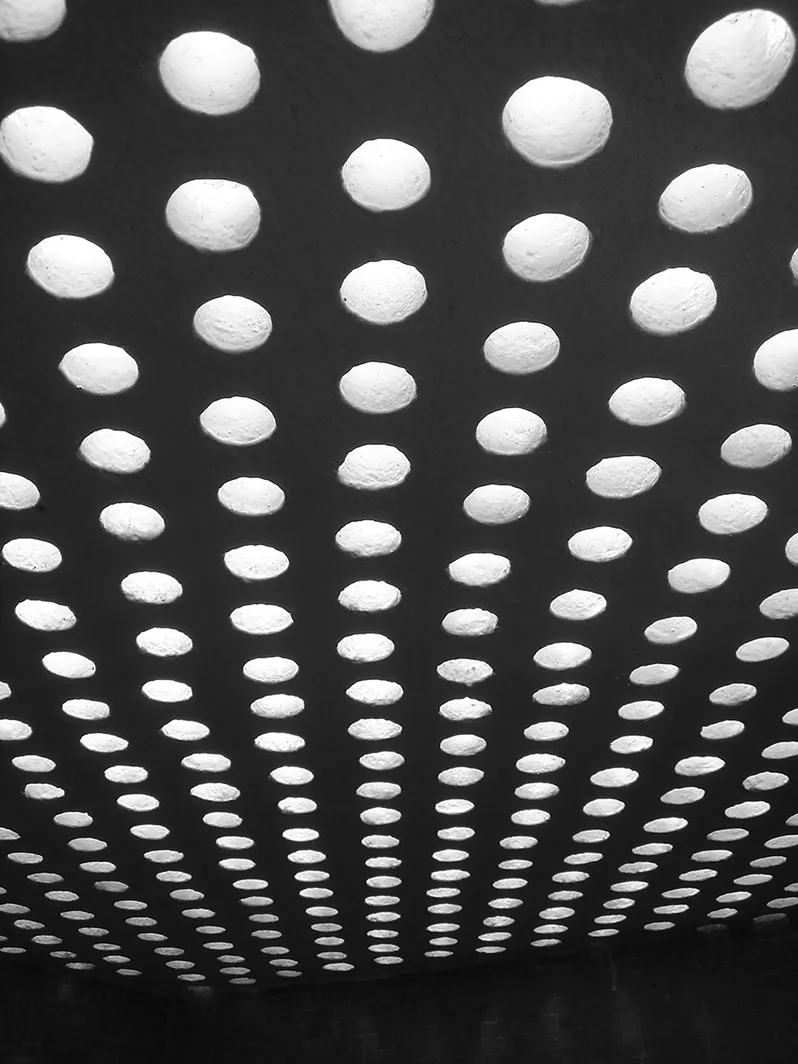
Filtering boundaries are halfway between construction and dissolution, and halfway between enclosure and openness. Their architectural nature is close to Gottfried Semper’s discourse on the tectonic character of textile enclosures and their osmotic qualities. Filtering boundaries perform as permeable intermediate structures that condition the observer’s relationship with the outside by means of gaze and light. The resulting experience manifests psychic realities that are perceptually more complex than the physical reality that surrounds the observer. Two sides emerge from the intervention of the filter: the inside and the outside. Two realms result from the mediation as well: the physical and the psychological. The origin of the psychic dimension can be found in the evocative aspect of the geometric patterning or organization that governs the filtering boundary. Architectural filters bring together a syntactic dimension – comprising their geometry and structure – and a semantic dimension – comprising their character. The combined syntactic and semantic dimensions define the filtering constructions where the scientific and the poetic are intertwined in a probabilistic symbiosis of unpredictable results. (Figure 1.1)
FIGURE1.1 Casa das Canoas. Rio de Janeiro. Brazil. Oscar Niemeyer. 1951. Photo by author.
A filtering boundary works as a porous membrane through which light passes into interior space, as gaze penetrates into the exterior world. Light infiltrates the interior, transfigured by its interaction with the filter, while gaze captures a view of the exterior that is fragmented and edited by the same filter. The permeable envelope acts like a sieve, blocking elements of the view and preventing direct communication between both sides, but the multiplicity of connecting vectors generates a plurality of viewpoints that deepen and double the relationship between inside and outside, resulting in a double transverse connection.1 This connection involves a mutual reconfiguration enacted through the proliferation of external views projected into interior space and onto the observer’s psyche. As montage, as mosaic, incorporating the external, the filter reasserts not only the relationship between internal and external but also the externality of the internal space with reference to the observer, perceptually enacting a recursion of internality and externality.
In approaching the study of filters, it is important to differentiate between a physical exterior and a psychic interior. The exterior alludes to a real landscape, where the light source is located, that is susceptible to transposition inside, and the interior refers to a sensory perception that incorporates the former into a psychic experience. Both sides relate through the interceding geometry of the filtering boundary, with several agents converging in the perceptual process: the exterior background, the light source, the observer’s psyche, and the transforming geometry of the filtering boundary.
The observer is an active agent interpreting the perceptual information. The geometry depends on the physical configuration of the filtering plane. When a filtering enclosure is highly porous, the transit of light and gaze increases and the perception of the interior space becomes more recognizable, objective, and specific – it can be read and understood as inside, but external. However, when a filtering enclosure is more opaque, less permeable, the transit of visual information is significantly limited and the presence of light and gaze are therefore reduced. In this case, the qualities of the space become more ambiguous and subjective, facilitating an experience that progressively loses its visual references, and in which the inside can be psychically internalized. As such, an architectural filter manifests permeable qualities that move the experience away from pure transparency or complete opacity, producing an infinite number of variations in the transit of light and gaze. This modulation has direct consequences for the perceptual constitution of internality and externality.
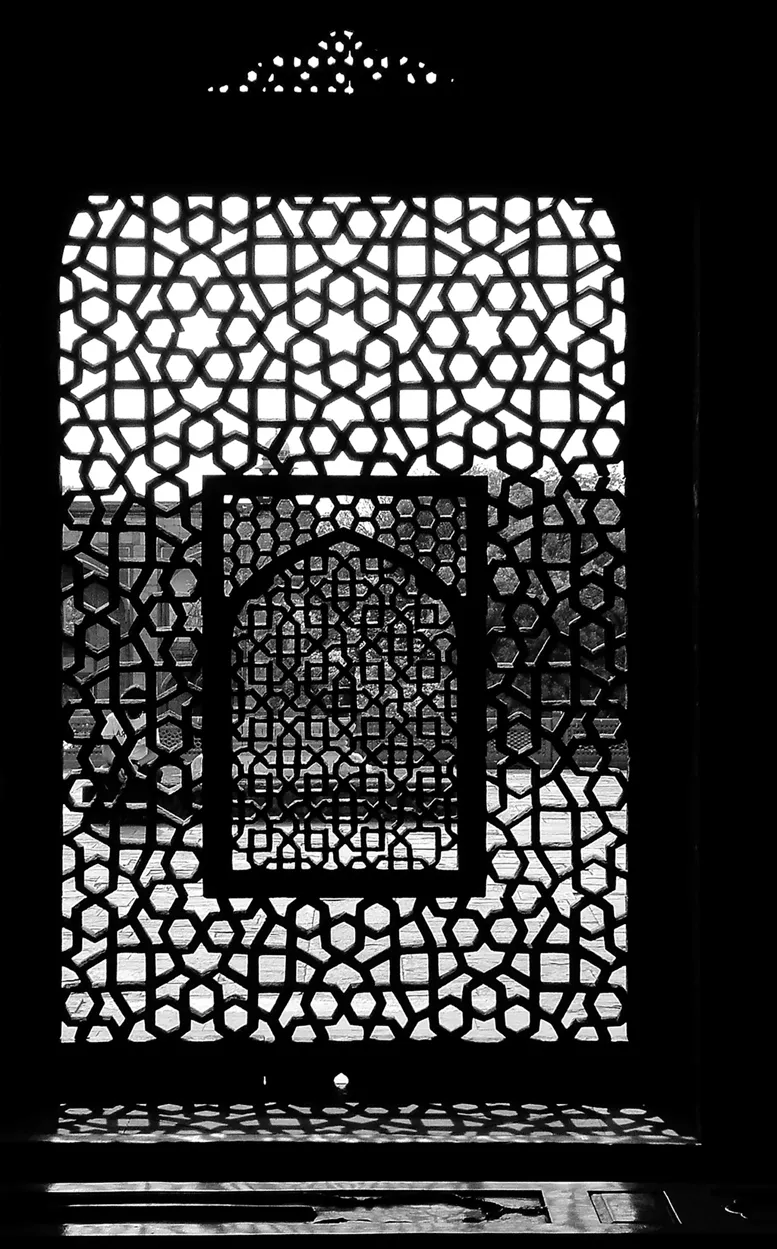
An emotional energy emerges during the filtering process, as the permeable boundary connects each side of the construction.2 This energy pushes the filtering boundary beyond the two-dimensional nature of the screen and into the three-dimensional domain of experience by visually projecting the filters’ participation in the construction of space. An architectural filter creates a space of transition in the tension between interiority and externality, between what is visible and what is obscured. The materialization of this tension is key to experiencing filtering boundaries as a nexus of relationships between elements that can no longer be separated, and from which a new condition has arisen. The mediating geometry of the filter generates an energy that converges into architectural emotion by disseminating the light over – what was before – an indiscriminate darkness. (Figure 1.2)
FIGURE1.2 Humayun’s Tomb. Delhi. India. Mirak Mirza Ghiyath. 1570. Photo by author.
Filters facilitate a discourse that is both rational and phantasmic. They instantiate imaginary realities in the midst of the stubbornly substantial and specific. Their built presence conjoins intuition, rigor, and architectural memory while promoting a spatial polysemy. Filters embody an enormous creative potential in their capacity to complicate our perception of solid and void, internal and external, presence and absence, space and place. The perceptual ambiguity created by filtering strategies evokes the “active voids of metaphysical nature”3 through their physical configuration, the latent absences they provoke, and the new connections and interpretations that they inspire. The built space behind the complex overlap of light, shadows, and broken and uncertain gazes foster a realm for architectural emotion.
This text is an attempt to interpret the architectural space that is reformulated by filtering boundaries in two ways: historically and phenomenologically. Both approaches correspond to studies that consider several decisive intervening agents – light, gaze, horizon, time, and movement – as well as the filters’ possible classifications. Such classifications consider two options: filters’ material execution – either by subtracting mass or by adding elements – and filters’ typological properties – origin, density, thickness, function, and message. The phenomenological approach starts with the objectively scientific and moves into the subjectively perceptual. Both approaches are woven into the final critique of specific cases. The ultimate goal is to propose an analytical, propositive, open discourse that explicitly addresses filtering boundaries as a highly relevant strategy in architectural design.
The proposed exploration of the space behind the filter takes place in three stages. Chapters 2 and 3 explore the perceptual processes behind the permeable limits of space. Chapter 4 analyzes the hypothesis that a filters’ material execution results from progressive openings executed in a theoretical primitive enclosure, and caused by two opposing constructive operations – as advanced by Leon Battista Alberti in the fifteenth century: the subtraction of mass, and the addition of independent elements. Chapter 5 develops a typological classification in the form of critique that offers a series of readings and interpretations of a series of cases with one shared thread: the capacity to produce deep spatial emotion from precise material operations. The cases selected seek to propose an understanding of the essence of filters, rejecting contingent aspects.4 A final chapter with general conclusions closes the study.
The hypotheses of this text are evaluated using a combination of deductive and inductive methodologies.5 The proposed case studies are not presented as illustrations to an autonomous theoretical body, but rather as inductive, evidentiary proofs of the deductively derived propositions advanced throughout the text. The critique of the cases is conceived as part of the methodology by extracting and confirming the initial hypotheses and theoretical assumptions. The scientific dimension is not so much the example, but the systematic and contrasted methodology that seeks the application of similar parameters to different situations. The study of the cases confirms a broad perspective on filtering boundaries in architecture following deductive and inductive principles.6
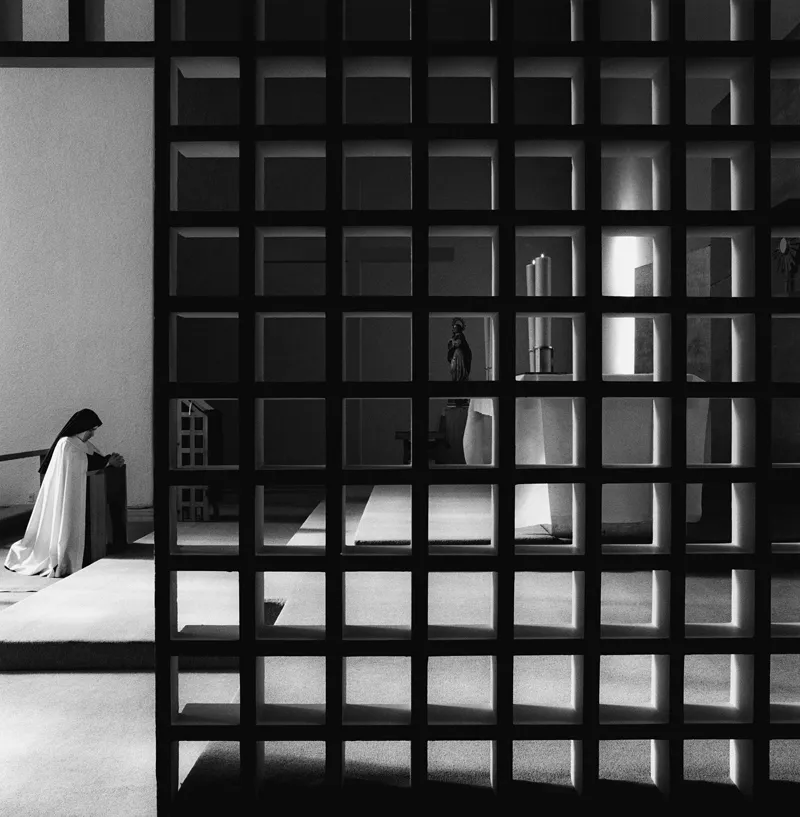
Architectural filters are a consequence of the solutions that are given to specific problematics and the specialization of a utilitarian function, that is, the common requirement of light and gaze concentration and dispersion. The methodology developed in this text required the study of specific cases sharing topological affinities. The set of ten cases generously exemplifies a broad catalogue of architectural filters that integrate light and gaze toward an emotional experience. (Figure 1.3)
FIGURE1.3 Chapel. Convent of Capuchinas Sacramentarias del Purísimo Corazón de María. Me-xico City. Luis Barragán and Mathias Goeritz. 1952. Photo by Mark Luscombe-Whyte.
Architectural filters have always existed. They embody a timeless strategy in the construction of space that has consolidated its presence over time and across different cultures. The utilitarian and poetic qualities of these architectural mechanisms have evolved through the filters’ adaptability and capacity to combine structure, function, and beauty. They offer versatile solutions in the production of spatial experiences that dissipate physical space and induce a psychic response to the architecture. The functional and emotional aspects of their design always result in unexpected visual effects that combine precision and poetry with a success that is rarely found in the history of architecture.
Notes
Jun’ichirō Tanizaki writes about the suggestive capacity of revealing space through slow or progressive visual sequences, as is traditional in Eastern cultures, in contrast with the full and immediate exposure of space proper to Western cultures. See: Jun’ichirō Tanizaki, In Praise of Shadows (Stony Creek, CT: Leete’s Island Books, 1977).
French-American Engineer Robert Le Ricolais wrote, “There is energy amongst the words of a poem and amongst the atoms of a molecular structure. The problem is how to maintain the tension so as to keep the energy in the structural and poetic structures.” Antonio Juárez Chicote, “El arte de construir con agujeros. Reflexiones en torno a Robert Le Ricolais,” Circo No 39 (Madrid, 1996). Translation by the author.
Jorge Oteiza, “An Experimental Proposal,” Oteiza’s Selected Writings (Joseba Zulaika ed.) (Reno: University of Nevada-Center for Basque Studies, 2003), 220. (Originally published in: Oteiza, Jorge, “Propósito experimental” São Paulo, 1956–1957).
“Only questions into the essence of things are meaningful.” Mies van der Rohe, cited in Fritz Neumeyer, The Artless Word: Mies van der Rohe on the Building Art (Cambridg, MA: MIT Press, 1991), 30. Translated by Mark Jarzombek.
“Critical imagination is a basic condition for any scientific research work. […] Just like the scientist does not reject intuition (in the etymological sense of intueri, look closely), and considers it an achievement to exercise the capacity to focus, the art...
Table of contents
Cover
Half Title
Title Page
Copyright Page
Dedication Page
Table of Contents
Acknowledgments
Foreword: Harmonic Interference
1 Introduction: Materializing Light and Gaze
2 The Filter as a Limit of Space
3 The Filter as a Transitional Space
4 The Filter as Structure and Construction
5 Generative Strategies
6 Conclusions: Behind Architectural Filters
Index
Trusted by 375,005 students
Access to over 1.5 million titles for a fair monthly price.
Study more efficiently using our study tools.
Frequently asked questions
Yes, you can cancel anytime from the Subscription tab in your account settings on the Perlego website. Your subscription will stay active until the end of your current billing period. Learn how to cancel your subscription
No, books cannot be downloaded as external files, such as PDFs, for use outside of Perlego. However, you can download books within the Perlego app for offline reading on mobile or tablet. Learn how to download books offline
Perlego offers two plans: Essential and Complete
Essential is ideal for learners and professionals who enjoy exploring a wide range of subjects. Access the Essential Library with 800,000+ trusted titles and best-sellers across business, personal growth, and the humanities. Includes unlimited reading time and Standard Read Aloud voice.
Complete: Perfect for advanced learners and researchers needing full, unrestricted access. Unlock 1.5M+ books across hundreds of subjects, including academic and specialized titles. The Complete Plan also includes advanced features like Premium Read Aloud and Research Assistant.
Both plans are available with monthly, semester, or annual billing cycles.
We are an online textbook subscription service, where you can get access to an entire online library for less than the price of a single book per month. With over 1.5 million books across 990+ topics, we’ve got you covered! Learn about our mission
Look out for the read-aloud symbol on your next book to see if you can listen to it. The read-aloud tool reads text aloud for you, highlighting the text as it is being read. You can pause it, speed it up and slow it down. Learn more about Read Aloud
Yes! You can use the Perlego app on both iOS and Android devices to read anytime, anywhere — even offline. Perfect for commutes or when you’re on the go. Please note we cannot support devices running on iOS 13 and Android 7 or earlier. Learn more about using the app
Yes, you can access Behind Architectural Filters by Miguel Guitart in PDF and/or ePUB format, as well as other popular books in Architecture & Architecture General. We have over 1.5 million books available in our catalogue for you to explore.