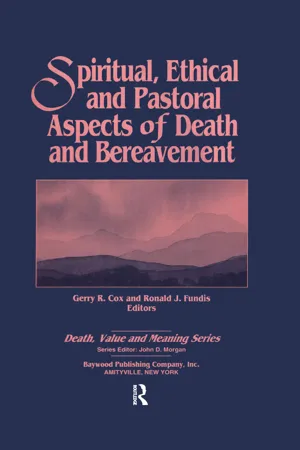
This collection of previously unpublished essays addresses a wide range of topics relevant to the on-going debates regarding dying and death and the subtleties, nuances, and complexities accompanying these phenomena. The authors have attempted to contribute their experiences, insights, and research results to clarify rather than obfuscate. Topic coverage is broad; however, content depth is not sacrificed. The diversity of authors' backgrounds, both geographical and disciplinary, also serves to make this volume unique. The chapters in this volume offer a substantial contribution in assisting care-givers in arriving at acceptable ethical positions in their pastoral, counseling, medical, and mortician roles.
eBook - ePub
Spiritual, Ethical, and Pastoral Aspects of Death and Bereavement
- 278 pages
- English
- ePUB (mobile friendly)
- Available on iOS & Android
eBook - ePub
Spiritual, Ethical, and Pastoral Aspects of Death and Bereavement
About this book
Information
PART I Ethical Issues
DOI: 10.4324/9781315230948-1
CHAPTER 1 The Ethics of Death Education
DOI: 10.4324/9781315230948-2
David K. Meagher
In giving thought to this chapter on the “Ethics of Death Education,” it reminded me of a poem I read many years ago. This poem, A Learned Man, by Stephen Crane, seemed to succinctly describe a major concern about death education and the death educator. Crane wrote [1, p. 119]:
A learned man came to me once.He said, “I know the way—Come.”And I was overjoyed with this.Together we hastened.Soon, too soon, were weWhere my eyes were useless.And I knew not the ways of my feet.I clung to the hand of my friend,But, at last he cried, “I am lost.”
Humankind has always concerned itself with death. We have developed rituals, designed institutions, formulated concepts and constructed language to help us cope with our own mortality and ultimate death. In our coping processes, we have created the funeral industry, hospice for the terminally ill, the science of thanatology, and death education.
In the last two years, death education has come under fire by a number of individuals and agencies. A sample of some of the criticisms would include the following statements: “Much of death education is psychological manipulation, it is a form of value modification that is being practiced on subjects (students and participants) by persons who presume that attitudes need to be changed” [2, p. 5], This critic goes on to ask: “Are we solving anything with this? Or are we only creating new problems?”
Another criticism states that: “Death education is not simply a matter of an educator helping a student/client through a crisis. Programmed repetition of death, despair, and personal evaluation of self-worth in these programs may be turning the participants into suicide victims” [3, p. 34].
A third critic asks: “What are the attitudes the death education advocate wants to change? What are the various death practices for which they seek ‘wider acceptance? The answer to these questions may not be easy to accept. Death education allows or encourages the participant to choose as options various death practices: suicide, euthanasia or abortion. These practices are completely acceptable to the death education practitioner” [4, p. 12].
Are these criticisms completely objective and valid? I think not. Is there justification for these criticisms? I believe there is. Does death education suffer from an almost a priori lack of credibility with respect to efficiency? Upon close scrutiny, this may be so.
Death education—what is it? Death education has been defined as that educational process by which the participant confronts the objective data surrounding the phenomena of death and dying, examines personal attitudes, and develops strategies for dealing with these phenomena as the final stages of life. Death education has also been defined as a process whereby each person is helped to develop from childhood through maturity and to senescence with an acceptance of death as a fact of life. Consistent with these two definitions is the concept that death education is a process to help individuals come to terms with his/her own feelings and attitudes towards death and dying. The death education referred to is not an endeavor limited to schools, but is directed to any and all death education programs. In addition to educational institutions at all levels, death education workshops and seminars are being offered by hospitals, residential care facilities, churches, community organizations, the federal government within its own jurisdiction, and by professional associations, not only for their membership but for the society as a whole. Education programs are offered by hospice through their out-reach programs. Organizations such as the American Red Cross, the Girl Scouts of America, and Cancer Care offer classes on coping with loss and dealing with the dying family member. Death education programs have been presented in newspapers, on television and in a variety of self-awareness, selfdevelopment books, such as Personal Death Awareness and The Art of Dying. In a way, one might define grief counseling as a form of death education. Death education does have, after all, three major components: prevention, crisis intervention and survivor postvention.
What is death education supposed to do? The literature provides the following answers.
The basic goals of death education have been described as:
- information sharing—including the dissemination of relevant concepts related to thanatology, to the care of the dying and bereaved;
- values clarification—this involves activities which enable individuals to consider a variety of alternatives and then to incorporate these choices into healthful behavior. Included in this outcome is the goal to help the participant consider socioethical issues related to death and to define value judgements that these issues raise;
- the development of effective coping behaviors — including problem-solving skills for self-reliance and helping others to make appropriate adjustments. The goal is to help the participant deal effectively with the idea of his/her personal death and the death of significant others; and
- the adoption of a positive attitude toward death and dying.
However acceptable these might appear to be, these goals contain statements that are grist for the critic’s mill and with some justification. Terms such as “appropriate adjustments,” “positive attitude,” and “effectively dealing with one’s death,” raise the issue of whose definitions of “appropriateness, “relevancy,” “positive,” and “effectiveness” will be accepted.
In death education, as in all of education, the concern is with human beings—to do something for them and with them. Is it the intention of death education to change attitudes? Should it be? The response in the literature since the beginnings of death education in the late sixties and early seventies has been an overwhelming YES. Simpson wrote in 1979 that the attitudinal objectives in death education are of primary importance [5, pp. 165-174]. In the same year, Hoetler and Epley stated that the prevalent assumption concerning the impact of death education has been the derivation of positive benefits from exposure to death related subject matter [6, pp. 67-76]. There seems to have been a universal agreement that the desired outcome of death education is the influencing or changing of attitudes of the participant. The direction of this change has been defined as toward a more positive or favorable attitude. An assumption underlying the choice of material that is presented in death education is that an adequate and appropriate death education is one that is based upon facing reality and not avoiding it. This is one of the places that lends some credibility to the aforementioned criticisms. What constitutes a positive or favorable attitude toward death and dying? If there is an agreement that a certain attitude is positive and that another attitude is negative, can this agreement be validated by empirical research? But we do not yet fully know which responses to death are healthy and which are pathological.
This brings to mind the question of what constitutes a good death? Is a good death a death that was portrayed in “The Love Story,” by Erich Segal, where the wife is dying; her face is made up; the slats of the blinds are angled so the sun shines through from heaven above [7]. In her last moment, she reaches for her husband, touches his hand, and asks him not to worry. Death is shared in a loving, non-fearing way.
When we say “a good death” do we mean “good” for the patient, “good” for the family, “good” for the institution, “good” for the society, or is the term not possible to generically or universally define? Might a “good death” depend on the wishes of the individual? Might not “good” be limited to how the individual wishes to live through his/her own dying?
Increased and heightened personal death awareness is obviously of significance. Whether or not it has fulfilled a role in preventing morbidity or pathological bereavement patterns or produced a better dying process is unclear. Ernest Becker, in The Denial of Death wrote that on a conscious level one may accept the eventuality of one’s death, but on an emotional level, one may strongly deny it [8], A positive death attitude may be seen as one in which this conflict is in the process of being resolved. A negative death attitude, conversely, is usually defined as a tendency to accept totally a denial or rejection of one’s own death. Too often, though, a positive attitude toward death and dying has been described as accepting one’s own death as inevitable. This presents a potential conflict of some interest. Does death education advocate that the dying patient accept death as inevitable in the light of some research that describes the rejection of the inevitability of death as a variable that seems to increase longevity and the quality of life in terminally ill patients? I refer here to the concept of the “survival quotient” which theorizes that terminally ill patients who are able to accept the severity of their disease, but deny the inevitability of their death, tend to live beyond their prognosis. Do we have valid research which clearly describes the negative consequences of a death denial or avoidance? Is there some inherent ethical wrong in an avoidance of death?
Catherine Sanders, in her book The Mourning After, describes four types of bereavement emerging from her study of bereavement [9], One type was identified as the “denial group.” Sanders writes that individuals in this group are .. needing to employ defence mechanisms in order to deal with crisis” [9, p. 129], They are what she calls “determined optimists,” reluctant to admit common human foibles and keep a “stiff upper lip.”
Sanders writes that there has been concern that those individuals undergoing grief who do not ventilate their emotions will be a risk for poor outcome. This was not the case in her study, Sanders reports. The coping mechanism of the “denial group” appeared to be facilitative. They did not deny death itself, but rather they denied their overt emotions surrounding the bereavement. Denial, Sanders concludes, is apparently an adaptive defence that serves them well in crises.
Much of the death education research has been studies which attempt to answer the question: Does death education cause any change in the participant? Much research has focused on the impact of the experience on something called “death anxiety” and/or “fear of death”; not the outcome of avoidance or acceptance or the assimilation and utilization of new knowledge. We tend to hypothesize that lowered anxiety or lessening of fear will bring about a greater acceptance of one’s own death and the death of others (more the death of others, I suspect, than one’s own death). As Ray and Najman wrote [10, p. 311]: “Since death is in fact inevitable, accepting it might be the least we can do. Not only do we thereby avoid anxiety associated with fear, but we would probably be, in such circumstances, best able to provide and prepare for death.” Desired outcomes?
There is a great deal to be desired from this type of research and reading any number of these studies will probably create confusion in the reader.
What do these studies reveal? Why is there confusion? A review of some recent studies might provide an answer. Hare and Cunningham found no difference between experimental and control groups in the fear of death [11]. Of course, these researchers permitted their subjects to choose their own treatment groups.
Lockard, in Death Studies, reported that the experimental group in this study had significantly lower death anxiety than did the control group at two weeks, four weeks and one year post treatment [12]. It was reported, though, that neither group deviated from some “defined” middle range of anxiety.
Peace and Vincent compared and correlated two variables: hospice care nurses and non-hospice care nurses experience in death education and their death anxiety [13]. Hospice care nurses had significantly more death education than the non-hospice care nurses, but they were not significantly different from the non-hospice care nurses in the level of death anxiety. Both groups, it was reported, tended to fall within a “defined middle range” of anxiety. Watts reported a “favorable” death attitude change resulting from a relatively brief death education unit [14].
The studies examining the effect of death education tend to employ a death anxiety scale (most often quoted instrument is the Templer Death Anxiety Scale) in a pre/posttest design along with course/ workshop evaluations by participants and self descriptions of attitudes or behaviors by the participants. These instruments are all inadequate means to assess the effectiveness of death education courses. Sanders addresses many issues concerning research in bereavement [9]. She states that stereotypes such as “pathological grief’ and “bad grief’ are often based on poorly designed research. A major research problem, according to Sanders, is inadequate instrumentation, primarily the lack of reliability and validation testing. The instruments have not been standardized; yet we use them, arrive at conclusions and develop programs of intervention based on these findings. Another major research problem, Sanders believes, is investigator bias. She writes that if one believes that “training will bring about a desired ‘better’ caregiver or person, one will prove it.”
The lack ...
Table of contents
- Cover
- Title
- Copyright
- Table of Contents
- Introduction
- PART I: ETHICAL ISSUES
- PART II: PASTORAL ISSUES
- PART III: SELECTED CANADIAN EXPERIENCES
- PART IV: CHILDREN AND THE DEATH EXPERIENCE
- PART V: SOCIAL, HISTORICAL AND SPIRITUAL ISSUES
- PART VI: BIOETHICAL ISSUES
- Epilogue
- Contributors
- Bibliography
- Index
Trusted by 375,005 students
Access to over 1.5 million titles for a fair monthly price.
Study more efficiently using our study tools.
Frequently asked questions
Yes, you can cancel anytime from the Subscription tab in your account settings on the Perlego website. Your subscription will stay active until the end of your current billing period. Learn how to cancel your subscription
No, books cannot be downloaded as external files, such as PDFs, for use outside of Perlego. However, you can download books within the Perlego app for offline reading on mobile or tablet. Learn how to download books offline
Perlego offers two plans: Essential and Complete
- Essential is ideal for learners and professionals who enjoy exploring a wide range of subjects. Access the Essential Library with 800,000+ trusted titles and best-sellers across business, personal growth, and the humanities. Includes unlimited reading time and Standard Read Aloud voice.
- Complete: Perfect for advanced learners and researchers needing full, unrestricted access. Unlock 1.5M+ books across hundreds of subjects, including academic and specialized titles. The Complete Plan also includes advanced features like Premium Read Aloud and Research Assistant.
We are an online textbook subscription service, where you can get access to an entire online library for less than the price of a single book per month. With over 1.5 million books across 990+ topics, we’ve got you covered! Learn about our mission
Look out for the read-aloud symbol on your next book to see if you can listen to it. The read-aloud tool reads text aloud for you, highlighting the text as it is being read. You can pause it, speed it up and slow it down. Learn more about Read Aloud
Yes! You can use the Perlego app on both iOS and Android devices to read anytime, anywhere — even offline. Perfect for commutes or when you’re on the go.
Please note we cannot support devices running on iOS 13 and Android 7 or earlier. Learn more about using the app
Please note we cannot support devices running on iOS 13 and Android 7 or earlier. Learn more about using the app
Yes, you can access Spiritual, Ethical, and Pastoral Aspects of Death and Bereavement by Gerry Cox,Ronald Fundis,Gerry R Cox,Ronald J Fundis in PDF and/or ePUB format, as well as other popular books in Theology & Religion & Ethics in Medicine. We have over 1.5 million books available in our catalogue for you to explore.