This book builds on the insights of Günther Bachmann, former Secretary General for the German Sustainability Council, who spent almost 20 years advising the German government on sustainability policy. The book discusses his experiences in negotiating stakeholder statements at the highest national levels.
Bachmann takes the reader behind the scenes of German sustainable policy and practice, whilst also comparing Germany with other national approaches. He tells the story of political events from his insider perspective, unfolding the narrative of sustainable development goals and how activists in their respective countries could and should relate to it. Furthermore, he suggests new lines of vision through the tangle of conference fatigue and buzzwords. The book argues that environmentalists often display entrenched attitudes that too often downplay success. The rhetoric of crisis and doom, if overstretched and reduced to alarm, paralyses action and innovation. Bachmann, who on the contrary argues positively and concretely, shows unusual but significant signs of hope and confidence in action and how these can be made effective in the politics of sustainable development.
This book will be of global relevance to sustainability professionals and policy makers and will advise them on how to successfully move ahead with sustainability policies.
1 IntroductionNever trust a lesson without thinking for yourself
DOI: 10.4324/9781003242024-1
If there is one thing I have learned about lessons and the concept of “lessons learned” it is to stay realistic, and sceptical. The first lesson from any event or book talking about lessons learned should be never trust a lesson, at least, not without further thought. There are two reasons for this: one is of a more general type, the other is more German-specific.
Of course, there is definitely a lot to learn about how to successfully drive sustainability politics. So, the idea of lessons learned and of sharing of experiences has almost become a defining element of any sustainable development conference, maybe more so than in other topics. Politicians and activists never tire of emphasising the need to learn from each other. Entire manuals are giving guidance on how to write lesson learned reports. Conference participants spend hundreds, if not thousands, of hours listening to, presenting or discussing lessons learned. Today, this has become an inflationary must-do that more often than not just occurs as a naive routine. Those endless hours are a part of political correctness, in particular with the social media generation. If every bit that had been offered and published as a lesson had really added value to people’s insights and influenced the debate, the world would be better off, one can assume. However, the amount of real time learnings does not correspond to the inflation of rather superficial and “standard” offering of lessons. The actual learning is not keeping pace. That’s why I use the concept very carefully.
Second, the breach of civilisation that occurred during the Holocaust forces us Germans to be maximally reluctant about telling others what to do. Suggesting there is anything at all to be learned from the Germans sounds awkward and absurd. For our decent fellow Germans, it is axiomatic that the German Vergangenheitsbewältigung (the coping with the past, politically, culturally, legally, as individuals and as society at large), still today, is incomplete. So, restraint became a virtue of German politics after liberation from fascism. It applied in the East as well as in the West. For a long time, German restraint could not be overdone. The moral high ground is not an option for Germany. As the economically strongest member state of the European Union, Germany naturally has a special responsibility to hold Europe together in the face of increasingly divergent interests. This can be done, if at all, with honesty, respect and clarity about one’s own interests, not by pushy lecturing. After fascism, against all odds, and with significant help of other nations, we developed a democracy and succeeded in building a responsible and accountable nation, and now begin the energy transition and a sustainable transformation.
This casts a new and very different light on Germany and certainly is challenging the rigor of the restraint. Susan Neiman, an American who directs the Einstein Forum, a public think tank outside of Berlin, suggests that America and other nations should learn from the German experience of coping with evil. Neiman (2019) sees Germany’s culture and politics deeply informed by this history. She is right. Even if this does not completely rid the German reality of racism and anti-Semitism, it seems to keep right-wing populism in check and helps democratic parties resist the bold reflexes of brazen populism. When Helen Clark, who served as prime minister of New Zealand from 1999 to 2008, and was the administrator of the United Nations Development Programme from 2009 to 2017, presented the results of her review of German politics to then-Chancellor Angela Merkel, she said that “what Germany does on sustainability is of global importance, not least because of the size of its economy and population. When major countries move on sustainable development, that is felt around the world” (Clark 2018a). In the review itself the peers allude to the global recognition of Germany’s capacity for sustainability, and continue by asking: “If Germany can’t pull out all the stops, who could? Those expectations of Germany will most likely increase” (Clark 2018b, p. 11).
People and politicians around the world yearn for democracy, sustainability and human rights (well, maybe not all). All countries should set out on the path to sustainable development and adopt national sustainability strategies. This is what the 2030 Agenda for Sustainable Development called for in 2015, repeating and strengthening what had been discussed as early as 1992 in the Earth Summit UN conference in Rio de Janeiro.
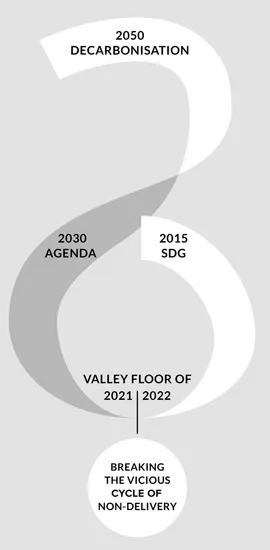
The world has agreed on sustainable development goals and on the target of not warming the Earth more than two degrees Celsius and therefore drastically cutting greenhouse gas emissions by 2050, in the even better case to a maximum of only 1.5 degrees Celsius. Some countries, including Germany, are translating this goal into a political promise to become climate neutral by 2045/2050 and to achieve full decarbonisation where possible. The goals that the global community has signed up to in the run-up to 2030, such as the elimination of hunger and malnutrition, the reduction of food waste, sustainable consumption and industrialisation, and the protection of the oceans, are no less ambitious than the Paris climate target. And they are to be achieved as early as 2030, having been adopted in 2015. Like two flags, 2030 and 2050 mark the commitment of the global community to at least minimally live up to its civilisational self-image. Half of these 15 years are reached in 2021/2022, but not half of the target distance (see Figure 1.1). All countries have a duty to find solutions to keep them in line with the 2030 agenda.
All countries? The differences between the countries of the world and within their societies are serious. As a result, development and equity must be brought together. People in the poorest countries insist on their right to free themselves from the hardships of hunger and poverty. And no one would “deny it to them”. All people everywhere should be able to live a life in dignity while preserving natural resources. This approach tries to make human development sustainable, and for this purpose, it adds “time” (the long run) and intergenerative justice as guiding essentials for politics and policies. This is also imperative for German domestic policy, since ecological and economic domestic policies still tend to neglect the social dimension in their distributional effects.
Figure 1.1 The valley floor of 2021/2022
The major emerging economies have a special position. Without their contribution, a global sustainability turnaround is impossible. High growth rates and their economic dynamism generate far too many climate-damaging emissions and pollutants. For instance, their share of the plastic flood in the oceans is high. Strangely enough, these countries associate the overcoming of extreme poverty with an increase in the number of super-rich people. It seems the term emerging economies can no longer be appropriate. They, too, must undergo fundamental transformation.
The world is demanding that Germany and the other industrialised countries with early (and therefore now old) industrialisation take on a peacemaker role in the turnaround to sustainability. The self-image of German politics is consistent with this role, but still not every German policy finds itself replicated in the world. The reasons for this may be a nitty gritty overengineering, high bureaucracy or unreasonable costs. Another reason may be insufficient communication of the idea, alternatives and solutions on the part of Germany.
Improving policy for sustainable development is an imperative, and lessons learned can be an important tool in doing so if they stimulate further thinking. Ambitious claims and honorary goals are of no use if they are not met. In fact, there is a gap between the ambition and the reality of the Paris Climate Accords. Emissions of greenhouse gases worldwide are rising, not falling. This is the Paris valley, and it is getting bigger and deeper. The pandemic is further widening this gap of vicious non-delivery.
The valley floor is even more serious in terms of the broader United Nations Sustainable Development Goals (SDGs). In 2015, all of the world’s nations agreed to the SDGs of the 2030 agenda. This was preceded by extensive discussions and negotiations. The decision to adopt the goals was not taken lightly. All of them are backed up with facts and figures. The 2030 agenda has met with much approval and also generated enthusiasm. Today, however, most of the goals already envisioned for 2030 are in the distant future. Instead of getting closer to them step by step, global trends are taking them off track. This is the reason for very firm warnings, whether from activists on the street, books or celebrities, or even at the highest level from the secretary general of the United Nations. He has declared a decade of action for the 2020s to achieve the 2030 goals and is stepping up the rhetoric. He is certainly right. Commitments and target achievement are clearly mismatched. For all people who believe in the credibility of politics and the rationality of political engagement, this gap is more than a temporary problem. Rather, it is a valley of non-delivery in the pursuit of the global commons.
The simple truth is that the world, while not at ground zero of commitments and goals, is in a zero position in terms of actions to deliver for those goals. The future, for better or worse, is decided on the bottom of this valley. Will we succeed in getting on a path that can redeem even important and complex goals? Or will the ambitious goals become a redevelopment case, getting ever more problematic to clean up? The beginning of the 2020s is crunch time, when the damaging trends are to be broken or the bottom is to be at least passed, or it remains at the bottom for the time being. Even after that, the challenge will remain on the table; sustainability is, after all, a process.
That countries themselves must do more is hardly disputed by those with the highest political responsibility. Only the how remains vague and undecided. How to build and strengthen institutions? How to successfully address and engage the private sector? How to “bring people along”? How to build on collective competence and strengthen self-efficacy? How can technical and administrative innovations go hand in hand with a culture of sustainability? How to build trust, and what role free advice can play through bodies with multistakeholders? How dare we hope? These are all serious questions, and open ones at that. They are being asked around the world.
The German approach to sustainability explicitly wants to be open to the world, innovative and capable of globalisation, and to reach people “at home”. The German energy transition is the flagship megaproject. With phasing out fossil and nuclear power and phasing in climate neutrality, this transition is a triple North Star. In a way, the ambition of the energy transition may remind us of a core element of a computer server station that is being taken out and replaced, while the server is in full swing. On the scale required, this has never been done before in any old industrialised country, and success is certainly not a given.
On the other hand, preconditions are good, both in terms of cultural preparedness, people’s mindsets, technology, and economic feasibility. Interestingly, the idea of sustainability is culturally deeply rooted in Germany and those roots are actively used as a driver for innovation. Germany is good at building institutional capacity, and the political system is strong enough to enable new forms of gatekeeping. No other government puts its own strategy before high-level experts for criticism so openly. After all, no other society that depends so heavily on the industrial economy has been pursuing a sustainability strategy for so long, enabling such extensive networking with the private sector, civil society and academia, and politics at all levels.
Both in climate protection and in sustainability policy, activists, ambitious officials and innovative companies form large and well-connected communities of like-minded people (with all the differences on details). This is good and certainly a prerequisite for overcoming the Paris chasm as well as the SDG chasm. To redeem this prerequisite, these communities need more influence and decision-making power. They also have to muster the courage to go off-script, to connect with deep roots, be visionary, develop a failure culture, understand better what makes a success, and how to create reasons for hope. However, for this to happen, they also need to change “internally”. They are still moving mostly in a bubble of their own making. The usual catchphrases there internalise how to address their own clientele. Unpleasant topics are often left out. We see this in Germany. Climate neutrality and a 100-percent supply of renewable energies might even become empty words because there is too little disclosure of the impositions and the limits they entail if everything else is left unchanged. An honest discussion would certainly be better in some places, because it would likely overturn conventional ideas about the implementation of goals, for example. By no means is it the case that good governance is just the product of determination, administrative coherence and alignment. This book presents insights and, from an insider’s and practitioner’s view, shows where there is a momentum in current policies, what organisational and social learning really means and where there are hidden fields of change. It seeks to provide information always with a critical eye toward unnecessary obstacles and mistakes, but also with pride in what has been achieved, insofar as this is appropriate.
Germany’s achievements, critics often say, are nice to look at, but they look very “German”: overly precise, too little life, too much engineering. And honestly, they sometimes certainly are. However, what works for Germany is good enough to drive the domestic solution-finding. It comes with a realistic, if not sceptical understanding of “lessons” that those achievements are no textbook solutions. Similarly, some see the phasing out of nuclear energy and coal and achievement of climate neutrality for the entire country by 2045 as overambitious. However, there are great potential benefits should this plan succeed. Critical voices have to take this into account. It could bring great advances in technology and social innovation; it could set a trend. As a concerted action, sustainability strategy could, after all, achieve more than the sum of sectoral measures.
That’s the subjunctive. But what about the present of change? In the midst of transformation, it may still seem abstract and distant to some contemporaries, but as a matter of fact, the present demands that we make decisions and take action. In German politics, this is generally understood, and there is also a readiness to act. How do we more efficiently combine the mutual advantages of digitalisation and sustainability? How do we secure and stabilise German supply chains, e.g. in semiconductors and information technology? How does German foreign policy act in the sales and growth markets for countless German companies, not only in the automotive industry? How can and should the European Union develop further? How can Germany strengthen sustainability policy in Africa? How can we make sustainability solutions mandatory without being overly prescriptive? How do we finance the huge investments required for this transition in the face of the debt that piles during the COVID-19 pandemic and the budgetary debt-to-GDP threshold that should not be above the 60% European threshold (the so-called debt brake (Schuldenbremse) is a German constitutional provision)? How will financial inflation and the financial debt management play out, and what about the non-financial debts? Will people stay in favour of sustainability if there are no quick fixes?
New and open so-called spaces of possibilities must be created, while the majority of people, in the face of threats, tend to react cautiously, conservatively and delimitatively to themselves. This is a political challenge. It is obligatory for German politics to actively navigate the future transformations, remembering that no future has ever been master...
Table of contents
Cover
Half Title
Series
Title
Copyright
Contents
List of figures
Acknowledgements
List of abbreviations
1 Introduction: Never trust a lesson without thinking for yourself
2 Germany: The basic facts
3 Roots: The background of today’s sustainability practise
4 Strategising: The state-of-the-art of German sustainability politics
5 Keystone: The German energy transition
6 Value: The undervalued component
7 Failures: An indispensable resource
8 Moments: Facing accumulated decision needs in sustainable development in Germany
9 Democracy: No end, but rather a becoming
10 Success: Navigating its elements
11 Seeds: The evolutionary germination principle, repurposed
12 Unite behind politics
Index
Trusted by 375,005 students
Access to over 1.5 million titles for a fair monthly price.
Study more efficiently using our study tools.
Frequently asked questions
Yes, you can cancel anytime from the Subscription tab in your account settings on the Perlego website. Your subscription will stay active until the end of your current billing period. Learn how to cancel your subscription
No, books cannot be downloaded as external files, such as PDFs, for use outside of Perlego. However, you can download books within the Perlego app for offline reading on mobile or tablet. Learn how to download books offline
Perlego offers two plans: Essential and Complete
Essential is ideal for learners and professionals who enjoy exploring a wide range of subjects. Access the Essential Library with 800,000+ trusted titles and best-sellers across business, personal growth, and the humanities. Includes unlimited reading time and Standard Read Aloud voice.
Complete: Perfect for advanced learners and researchers needing full, unrestricted access. Unlock 1.5M+ books across hundreds of subjects, including academic and specialized titles. The Complete Plan also includes advanced features like Premium Read Aloud and Research Assistant.
Both plans are available with monthly, semester, or annual billing cycles.
We are an online textbook subscription service, where you can get access to an entire online library for less than the price of a single book per month. With over 1.5 million books across 990+ topics, we’ve got you covered! Learn about our mission
Look out for the read-aloud symbol on your next book to see if you can listen to it. The read-aloud tool reads text aloud for you, highlighting the text as it is being read. You can pause it, speed it up and slow it down. Learn more about Read Aloud
Yes! You can use the Perlego app on both iOS and Android devices to read anytime, anywhere — even offline. Perfect for commutes or when you’re on the go. Please note we cannot support devices running on iOS 13 and Android 7 or earlier. Learn more about using the app
Yes, you can access How to Successfully Encourage Sustainable Development Policy by Günther Bachmann in PDF and/or ePUB format, as well as other popular books in Politica e relazioni internazionali & Sviluppo sostenibile. We have over 1.5 million books available in our catalogue for you to explore.