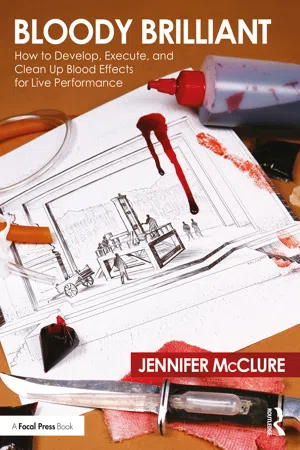
Bloody Brilliant: How to Develop, Execute, and Clean Up Blood Effects for Live Performance
eBook - ePub

Bloody Brilliant: How to Develop, Execute, and Clean Up Blood Effects for Live Performance

  1. 168 pages
  2. English
  3. ePUB (mobile friendly)
  4. Available on iOS & Android
eBook - ePub

Bloody Brilliant: How to Develop, Execute, and Clean Up Blood Effects for Live Performance

About this book

Bloody Brilliant: How to Develop, Execute, and Clean Up Blood Effects for Live Performance offers methods and techniques for delivering this special effect on the stage.

The world of live theatre presents its own set of unique challenges when creating special effects, particularly blood. There are no cropped-view frames, multiple angles, or reshoots – everything is live and in view of the audience. This book provides helpful insight, information, techniques, and tricks for producing reliable and repeatable blood effects, covering everything from design and budgeting to safety and clean-up. Filled with easy-to-follow descriptions and full-color artwork, this text includes:

    • Practical examples of blood effect budgets, outlining not just money but also labor needs.
    • A breakdown of the components for making an original blood recipe, as well as reliable, industry-tested recipes.
    • Options for dispensing blood to create realistic effects for any budget size.
    • A comprehensive wash-testing database of over 500 examples of fabrics and blood combinations.

Prop managers and builders in professional, educational, and regional theatre are sure to benefit from the tips outlined in this book.

Frequently asked questions

Yes, you can cancel anytime from the Subscription tab in your account settings on the Perlego website. Your subscription will stay active until the end of your current billing period. Learn how to cancel your subscription.
No, books cannot be downloaded as external files, such as PDFs, for use outside of Perlego. However, you can download books within the Perlego app for offline reading on mobile or tablet. Learn more here.
Perlego offers two plans: Essential and Complete
  • Essential is ideal for learners and professionals who enjoy exploring a wide range of subjects. Access the Essential Library with 800,000+ trusted titles and best-sellers across business, personal growth, and the humanities. Includes unlimited reading time and Standard Read Aloud voice.
  • Complete: Perfect for advanced learners and researchers needing full, unrestricted access. Unlock 1.4M+ books across hundreds of subjects, including academic and specialized titles. The Complete Plan also includes advanced features like Premium Read Aloud and Research Assistant.
Both plans are available with monthly, semester, or annual billing cycles.
We are an online textbook subscription service, where you can get access to an entire online library for less than the price of a single book per month. With over 1 million books across 1000+ topics, we’ve got you covered! Learn more here.
Look out for the read-aloud symbol on your next book to see if you can listen to it. The read-aloud tool reads text aloud for you, highlighting the text as it is being read. You can pause it, speed it up and slow it down. Learn more here.
Yes! You can use the Perlego app on both iOS or Android devices to read anytime, anywhere — even offline. Perfect for commutes or when you’re on the go.
Please note we cannot support devices running on iOS 13 and Android 7 or earlier. Learn more about using the app.
Yes, you can access Bloody Brilliant: How to Develop, Execute, and Clean Up Blood Effects for Live Performance by Jennifer McClure in PDF and/or ePUB format, as well as other popular books in Media & Performing Arts & Performing Arts. We have over one million books available in our catalogue for you to explore.

Information

Chapter 1Planning Blood Effects

DOI: 10.4324/9780367854669-2
When a production calls for a blood effect, it will affect multiple creative departments, so it’s important to start conversations about them as early as possible. This chapter will offer questions to pose to your director and creative team to help figure out what type of effect they would like to see. We will discuss considerations to keep in mind for the different departments that are involved in blood effects. All the steps of developing a blood effect will be broken down to help understand how to budget not only money but time. I will also provide some scenarios for testing your blood effect. Keep in mind that every situation poses its own set of challenges, so these are all suggestions, not steadfast rules.
Despite the opportunity to plan ahead, a blood effect could still be requested late in the production process. Understanding what an ideal scenario looks like will help you know where to make quick decisions and not feel overwhelmed, as well as how much is possible in a short amount of time. Your greatest strength when working with blood effects is the ability to provide options and remain flexible to changing ideas.
Building a blood effect is an exciting part of a production, but be careful not to express an irreverent attitude when talking about what will be depicted onstage. Although the acts we show are all fake, they are based on knowledge of how things really can happen, and that can be sensitive for some participants in the process. This is discussed in more depth in Chapters 4 and 6, when specific actions and effects are described, but in short, always keep a professional and respectful manner when working with blood effects.

Understanding What the Director Wants

When starting to plan a blood effect, the first conversation is usually with the production’s director. I encourage them to tell me what their ultimate dream look would be by asking, “What is the movie in your mind?” to get a conversation started. It can be very helpful if the director can provide some reference to what they are interested in. Specific scenes in movies, pictures, paintings, or even other theatrical productions can all be used to quantify exactly what look is desired. Ask them to provide you with some visual reference to help get a good idea of what they are picturing, but if they can’t provide this, do some research to present to them. Without good visual reference, there can be multiple interpretations of “just a little blood” or “covered in blood”. Ideally, these conversations happen early enough in the process to allow enough prep time to budget the effect.
It is better to start with the ideal version of an effect and then determine if your production has the resources to support it. The effect may wind up being scaled back, but taking things away is far easier than adding things last minute.

Who Is Responsible for the Blood Effect?

It should be determined early on which department, or combination of departments, will be responsible for the blood effect. In many theaters, the prop department provides the blood and is involved in planning the blood effect. If the blood is mainly on the actor’s face or body, the costume designer and costume shop may prefer to take the lead. If a producing organization has a make-up designer, they will likely want to design or be part of the conversation about the blood used in the show. It is possible that multiple departments may all be contributing in some way to the blood effects in a show. Costumes could provide a prosthetic with a wound or specific make-up for an actor’s face, and props may provide the blood knife and blood that is used. Having clearly defined roles of who will take the lead coordinating and budgeting the effect will prevent a potential problem or misunderstanding. You don’t want to get to the blood moment in tech when the clock is ticking and realize no department is adequately prepared.
Budgeting, coordinating, and creating the effect is the beginning of the process, but you should also have a plan for who maintains the effect during performances. Things to think about are who mixes the blood recipe, who presets the blood effects, who is responsible for clean-up, etc. This is often a combination of stage management, run crew, and the wardrobe department. For example, the props staff might test and mix the blood recipe and make all the blood packs needed for the performance run. The properties runner or assistant stage manager might then be responsible for setting the blood pack at a certain place on the stage for the actor to pick up. Then a run crew member might help the actor change out of their blood-stained clothes at the end of the scene and immediately take the clothing to the wardrobe supervisor to begin soaking the item as soon as possible. The stage carpenter might then inspect the scenery after the sh...

Table of contents

  1. Cover
  2. Half Title
  3. Title
  4. Copyright
  5. Dedication
  6. Contents
  7. Acknowledgments
  8. Introduction
  9. Chapter 1 Planning Blood Effects
  10. Chapter 2 Choosing a Blood
  11. Chapter 3 Containing and Delivering the Effect
  12. Chapter 4 Creating Specific Blood Effects
  13. Chapter 5 Alternate Blood Effect Options and Basic Prosthetics
  14. Chapter 6 Putting It All Together
  15. Chapter 7 Cleaning Up the Scene of the Crime
  16. Bibliography
  17. Index