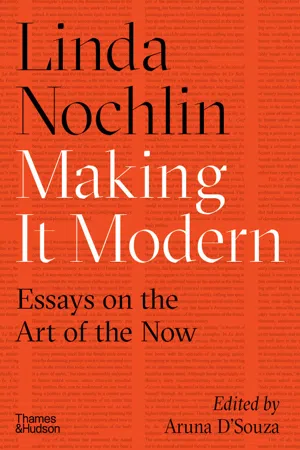
This illustrated, edited collection of essays brings together for the first time some of the pioneering art historian Linda Nochlins most important writings on modernism and modernity from across her six-decade career. Before the publication of her seminal tract on feminism in art, Why Have There Been No Great Women Artists?, Nochlin had already firmly established herself as a major practitioner of a politically sophisticated and class-conscious social art history, with her writings on modernism being transformative to the discipline. Nochlin embraced Charles Baudelaires conviction that modernity meant to be of ones time - and that the role of an art historian was to understand the art of the past not only in its own historical context, but according to the urgencies of the contemporary world. From academic debates about the nude in the 18th century to the work of Robert Gober in the 21st, whatever she turned her analytic eye to was very much conceived as the art of the now - the art we need to look at to navigate the complexities and contradictions of the present.
- 448 pages
- English
- ePUB (mobile friendly)
- Available on iOS & Android
eBook - ePub
About this book
Information
Topic
ArtSubtopic
History of Modern Art14
Kelly: Making Abstraction Anew
Art in America 85, no. 3, March 1997
At first sight, Ellsworth Kelly’s show at the Guggenheim Museum was literally breathtaking. No, not literally: figuratively breathtaking. Literally, it was breath-giving. It enhanced inhaling and exhaling. Kelly’s work at its best brings on an expanded breathing, a kind of inward “ahhhh,” as it and I, the viewer, spread our wings and our lungs. These exacerbated reds, these bluer than true blues, these expansive, unnamable shapes remind me that the Greek word pneuma means both breath and spirit. Breathing is the essence of these works, but breathing as expansion, not as effort: they never bring on puffing or panting, even going up the ramp of the Guggenheim, but instead induce an exaltation of lungs and spirit.
The Guggenheim Museum’s upward exhibition trajectory transformed the artist’s career into a kind of allegory of ascent, a progression from small to large, from multiple to bipartite to single, from complex to simple. But Kelly’s work does not merely present an inevitable unfolding, from the smaller works of the early 1950s, whether grids, checkerboards or freer and more surprising patterns, to the stark polyptychs of the later 1950s and early 1960s, to the large, bold bichromatic works of the 1970s, to the monochrome panels and plinths that mark his latest inventions; rather, it is the diversity and surprisingness of his achievement that is striking. The sense of a seemingly “inevitable” development always comes after the fact: it could have been otherwise, and sometimes was.1
Kelly’s later work may look increasingly purified, even reductive, at first inspection, and indeed, the exhibition stressed this reading; but if one deviated from that main highway of ascension the Guggenheim thrust upon the viewer and strayed to the byways, as it were, one was rewarded by a sense of the variety of Kelly’s career, for he is not just a painter of large-scale panels in oil on canvas, but a draftsman, a sculptor, a collagist, a printmaker and a photographer of major achievement. His work, far from being constricted, is multiple: each medium elicits another, and often opposing, aspect of his surprisingly mobile talent. And in each realm, his work responds to the particular qualities he decides, consciously or not, the genre calls forth. His photography is not, as some critics have maintained, simply a rediscovery of his abstractions in nature. His photography is not abstract, nor is its iconography that of the natural world; rather, composed of selected elements of the manmade environment that are almost indecipherable at first glance, Kelly’s black-and-white photographs combine an austere, reductive composition with richness of perceptual detail. Some of the images derive their impact from carefully controlled references to qualities of the ordinary snapshot: the snapshot’s fortuitous relationships or inconsequentiality, for instance. The small black-and-white dog revealing its behind next to a pile of unevenly stacked bricks in Meschers #1 of 1950, or the almost indiscernible writing marking the specificity of Opening to a Cellar (1977), or the wild gesticulation of ruined wires growing out of broken concrete in Shelled Bunker, Meschers #7, 1950: these elements are all to some degree derived from a snapshot aesthetic, irregularities given aesthetic shapeliness or overtones of menace or humor by Kelly’s choice of vantage point and the controlled nuances of black, gray and white.
Kelly’s is an oeuvre of decided complexity, both in terms of its individual history and in terms of its problematic relation to the recent and more distant past of abstract art. Earlier European abstraction’s theoretical engagement with the logical polarities of chance and determination—Jean Arp versus de Stijl—seems to be reenacted in Kelly’s Colors for a Large Wall (1951, fig. 56). An important early work, Colors repays concentrated attention, and even a certain amount of activity on the part of the viewer. I must admit that I attempted to chart the permutations of this work, diagramming the sixty-four square panels that make up the 96-by-96-inch totality—brown, white, violet, white, black, orange, white, blue-green across; brown, white, black, red-orange, white, green, white, black down—looking for some sort of hidden system, some clue as to why Kelly arrived at this sequence of colors and not another, despite the fact that the sequences of these colored squares are said to be based purely on chance. But then, what is chance based on? The notion that there is a law of chance begs the question.

56 Ellsworth Kelly, Colors for a Large Wall, 1951. Oil on canvas, sixty-four panels, 94½ × 94½ in. (240 × 240 cm)
Historically, the principle of chance, the liberating power of the aleatory, in its connection with the unconscious, has played a major role in twentieth-century avant-garde practice. Through the influence of Arp, whom Kelly met in Paris in 1950, it played an important part in Kelly’s early practice. For Arp, chance had serious if mysterious causes and profound consequences: “The ‘law of chance,’” Arp stated, “which embraces all laws and is unfathomable like the first cause from which all life arises, can only be experienced through complete devotion to the unconscious. I maintained that anyone who followed this law was creating pure life.”2 Kelly’s view of the role played by chance in his art was considerably less exalted: “Making paintings according to the principles of chance was a way to remove my own personality. I want to eliminate the ‘I made this’ from my work,” he once said.3 A strategy of depersonalization deployed in the creation of a recognizably unique style: this is one of the paradoxes that engaged Kelly over the years.
Kelly’s work has been vitalized by contradiction from the time of the artist’s earliest engagement with abstraction in Paris. At the time, after World War II, in works like the La Combe series of 1950–51 or Meschers of 1951, he explored the possibility of an abstraction that was neither directly expressive, ostensibly “subjective,” an apparent index of emotion, like that of the Abstract Expressionists, nor, like more traditional and European schools, geometric, coloristically reduced to the primaries, or based on an a priori system. Later, it seemed to be the varied ways he dealt with a whole range of contradictions that made, and continues to make, a Kelly work into the uniquely strange entity it so often is, at once deeply satisfying and disconcerting: as though equilibrium were just barely achieved and momentarily held, like that of the ballerina on pointe, and might—and for moments even does—turn into something much more unstable. Take, for example, the tensions implicit in the relation of curve to radius in a work like Blue Curve III (1972, fig. 57), one of a series of Curves. What is the relation of this curve—a segment of a large circle—to the “radii” implied by the work’s straight edges—straight lines which are too short to reach the center of the circle the curve would make if completed? It is precisely this “inconsistency” between length of radius and curve of arc which accounts for the sense of soar and sweep in those Curves where the discrepancy is most exaggerated, and lifts them from the realm of geometry to that of imaginative flight, Stéphane Mallarmé’s L’Azur meeting the Concorde on the walls of the Guggenheim.

57 Ellsworth Kelly, Blue Curve III, 1972. Oil on canvas, 67¾ × 166½ in. (172.1 × 422.9 cm)
In many cases, it is the viewer who activates the tensions latent in a particular work or group of works; it is often the spectator’s changing position that makes the later Panels and Curves spring provocatively to life. Step to the left, and the left margin of a Curve lengthens out with you; step to the right and you could swear that the right edge is longer. I performed a solemn and repetitive clog dance—left, left, left; right, right, right—in front of several of these impervious and unnerving objects, convinced that the edges were, in fact, uneven in length, despite the measurements given in the catalogue and their—almost—obvious evenness when you stop shuffling and plant yourself exactly “in front” of them. (But then, because of the building, they were so often hung at odd angles.)
The constant resort to the quirky awkwardness of the irregular quadrilateral—a form which calls to mind the architectonic stability of the rectangle but fails to maintain that trust and falls short of the more dynamic equilibrium of the parallelogram, too—is another of Kelly’s strategies for undermining the pull of the “geometric unconscious.” A series of differently colored quadrilaterals, disharmonized against a wall, can make one jittery indeed. The same might be said of the combination of the curve with the straight edge in four-sided figures: works like Green Panel with Curve of 1992 or Yellow Panel with Curve of 1991 strain both visual and haptic response with their apparent simplicity and their refusal to conform to the stable norms of more conventional geometric figures.
Kelly’s sculpture transfers these contradictions from two dimensions to three, from wall to space. Look at these slender wood or metal totems rising from the museum floor: how uncannily they maintain their verticality, how inscrutably they are anchored to the ground from which they rise. What holds them down, one wonders, what keeps them from soaring off into space or tipping over? The guard finally tells us that they are anchored to the marble floor of the Guggenheim by invisible pins. Others are buttressed by horizontal steel elements under the pavement. Or consider the antithesis between horizontal and vertical, each of which creates a different sort of spatial and gravitational expectation, in White Angle (1966). Here too, appearances are deceptive: what looks like a short-seated, high-backed beach chair when seen from a point directly in front of it—or in the foreshortened photograph in the exhibition catalogue—reveals, when viewed in profile, that it is actually constructed of two exactly equal lengths of painted aluminum.
Yet it is perhaps the way that Kelly’s work has embodied and developed a bold and ever-challenging semantics of color that marks it as a major contribution to modern visual practice. “Color,” says Jacqueline Lichtenstein in her wonderfully eloquent study of the subject in the age of French classicism, “bears a striking resemblance to the god of negative theology that the categories of rationality can never adequately apprehend and of which the only way to speak is to say nothing.”4 Difficult though it may be to talk about color—harder, for instance, than to discuss iconography or composition—Kelly’s color, within the framework of the artist’s opened-out, edgy, sometimes metamorphic geometry, leads to intensive speculation, although certainly not of a traditional philosophical sort; to a series of observations, which, if put in a certain order, might stand in for speculative analysis. Kelly’s color, while often unitary, never looks uncomplicated: it is, to begin with, usually a little “off,” painstakingly mixed by the artist, deviating both from the simplified verities of the primaries and his more recent insistence on full saturation. Some of the hues look tertiary: yellow-yellow green or red-red orange. This is far from the mature Piet Mondrian’s simplified color world and closer to Paul Gauguin’s quirky and evocative palette.
Perhaps I should explain that I come to Kelly as a pilgrim from the field of nineteenth-century French modernism. I see him from a vantage point in a past with its own problematics of form and color, a view that is both different and more distant than that of many critics of contemporary art. It is not that I want to relate him to this past in terms of the specific influence of nineteenth-century artists. As far as I can see, Kelly’s work is not directly related to such a precedent; far too much has intervened. But even so, it interests me to look at his work through the prism of that particular Parisian past, especially since Paris meant so much to Kelly in his younger days; for I cannot help but see Kelly as a major incarnation of the nineteenth-century vanguard’s unpredictable future.
I thought of Edgar Degas initially when I saw the Kelly retrospective, and I continued to think of Degas as I progressed through it (fig. 58). To be precise...
Table of contents
- Cover
- Title Page
- About the Author
- Other Titles of Interest
- Contents
- Acknowledgments
- How Linda Nochlin Made it Modern
- Revolutions in Art and History
- Bodies of Modernity
- Abstracting the Body
- Othering Art History
- Abstraction and Realism
- Museums and Vision
- Genre and Form
- Art as/and Work
- Further Reading
- Picture Credits
- Text Sources and Credits
- Index
- Copyright
Trusted by 375,005 students
Access to over 1.5 million titles for a fair monthly price.
Study more efficiently using our study tools.
Frequently asked questions
Yes, you can cancel anytime from the Subscription tab in your account settings on the Perlego website. Your subscription will stay active until the end of your current billing period. Learn how to cancel your subscription
No, books cannot be downloaded as external files, such as PDFs, for use outside of Perlego. However, you can download books within the Perlego app for offline reading on mobile or tablet. Learn how to download books offline
Perlego offers two plans: Essential and Complete
- Essential is ideal for learners and professionals who enjoy exploring a wide range of subjects. Access the Essential Library with 800,000+ trusted titles and best-sellers across business, personal growth, and the humanities. Includes unlimited reading time and Standard Read Aloud voice.
- Complete: Perfect for advanced learners and researchers needing full, unrestricted access. Unlock 1.5M+ books across hundreds of subjects, including academic and specialized titles. The Complete Plan also includes advanced features like Premium Read Aloud and Research Assistant.
We are an online textbook subscription service, where you can get access to an entire online library for less than the price of a single book per month. With over 1.5 million books across 990+ topics, we’ve got you covered! Learn about our mission
Look out for the read-aloud symbol on your next book to see if you can listen to it. The read-aloud tool reads text aloud for you, highlighting the text as it is being read. You can pause it, speed it up and slow it down. Learn more about Read Aloud
Yes! You can use the Perlego app on both iOS and Android devices to read anytime, anywhere — even offline. Perfect for commutes or when you’re on the go.
Please note we cannot support devices running on iOS 13 and Android 7 or earlier. Learn more about using the app
Please note we cannot support devices running on iOS 13 and Android 7 or earlier. Learn more about using the app
Yes, you can access Making it Modern by Linda Nochlin, Aruna D'Souza in PDF and/or ePUB format, as well as other popular books in Art & History of Modern Art. We have over 1.5 million books available in our catalogue for you to explore.