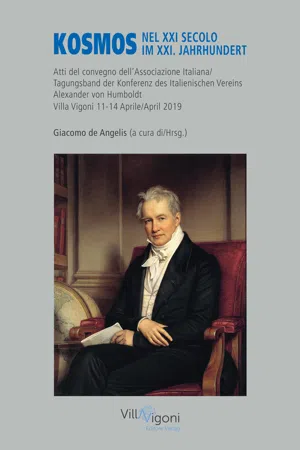
eBook - ePub
KOSMOS IM XXI. JAHRHUNDERT KOSMOS NEL XXI SECOLO
Atti del convegno dell'Associazione Italiana/ Tagungsband der Konferenz des Italienischen Vereins Alexander von Humboldt Villa Vigoni 11-14 Aprile/April 2019
- 264 pages
- English
- ePUB (mobile friendly)
- Available on iOS & Android
eBook - ePub
KOSMOS IM XXI. JAHRHUNDERT KOSMOS NEL XXI SECOLO
Atti del convegno dell'Associazione Italiana/ Tagungsband der Konferenz des Italienischen Vereins Alexander von Humboldt Villa Vigoni 11-14 Aprile/April 2019
About this book
Questo volume raccoglie gli atti del convegno nazionale dell'Associazione Italiana Alexander von Humboldt, tenutosi presso il Centro italo-tedesco per il dialogo europeo Villa Vigoni, (Loveno di Menaggio) dall'11 al 14 aprile 2019. Il convegno, dal titolo Kosmos nel XXI Secolo, dedicato alla celebrazione dei 250 anni dalla nascita di Alexander von Humboldt, si è proposto come una rivisitazione in chiave attuale dell'ultimo lavoro di Humboldt e suo testamento spirituale Kosmos – Entwurf einer physischen Weltbeschreibung. Partendo dalla immagine integrata e coerente del cosmo proposta da Humboldt, il convegno si è delineato come una vivace occasione di dibattito interdisciplinare su questioni di interesse globale e di grande attualità. Temi inerenti al fabbisogno energetico, alla biodiversità, ai viaggi, alla comunicazione, alle migrazioni, alla poesia, alla storia
e alla geografia sono stati affrontati con interesse e spirito costruttivo tra discipline scientifiche e umanistiche nel suggestivo contesto di Villa Vigoni e del lago di Como. Il convegno, sostenuto dalla fondazione tedesca Alexander von Humboldt, è stato aperto e concluso dai rappresentanti istituzionali della Repubblica Federale di Germania ed ha avuto una ampia partecipazione nazionale ed internazionale.
Dieser Sammelband enthält die Beiträge zur nationalen Konferenz der italienischen Alexander von Humboldt Gesellschaft, die vom 11. bis 14. April 2019 im Deutsch-Italienischen Zentrum für Europäischen Dialog Villa Vigoni in Loveno di Menaggio (Como) stattfand. Die Konferenz mit dem Titel Kosmos im XXI. Jahrhundert widmete sich der 250 Jahr-Feier des Geburtstags Alexander von Humboldts und bot somit einen aktuellen Blick auf Humboldts letztes Werk und sein geistiges Erbe: Kosmos – Entwurf einer physischen Weltbeschreibung. Ausgehend von Humboldts Bild des Kosmos, bot die Konferenz eine lebendige Gelegenheit für eine interdisziplinäre Debatte über Fragen von globalem und aktuellem Interesse. Fragen der Energienachfrage, Biodiversität, Reisen, Kommunikation und Migration, Poesie und Geschichte sowie Geographie wurden behandelt und in
einem interessanten und konstruktiven Vergleich zwischen den Disziplinen im wissenschaftlich und humanistisch Kontext von Villa Vigoni diskutiert. Die Konferenz, unterstützt von der Alexander von Humboldt Stiftung, wurde von den institutionellen Vertretern der Bundesrepublik Deutschland eröffnet und hatte eine große nationale sowie internationale Beteiligung.
Information
Topic
Ciencias biológicasSubtopic
BiologíaA very special Humboldtian, or Darwin on the quantity and variety of life
Antonello La Vergata
1. Prologue: Darwin the Humboldtian
Charles Darwin admired “the illustrious Humboldt”. As a young man in Cambridge, he wrote to his sister Caroline on 28 April 1831: “All the while I am writing now my head is running about the Tropics; in the morning I go and gaze at Palm trees in the hot-house and come home and read Humboldt: my enthusiasm is so great that I cannot hardly [sic] sit still on my chair” (Darwin 1985–: vol. 1, p. 122). He considered Humboldt “the greatest scientific traveller who ever lived”, and he was fascinated by his “glorious descriptions” and “glowing accounts of tropical scenery”, and the “rare union of poetry with science which he so strongly displays when writing on tropical scenery”. Humboldt’s Personal Narrative of Travels to the Equinoctial Regions of the New Continent, during the Years 1799-1804 (1814-1829)26 was one of the works that most influenced him: it “stirred up in me a burning zeal to add even the most humble contribution to the noble structure of Natural Science” (Barlow ed. 1958: 67-68). “I never forget that my whole course of life is due to having read & re-read as a Youth his Personal Narrative”27. He had with him on the Beagle a copy of the 1822 English translation of volumes 1 and 2, combined in one volume, a present by his professor of botany at Cambridge, John Stevens Henslow, “to his friend C. Darwin on his departure from England upon a voyage around the World 21 Sept.r 1831”. Believe it or not, he went so far as saying that “nothing could be better adapted for cheering the heart of a sea-sick man” (Darwin 2001: 18, 24, 42). He took the book up and annotated it even in his mature life28. It is no exaggeration to say that he saw tropical nature through Humboldt’s eyes29. While at Bahia, he wrote in his diary on 28 February 1832: “I am at present fit only to read Humboldt; he like another sun illumines everything I behold” (Darwin 2001: 42). And in a letter to Henslow from Rio de Janeiro on 18 May 1832: “Here I first saw a Tropical forest in all its sublime grandeur […] I formerly admired Humboldt, I now almost adore him; he alone gives any notion of the feelings which are raised in the mind on first entering the Tropics” (Darwin 1985–: vol. 1, p. 237)30.
2. Measuring and contemplating
To Humboldt, measuring and describing, analysis and synthesis were one with the aesthetic contemplation of nature, what Darwin called the “enthusiasm” of his descriptions31. Indeed, he thought that the pleasure that a “receptive mind” derives from the contemplation of nature is so great that in the preface to the first edition of his Ansichten der Natur (1808) he felt almost compelled to apologise to the reader for adding “some scientific explanations” to each of the essays contained in the book: that pleasure, he said, “is multiplied by an understanding of the intimate connection of natural forces”. In the preface to the second and third editions of the work he wrote that his purpose was “to describe nature in such a way as to convey as much as possible the pleasure of vision, while at the same time contributing, on the basis of the present state of science, to a better understanding of the harmonious whole which governs the action of natural forces”. It was a difficult task to offer “an aesthetic treatment of the great sceneries of nature”, with the aim of combining “a literary purpose and a purely scientific one, the desire to ignite the imagination, while at the same time enriching the life of ideas through the growth of knowledge” (Humboldt 1987; his emphasis). But it was a necessary and rewarding task, and Humboldt pursued it throghout his life, including in his studies on apparently dreary subjects. Plant geography, for instance, considered vegetables “sous leurs rapports d’association locale dans les différents climats”. But it did not resctrict itself to this:
[Elle] ne range pas seulement les végétaux selon les zones et les hauteurs différentes auxquelles ils se trouvent; elle ne se contente pas de les considérer selon les degrés de pression atmosphérique, de température, d’humidité et de tension électrique, sous lesquels ils vivent: elle distingue parmi eux, comme parmi les animaux, deux classes qui ont une manière de vivre et, si l’on ose le dire, des habitudes très-différentes.
Les uns croissent isolés et épars […] D’autres plantes, réunies en société comme les fourmies et les abeilles, couvrent des terrains immenses, dont elles excluent toute espèce hétérogène […] Ces plantes associées sont plus communes dans les zones tempérées que sous les tropiques, dont la végétation moins uniforme est par cela même plus pittoresque. (Humboldt 1805: 14-15)
The naturalist must not be a mere classifier, for the latter “makes different groups of many plants that the student of the physiognomy of nature cannot but associate to one another”. The impression générale of an area owes its special character not only to the mass of its forms of life. Its physionomie varies with geography more than taxonomical groups do. And physionomy is a source of aesthetic inspiration.
L’homme sensible aux beautés de la nature trouve [dans la géographie des plantes] l’explication de l’influence qu’exerce l’aspect de la végétation sur le goût et l’imagination des peuples. Il se plaira à examiner en quoi consiste ce que l’on nomme le caractère de la végétation, et la variété de sensations qu’elle produit dans l’âme de celui qui la contemple. Ces considérations sont d’autant plus importantes qu’elles touchent de près aux moyens par lesquels les arts d’imitation et la poésie descriptive parviennent à agir sur nous. Le simple aspect de la nature, la vue des champs et des bois, causent une jouissance qui diffère essentiellement de l’impression que fait l’étude particulière de la structure d’un être organisé. Ici, c’est le détail qui nous intéresse et qui excite notre curiosité; là, c’est l’ensemble, ce sont des masses, qui agitent notre imagination […]
Dans la variété des végétaux qui couvrent la charpente de notre planète, on distingue sans peine quelques formes générales auxquelles se réduisent la plupart des autres, et qui présentent autant de familles ou groupes plus ou moins analogues entre eux. Je me borne à nommer quinze de ces groupes32, dont la physionomie offre une étude importante au peintre paysagiste. (ibid.: 30-31).
Furthermore, botanical geography is a privileged field for testing that most speculative exercise of scientific imagination: the origin and transformations of floras.
«C’est par le secours de la géographie des plantes que l’on peut remonter avec quelque certitude jusqu’au premier état physique du globe […]. C’est cette science qui examine si, à travers l’immense variété des formes végétales, on peut reconnoÎtre quelques formes primitives, et si la diversité des espèces doit être considérée comme l’effet d’une dégénération qui a rendu constantes, avec le temps, des variétés d’abord accidentelles.
Si j’osois tirer des conclusions générales des phénomènes que j’ai observés dans les deux hémisphères, les germes des cryptogames me paroîtraient les seuls que la nature développe spontanément dans tous les climats. (ibid., 20)
But Humboldt rejected evolution immediately. Transformations were caused by man, and they merely consisted in some forms being transported from one area to another.
L’homme inquiet et laborieux, en parcourant les diverses parties du monde, a forcé un certain nombre de végétaux d’habiter tous les climats et toutes les hauteurs; mais cet empire n’a point dénaturé leur structure primitive. La pomme de terre, cultivée au Chili à trois mille six cents mètres (1936 toises) de hauteur, porte la même fleur que celle que l’on a introduite dans les plaines de la Sibérie. L’orge qui nourrissait les chevaux d’Achille étoit sans doute le même que nous semons aujourd’hui. Les formes caractéristique des végétaux et des animaux que présente la surface actuelle du globe, ne paroissent avoir subi aucun changement depuis les époques le plus reculées. L’ibis enfoui dans le catacombes d’Égypte, cet oiseau dont l’antiquité remonte presque à celle des Pyramides, est identique avec celui qui pêche aujourd’hui sur les bords du Nile; identité qui prouve évidemment que les dépouilles des animaux fossiles que renferme le sein de la terre, n’appartiennent pas à des variétés des espèces actuelles, mais à un ordre de choses très-différent de celui sous lequel nous vivons, et trop ancien pour que nos traditions puissent y remonter33.
In Kosmos Humboldt summed up the task and results of botanical geography in the following way:
Die Fülle der Organismen, deren räumliche Vertheilung die Geographie der Pflanzen und Thiere verfolgt, wird entweder nach der Verschiedenheit und relativen Zahl der Bildungstypen, also nach der Gestaltung der vorhandenen Gattungen und Arten, oder nach der Zahl der Individuen betrachtet, welche auf einem gegebenen Flächeraume einer jeden Art bekommt. Bei den Pflanzen wie bei den Thieren ist es ein wichtiger Unterschied ihrer Lebensweise, ob sie isoliert (vereinzelt) oder gesellig lebend gefunden werden. Die Arten, welche ich gesellige Pflanzen genannt habe, bedecken einförmig große Strecken […] Diese Art der geographischen Vertheilung bestimmt, neben der individuellen Form der Pflanzengestalt, neben ihrer Größe, Blatt– und Blütenform, hauptsächlich den physiognomischen Charakter einer Gegend […]
Eine wissenschaftliche Behandlung des Gegenstandes hat erst angefangen, als man die Geographie der Pflanzen mit der Lehre von der Vertheilung der Wärme auf dem Erdkörper in innige Verbindung brachte, als man die Gewächse nach natürlichen Familien ordnen und so numerisch unterscheiden konnte, welche Formen von Aequator gegen die Pole ab- oder zunehmen, in welchem Zahlerverhältniß in verschiedenen Erdstrichen jede Familie zu den ganzen daselbst wachsenden Masse der Phanerogamen stehe. Es ist ein Glücklicher Umstand meines Lebens gewesen, daß zu der Zeit, in welcher ich mich fast ausschließend mit Botanik...
Table of contents
- Giacomo de Angelis- Prefazione/Vorwort
- Das Humboldt Kolleg
- Giacomo de Angelis - Kosmos im XXI Jahrhundert: Gruβwort
- Enno Aufderheide - Gruβwort
- Sandro M. Moraldo - Gruβwort
- Sezione natura / Sektion Natur
- Enno Aufderheide - Alexander von Humboldt: a life for science, humanity and nature
- Francesca Lupi - Energy in the deserts from wind and sun: the challenge of the solar updraft power plant technology
- Diletta Giuntini - Bioinspired supercrystalline composites: nanoscience meets materials engineering
- Ana Montaner-Pizá - Nuclear symmetries and beta decay
- Sezione terra / Sektion Erde
- Carlos Sambricio, Nuria Sanz - Humboldt-Bauzá, relación de cooperación científico-política a través del discurso geográfico
- Antonello La Vergata - A very special Humboldtian, or Darwin on the quantity and variety of life
- Sandra Rebok - “A vast field to conquer for the sciences”: The American West in Humboldt’s Kosmos
- Ignazio Becchi - Tracing the steps of Amerigo Vespucci
- Sezione cielo / Sektion Himmel
- Berta Rubio - If we could have the privilege of talking to Alexander von Humboldt today about the origin of the chemical elements in the Earth
- Pietro U. Dini - Zur kosmologischen Vorstellung bei den Prußen. Fall-studie vom Lexikon
- Siegrid Agostini - Il Traité du monde di René Descartes e il Kosmos di Alexander von Humboldt. Due modelli a confronto.
- Riccardo Ginevra - Inherited poetics and Indo-European cosmological structure in the Voluspá, the Homeric Hymn to Demeter, and the Telipinu myth
- Giulio Navarra - La cosmologia degli arabi: Alessandro di Afrodisia e il trattato Sul governo delle sfere celesti
- Sezione popoli / Sektion Völker
- Carlotta Santini - L’unità del mare e l’unità dei popoli. Modelli antropogeografici per una fenomenologia delle relazioni uomo/mare.
- Katharina Salzmann - La promozione del multilinguismo nella comunicazione accademica: considerazioni generali e proposte didattiche
- Corrado Malandrino - La visione liberale e progressista del Kosmos di Alexander von Humboldt
- Riccardo Pozzo - Cento miliardi per Orizzonte Europa, ma quale ruolo per le scienze umane e sociali?
- Sezione esplorazione / Sektion Erforschung
- Francesco Paolo Gallotta - Storia e modernità nel pensiero di Martin Heidegger
- Sotera Fornaro - Alexander von Humboldt e la Altertumswissenschaft: alcune considerazioni.
- Patrizio Malloggi - Colori tra lingua e cultura
- Tommaso Giuseppe Ferro - La nozione di ‘causa’ in Ulrico di Strasburgo
- Yaseen A. Al-Soud - Recent Applications of Triazoles in Medicinal Chemistry
- Marwan S. Mousa - Twenty two years (1997 – 2019) of Academic Cooperation, Networking and Partnership in changing communities as part of the Humboldt Kosmos
- L’associazione italiana Alexander von Humboldt: storia
- Authors
Trusted by 375,005 students
Access to over 1.5 million titles for a fair monthly price.
Study more efficiently using our study tools.
Frequently asked questions
Yes, you can cancel anytime from the Subscription tab in your account settings on the Perlego website. Your subscription will stay active until the end of your current billing period. Learn how to cancel your subscription
No, books cannot be downloaded as external files, such as PDFs, for use outside of Perlego. However, you can download books within the Perlego app for offline reading on mobile or tablet. Learn how to download books offline
Perlego offers two plans: Essential and Complete
- Essential is ideal for learners and professionals who enjoy exploring a wide range of subjects. Access the Essential Library with 800,000+ trusted titles and best-sellers across business, personal growth, and the humanities. Includes unlimited reading time and Standard Read Aloud voice.
- Complete: Perfect for advanced learners and researchers needing full, unrestricted access. Unlock 1.5M+ books across hundreds of subjects, including academic and specialized titles. The Complete Plan also includes advanced features like Premium Read Aloud and Research Assistant.
We are an online textbook subscription service, where you can get access to an entire online library for less than the price of a single book per month. With over 1.5 million books across 990+ topics, we’ve got you covered! Learn about our mission
Look out for the read-aloud symbol on your next book to see if you can listen to it. The read-aloud tool reads text aloud for you, highlighting the text as it is being read. You can pause it, speed it up and slow it down. Learn more about Read Aloud
Yes! You can use the Perlego app on both iOS and Android devices to read anytime, anywhere — even offline. Perfect for commutes or when you’re on the go.
Please note we cannot support devices running on iOS 13 and Android 7 or earlier. Learn more about using the app
Please note we cannot support devices running on iOS 13 and Android 7 or earlier. Learn more about using the app
Yes, you can access KOSMOS IM XXI. JAHRHUNDERT KOSMOS NEL XXI SECOLO by Giacomo de Angelis,Giacomo de Angelis in PDF and/or ePUB format, as well as other popular books in Ciencias biológicas & Biología. We have over 1.5 million books available in our catalogue for you to explore.