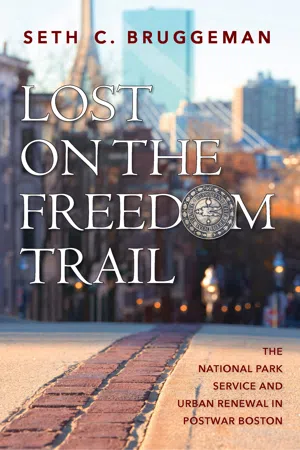
One gets the sense today, walking along the Freedom Trail, that Bostonians have always lived in quiet partnership with the past. Allusions to the American Revolution are so ubiquitous that, in some sections, little sense lingers of what happened before or after the two decades we typically associate with the nation’s founding drama. Indeed, histories of the Massachusett people, Boston’s Puritan past, its abolitionist saga, and especially the struggles of working people and generations of immigrants, all take a decided back seat to the prevailing narrative of Paul Revere and his exploits. But why is that? Boston National Historical Park is obligated by its authorizing legislation to preserve properties that are “associated with the American Revolution and the founding and growth of the United States.”1 It’s a wide-ranging mandate, but one which—with important exceptions—has invariably settled on the late eighteenth century and a few years beyond. As we will see in chapter two, the people charged during the mid-twentieth century with imagining a national park for Boston considered, albeit briefly, casting the unit’s interpretive net much wider. The park’s commitment to the Revolutionary past, therefore, is a choice, one bound up with a very particular way of remembering the American Revolution rooted in habits of memory with a history all their own.
My purpose in this chapter is to understand why it was that people came to believe in the first place that Boston needed a national historical park to safeguard its Revolutionary past. It’s a simple question, but one that requires we grapple with several other questions along the way. Why, for instance, have Bostonians so consistently chosen to favor Revolutionary memories above all others? To find out, I survey the early history of historic preservation and heritage tourism in Boston and discover that Revolutionary memory became particularly profitable there well before World War II. How, then, did the federal government end up doing history in Boston, or anyplace for that matter, during the first half of the twentieth century? This question requires that we consider dramatic changes in the National Park Service during the New Deal years. Along the way, we meet the park’s earliest protagonists—U.S. Representative John W. McCormack and NPS historian Edwin Small—and see how their formative encounter in 1938 reflected both change in the NPS and considerable resistance to change in South Boston. And finally, the question that roiled my research early on: which came first, the NPS or the Freedom Trail? Although possibilities for both in Boston emerged more or less concurrently, we’ll see that it was the trail and its progenitors that set the terms by which subsequent generations of tourists would experience Boston’s heritage landscape. This fact had everything to do with urban redevelopment and renewal at mid-century, the emergence of a so-called New Boston, and the aspirations among some to determine how and what the rest of us get to remember.
Revolutionary Memory and its Uses in Nineteenth-Century Boston
The history of remembering the Revolution, of course, long predates the first stirrings of a national park concept for Boston.2 Historians tell the story in three acts. First was a brief, though intense, period of remembering just as the war came to a close: memorial sermons and battlefield tours in Lexington and Concord; blockbuster Fourth of July celebrations in Philadelphia; the careful editing of George Washington’s wartime papers by his assistants at Mount Vernon.3 Subsequent decades, however, introduced a second phase, a period of commemorative uncertainty that reflected tensions persistent throughout the war. The American Revolution was, after all, “the first American Civil War,” a long and costly ideological conflict that pitted friends and families against one another, often in murderous violence. And for what? The first government it created succumbed in less than a decade to the radically different vision of a few elite statesmen. And clearly, given the persistence of forced labor and landed patriarchy, the ideals of liberty set forth by the founding generation had very obvious limitations. Historian Michael A. McDonnell notes that, to move past the Revolution’s problematic legacy and to build a functional nationalism, Americans set out after the war to forget its most troubling contradictions. But “forgetting,” as he puts it, “was a political project and it took time.”4 It wasn’t until the 1820s that the politics of forgetting produced something resembling a national consensus about how to remember the Revolution. But not even during this third act, as we will see, could Americans entirely ignore the fierce claims made by many that the Revolution’s legacy was incomplete.
Each of these acts played out in Boston with such vigor that it, alongside Philadelphia, may fairly claim to be a birthplace of American Revolutionary memory. It was Boston, for instance, that generated the epoch’s earliest and most durable iconography. Paul Revere’s The Bloody Massacre, Perpetrated in King-Street, Boston, on March 5th, 1770 (1770) “was almost immediately turned into a site of American cultural and national memory,” and also famously omitted the mixed-race Crispus Attucks, who later became a hero of abolitionists.5 Theatrical performances, including Mercy Otis Warren’s tribute to the massacre, Adulateur (1773), repeated Revere’s themes toward encouraging outrage against the British.6 Similarly, John Trumball’s The Death of General Warren at The Battle of Bunker Hill (1786) inspired a painterly genre all its own while, again, erasing race—Peter Salem in this case—from the nation’s memory of its founding trauma. And, of course, Charles Bulfinch built the first Revolutionary monument, a towering column, atop Beacon Hill in 1790, though it would remain there for barely two decades.7 So, although the war’s first commemorations, like the Revolution itself, showcased a variety of perspectives, some Bostonians—and others who looked to Boston for symbols of the Revolution’s legacy—had already begun to sketch out a more staid memory of white entrepreneurs and property owners in earnest struggle against the imperial excesses of a distant monarch.8
The War of 1812, and the United States’ second victory against the British, intensified the nation’s commemorative mood. Nostalgic nods to the Revolution, and particularly to George Washington, appeared high above Baltimore and deep within rural Virginia by 1815.9 Washington’s adopted grandson, George Washington Parke Custis, completed his Arlington House by 1817 and created there a veritable theme park of Revolutionary memorabilia and costumed performance.10 It was amid this acute period of Revolutionary nostalgia that Boston’s 1822 city charter, its first, included a provision tasking city council with the protection of two historic sites: Boston Common and Faneuil Hall.11 Only three years later, builders set to work on the iconic Bunker Hill Monument.12 And, amid all of it, as historian Whitney Martinko describes, a nascent interest in the adaptive reuse and rehabilitation of Boston’s oldest buildings flourished alongside a trade in print guides to the city’s historic landscape. Although historians have long looked to the 1853 restoration of Washington’s Mount Vernon in Virginia as the real beginning of the nation’s heritage industry, it is clear that Bostonians had trod the path at least a generation earlier.
This facet of Boston’s early fascination with its own past is particularly relevant to our story. It reminds us, for instance, that although Bostonians have long cherished their Revolutionary heritage, it’s not the only history they’ve valued. Consider, for instance, the city charter and its proto-preservation mandate. Although Americans may have associated Faneuil Hall primarily with the Revolution by 1822, Boston Common conjured a much deeper past hearkening back to the city’s Puritan forebears. It wasn’t the only site valued for associations beyond the Revolution. The Old Feather Store (1680) and the Province House (1679), for instance, typified other sites that, though significant for histories predating the Revolution, inspired the city’s collectors and would-be preservationists.13 And this is to say nothing, of course, of early efforts in Boston and its surrounding communities to commemorate Puritan notables including William Bradford and Cotton Mather.14 Backward-looking Bostonians could—and did—follow any of several paths into the city’s deep and rich history. One of those paths led to the Revolution; others did not.
Why then did Boston’s heritage gaze shift precipitously toward the Revolutionary past by the 1830s? It is true, as others have pointed out, that the Revolution weighed heavily on the minds of Americans after the War of 1812. Just as Americans today lament the passing of World War II veterans, vanguards of the so-called greatest generation, Americans during the 1820s valorized the lives of a vanishing generation of Revolutionary War soldiers.15 The triumphant return and nostalgic national tour of General Lafayette in 1824–25 reinforced the tendency to think of veterans, including Lafayette himself, as relics of a bygone era who might endow those near to them with special powers of retrospect.16 Interestingly, for years after the war, veterans remembered it in decidedly unglamorous terms. Soldiering was monotonous, they recalled, punctuated only occasionally by treacherous combat and more often by unprincipled recruits scavenging the countryside for wine and adventure. Pension records reveal more soldiers propelled to enlist by boredom and churlish in-laws than by conviction.17 Written accounts of the war shifted significantly, however, by the 1820s, and increasingly “featured common themes, individuals, and tropes,” many of which would become staples of modern Revolutionary memory.18 It was a shift, incidentally, that coincided too with the deaths of the Revolution’s last remaining political icons, including Thomas Jefferson (1826), John Adams (1826), and James Monroe (1831).
It was precisely that generation’s unfinished business, ironically, that intensified longing in subsequent decades for its supposed virtue. The congressional machinations required to sustain slavery in the young republic, typified by the Missouri Compromise of 1820, created anxieties everywhere and always present in the United States. Contestants on both sides of the slavery debate invoked Revolutionary forebears in their claims to republican virtue. And, increasingly, the argument against slavery issued forth from Boston. Abolitionism had, of course, been present in American political discourse since before the Revolution, but its terms had been largely defined by the staid and legalistic Quakers of the Pennsylvania Abolition Society. By the late 1820s, however, the balance had shifted to Massachusetts. Historian Richard Newman explains the change as owing, in part, to the intensity of revivalism in Massachusetts during the Second Great Awakening and a greater openness there to the grassroots politics that accompanied the presidency of Andrew Jackson.19 Also unlike their Quaker counterparts, who advocated for gradual abolition, Massachusetts abolitionists demanded immediate abolition—for which William Lloyd Garrison became the nation’s leading advocate. Garrison, by organizing abolitionist societies in Boston and headquartering his newspaper, the Liberator, there in 1831, ensured that any nostalgia for the city’s Revolutionary past would have to contend with the specter of its greatest failure.
And yet, as concerned as some Americans in the early republic may have been with the past, many were also squarely focused on the future. Boston was no exception. Reverence for Bulfinch’s monument to the Revolution, for instance, did not exceed desires to clear the view from his majestic new State House, itself a monument to the potential of American republicanism. The monument’s removal in 1811 prefigured widespread change throughout Boston’s landscape. As Martinko points out, Boston Mayor Josiah Quincy initiated a period of what we would later term “urban renewal” in the years after the 1822 charter. Key among his accomplishments was construction of Quincy Market in 1826.20 The market’s iconic Greek Revival edifice conjured the hazy grandeur of classical republicanism while imposing order on Boston’s generations-old commercial district. The market’s retro republicanism thus constituted a new way of imagining Boston’s past and future, in immediate juxtaposition with nearby Faneuil Hall, wherein Boston’s leading patriots famously excoriated British rule. Urban renewal thus put old and new into sharp contrast. In some cases, owners concerned with protecting their properties from demolition sought, amid Boston’s burgeoning cult of Revolutionary memory, to reimagine their homes as historic relics by way of advocating for their survival. These proto-preservationists, Martinko contends, perceived in urban renewal more than just a shift in aesthetics. In their eyes, renewal prompted a battle to determine which portions of the city would be public, which would remain private, and who would profit most from Boston’s new political economy.21 Simultaneously backward- and forward-looking, early concern for Boston’s historic buildings thus mingled Revolutionary memory with some of the 1820s’ leading preoccupations: power, profit, property, and party politics.
The folding of Revolutionary memory into American political culture is particularly significant for explaining why it was that Boston’s historical gaze focused increasingly on the Revolution during the 1830s. It is an argument made most famously in Alfred F. Young’s classic 1981 essay, “George Robert Twelves Hewes (1742–1840): A Boston Shoemaker and the Memory of the American Revolution,” which was reprinted in 1999 and since in The Shoemaker and the Tea Party. Young makes the point that Boston’s working people—even folks largely uninterested in ideological matters—found as great a stake in the Revolution as any of its patricians. His example is George Robert Twelves Hewes, a workaday shoemaker who participated in the Boston Tea Party and who became famous for it shortly before his death in 1840. Young shows us that Hewes, and probably the Tea Party too, would have remained unknown to us had the obscure shoemaker and his Revolutionary memories not been repurposed during the 1830s by an affiliation of Whig politicians in their campaign against labor activists, abolitionists, and others who struggled to make real the promises of American liberty. As Young puts it, “Hewes was taken over by such conservatives [who] tamed him, sanitizing him and the audacious popular movement he had been a part of.”22
Boston’s fascination with the Revolutionary past, above all other pasts, thus stemmed from its political expediency during an era of radical change, when it fell to a new generation of leaders to sort out the aspirations of their predecessors. That new generation was anything but unified, but because the Revolution’s legacy was so ambiguous, its memory could be populated with no end of contradictory meanings. At one end of the spectrum, as Young shows us, Whig politicians managed to transform war veterans into symbolic endorsements of an economic system that bred inequality. At the other end, Boston’s abolitionists pitched Revolutionary memory in support of their efforts to ensure equality for all Americans.23 In the years preceding the American Civil War, the contest between these two distinct visions raged within the walls of Revolutionary Boston’s most iconic building: Faneuil Hall. Beginning in 1837, when abolitionist Wendell Phillips scathingly criticized Massachusetts Attorney General James T....