In this powerful new book, James Rickabaugh, former superintendent and current director of the Institute for Personalized Learning (IPL), presents the groundbreaking results of the Institute's half-decade of research, development, and practice: a simple but powerful model for personalizing students' learning experiences by building their levels of commitment, ownership, and independence. Tried and rigorously tested in urban, suburban, and rural districts--and in different academic and economic settings--the IPL model has been proven to enhance student engagement and achievement at all levels. Rickabaugh provides principals and other top-level leaders with * Step-by-step guidance for implementing the model;
* A detailed overview of the research and work behind the model's development;
* A complete introduction to the heart of the model—a comprehensive, multi-layered framework centered on the three core components of learner profiles, customized learning paths, and proficiency-based progress;
* Tools and activities for assessing and adjusting the model to meet the specific needs of students and staff;
* Strategies for increasing and reinforcing enthusiasm for the change process among everyone involved, from the classroom to the greater community; and
* An abundance of real-life examples and reflections from students, teachers, principals, and superintendents whose schools have flourished in record time and with minimal additional funding or resources. Tapping the Power of Personalized Learning offers a blueprint that dramatically improves student outcomes and prepares today's learners to meet life's challenges in college and beyond.
- 148 pages
- English
- ePUB (mobile friendly)
- Available on iOS & Android
eBook - ePub
About this book
Information
Topic
EducationSubtopic
Education GeneralChapter 1
Assumptions, Logic, and Levers: Changing Practices
. . . . . . . . . . . . . . . . . . . .
As we continued to push new models, it was clear that everybody had an assumption about school: teachers, parents, principals, and students. These assumptions were so powerful that any changes were always met with a need for assurance that things would be "better." This was the very moment that became the tipping point. I asked just one question: "Can you tell me about a time where you were part of an effective learning experience?" First of all, everyone had a story, but even more importantly, everybody could articulate a powerful personalized learning experience.
—Ryan Krohn, assistant superintendent for curriculum and instruction/education accountability, School District of Waukesha, Wisconsin
It's funny how change can sneak up on you in unexpected ways. Our partnership with the Institute for Personalized Learning opened a door that allowed us to dream big—to rethink education as we had experienced it up to this point. We could overhaul our teaching strategies and the environment in which we support students. We were able to take the ceiling off of our teaching and reach our students in ways we never had before.
With administrative support to try new things, we have been able to take risks with our instruction and with our students. We are now free to "fail forward." The power has now shifted from us being the sole deliverers of instruction, to our students giving voice to what that instruction will look like. They are now copilots in our learning journey. The results have been more than we could have expected: Our students are engaged, we are engaged, and the things that our students know and do truly show that they are on the road to being strong 21st century learners.
Now that year 2 of our personalized learning journey is coming to a close, we cannot imagine teaching any other way. We are invigorated. We are passionate. We are continually looking for ways to improve—not for us, but for the greater good of our students.
—Kate Sommerville & Angela Patterson, 5th grade teachers, Swanson Elementary School, Elmbrook School District, Wisconsin
Three hundred years ago, if you were ill and visited a physician, you might have expected to have your blood drawn, but not to be tested—to actually treat your illness. Today we know that bloodletting probably contributed to the deaths of many patients and made many others more susceptible to illness and disease.
Although we might look back now and scoff, bloodletting was based on commonly held assumptions about the best ways to treat illnesses and was considered among the best medical practices of its day. In fact, much research was conducted to determine the conditions under which it should be applied and what other medical procedures might complement it.
Interestingly, there were physicians and researchers even then who questioned the efficacy of bloodletting. Still, the practice continued because it was generally assumed to be the right thing to do. It was only when the medical community discovered the true causes of illnesses and began to apply more effective procedures that bloodletting fell into broad disfavor. It was never entirely abandoned, however: the practice is actually still being used today to treat certain blood-related ailments. The difference is that assumptions underlying its use are now much more sound, making it a very specifically targeted procedure (Greenstone, 2010).
So, what does bloodletting have to do with our practices in education today? It is disheartening to think of the number of school practices that are still supported, reinforced, and even expanded despite having consistently failed a large portion of learners. In many instances, these practices may have been suited to the context and purposes of education when they were first employed over a century ago. But today, when virtually all learners are expected to achieve at high levels, they are inadequate. Like bloodletting, some traditional practices may be effective under specific, limited conditions—and that's all.
The Power of Assumptions
Assumptions, of course, are what we believe to be true. Whether we're conscious of them or not, the assumptions we hold can play a crucial role in how we form our perceptions and develop our beliefs. When our assumptions are correct, they help us to focus on actionable options rather than become distracted by impractical and unworkable solutions. When they are not correct, they confine us to a narrow set of possibilities and prevent us from charting new courses, practicing new behaviors, or setting new goals.
The world has changed enormously since certain existing assumptions about education first took root. For example, there was a time when we could afford to educate only a select few learners at high levels and allow the rest to leave school with relatively low skills, knowing that the lower-skilled workers could still secure jobs that ensured a middle-class lifestyle. Today, most of those jobs are either automated or outsourced abroad. Our current economy requires an ever-growing portion of each graduating class to fill increasingly skilled and complex work roles, yet our schools operate in ways designed to serve an economy that existed 50 or even 100 years ago. Today we know much more about brain development and how people learn, yet we continue to manage schools as though more effort and accountability alone will somehow bridge performance gaps.
When redesigning a school system, we must first examine the assumptions upon which the current system rests and abandon those that are misguided. For example, consider the following assumptions about common school practices:
- Practice: Grouping learners by age and moving them through the system in batches. Assumption: Students learn at the same rate and are ready for new learning at the same time as others born in the same year.Fact: Each student learns at his or her own pace based on level of interest, learning history, maturity, and background knowledge.What if…we gave students the support they needed to learn at a pace dictated by their individual readiness rather than by their ages?
- Practice: Using the same instructional approaches for entire groups of learners. Assumption: Ability to keep pace with the class and learn from a set of standard instructional strategies is a good measure of learning aptitude.Fact: Not all students learn in the same ways, and teaching them as though they did makes it inevitable that some will be held back when they're ready to move forward while others will struggle to keep up.What if…we gave students the time they needed to learn and the support necessary to learn in the ways that best fit them?
- Practice: Waiting for learners to fail repeatedly before providing "remediation." Assumption: Failure is inevitable for some, and learners who fail need to be "fixed."Fact: We don't have to wait for students to fail repeatedly before adjusting instruction to their learning needs, and "fixing" should begin with the instructional strategies.What if … students were able to learn the way they learn best from the beginning and could receive the support they need in real time, as they're struggling?
- Practice: Attempting to capture learning performance and progress through credits and letter grades. Assumption: It isn't necessary to be specific when reporting what students have learned; a general indication of what the educator judges as unsatisfactory, satisfactory, or exemplary is enough.Fact: Credits and grades tell us little about the nature and level of current student learning. At best, credits are general indicators of progress, and grades are too often contaminated by factors unrelated to learning.What if…learners had access to immediate feedback and were able to track their progress against standards in detail and in real time, all of the time?
- Practice: Using a system of rewards and sanctions to control student behavior. Assumption: Students will not choose to learn without either the promise of rewards or the threat of sanctions.Fact: Students show us constantly that they will choose to learn what they see as relevant, purposeful, interesting, and challenging. We only need to watch learners who appear bored and disconnected at school engage in social media, video games, and extracurricular activities to see that they can be motivated to commit deeply. Further, when we send learners the message that we don't believe they will choose to learn without external motivators in place, we communicate that the learning isn't worthwhile on its own.What if…the incentives and supports we offered to students were designed to develop self-regulatory skills and an internally driven commitment to learn?
- Practice: Administering standardized tests and assessments that focus almost exclusively on content knowledge. Assumption: Knowing names, dates, places, sequences, and formulas is enough.Fact: It isn't enough to define learning as simply memorization and recall of information. Technology has made memorization less necessary than it used to be, and much of what we might ask learners to memorize today may no longer be relevant or even accurate in the future. Further, when we allocate significant portions of learning time to low-level activities such as memorization and recall, we waste time that students could dedicate to building skills and learning capacity. These are competencies that will serve learners well in situations where problems are not neatly defined and challenges demand deeper understanding and creative, flexible approaches.What if…learning and teaching were focused on building the learning skills and capacity necessary to thrive in a rapidly changing future, with specific content serving to provide context for learning application?
The Logic of Personalized Learning
We know that learning begins with attention. Unless we are able to find relevance and draw connections, we are bound to let opportunities for learning pass us by. Sinatra (2000) describes the learning process as autonomous, active, and self-constructed. Every day, we encounter innumerable stimuli that have the potential to result in learning. Because it is impossible to take in everything, we learn to pay attention to the stimuli that seem to hold meaning or relevance for us. This dynamic has important implications for the work of stimulating and nurturing learning in schools.
The traditional, "industrial" model of learning was designed to provide substantially the same learning stimuli to everyone in the class at the same time. Some learners would find a reason to pay attention—due to personal interest, perhaps, or because they wanted to please the teacher, or maybe because they knew they needed to do well to be allowed on the football team—and others wouldn't. Such an outcome may have been acceptable in an era when most students were destined for traditional factory jobs, but today we need an educational system capable of supplying all students with a strong academic foundation. Our society requires citizens who can adapt to rapidly changing environments, think creatively, and critically analyze problems. Rather than a one-size-fits-all approach, we need an educational system built on the understanding that all learning is personal and with the flexibility to engage learners where they are rather than where the lesson, curriculum, or pacing chart assumes they should be.
Unless students are open and ready to learn, they aren't likely to do it. The school leader's challenge is to support educators as they create the conditions for individual learners to notice, engage with, and learn new content and skills. We can no longer be satisfied simply with sowing information like a farmer and hoping that the seeds of knowledge will take hold. We must actively ensure that students make frequent connections when learning and engage deeply as they learn. Unless we understand and accept the logic of this premise, there is no compelling reason to personalize the learning experience (see Figure 1.1).
Figure 1.1 Personalized Learning Logic Model
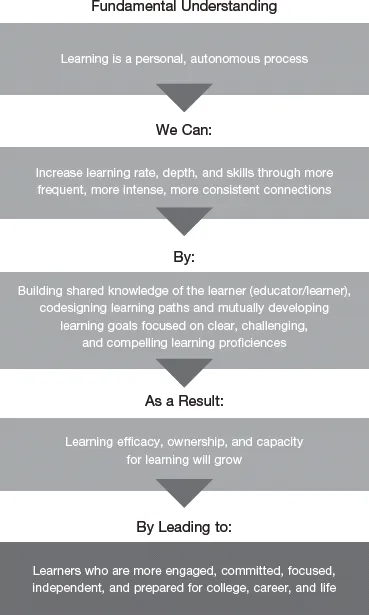
By increasing the frequency, intensity, and consistency of the connections students form with content, knowledge, and skills while also minimizing irrelevant stimuli, educators can have a dramatic effect on student learning. The intensity of the learning experience will be determined by students' levels of psychological readiness and emotional states, just as consistency in making connections will be determined by their levels of readiness, pace, and existing skills. When measuring student progress, we must do so against clear, compelling, and worthy proficiencies. Students will have little reason to commit unless the learning is challenging, purposeful, and ultimately useful. Given that learning starts with the learner, any connections that students make will be based on their experiences, interests, goals, and needs. The first thing we as educators must do to nurture these personalized connections is to really know our learners. Only then are we in a position to share knowledge and understanding with them.
Employing the Right Levers
Though there have been myriad changes to our education system over the years—increased accountability, calendar and schedule changes, school choice, merit pay, ability grouping, smaller schools, increased testing, higher standards—few have resulted in improved outcomes for all learners (Payne, 2008). Decades of efforts have failed to meet the needs of our society. We deserve a system with the capacity to address current and emerging aspects of learning such as flexible thinking, systems awareness, and effective problem framing that are increasingly necessary for success in the world at large.
The good news is that we are beginning to understand just why previous approaches haven't worked and what we might do to change the situation. Recently, my colleague Tony Frontier and I completed a review of over 40 years of research on school improvement initiatives and created a simple framework to determine the potential efficacy of efforts to improve learning (Frontier & Rickabaugh, 2014). Our framework identifies the following five levers for change to which policymakers and educational leaders typically have access when trying to make system improvements:
- Structures: Organizational options, tools, and logistics
- Samples: Student grouping options
- Standards: Expectations and progress benchmarks
- Strategies: Interactions that produce learning
- Self: Student and teacher beliefs about learning and their roles in learning
Each of these five Ss holds varying levels of promise for supporting significant and sustainable improvements in learning. Interestingly, the levers most often employed by legislators, policymakers, and even some educational leaders are those with the least potential to affect student learning.
Lever 1: Structures. This lever refers to the mani...
Table of contents
- Cover
- Title Page
- Table of Contents
- Preface
- Introduction: Imagine Schools Where …
- Chapter 1. Assumptions, Logic, and Levers: Changing Practices
- Chapter 2. The Honeycomb Model
- Chapter 3. Personalized Learning from the Students' Perspective
- Chapter 4. The Five Key Instructional Shifts of Personalized Learning
- Chapter 5. Building Educator Capacity: Personalized Professional Development
- Chapter 6. Secrets to Scaling and Sustaining Transformation
- Appendix A: An Action Plan for Implementation
- Appendix B: Sample Design Principles
- Appendix C: Personalized Learning Skill Sets for Educators
- References
- About the Author
- Copyright
Trusted by 375,005 students
Access to over 1.5 million titles for a fair monthly price.
Study more efficiently using our study tools.
Frequently asked questions
Yes, you can cancel anytime from the Subscription tab in your account settings on the Perlego website. Your subscription will stay active until the end of your current billing period. Learn how to cancel your subscription
No, books cannot be downloaded as external files, such as PDFs, for use outside of Perlego. However, you can download books within the Perlego app for offline reading on mobile or tablet. Learn how to download books offline
Perlego offers two plans: Essential and Complete
- Essential is ideal for learners and professionals who enjoy exploring a wide range of subjects. Access the Essential Library with 800,000+ trusted titles and best-sellers across business, personal growth, and the humanities. Includes unlimited reading time and Standard Read Aloud voice.
- Complete: Perfect for advanced learners and researchers needing full, unrestricted access. Unlock 1.5M+ books across hundreds of subjects, including academic and specialized titles. The Complete Plan also includes advanced features like Premium Read Aloud and Research Assistant.
We are an online textbook subscription service, where you can get access to an entire online library for less than the price of a single book per month. With over 1.5 million books across 990+ topics, we’ve got you covered! Learn about our mission
Look out for the read-aloud symbol on your next book to see if you can listen to it. The read-aloud tool reads text aloud for you, highlighting the text as it is being read. You can pause it, speed it up and slow it down. Learn more about Read Aloud
Yes! You can use the Perlego app on both iOS and Android devices to read anytime, anywhere — even offline. Perfect for commutes or when you’re on the go.
Please note we cannot support devices running on iOS 13 and Android 7 or earlier. Learn more about using the app
Please note we cannot support devices running on iOS 13 and Android 7 or earlier. Learn more about using the app
Yes, you can access Tapping the Power of Personalized Learning by James Rickabaugh in PDF and/or ePUB format, as well as other popular books in Education & Education General. We have over 1.5 million books available in our catalogue for you to explore.