This e-book collection of articles from Educational Leadership provides a compelling look at what it means to truly open students to learning--heart, mind, body, and soul. The articles describe how to impart relevance, respect, and reward while also teaching traditional and not-so-traditional curriculum subjects. They span all grade levels and subjects and offer both inspiration and practical advice.
eBook - ePub
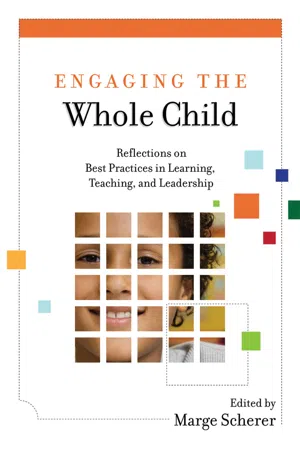
Engaging the Whole Child: Reflections on Best Practices in Learning, Teaching, and Leadership
Reflections on Best Practices in Learning, Teaching, and Leadership
- English
- ePUB (mobile friendly)
- Available on iOS & Android
eBook - ePub
Engaging the Whole Child: Reflections on Best Practices in Learning, Teaching, and Leadership
Reflections on Best Practices in Learning, Teaching, and Leadership
About this book
Information
Topic
EducationSubtopic
Education GeneralJoy in School
Joyful learning can flourish in school—if you give joy a chance.
Two quotes about schooling particularly resonate with me. The first is from John Dewey's Experience and Education (1938): "What avail is it to win prescribed amounts of information about geography and history, to win the ability to read and write, if in the process the individual loses his own soul?" (p. 49). If the experience of "doing school" destroys children's spirit to learn, their sense of wonder, their curiosity about the world, and their willingness to care for the human condition, have we succeeded as educators, no matter how well our students do on standardized tests?
The second quote comes from John Goodlad's A Place Called School (1984). After finding an "extraordinary sameness" in our schools, Goodlad wrote, "Boredom is a disease of epidemic proportions. … Why are our schools not places of joy?" (p. 242). Now, a generation later, if you were to ask students for a list of adjectives that describe school, I doubt that joyful would make the list. The hearts and minds of children and young adults are wide open to the wonders of learning and the fascinating complexities of life. But school still manages to turn that into a joyless experience.
So what can schools and teachers do to bring some joy into children's formal education? Children typically spend from six to seven hours each day in school for nearly 10 months each year. During the school year, children generally spend more time interacting with their teachers than with their parents. What happens inside schools has a deep and lasting effect on the mind-sets that children develop toward lifelong learning.
Dewey's point about the destructive power of our schools should make us ask ourselves some fundamental questions: What is the purpose of school? What dispositions about learning, reading, school, the world, and the self do we want to cultivate? Ask young adults why they go to school. You will hear nothing about joy.
I am not using the word joy as a synonym for fun. For many children, having fun is hanging out at the mall, watching TV, text-messaging their friends, or zipping down a roller-coaster. Having fun certainly brings us joy, but students don't need to be having fun in school to experience joy. According to my Random House dictionary, joy means, "The emotion of great delight or happiness caused by something good or satisfying." Surely our schools can do some of that. Joy and learning—including school content—are not mutually exclusive. Many of our greatest joys in life are related to our learning. Unfortunately, most of that joyful learning takes place outside school.
As educators, we have the responsibility to educate and inspire the whole child—mind, heart, and soul. By focusing on the following essentials, we can put more joy into students' experience of going to school and get more joy out of working inside one.
JOY 1: Find the Pleasure in Learning
Why do people learn? I don't mean inside school—I mean learning as a part of life. Surely a large part of our learning is necessary for survival and a basic quality of life.
But there is another, entirely different, reason to learn. Learning gives us pleasure. This kind of learning is often (but not always) motivated from within, and no outside forces or coercions are needed. We also don't mind the possible difficulties in this learning. We often expect the challenges we encounter; we tend to see them as a natural part of the learning process, so we are far more open to taking risks. Some love to learn about cars, others love to learn about history, and some find great joy in learning how to dance. According to Mihaly Csikszentmihalyi (1990), such learning is an example of flow, which he defines as
the state in which people are so involved in an activity that nothing else seems to matter; the experience itself is so enjoyable that people will do it at even great cost, for the sheer sake of doing it. (p. 4)
If we want students to experience more flow in school—if we want them to see school and learning as joyful—we need to rethink how and what we teach. No longer can schooling be primarily about creating workers and test takers, but rather about nurturing human beings (Wolk, 2007). By helping students find the pleasure in learning, we can make that learning infinitely more successful.
JOY 2: Give Students Choice
Outside of school, children are free to pursue their interests, and they do so with gusto. They learn how to play baseball or the drums; they learn how to ice skate or play video games; they read comic books, graphic novels, skateboard magazines, and Harry Potter.
But during a typical six-hour school day, how much ownership do students have of their learning? Practically none. It's not surprising that their interest in learning dissipates and that teachers complain of unmotivated students.
Joy in learning usually requires some ownership on the part of the learner. Students can own some of their school learning in several ways. They can choose the books they want to read through independent reading. In writing workshop, we can inspire them to be real writers and choose for themselves what genres to write in. During units in math, science, art, and social studies, they can choose specific subtopics to study; then, as "experts," they can share their learning with the class. Students can also choose which products they want to create to demonstrate their learning. What brings more joy—studying the civil rights movement in the United States through a textbook and lectures or creating comic books, writing and performing plays, interviewing people to create podcasts, and proposing your own ideas? Which would you rather do?
I advocate giving students one hour each day to study topics of their choice in what I call "Exploratory" (Wolk, 2001). In Exploratory, teachers collaborate with students to help shape student-initiated ideas into purposeful, inquiry-based investigations. During this time, students are scattered around the room, absorbed in an endless variety of topics that matter to them. While one student is studying the life of ants, a second is researching the workings of the FBI, and a third is exploring the life of Frida Kahlo. While two students work together to investigate the history of soccer, another is engrossed in surveying adults on their opinions of video games. Exploratory can teach students that school can be a place that nurtures curiosity, inspires them to ask questions, and helps them find the joy in learning.
JOY 3: Let Students Create Things
People like to make stuff. Having control of our work and using our minds and hands to create something original give us a tremendous sense of agency. There is a special pride in bringing an original idea to fruition. It empowers us and encourages us; it helps us appreciate the demanding process of creating something from nothing.
The list of what students can create across the curriculum is virtually limitless: newspapers and magazines, brochures, stories, picture books, posters, murals, Web sites, podcasts, PowerPoint presentations, interviews, oral histories, models, diagrams, blueprints and floor plans, plays and role-plays, mock trials, photographs, paintings, songs, surveys, graphs, documentary videos—the list goes on and on. At its best, school should help and inspire students to bring their own ideas and creations to life.
JOY 4: Show Off Student Work
Our schools and classrooms should be brimming with wonderful, original student work. School spaces that are devoid of student work perpetuate a sterile and joyless environment. I tell my teacher education students that the walls of their classrooms should speak to people; they should say exactly what goes on in that space throughout the school day. I can tell what teachers value by simply walking into their classrooms and looking at the walls.
The same is true for a school building. My son, Max, is in 4th grade, and his school, Augustus H. Burley School in Chicago, is a joyous place to visit. The hallways and classrooms are filled with remarkable student work, and there is rarely a worksheet in sight. The teachers also show off the students themselves. There are photographs of students next to their favorite books, above their posted work from writing workshop, and next to the doors of some classrooms.
JOY 5: Take Time to Tinker
Gever Tulley has started a unique summer school in California called the Tinkering School. His blog describes it this way:
The Tinkering School offers an exploratory curriculum designed to help kids—ages 7 to 17—learn how to build things. By providing a collaborative environment in which to explore basic and advanced building techniques and principles, we strive to create a school where we all learn by fooling around. All activities are hands-on, supervised, and at least partly improvisational. Grand schemes, wild ideas, crazy notions, and intuitive leaps of imagination are, of course, encouraged and fertilized. (Tulley, 2005)
At Tinkering School, students are allowed to dream. They come up with their own ideas for an object, and the faculty and staff help them sketch, design, and build it. When have you seen a public school that encouraged students to come up with "grand schemes, wild ideas, crazy notions, and intuitive leaps of imagination"? In fact, schools actually work to prevent this from happening.
Our school days are too planned, leaving no room for spontaneity and happenstance. Kindergarten is the last refuge in school for letting kids tinker. Once they enter 1st grade, students must banish the joy of "fooling around" with objects and ideas and, instead, sit at their desks most of the day listening to lectures, reading textbooks, and filling out worksheets.
Sometimes the best ideas come from tinkering—and teachers, not just students, should be doing more of it. We must push beyond the teacher-proof curriculum the textbook industry has created, which tries to plan every subject for every hour of the day. Far from being think tanks or workshops, our schools continue to be assembly lines. We need to free teachers to take risks, experiment, play with the art of pedagogy, and feel the joy that comes from tinkering with their teaching.
JOY 6: Make School Spaces Inviting
Why do classrooms need to look so much like, well, classrooms, with desks in rows or arranged in groups, with a chalkboard or whiteboard at the front? When I walk into a classroom in my son's school, I usually see a space that looks a lot like a family room. There's a large rug, a class library with the best in children's and young adult literature, bean bags, couches, comfortable chairs, pillows, colorful curtains, fabric hung over the ceiling lights, and lamps scattered about the classroom. In fact, sometimes the ceiling lights are off, and the lamps warmly light the room.
And what about the public spaces inside and outside the school—the hallways, foyers, meeting areas, and school grounds? Anyone who has spent time at a university knows how integral these spaces are to the learning and social dynamics of the campus. The same can be true for a school. Why not transform these often unused and sterile spots into places for small groups of students to work or cozy nooks for kids to read or write? How about filling a foyer with plants and flowers? Why not give a large wall to the students to create and paint a mural? One colorful mural can transform a barren hallway or entrance into a vibrant and joyful sight. And schools can turn outdoor spaces into gardens, sculpture parks, walking paths, and quiet reading areas.
JOY 7: Get Outside
I am bewildered by how much time students spend inside schools. I don't mean that the school day should be shorter; I mean that more of the school day should be outside. We adults know all too well how much we like to get outside for a respite during the workday, and the same applies to students and teachers in school. They need a break from being confined inside a classroom all day. Fresh air, trees, and a sunny day can do miracles for the human spirit.
Interacting with nature brings a unique joy. Gavin Pretor-Pinney (2006) writes, "I have always loved looking at clouds. Nothing in nature rivals their variety and drama; nothing matches their sublime, ephemeral beauty" (p. 9). Naturalist and artist David Carroll (2004) describes his childhood enthrallment of seeking out turtles as he walked the ponds and marshes:
The sheer joy of being there, of simply bearing witness, continued to be paramount. I went out neither to heal my heartbreaks nor to celebrate my happiness, but to be in nature and outside myself. Turtles, spotted turtles most significantly, were a living text moving upon an endless turning of the pages of the natural world. (p. 27)
The easiest way to get students outside is simply to have recess. There is a special joy in standing amidst the students as they burst from the school and spread out like a swarm of hungry ants. Kids say that recess is their favorite time in school. Recess was also one of my favorite times of the day as a teacher because I was outside and surrounded by children having fun. Tragically, recess has become a rare sight, which may say more about our schools today than anything else. Why do so many schools find it so difficult to allow children 20 minutes each day to play?
As a teacher, I would often take my students outside to read, write, or have a class meeting. It is delightful for a student to sit under a tree and read or for a class to sit in a circle on the grass and talk. Much of our science curriculums could directly include the outdoors. A school does not have to be near a forest or the ocean for students and teachers to explore nature. Ecosystems are all around us. Have students dig a hole in a patch of dirt, and they will witness the flourishing life in the soil beneath their feet. Don't underestimate the power of sheer joy that children—and adults—can experience from tipping over a large rock and seeing the ground teeming with life.
JOY 8: Read Good Books
Everyone loves a good story. We all know that if you have a 5-year-old sitting on your lap and a good book in your hands, you will soon experience the magic of stories. And what amazing stories there are! We are living in an astonishing time of children's and young adult literature. Immerse students in a culture of good books, and you surround them with joy.
For the past few years, I've been working on a grant with a Chicago public school, in part to help teachers make literature an important feature of their classrooms. I have brought loads of good books into the school. As I did book talks in 4th and 8th grade classrooms about dozens of new titles we ordered, the room was abuzz with students who could not wait to get their hands on the books. When I walk into a classroom now, I am met with the excited voices of the students telling me what books they're reading.
Of course, if we want joy in schools, then sometimes students should read books that aren't so "serious." I believe that books with important themes can make a better world, but we must also sometimes allow—even encourage—students to experience books for sheer pleasure. Have 3rd graders read Dav Pilkey's Captain Underpants and the Perilous Plot of Professor Poopypants (Scholastic, 2000). Have 5th graders read Jeff Kinney's Diary of a Wimpy Kid (Amulet, 2007). Have young adults read Sherman Alexie's very funny (and serious) The Absolutely True Diary of a Part-Time Indian (Little Brown, 2007). Encourage students to read thrillers; romance novels; action-adventure books; stories about sports, animals, and pop culture; graphic novels and manga; and nonfiction on topics they love. You will see plenty of joy.
JOY 9: Offer More Gym and Arts Classes
In recent years, with our zeal for increasing test scores, "specials" in school have become nearly as rare as recess. It is not uncommon, especially in more impoverished schools, for students to have no art, music, and drama at all, and gym only once or twice a week. In my son's previous school in Chicago, he did not have gym until January.
With his work on multiple intelligences, Howard Gardner has helped us better appreciate the uniqueness of children and has spoken to the need to give students opportunities to use their varied strengths and interests in school. For the legions of children who have a special affinity for the visual arts, theater, music, or sports, classes in these subjects are golden times for them to experience joy in school. But how much joy can they experience when it's limited to 45 minutes each week?
JOY 10: Transform Assessment
When I was a kid, I dreaded report card time. When I was a teacher, many of my students were anxious about their grades. For far too many students, assessment in its dominant forms—tests, quizzes, letter grades, number grades, and standardized tests—is a dark cloud that never seems to leave. Must it be this way?
The idea of assessment in school is not inherently bad; children assess themselves all the time. When they're busy doing something they love outside school, such as tae kwon do, baking, or playing the saxophone—when they're experiencing flow—they don't mind assessment at all. In fact, they see it as an important part of the process. But for most students, assessment in school is the enemy.
We can, however, make it a more positive experience. We need to help students understand the value of assessment. We also need to rethink "failure." Our schools see failure as a bad thing. But adults know that failure is a vital part of learning. Portraying failure as a bad thing teaches a child to avoid risk taking and bold ideas. Imagine if we graded toddlers on their walking skills. We would be living in a nation of crawlers.
We should limit how we use quantitative assessments and make more us...
Table of contents
- Cover
- Table of Contents
- Foreword
- Introduction: Inviting Students to Learn
- Part 1. Engaging the Whole Child: Heart, Mind, and Soul
- Joy in School
- The Moral North Star
- Teaching as Jazz
- Engaging Students Around the Globe
- Part 2. Inspiring Trust and Confidence
- Cultivating Optimism in the Classroom
- The Teacher as Warm Demander
- Conversations That Matter
- Help Us Care Enough to Learn
- The Wounded Student
- Part 3. Deepening Students' Thinking
- All Our Students Thinking
- Balance in the Balance
- Energizing Learning
- Of Whales and Wonder
- Learning in Depth
- Clash! The World of Debate
- Part 4. Instilling the Desire to Achieve
- Students at Bat
- Feedback That Fits
- Springing into Active Learning
- They Can Because They Think They Can
- The View from Somewhere
- Part 5. Building on Student Interests
- The Music Connection
- Turning On the Lights
- A (Pod)cast of Thousands
- "You Should Read This Book!"
- Part 6. Empowering Students
- Footprints in the Digital Age
- Amplifying Student Voice
- Working with Tech-Savvy Kids
- The Power of Audience
- Part 7. Connecting with Students' Communities and Cultures
- The Violence You Don't See
- Family Partnerships That Count
- Engaging African American Males in Reading
- Connecting With Latino Learners
- Cultures in Harmony
- Life Ain't No Crystal Stair
- Study Guide
- Copyright
Trusted by 375,005 students
Access to over 1.5 million titles for a fair monthly price.
Study more efficiently using our study tools.
Frequently asked questions
Yes, you can cancel anytime from the Subscription tab in your account settings on the Perlego website. Your subscription will stay active until the end of your current billing period. Learn how to cancel your subscription
No, books cannot be downloaded as external files, such as PDFs, for use outside of Perlego. However, you can download books within the Perlego app for offline reading on mobile or tablet. Learn how to download books offline
Perlego offers two plans: Essential and Complete
- Essential is ideal for learners and professionals who enjoy exploring a wide range of subjects. Access the Essential Library with 800,000+ trusted titles and best-sellers across business, personal growth, and the humanities. Includes unlimited reading time and Standard Read Aloud voice.
- Complete: Perfect for advanced learners and researchers needing full, unrestricted access. Unlock 1.5M+ books across hundreds of subjects, including academic and specialized titles. The Complete Plan also includes advanced features like Premium Read Aloud and Research Assistant.
We are an online textbook subscription service, where you can get access to an entire online library for less than the price of a single book per month. With over 1.5 million books across 990+ topics, we’ve got you covered! Learn about our mission
Look out for the read-aloud symbol on your next book to see if you can listen to it. The read-aloud tool reads text aloud for you, highlighting the text as it is being read. You can pause it, speed it up and slow it down. Learn more about Read Aloud
Yes! You can use the Perlego app on both iOS and Android devices to read anytime, anywhere — even offline. Perfect for commutes or when you’re on the go.
Please note we cannot support devices running on iOS 13 and Android 7 or earlier. Learn more about using the app
Please note we cannot support devices running on iOS 13 and Android 7 or earlier. Learn more about using the app
Yes, you can access Engaging the Whole Child: Reflections on Best Practices in Learning, Teaching, and Leadership by Marge Scherer in PDF and/or ePUB format, as well as other popular books in Education & Education General. We have over 1.5 million books available in our catalogue for you to explore.