![]()
Part I
Transforming the Curriculum
. . . . . . . . . . . . . . . . . . . .
We are now at a point where we must educate our children in what no one knew yesterday, and prepare our schools for what no one knows yet.
—Margaret Mead
Margaret Mead, a distinguished anthropologist, made the comment above in the mid-1950s. Her perceptions were, and still are, timely. It is estimated that by the year 2020, there will be 123 million high-paying, high-skill jobs in the United States, but only 50 million Americans will be capable of filling these positions (Winfrey, 2010). The key way to prove this prediction wrong is to provide students with meaningful units of study that mirror modern learning. The chapters in Part 1 address the foundational concepts involved in transforming current curriculum to accord with modern-learning environments.
Transformational Perspectives
Chapter 1 focuses on the necessity of professional collaboration in transforming units of study and explains the use of orbits of ability and digital learning networks. This chapter also introduces the transformational matrix and its four upgrade zones.
Transformational Lenses
Chapter 2 examines curriculum design and instructional practices as they relate to upgrading units of study through the lenses of teacher roles, entry levels, entry points, 21st century clarifications, and standards connections.
Applications of Technology and Web-Based Tools
Chapter 3 discusses the authentic incorporation of technology and web-based tools in modern-learning environments and explains the purpose and use of the TECHformational matrices included in the Appendix.
The Transformation Spiral
Chapter 4 provides an overview of the transformation spiral's four phases: appraisal and brainstorming, commitment and communication, reactions and reflections, and revisions.
![]()
Chapter 1
Transformational Perspectives
. . . . . . . . . . . . . . . . . . . .
Working with you … allowed this movie to be the truest version of what it would be.
—J. J. Abrams
J. J. Abrams's observation (Jensen, 2011) about his collaboration with Steven Spielberg on their film Super 8 encapsulates what transforming curriculum involves: collaborating to create a curriculum that exceeds the originally planned version. Collaboration is not new. But in 21st century classrooms, there are new expectations for what collaborations should entail and aim toward.
Educators who design curriculum exemplify these new expectations. A curriculum map, a single unit of study, or a detailed instructional plan is the result of collaborative and collegial conversations and decision making (Hale & Dunlap, 2010). Teachers must ask hard questions based on their interpretation of standards, determination of big ideas and essential questions, and development of authentic performance tasks, all the while respecting others' thoughts and ideas, negotiating what to cut and what to keep (and why), and determining what is in students' best interests.
This chapter lays a foundation on which the next three chapters build, explaining what teachers need to do as they begin the collaborative process of upgrading curriculum one unit at a time. To create modern-learning environments, educators cannot function as if they are preparing students for 1982 (Jacobs, 2010). When teachers begin transforming curriculum, they must
- Actively seek out collaborative relationships (orbits of ability) that facilitate the process of upgrading units of study.
- Consider how each of the four main categories of upgrading units of study affects student learning and engagement.
Orbits of Ability
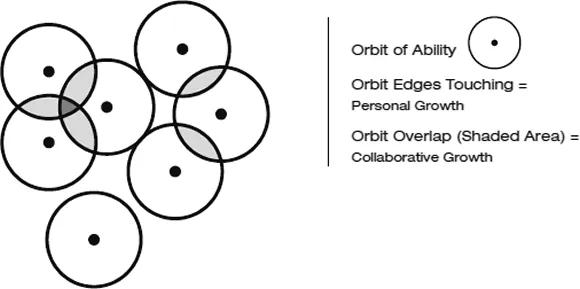
A teacher who aims to transform curriculum must first consider which orbits of ability are necessary to upgrade a particular unit of study. An orbit of ability is a given person's knowledge and talent, or expertise. When one person moves into another person's orbit of ability, his or her knowledge and capabilities grow (see Figure 1.1). Every teacher has his or her own orbit or orbits of ability that others can learn from. Accessing orbits of ability can take place during any interaction with colleagues, friends, family members, or even a new acquaintance.
FIGURE 1.1 | Orbits of Ability
The most effective way for teachers to ensure that their orbits' edges touch is to work together purposefully to improve one another's capabilities. The more orbits of ability that overlap, the greater the degree of professional growth. As the isolated orbit in Figure 1.1 demonstrates, a person may have an expertise that he or she is not willing to share. In modern-learning (and modern-teaching) environments, someone who chooses not to share his or her expertise will eventually have difficulty functioning in the workplace.
During the curriculum transformation process, it is imperative that participants feel comfortable admitting when they do not know necessary information or lack certain abilities. Teachers must be given social and emotional permission to be learners with their colleagues and administrators. The teachers responsible for transforming a unit of study need to seek out the people whose orbits of ability are required to upgrade the unit. These experts will vary depending on the unit's content, task, and purpose. The transformational snapshots in Part 2 provide nine examples of educators seeking out orbits of ability to aid them in upgrading their units of study.
Digital Learning Networks
Active participation in a well-functioning professional learning community (PLC) has proven to help improve student learning (DuFour, Eaker, & DuFour, 2005). This is true for those involved in Internet-based collaborations as well. Educators can connect and interact online with fellow educators through digital learning networks (DLNs) using social networking tools such as Facebook, Twitter, Diigo, and ASCD EDge (edge.ascd.org). If your school site or district filters social networking sites, consider using a personal computer or device to network after school hours until Internet access policies change.
In the 21st century, geographical location has become inconsequential to networking, sharing, collaborating, organizing, and creating. The Common Core State Standards for English Language Arts and Literacy (NGA Center & CCSSO, 2010a) expect modern classrooms to emulate students' eventual workplace settings, "in which people from often widely divergent cultures and who represent diverse experiences and perspectives must learn and work together" (p. 7). If we want our students to one day be able to learn and work with colleagues from widely divergent cultures, we must model these expectations in the educational workplace. Educators need to communicate effectively with others for specific tasks and purposes, evaluate others' points of view constructively and respectfully, and collaboratively transform professional practice using technology and web-based tools strategically and capably.
Active networking through DLNs increases teachers' access to orbits of ability when they are brainstorming or planning an upgraded unit of study. For example, a small group of teachers working with an instructional coach we know asked the coach to help them brainstorm alternatives to having their students create a traditional diorama. The instructional coach immediately logged in to her Twitter account using her mobile device and sent a tweet to inquire whether anyone had any innovative alternative ideas. Within minutes, multiple responses appeared that provided a wide variety of suggestions and links to resources. The instructional coach and the group of teachers immediately used this instantaneous information to develop a wiki at www.wikispaces.com.
Linda Darling-Hammond (1997) reminds educators that "the challenge of ensuring success for all students requires teachers and school leaders to work and learn collaboratively, reflect on their practice, and continually expand their knowledge and skills" (p. 15). Getting involved in DLNs is one way to rise to the challenge of collaborating professionally and expanding our knowledge and understanding.
The Transformational Matrix
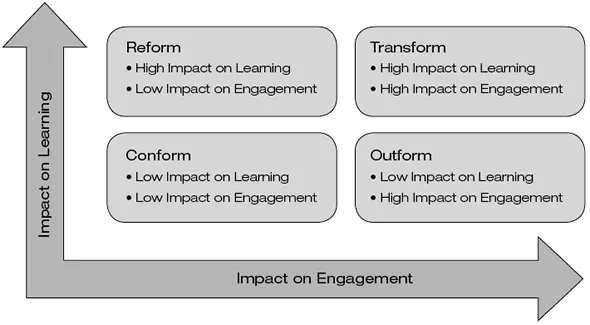
Whether you collaborate on curriculum transformation in person or virtually, it is helpful to have a visual reference that represents the four categories of potential upgrade, or upgrade zones. The transformational matrix (see Figure 1.2) classifies these upgrade zones according to the degree of their impact on student learning and engagement.
FIGURE 1.2 | Transformational Matrix
The transformational matrix is not meant to convey that the outcomes of an upgraded unit of study are neat and clean and fit perfectly into one of four boxes. When teachers are asked, "What constitutes a positive impact on learning and engagement?" answers will vary depending on teachers' personal and professional experiences as well as on the school or district's collaboration history and current culture. Here is what each upgrade zone looks like in action:
- Conform (low impact on learning/low impact on engagement). In this zone, the actions of teachers are more visible than are those of students. Even when teachers include technology and web-based tools in the unit of study, students are passive receptors of the content.
- Outform (low impact on learning/high impact on engagement). In this zone, the purposeful use of technology and web-based tools increases student engagement, but the transformation is largely aesthetic. Interactions in this zone are sometimes referred to as "playground experiences," because the students are active and engaged in the learning process. Closer examination, however, reveals that students' contributions to their learning process are based on what the teacher has selected or created.
- Reform (high impact on learning/low impact on engagement). In this zone, students' interactions are based on an articulated task and purpose. The teacher may or may not be the audience. Students create content rather than simply react to what the teacher has created or selected. This zone tends to generate greater student achievement but may not necessarily be engaging for students. Cognitive and metacognitive expectations require deeper thinking and justification but could be accomplished without technology or web-based tools, although they are incorporated into a unit of study.
- Transform (high impact on learning/high impact on engagement). This zone represents student-centered ownership of learning. Students not only create content and choose software and web-based tools to use, but also make choices based on a specific task, purpose, and audience. The teacher acts as a facilitator for learning in this zone. Students engage in authentic higher-order thinking and often share their work and thoughts beyond the classroom walls using self-selected technology and web-based tools.
Discussion Questions
- When explaining the transformational matrix, we mentioned that educators might have varying ideas of what constitutes a positive impact on student learning and engagement. How has your educational system encouraged teachers to collaboratively establish what cognitively and socially constitute positive impacts on student learning and engagement? If your school or district has not worked collectively to establish these expectations, what might you do to work through this process with your colleagues? How would your team come to consensus or calibrate the definitions of positive impacts on learning and engagement?
- You can access orbits of ability in person or virtually. How would you define or describe the talents and knowledge in your personal orbit or in others' orbits of ability? If you are not comfortable with social networking or the concept of DLNs, whose orbit of ability could you access for assistance? If your own orbit of ability includes a comfort with using social networking and DLNs, whom could you assist in establishing their own DLNs?
- The transformational matrix's vertical and horizontal arrows purposefully do not read "Positive Impact on Learning" because educators' interpretations of positive could vary. How does the explanation of each upgrade zone shape your understanding of what the four zones constitute?
![]()
Chapter 2
Transformational Lenses
. . . . . . . . . . . . . . . . . . . .
To me, eyewear goes way beyond being a prescription…. The shape of a frame or the color of lenses can change your whole appearance.
—Vera Wang
Although Vera Wang was talking about glasses, her observations apply to more than eyewear. Just as changing your glasses can change your whole appearance, upgrading certain aspects of a unit of study can change the unit's entire appearance. Student-centered, 21st century units of study help develop independent and interdependent critical thinkers, creative problem solvers, collaborators, communicators, and contributors. As Stewart (2012) observes, educators must focus on curriculum design and instructional practice with a 21st century mind-set:
We all have a tendency to think that the curriculum that was in place when we went to school ought to be the curriculum of today. This is comfortable for everyone—teachers, academic experts, and parents. But just as the 19th century school curriculum of the agricultural era gave way to a more scientific and technical curriculum after the industrial revolution (Zhao, 2009), so the hyperdigital and global world of the 21st century will demand different knowledge and skills from our students if they are to be successful…. The world is changing at breakneck speed. How can we, as educators, best prepare our students for the jobs of the future, many of which have not even been invented yet? What will our students need to be successful citizens and leaders not only in their own communities but in the nation and ...