![]()
Chapter 1
What Are World-Class Schools?
. . . . . . . . . . . . . . . . . . . .
world-class (wûrld′klăs′) adj. Being among the best or foremost in the world; of an international standard of excellence: a world-class figure skater.
—American Heritage Dictionary of the English Language (5th ed., 2010)
According to Merriam-Webster (n.d.), the first known use of the term world-class was in 1950. For more than half a century, and no doubt long before the term was popularized, we've been interested in—even fixated on—the idea of being world-class. This interest is only increasing as societies become increasingly globalized: If you search for the term world-class on Google, you'll receive almost half a billion results! Are we the best? Are we among the best? Are we good enough? These are the questions at the root of world-classness.
Before turning our attention to the issue of world-class schools, let's examine two examples of world-classness—one from the world of sports and one from the world of business.
A World-Class Example from the World of Sports
In an article for McKinsey Quarterly titled "World-Class Teams," David Kirk (1992), former captain of New Zealand's All Blacks rugby team, poses a question fundamental to defining the term world-class: "If world-class teams can be recognized from the outside by a lack of mistakes, an ease of performance that leads to high margins of victory, and a joy in going about their business, what is it about them internally that enables them to perform so well?" Kirk proceeds to provide a set of "qualities of greatness" that transcend his sport and time: vision, ability, divine discontent, and discipline.
Vision
Kirk describes vision as "something to believe in, something to achieve, something to become." He continues:
All teams have objectives, and the best teams are clear about exactly what they are, but few have real vision. Objectives are cold, intellectual, rational, believable. Progress toward them is quantified, defined, measured. Visions must be rational, but they are also emotional. They are often distant. They must excite and engage and frighten. They must be big.
Kirk describes two dimensions of vision: one external and one internal. An external vision—of winning the World Cup, for example—reflects a desire to be the best in the world at something, whereas an internal vision is one "of realizing potential, of growing, of taking the chance for the team and the members to become what they are able to be."
Ability
World-class teams can't exist without world-class players who exhibit ability—a mastery of skills. However, Kirk cautions that although ability is crucial, "so too is complementarity. Teams are created out of the belief that they generate an energy and synergy that make the whole greater than the sum of the parts. In the world-class team, the result is performance that is consistently at or beyond the level that any reasonable person could expect."
Divine Discontent
In practical terms, divine discontent refers to a tendency toward highly analytical and self-critical behaviors among team members—continuously asking, What mistakes did we make? How can we eliminate them? What can we learn from our mistakes? How can we get better? Kirk notes that divine discontent "is an attitude to learning and growth that is never satisfied with past achievements but always searching for the next challenge. It is remarkable how many sports players and teams are perpetually dissatisfied with their performance. After what seems an outstanding performance they appear ill at ease. Outsiders may even think them churlish."
Discipline
According to Kirk, discipline begins with developing a "set of boundaries that define what is acceptable and unacceptable" regarding even the smallest and most mundane matters (e.g., "It is unacceptable to attend team practice without the correct attire and equipment."). These boundaries are clear and nonnegotiable, so there can be no confusion; everyone on the team knows the rules of the game and sticks to them. "Starting from small beginnings like this," writes Kirk, "the leader should ensure that discipline is applied to communications, team structure, organization, and management. What begins as an external rule does not stay so for long in world-class teams. High performers internalize standards and drive themselves to meet them. This is the essence of true self-discipline, a quality shared by all the best players I knew" (p. 4).
A World-Class Example from the World of Business
Throughout my life, I've stayed at many hotels—some acceptable, others run-of-the-mill, and, occasionally, a few that were truly outstanding. Although there are many world-class hotel chains, I'd have to give my personal vote to the Four Seasons. This luxury hotel brand has about 100 properties around the world, often located in key international cities and in highly desirable vacation destinations. It is consistently named by Fortune magazine as one of the 100 best companies in the world to work for, and its hotels are routinely listed among the best in the world by such authorities as Condé Nast Traveler and Travel+Leisure magazines.
Quality Product
So what is so special about the Four Seasons? According to Karen Harrison (2014), a luxury travel consultant, it is one of the world's best hotel companies for one simple reason: It does everything well. "The brand claims extremely high guest loyalty because it is consistent," she writes. "Guests expect and enjoy beautiful design; exceptional hotel service; and outstanding dining, spa, and golf options. Four Seasons is not the only luxury hotel brand, or the only one with remarkable service. But Four Seasons' consistency is what gives it an edge" (p. 2).
Exceptional Service
Four Seasons Hotels Ltd. is headquartered in Toronto, Canada, where it was founded in 1960 by Isadore Sharp, whose family remains active in the management of the company. In a keynote speech delivered at the Entrepreneurship Conference hosted by the Graduate School of Business at Stanford University, Sharp explained that the hotel chain's excellence was rooted in a key decision that he made early on in the company's history: to fire top people who weren't motivated to serve customers above all else. Although Sharp acknowledged that other companies had similar operating philosophies, he noted the key difference: "We enforced it" (cited in Murphy, 2010). Put another way, Four Seasons Hotels Ltd. operates according to the Golden Rule: Treat others the way you would like them to treat you.
In his speech, Sharp continued:
The outcome in our industry normally depends on the front-line employees—doormen, bellmen, waiters, maids—the lowest-paid people—and often, in too many companies, the least motivated. These front-line staff represent our product to our customers. In the most realistic sense, they are the product. When our employees are trusted to use their common sense, they can and do turn mishaps into new service opportunities. Then, what the customer remembers is not the complaint, but the outcome. (Cited in Murphy, 2010)
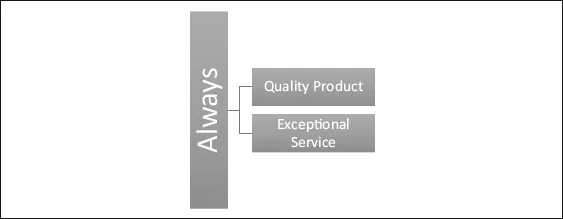
In sum, the lesson we can learn from the Four Seasons is that any endeavor requires two essential elements for it to be truly world-class: quality product and excellent service (see Figure 1.1).
Figure 1.1. Defining World-Class in Terms of Quality and Service
Defining World-Class Schools
Although there is no single universal definition for world-class schools, we can examine some established perspectives on the elements necessary for world-classness.
The Business and Nonprofit Worlds' View of World-Class Schools
To develop ideas for making the U.S. education system more efficient, the National Center on Education and the Economy (NCEE) created the New Commission on the Skills of the American Workforce, a group led by prominent figures in the business and nonprofit worlds. In 2009, three representatives from the commission wrote an article for the Washington Post elucidating the following 10 steps that they consider essential for establishing world-class schools (Brock, Marshall, & Tucker, 2009):
- Set rigorous standards for licensing teachers and recruit from the top third of college graduates. "If we insisted on high standards for our teachers and didn't waive them, teachers' pay would have to rise, a lot, and the pay for those in the shortest supply—math and science teachers, and teachers willing to work in tough inner-city schools and isolated rural areas—would rise the most" (p. 1).
- Encourage outstanding students to select teaching as a career and treat them like professionals. Also, put teachers in charge of their schools.
- Reward schools that do great work. "Provide cash payments of 10 percent of the school budget every year to every school where students significantly exceed the statistical predictions of performance for students with the same characteristics …. The financial reward should come as a big bonus for the school, and the faculty should decide how to spend it. This is better than rewarding individual teachers on the basis of their students' performance" (p. 1).
- Hold teachers accountable for student achievement. After three years, take over schools that are unable to keep at least 90 percent of all major student groups on target for high school graduation. "Declare such schools and districts bankrupt and void all contracts with their staffs" (p. 2).
- Replace typical accountability tests with high-quality, course-based exams. "Rigor, creativity and innovation in student performance require a high-quality curriculum and exams, and will be impossible to achieve if we continue to use the kind of multiple-choice, computer-scored tests that are common today" (p. 2).
- Collect appropriate school and student performance data and make them available to parents, students, and teachers. Once the information is available, "allow parents to choose freely among available public schools" (p. 2).
- Provide high-quality training and technical assistance to every school, but especially to those with less successful students.
- Limit variations in states' per-pupil expenditures to schools. Allow no more than a 5 percent variation in funding from school to school (except when a greater variation can be legitimately accounted for, such as when educating high-cost students—that is, students who require extensive resources beyond typical schooling costs in order to be successful, e.g., students of low socioeconomic [SES] status, bilingual students, students with disabilities). In the United States, "students who need the most help have the lowest school budgets—a formula for national failure" (p. 2).
- Provide a range of social services to children from low-income families. "The state cannot eliminate students' poverty, but it can take steps to alleviate its effects on students' capacity to learn" (p. 2).
- Provide high-quality early-childhood education. Make the services available to all 4-year-olds and, preferably, to 3-year-olds of low socioeconomic status (SES).
It is noteworthy that the people who developed the above vision of world-class schools were key public servants and policymakers themselves: William Brock was U.S. secretary of labor in the Reagan administration; Ray Marshall held the same position in the Carter administration; and Marc Tucker was president of the NCEE. Their no-nonsense views resonate across business and policy organizations, and may well do the same with the general public.
Many U.S. policymakers and business professionals are increasingly alarmed by the achievement gap between students in the United States and those in many other nations. For his 2008 book The Global Achievement Gap, Tony Wagner interviewed employers around the country and arrived at the conclusion "that there is a core set of survival skills for today's workplace, as well as for lifelong learning and active citizenship—skills that are neither taught nor tested even in [the United States'] best school systems" (p. 14). Young people need a range of skills—basic academic skills as well as skills related to collaborating, adapting, and applying knowledge in the workplace. However, a survey of employers found that well over 50 percent of new high school graduates are inadequately prepared in the most essential skills: those related to oral and written communications, professionalism and work ethics, and critical thinking and problem solving. Four-year college graduates are better prepared, but not excelling, with only about one-quarter perceived to have high-quality preparation (The Conference Board, Corporate Voices for Working Families, The Partnership for 21st Century Skills, and the Society for Human Resource Management, 2006). Consequently, we have to challenge the efficacy of the curricular standards in place throughout the United States. Are they really preparing students with the necessary knowledge and skills for life in the 21st century and beyond?
International Views of World-Class Schools
In their 2008 article "Learning from World-Class Schools," authors Andreas Schleicher and Vivien Stewart discuss four key features shared by schools in countries with high-performing schools:
1: High Universal Standards. Schleicher and Stewart note that "many countries have shifted away from control over education content to a focus on outcomes" (p. 48). Outcomes-focused standards help to define and measure educational excellence, "make educational objectives transparent to students, and provide a framework for teachers while avoiding the risks of narrowing the curriculum and teaching to the test" (p. 48). These standards vary considerably across nations. For example, whereas some countries (e.g., Finland) provide broad standards and leave how to achieve them to teachers' discretion, other countries (e.g., the United Kingdom) provide detailed standards that include benchmarks to be achieved on the way to reaching mastery. Regardless of the approach, standards are a significant driver of change and improvement in countries with high-performing schools.
2: Accountability and Autonomy. Balancing accountability and autonomy seems to be instrumental to building sound and sustainable excellence in schools. For example, many successful education systems, such as those in Canada or Japan, "couple the focus on universal standards and outcomes with efforts to move responsibility to the front line, encouraging responsiveness to local needs and strengthening accountability systems" (p. 49).
Interestingly, on the accountability side of the ledger, there doesn't appear to be a single best formula to follow. Many Asian educational systems, like that of Singapore, focus on externally driven, test-based accountability, whereas other national systems, such as those in Denmark and Finland, focus more on formative assessment and self-evaluation. What is common across most high-performing national education systems is the fact that "the primary purpose of any systematic assessment of school performance in these countries is to reveal best practices and identify shared problems in order to encourage teachers and schools to develo...