How can we approach professional development in a thoughtful way, keep teachers motivated, and make the process worthwhile? It's a truth that school leaders can't deny: teachers tend to think of PD as a distraction from the "real work" of the classroom—as something to get through instead of an opportunity to engage, learn, and grow as professionals. Too often, they're absolutely right. When PD is packaged as a one-size-fits-all, one-and-done experience, even content that teachers might greet with enthusiasm won't stay with them for long. It just doesn't stick. In Professional Development That Sticks, Fred Ende makes the case for a better approach—one that melds traditional PD structures with personalized learning. Here, school leaders will find a framework for developing professional learning experiences that spark and maintain teacher motivation and lead to real changes in practice. Ende's three-stage professional development for learning (PDL) process covers critical aspects of planning, providing, and following up. In addition, PDL's Think, Act, and Reflect method ensures your teachers will acquire meaningful, deep, "sticky" learning that lasts.
eBook - ePub
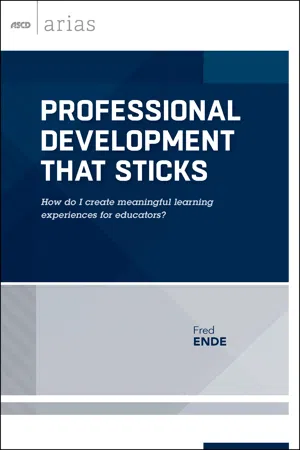
Professional Development That Sticks
How do I create meaningful learning experiences for educators? (ASCD Arias)
- 48 pages
- English
- ePUB (mobile friendly)
- Available on iOS & Android
eBook - ePub
Professional Development That Sticks
How do I create meaningful learning experiences for educators? (ASCD Arias)
About this book
Information
Topic
EducationSubtopic
Education General
Sticky Questions
It's Tuesday afternoon at 3:30. It's been an amazing day teaching science to your 8th grade students. Great work has taken place, and you have a million and one things to do in order to get ready for tomorrow. However, there's a faculty meeting (which would be fine, except for the fact that according to the agenda, it looks like a "sit ‘n git" session led by an expert speaking on a topic with little relation to middle school, let alone middle school science), and you're feeling pretty mind-wiped at the end of the day. But you know you have to go, so you give up what you want to do and attend. As you sit there trying to absorb the information being shared, you ask yourself the often present question, "Why am I here?"
Sound familiar? This dismal picture is all too often what professional development (or PD) looks like: generic, impersonal, and largely forgettable. Why has this become the norm for educators? Why isn't their PD more engaging, relevant, and impactful? The sad truth is that there is a lack of agreement in the field about what "good PD" is and what it looks like, leaving many leaders with only a vague idea of how to provide their teachers with PD that will stick and have a lasting positive effect on both teachers and students. To demonstrate this point, let's begin with a quick quiz. I'll ask the questions, and you supply the answers. Easy, right? Here we go.
1.Professional development is…
A. An opportunity to grow as a professional. B. A boring, wasteful chore.
C. Something over which I have no control.
D. All of the above.
E. None of the above.
2. Professional development and personal learning are similar/different (circle one) because _________________________.
3. In order for professional development to stick or be long-lasting, I need to make sure I do the following: _______________________________________.
4. Which of the following five activities are examples of professional development? Why?
A Attending an Edcamp conference event to serve as a session facilitator.
B. Attending an Edcamp conference event as a participant.
C. Reading the Marshall Memo.
D. Meeting to discuss professional development needs with the district superintendent and assistant superintendent for curriculum.
E. Engaging in face-to-face and virtual conversations with colleagues about the meaning of the word perception and how it affects our lives as educators and parents.
After responding to these four questions, I have no doubt you had trouble settling on one answer for each. This is probably a quiz you'd want to avoid if you had to select one "correct" response.
That's the funny thing about professional development. There isn't really a "right" answer in terms of what it is, how it works, or when it should happen. There are a lot of supporting ideas, sure, and we often do a decent job of explaining what it shouldn't be, how it can't work, or when it shouldn't happen. But none of that really gets to the heart of why professional development is so important and why it has to stick when we engage in it. We'll come back to the idea of "stickiness" throughout this book; first, let's define what professional development really is.
What Is Professional Development?
Like the duck-billed platypus, professional development is often easy to spot but difficult to categorize. We know it when we experience it and can see it happening, but we don't always know what it's all about. The purpose of professional development is pretty easy to speak to. In my ten years as a science teacher and department chair—and five additional combined years as a curriculum program director and assistant director of curriculum—I have yet to find the leader or learner who disagrees with this statement:
All of us, no matter what role we hold, no matter what organization we work for, no matter what profession we belong to, need to strive to keep getting better. And getting better requires lots of work—work that we often don't yet know how to do on our own.
Even though professional development has existed in American education since the days of the "common school" (in some form or another), it wasn't until the second half of the 20th century that school populations began to grow racially, ethnically, and developmentally diverse, requiring teachers to think and teach differently in order to truly help all learners succeed. Early professional development was of the "sit ‘n git" variety, which usually involved teachers attending assigned sessions for a designated number of hours. During these sessions, teachers might have taken notes, asked questions, or simply done their best to keep up with the pace of the information provided.
Was this effective? By today's standards, no. Nevertheless, this traditional form of professional development matched the nature of the teaching and learning that was going on in classrooms at the time. This doesn't mean that it was any more or less effective, but it does mean that the professional development experienced by educators was often similar to how teachers were learning with and leading their own students. With the passage of the Elementary and Secondary Education Act (ESEA) in 1965, an increase in federal funds began to help the neediest students become more successful. This also meant there were additional opportunities to structure professional development for teachers. The findings of the Coleman Report in 1966 helped put an emphasis on the power of PD by showcasing that a variety of factors (e.g., teacher preparation, stakeholder communication ability, learner sense of control) truly created a comprehensive learning environment (Kaestle, 2001). As the 1970s began, more and more teachers engaged in professional development. Unfortunately, though, much of this professional development was conducted in a way that didn't stick—it didn't have a positive long-term impact on teaching and learning. The 1970s might be a decade that's remembered for a number of things, but by all accounts, professional development isn't one of them.
Almost 50 years later, professional development has generally remained the same. A good portion of PD still consists largely of "you sit, I talk" or "one size fits all" sessions. Often, those who are ostensibly being developed have little or no say in the development itself, and leaders sometimes consider PD as an afterthought—something that must be done but for which there isn't a ton of available time.
Well, there goes your good mood, huh? Fear not; it isn't all doom and gloom. Professional development can indeed be lasting and incredibly sticky, and it can make a tremendous difference for educators. Even the most traditional forms of PD can have a powerful effect, if matched with the right audience, provided at an appropriate time, and delivered in an effective way. Consider, for instance, how teachers might react to two hours of lecture-based professional development held before school and led by an incredibly engaging facilitator versus two hours of lecture-based professional development held after school and led by a dull presenter. I've been a participant in both scenarios, and I can tell you clearly: one was much stickier for me than the other.
The purpose of this book, then, is to provide you with a number of ideas and practical strategies to design, implement, and reflect on PD that truly sticks. And as you'll see, it doesn't have to be as hard as we might think it is, especially given the preponderance of PD that seems to lack purpose. Before we go in depth about planning, providing, and following up on powerful PD, though, we have two more stops to make.
PD? PL? How about PDL?
As an avid user of social media, I see posts every day that are full of complaints about professional development and focus on debates, questions, and clarifications about how it compares to personalized learning. Over time, I've realized that professional development and personalized learning are really two sides of the same learning coin. Here's why:
- Research finds that the best professional development is focused on the learner as an individual, is engaging, requires follow up, and has direct applicability to the audience's role (Guskey, 2009).
- According to the International Society for Technology in Education, personalized education experiences focus on the learner, are engaging and allow for deep learning, require regular follow up, and are tied to a learner's given role (Basye, 2014).
As you can see, both concepts actually can—and should—go hand in hand. In fact, the most accurate reference isn't PD or PL; rather, it's PDL, because Professional Development for Learning is what it really needs to be about. Without a focus on instilling deep and sticky learning, PD won't mean a thing, and you can't have personal learning without some way to develop further as a professional. Therefore, the debate about whether we want to call it professional development or personalized learning is a non-starter because when done well, both are inherently the same thing.
Professional development for learning should be meaningful for the deliverer, the audience, and those learners who are the end recipients of the learning (usually our students but could also be teachers, leaders, or parents). In fact, the best PDL is designed to have just as much impact on the facilitator of the learning as it does on students.
A tall order? Possibly, but research shows that continuing on our current path would be a bad idea. According to a Gallup poll conducted in the fall of 2014, superintendents throughout the United States—when asked about professional development—were able to cite a tremendous number of areas that were being explored with their staff (Gallup, Inc., 2014). It was clear that professional development was taking place, yet the data also illustrated the necessity and urgency of building professional capacity for PDL. Only one-third of those polled indicated that their districts had sufficient professional learning plans in place for new teachers, only a quarter of teachers (and half of principals) played an active role in determining PDL priorities, and only one-fifth of all districts supplied appropriate time for educator learning.
This begs the question: If we aren't providing our leaders and learners with the time and choice to cultivate their own learning, how can we in all fairness have high expectations of them? It's a sobering question. Thankfully, it's also one for which we can provide a positive answer. We just need to make some accessible changes to the way we structure our professional learning.
Making PDL Sticky
We can thank Malcolm Gladwell, author of the best-selling The Tipping Point (2000), for providing us with a way of looking at stickiness that moves beyond the gum on your shoe. Gladwell describes the key to what makes an initiative successful as its "stickiness factor" or how entwined it becomes in your whole way of being. In determining stickiness, he writes, "Is the message (or the food, or movie, or product) memorable? Is it so memorable, in fact, that it can create change, that it can spur someone to action?" (Gladwell, 2000, p. 92)
Gladwell has it right. Professional development for learning will have a more lasting impression if it remains in the minds of its target audience and causes them to take action. But what does this kind of PDL look like? Let's start with what we know. An excellent review of professional development needs was recently conducted by the Teacher Development Trust (2015) out of the UK. Based on their report, Guskey's analysis (2009), and my own experience as an assistant director of curriculum, we can reasonably determine that PDL works when
- It is meaningful to all three parts of the process (i.e., facilitator, audience, and learners down the line).
- It is highly engaging for the audience through hands-on activities and alignment to specific needs.
- The audience has a say in the PD being offered, and the learners at the end of the chain have an opportunity to reflect on the big picture.
- Enough time is provided for the facilitator to showcase the importance of the work, for the audience to sense its urgency, and for learners to see a difference in their learning experience.
Exploring each of these areas in depth is beyond the scope of this book, but we can examine the overarching effect of having them all together: stickiness. Now that we've pinpointed the four ingredients for making PDL sticky, we have to identify how to make this stickiness a reality.
That's where the Think, Act, Review (TAR) method comes in. Just like the end result it leads to, the TAR method is itself a sticky process. It has a memorable name, is easy and effective to use, and generates a strong feedback loop that makes you want to use it again and again. The TAR method guides my thinking as I plan, provide, and evaluate professional development for learning. Truly, it plays a tremendous role in the work that I do.
Professional development for learning consists of three phases. You start with the planning phase, where you consider all of the facets of what you hope to work on. Then you move on to the providing (or facilitating) phase, where you or your provider engages in the PDL with your audience. Finally, you finish with the following-up (or reflecting) phase. Great professional development doesn't end after it has been provided. The TAR method provides a framework for engaging in each of these phases to ensure a PDL experience that is both meaningful and long-lasting. (See Figure 1 for an outline of this framework and some key questions to guide you through each phase.)
- The T is all about thinking. Regardless of whether you're in the planning, providing, or following-up phase, careful study and deep thinking must be part of every step. For example, in the planning stage, you'll have to think about the purpose of your PDL, a structure that matches that purpose, and practical questions and logistics that will guide its development. When providing the PDL, you'll have to think about logistics and relationships. Not all PDL is created to be the same, and PDL that doesn't match its audience is bound to make it less effective. People, by nature, want to feel like they belong and have a say. When you're providing the PDL, you'll have to think about your facilitation and how attendees are engaging in the learning (or not). Of course, the following-up stage is also the time to think about all that juicy data sitting on your desk waiting to be analyzed.
- The A? That stands for act. As professional development leaders, we must serve in an acting role during all three phases. Even if you aren't personally the one providing the PD, you need to act on a number of key items to ensure each of the phases is successful. For example, as we'll discuss later, when I engage in the acting stage, I'm engaging in conversations with PDL providers to build a contract, leading the professional learning myself, learning alongside participants, or reading through PDL evaluations and putting together an analysis.
- Finally, the R represents careful review. All three phases require reflection to take place, and everyone involved in the process needs to be engaged in a continuous cycle of reflection. Reflecting and review can never be saved for the end. When planning, I constantly ask questions about whether the logistics will work as designed, and I regularly ask for input from colleagues to see what they think about a planned design. When providing PDL, I'm listening to conversations and asking myself questions about what participants are (and are not) learning. I'm also reflecting with providers, both during PDL sessions (e.g., during a break or lunch) and after (e.g., while recapping the event or discussing the session data analysis). When a session is complete, I also reflect on what to do next and what the future might hold for this type of work, this type of learning session, and this facilitator. It is important to remember t...
Table of contents
- Cover
- Title Page
- Table of Contents
- Sticky Questions
- Encore Divider
- Encore
- References
- Related Resources
- About the Author
- Copyright
Trusted by 375,005 students
Access to over 1.5 million titles for a fair monthly price.
Study more efficiently using our study tools.
Frequently asked questions
Yes, you can cancel anytime from the Subscription tab in your account settings on the Perlego website. Your subscription will stay active until the end of your current billing period. Learn how to cancel your subscription
No, books cannot be downloaded as external files, such as PDFs, for use outside of Perlego. However, you can download books within the Perlego app for offline reading on mobile or tablet. Learn how to download books offline
Perlego offers two plans: Essential and Complete
- Essential is ideal for learners and professionals who enjoy exploring a wide range of subjects. Access the Essential Library with 800,000+ trusted titles and best-sellers across business, personal growth, and the humanities. Includes unlimited reading time and Standard Read Aloud voice.
- Complete: Perfect for advanced learners and researchers needing full, unrestricted access. Unlock 1.5M+ books across hundreds of subjects, including academic and specialized titles. The Complete Plan also includes advanced features like Premium Read Aloud and Research Assistant.
We are an online textbook subscription service, where you can get access to an entire online library for less than the price of a single book per month. With over 1.5 million books across 990+ topics, we’ve got you covered! Learn about our mission
Look out for the read-aloud symbol on your next book to see if you can listen to it. The read-aloud tool reads text aloud for you, highlighting the text as it is being read. You can pause it, speed it up and slow it down. Learn more about Read Aloud
Yes! You can use the Perlego app on both iOS and Android devices to read anytime, anywhere — even offline. Perfect for commutes or when you’re on the go.
Please note we cannot support devices running on iOS 13 and Android 7 or earlier. Learn more about using the app
Please note we cannot support devices running on iOS 13 and Android 7 or earlier. Learn more about using the app
Yes, you can access Professional Development That Sticks by Fred Ende in PDF and/or ePUB format, as well as other popular books in Education & Education General. We have over 1.5 million books available in our catalogue for you to explore.