Even in an education system driven by the Common Core State Standards and high-stakes testing, teachers must adapt their methods to the styles of the modern learner. This means creating a student-centered classroom, driven by brief, interactive instruction from highly skilled teachers who know when the time is right to get out of the way. The five-minute teacher is one who delivers quick, thought-provoking lessons that send students clamoring to find meaning on their own, with the help of peers, and using the concepts and tools the teacher has provided in just a few minutes to create a wondrous, student-centered classroom. Barnes shares real anecdotes and practical strategies for transforming any learning environment into a remarkable, student-centered classroom, facilitated by a five-minute teacher.
eBook - ePub
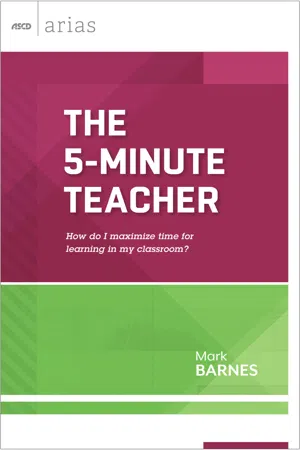
The 5-Minute Teacher
How do I maximize time for learning in my classroom? (ASCD Arias)
- 48 pages
- English
- ePUB (mobile friendly)
- Available on iOS & Android
eBook - ePub
About this book
Information
Topic
ÉducationSubtopic
Éducation générale
Introduction
It was the end of class. Twenty-five students—seated around tables, in beanbag chairs, and at computers—brought an end to nearly as many activities. A smiling young man shook his head and called out, “Mr. Barnes, this class goes by so fast. My other classes are so slow.”
I shrugged, smiled inwardly, and replied (somewhat stereotypically), “Well, time flies when you’re having fun.” There is no magic behind making each 55-minute class enjoyable for my students. I’ve learned that the hard way. It’s the structure of the student-centered classroom that creates a powerful, exciting learning environment that students actually enjoy. The so-called five-minute teacher—who should be nearly invisible—is just part of the fun.
Five minutes. Three hundred seconds. It can be like a whisper disappearing in an instant, or it can feel like an eternity—depending on the content that fills the time. Still, five minutes can be the most important part of a student’s day. When students are poised to learn something new, five minutes can prepare them for experiences that will open doors and minds. The trick is making those five minutes count.
In more than 20 years as a classroom teacher, I’ve learned that 45–55 minutes can be a complete waste of time, whereas a few well-planned, well-executed seconds can create remarkable new learning opportunities. Highly motivated students may be better equipped to listen to lengthy lectures and 30-minute lessons, but they’ll learn the material equally well, and perhaps better, if they investigate the content after instruction that lasts five minutes or less. Reluctant learners are prone to become disruptive as soon as a lesson surpasses the 300-second mark. In fact, you’ll probably lose them much faster if you don’t engage them immediately.
What if any teacher could improve learning and change lives while teaching less? Notwithstanding the Common Core State Standards, high-stakes testing, Student Learning Objectives, or any other constraints that make teachers believe they must spend countless hours creating lengthy lesson plans, it’s time for educators to move toward doing less. I don’t mean to suggest that teachers should put less effort into planning and executing their lessons. Rather, I’m referring to a shift in philosophy—one that’s about valuing every minute of every class and making those minutes look and feel different from how they currently look and feel. In the following pages, we’ll explore a different vision of teaching and learning, and, hopefully, you’ll discover the power of becoming a five-minute teacher and building a student-centered classroom.
Quickly Identify What’s Most Important
I recognize that the term five-minute teacher might imply direct instruction that only lasts for five minutes. In other words, five minutes of teaching followed by student work for the remaining time. Although some days might look like this (depending on the activity or project), the term actually refers to the idea that the teacher should never stand and deliver content for more than five minutes at a stretch. Instead, instruction should occur in brief increments, allowing students to explore content independently and collaboratively and to use rich project-based activities, collaborative conversations, mobile devices, and digital tools.
A five-minute teacher works much harder than an “old-school,” stand-and-deliver teacher who lectures for 15–25 minutes before relegating students to some mundane, rote-memory practice activity. When you become a five-minute teacher, you craft brief lessons that weave their way seamlessly through student-centered, inquiry-based discussions, activities, and projects. A five-minute teacher is the perfect combination of artist, entertainer, leader, follower, and magician—a master educator who isn’t afraid to get out of students’ way so they can discover learning with little guidance.
For those who are comfortable with the traditional stand-and-deliver model, this concept may seem abstract or incomprehensible. Even the average progressive-minded teacher who integrates technology and collaboration may use 15 or more minutes for direct instruction. If you teach long blocks—say 70–90 minutes—you might honestly need 15 or more minutes of what looks like direct instruction. A five-minute teacher, though, will break these 15 minutes into three or more segments and use video, questioning, collaboration, reflection, and other innovative means to create a class with plenty of forward motion and effective transitions from teacher-directed time to student-directed time. Although these concepts are not new, understanding how to use them efficiently is critical for a successful five-minute teacher.
Excellent student-centered lessons eliminate many of the traditional activities that bore students and diminish learning. Therefore, understanding what to keep and what to throw away each day is essential. The following sample lesson illustrates how traditional activities and lectures are replaced with engaging, progressive practices that help students soak up information and become independent learners. This approach is outlined in more detail in my book, Role Reversal: Achieving Uncommonly Excellent Results in the Student-Centered Classroom (2013).
To visualize effective instruction in five minutes or less, imagine a middle school history teacher who works in 60-minute blocks. She is introducing a lesson on the Civil War that might typically need 15–20 minutes of instruction. This instruction includes assistance from various supplemental materials, such as slides, textbooks, or handouts that contain information about events that sparked the war. After a boring, rote-memory activity, the teacher asks some whole-group questions, which only a handful of students hear and to which even fewer respond. Regardless of what students are doing that might appear to be interactive on the surface (e.g., copying notes or answering textbook questions), this is ultimately teacher-led, unimaginative direct instruction that will, in most instances, detract from real learning.
With this in mind, what strategies and tools might a creative five-minute teacher employ? First, let’s consider how she might deliver instruction for this same Civil War lesson. Whereas the traditional teacher instructs students to copy causes of the war from the whiteboard, the five-minute teacher begins the class by dividing students into two groups—the North and the South. (This kind of role-play can be applied to almost any class.) The activity begins when a student is told that she represents South Carolina and is starting a sort of mutiny called a secession. She wants to leave the other states because she doesn’t want the same things that they want. Soon, more students secede, and sides are drawn for a simulated war.
Carefully written instructions that explain the simulation are delivered. The instructions—which can be posted on a whiteboard, classroom website, blog, or sheet of paper—direct students to divide each of the groups into three subgroups, representing regiments that will fight different battles. Maps are provided (either via web links or on paper), and students are directed to plan their offense or defense. Note that, unlike a traditional lesson, this five-minute teacher activity does not begin with events that led to the Civil War. The simulation engages students in collaboration, planning, and problem solving. This initial enthusiasm sparks further curiosity about the actual events. The initial simulation lasts approximately 15 minutes, and the instruction for the division of sides and ensuing contest might take a total of th...
Table of contents
- Cover
- Title Page
- Table of Contents
- Content
- Encore Divider
- Encore
- References
- Related Resources
- About the Author
- Copyright
Trusted by 375,005 students
Access to over 1.5 million titles for a fair monthly price.
Study more efficiently using our study tools.
Frequently asked questions
Yes, you can cancel anytime from the Subscription tab in your account settings on the Perlego website. Your subscription will stay active until the end of your current billing period. Learn how to cancel your subscription
No, books cannot be downloaded as external files, such as PDFs, for use outside of Perlego. However, you can download books within the Perlego app for offline reading on mobile or tablet. Learn how to download books offline
Perlego offers two plans: Essential and Complete
- Essential is ideal for learners and professionals who enjoy exploring a wide range of subjects. Access the Essential Library with 800,000+ trusted titles and best-sellers across business, personal growth, and the humanities. Includes unlimited reading time and Standard Read Aloud voice.
- Complete: Perfect for advanced learners and researchers needing full, unrestricted access. Unlock 1.5M+ books across hundreds of subjects, including academic and specialized titles. The Complete Plan also includes advanced features like Premium Read Aloud and Research Assistant.
We are an online textbook subscription service, where you can get access to an entire online library for less than the price of a single book per month. With over 1.5 million books across 990+ topics, we’ve got you covered! Learn about our mission
Look out for the read-aloud symbol on your next book to see if you can listen to it. The read-aloud tool reads text aloud for you, highlighting the text as it is being read. You can pause it, speed it up and slow it down. Learn more about Read Aloud
Yes! You can use the Perlego app on both iOS and Android devices to read anytime, anywhere — even offline. Perfect for commutes or when you’re on the go.
Please note we cannot support devices running on iOS 13 and Android 7 or earlier. Learn more about using the app
Please note we cannot support devices running on iOS 13 and Android 7 or earlier. Learn more about using the app
Yes, you can access The 5-Minute Teacher by Mark Barnes in PDF and/or ePUB format, as well as other popular books in Éducation & Éducation générale. We have over 1.5 million books available in our catalogue for you to explore.