In this essential guide, Starr Sackstein—a National Board Certified Teacher—explains how teachers can use reflection to help students decipher their own learning needs and engage in deep, thought-provoking discourse about progress. She explains how to help students set actionable learning goals, teach students to reflect on and chart their learning progress, and use student reflections and self-assessment to develop targeted learning plans and determine student mastery. Filled with practical tips, innovative ideas, and sample reflections from real students, this book shows you how to incorporate self-assessment and reflection in ways that encourage students to grow into mindful, receptive learners, ready to explore a fast-changing world.
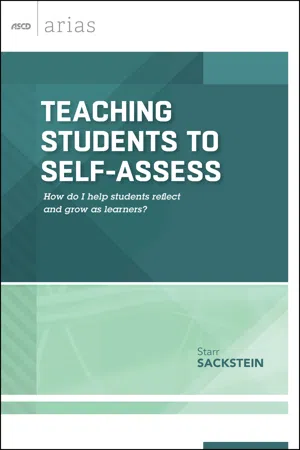
eBook - ePub
Teaching Students to Self-Assess
How do I help students reflect and grow as learners? (ASCD Arias)
- 59 pages
- English
- ePUB (mobile friendly)
- Available on iOS & Android
eBook - ePub
Teaching Students to Self-Assess
How do I help students reflect and grow as learners? (ASCD Arias)
About this book
Information
Topic
EducationSubtopic
Education General
Introduction
Education in the 21st century sometimes seems to be in a new language that has yet to be decoded. The traditional one-size-fits-all method of transmitting knowledge to passive students is no longer adequate. Today, learning is interactive and ever-changing, like our students. With information available in every corner of the world, students no longer rely on a single person to convey content. Instead, they need a guide to help them interpret the facts and the thoughts that they uncover. This new facilitative role of the educator enables students to go beyond what they already know and seek out knowledge that will help them develop and innovate.
To help students grow, we must teach them to develop the skill of metacognition—that is, to become aware of their own thought processes. If we teach students to know themselves well, they can ask the right questions and garner the help they need to become successful in every situation.
Reflection is an essential tool that enables students to decode what they know and what challenges them—and, most important, to distinguish between the two. Teaching reflection can help students decipher their own learning needs and elicit evidence from their own work to support their growth.
But giving students time to think about what they learned isn’t enough; deep reflection and self-analysis are not innate skills. Students must be taught how to consider their work intelligently against standards to be able to show mastery and set goals for developing themselves as learners.
Teachers can use differentiation and scaffolding to help students go beyond simple regurgitation of words and facts to engage in deep, thought-provoking discourse about progress. Using a variety of written and spoken means, students can discuss what it is they know without taking tests or being told by a teacher. Providing students with examples of mastery, a clear understanding of expectations and standards, and multiple opportunities to explore content will enable them to grow into mindful, receptive learners, ready to explore the 21st century world.
Reading this book, you will learn
- What reflection is.
- How to teach reflection.
- When to use reflection.
- How to empower students to take charge of their own learning and assessment.
What Is Reflection and Why Should We Teach It?
A few years ago, I decided that it was time to dive deeply and honestly into my own practice. After 10 years of teaching, observation notes and student feedback weren’t enough to push me to the next level, so I took on National Board Certification.
I got my first taste of the task’s enormity when the "welcome box" arrived in the mail. It felt like hello in 12 languages I didn’t speak. Undaunted, I began the arduous journey. Commencing with 112 pages of standards that defined what reflective teachers do, I eagerly made connections to my own practice, scrawling my annotations on the pages like graffiti.
It soon became evident that content knowledge was only a small percentage of the expectation. I’d need to scrutinize my practice over the course of a year, gathering materials from students, filming my classes, and meticulously examining the choices I made to foster students’ learning. I was required to study my feedback to students and the resulting student growth, analyze both whole-class and small-group discussion, and evaluate community outreach and involvement. Watching the footage of my class discussions and group work, like a coach prepping for big game, I analyzed my delivery, questions, wait time, and even vocal intonation. The data I gathered on myself were invaluable and led me to make crucial changes to my practice and my behavior in the classroom.
Since achieving National Board Certification, reflection has become an integral part of my practice and my evolution as an educator. With a critical eye, I explore what works and what needs work, and I find solutions to help me continue to grow and keep up with the changing educational landscape.
Because of the incredible effect that reflection has had on my practice, I was eager to teach this tool to my students. During the certification process, I began to connect the process of analyzing my own performance against teaching standards to what my students needed. How could I help students examine the choices they made as learners? How could helping them understand the skill expectations of a lesson better prepare them for success?
What Reflection Looks Like in the Classroom
Many of us think about stuff after it happens. The difference between reflection and just thinking about something, however, is intention. Let’s examine what reflection looks like in the classroom. Teachers who incorporate student reflection effectively
- Explicitly teach students what reflection is and allow them to practice during class time. Effective teachers give students feedback on their reflections: what are students doing well? What could they do better? They highlight particular portions of students’ reflections and offer strategies or ask probing questions to help them add depth—for example, "You clearly understood the information, but I’m not sure you were able to connect the content to the skills. Which standards did you address in this assignment, and how can you show your growth?"
- Teach students to question everything. Teachers who use reflection effectively help students understand how reflection engages them in their own thinking and learning processes and teach them that learning is active, not something that happens to them.
- Avoid treating reflection as an add-on. Instead, they teach reflection as a necessary, inextricable part of what is already happening in class.
- Make reflection more about actual learning than about how much students liked the content or learning activity. Effective teachers make expectations clear so that students have a baseline to assess their learning against and are able to discuss their learning in terms of the standards being taught.
- Differentiate how students reflect. Just as there is no single type of student, there is no one right way to do reflection. Teachers who effectively use reflection give students the freedom to choose how they reflect, whether in writing, through video, or in face-to-face conferences.
- Ask students to share their reflections with others. For example, teachers may have students maintain a reflection blog throughout the school year. Students can use a variety of tools to support their style of reflection, including social media websites or applications like Twitter, Blogger, WordPress, Voxer, and Instagram. These new techniques help teachers connect students’ learning to the larger world outside school.
- Model reflection. Effective teachers model reflection often and share their process and insights with their students. I myself maintain two blogs in which I tackle issues that arise daily and share my experiences with others, encouraging dialogue. I often participate in Twitter chats with a rigorous community of professionals that push me to consider my beliefs as an educator and validate my practices. Effective teachers also model continual growth after the reflection, putting into action what they’ve learned from the reflection process.
Benefits of Reflection
After every project my students complete, I eagerly read their reflections, seeking ways to improve their collective experience. My students have become adept at weaving their thoughts and experiences into evidence-based written pieces that explore learning and standards and honestly reflect the work they have done.
Tip: Always read students’ reflections before reading their work. Doing so will help you focus your read of their work and provide specific feedback on what they are working on. This also ensures that you won’t view their work through your own agenda.
It wasn’t always this way—and if you’re just beginning to use reflection as a learning tool, it may not be this way at first for you, either. When we first start reflecting, it can feel like a burden. If students don’t understand why they are doing it, then it will seem superfluous to them. Thus, it is crucial to communicate to students why we reflect. They need to understand the value of reflection as it pertains to both their lives and their learning.
Once everyone begins reaping its benefits, it’s easy to recognize that reflection is an important part of the learning process and essential to our overall growth. By developing metacognitive awareness, students can clearly understand and articulate what they know and can do and where they need to ask for help. Being able to identify one’s own areas of strength and need is an essential life skill.
As teachers, we must make this point clear to our students, and we must value what they share with us in their reflections. Reflection is an opportunity for us to share a moment with each student and get inside his or her head, in the process deepening our relationship with that student. The insights we gather provide valuable context that we can apply in our practice. With a greater understanding of our students’ needs, we are able to tailor our instruction and teach more effectively.
Since I started using reflection with my students, I’ve witnessed profound growth in their ability to discuss their learning. They understand themselves as learners and often develop strategies for working to their own strengths and weaknesses. They are capable of asking for help in ways they couldn’t before, making them advocates for their own learning.
In that vein, I’ll let students explain the benefits of reflection in their own words. The following quotation comes from a conversation I had with one of my seniors:
Although I found reflections to be kind of a hassle in the beginning of the year, now I really appreciate taking the time to sit and write them. It allows me to look back on the process of actually planning and writing my assignments as well as being able to identify the skills I actually learned and took away from the project. Reflections make me think about the challenges I faced and teach me how to approach similar problems in other situations.
—Amada Guapisaca, 12th gradeAnother senior explained how reflection helps her grow:Reflecting on our learning helps us focus on what we need to work on in the future. If I write in my reflection that I am having troubles writing transitional phrases in my essays, I would know that in the next essay this is something specific that I want to review and work on. It helps the students and the teachers that read the reflections narrow into what should be taught or reviewed for the next assignment.
—Markella Giannakopoulos, 12th grade
Reflection Questions:
1. Do you currently use reflection in your own learning? What does it look like?
2. How can making reflection a part of your students’ learning enhance your ability to help them grow as learners and people?
3. How can reflection deepen teacher-student relationships and a person’s relationship with him- or herself? How can reflection enhance a person’s ability to learn?
Getting Started with Reflection
Goals are the necessary starting point to the learning process: all learning begins with setting the final objective. Thus, before students can reflect, they need to come up with learning goals—a process that is easier said than done. This section addresses how teachers can help students set reasonable goals and adjust their instruction based on the outcomes of those goals.
Helping Students Create Actionable Goals
How many times have you asked students to set learning goals, only to see statements like "I want to do better" and "I will complete all my work"? If your answer is "Too many times to count," then it’s time to explicitly teach students what an actionable goal is and how to set one.
A major reason students get away with vague goals is that teachers aren’t using goal setting as an authentic learning tool. Many teachers are accustomed to making the real choices for students, whether the goal is graduating or just passing the unit test. Instead of encouraging students to create focused, self-directed goals, they use goal setting as a way to fill time or to grant students a superficial sense of empowerment.
We need to reframe goal setting so that students understand how important goals are to the learning process and recognize that vague or unattainable goals will not help them succeed. Then we can guide them in creating their own robust learning goals. If goals are the front line in producing growth, then kids need to know why setting actionable long-term and short-term goals is essential to their success.
Figure 1 encapsulates the goal-setting process for students.
FIGURE 1: A Guide to Setting Achievable Short-Term Goals

Here’s how you can break down the steps and guide students in creating their own goals:
1. Have students write a list of long-term goals they would like to set for themselves. "Long-term" could be the span of a marking period or the length of one school year—no longer, or the goals wil...
Table of contents
- Cover
- Title Page
- Table of Contents
- Introduction
- Encore Divider
- Encore
- References
- Related Resources
- About the Author
- Copyright
Trusted by 375,005 students
Access to over 1.5 million titles for a fair monthly price.
Study more efficiently using our study tools.
Frequently asked questions
Yes, you can cancel anytime from the Subscription tab in your account settings on the Perlego website. Your subscription will stay active until the end of your current billing period. Learn how to cancel your subscription
No, books cannot be downloaded as external files, such as PDFs, for use outside of Perlego. However, you can download books within the Perlego app for offline reading on mobile or tablet. Learn how to download books offline
We are an online textbook subscription service, where you can get access to an entire online library for less than the price of a single book per month. With over 1.5 million books across 990+ topics, we’ve got you covered! Learn about our mission
Look out for the read-aloud symbol on your next book to see if you can listen to it. The read-aloud tool reads text aloud for you, highlighting the text as it is being read. You can pause it, speed it up and slow it down. Learn more about Read Aloud
Yes! You can use the Perlego app on both iOS and Android devices to read anytime, anywhere — even offline. Perfect for commutes or when you’re on the go.
Please note we cannot support devices running on iOS 13 and Android 7 or earlier. Learn more about using the app
Please note we cannot support devices running on iOS 13 and Android 7 or earlier. Learn more about using the app
Yes, you can access Teaching Students to Self-Assess by Starr Sackstein in PDF and/or ePUB format, as well as other popular books in Education & Education General. We have over 1.5 million books available in our catalogue for you to explore.