The Common Core State Standards require all students to think in complex and creative ways and apply classroom learning in new contexts. Yet many teachers already struggle with reaching all learners, who come to school with varied levels of readiness, interests, and learning profiles. What to do now that the expectations are even higher? Differentiated instruction experts Carol Ann Tomlinson and Marcia B. Imbeau offer practical, thoughtful advice on how to plan, deliver, and assess instruction that meets this new level of challenge. Combining the goals of the Common Core with the principles of differentiation, the authors present an eight-step process to help teachers make rich, intellectually rigorous curriculum accessible to a very broad range of students. With examples across grade levels and content areas and a checklist for reflection on the eight steps, this timely publication will show you how to meet high expectations with responsive instruction and help all your students grow as thinkers and problem solvers.
eBook - ePub
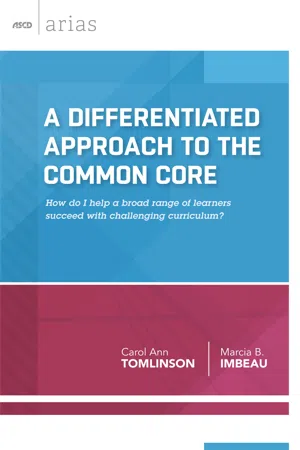
A Differentiated Approach to the Common Core
How do I help a broad range of learners succeed with a challenging curriculum?
- 57 pages
- English
- ePUB (mobile friendly)
- Available on iOS & Android
eBook - ePub
A Differentiated Approach to the Common Core
How do I help a broad range of learners succeed with a challenging curriculum?
About this book
Information
Topic
EducationSubtopic
Education General
The Opportunity and the Challenge
The Common Core State Standards provide teachers with an opportunity and a challenge. Taught effectively, the Common Core standards encourage students to understand what they are learning (rather than largely memorize and repeat information) and to apply and transfer what they learn. The result would be "deep learning," which is much more durable and useful than rote learning or "surface learning." That’s the opportunity. The challenge is that the Common Core demands this level of learning from more than just the "smart" or "advanced" kids. It requires virtually all learners to think in complex and creative ways and be able to use what they learn in contexts beyond those practiced in class.
While our best knowledge of teaching and learning indicates this expectation is entirely appropriate, for many of us, thinking about how to teach complex content in a classroom where student needs and readiness levels vary considerably is unfamiliar territory. The goal of this brief publication is to provide a framework for developing curriculum and planning instruction for academically diverse student populations in Common Core classrooms or, for that matter, in any classroom that calls on all students to master intellectually rigorous standards. To that end, we offer an eight-step process for creating differentiated lessons based on Common Core standards and then delivering this instruction in a way that supports the successful understanding of a broad range of learners.
All of the steps are discussed at an introductory level, as our goal in this publication is to launch a pathway to learning, not to complete it. To learn more about each of the eight steps, please refer to the list of resources available online at www.ascd.org/ASCD/pdf/books/DICOMMCORE.pdf. Due to space restriction, we’ve also chosen to illustrate the principles in action with a few examples that should be clear to teachers in all grades and content areas.
Step 1: Planning to "Teach Up"
A teacher who believes that dynamic curriculum enlivens learning for all students and who is genuinely optimistic about all students’ prospects for success enters the planning process in a very different place than a teacher who believes that curriculum is a textbook or a list of standards to be covered and only some students have the capacity to succeed academically. The former, optimistic approach is what we call "teaching up."
"Teaching up" is rooted in what Carol Dweck (2006) labels a "growth mindset"—the belief that it is not so much an intelligence quotient that determines success in school as it is a person’s willingness to work hard and persist in the face of difficulty and the presence of a support system that both encourages and informs the hard work. Teachers with growth mindsets believe that the brain is malleable and that the more we teach students as though they are smart, the more likely they are to become smart. Teachers who work from a growth mindset envision student capacity as something like an iceberg: a great deal of potential is hidden from our view at any given time. The best teaching stems from the intent to teach to the unseen as well as to the visible in order to bring to the surface additional possibilities.
"Teaching up" means planning instruction for the broadest possible range of learners. It means aiming high and then building scaffolding that helps all students reach those heights, including the students who may not have seen themselves as capable of making the climb. It is not a casual statement that "all kids can learn" but rather an enacted commitment to working with all students—step by step and regardless of what their entry point into a discipline, unit, or topic may be—in a way that makes their growth evident to them and fuels their motivation to keep moving forward.
"Teaching up" begins with the teacher asking, "What is the most thought-provoking, interesting, and engaging lesson (or unit) I can design to ensure that students will want to invest energy in complex questions, address significant issues, and master skills necessary for success with critical content?" Later in the design process, that question is followed by another: "How can I plan time, space, resources, and other elements to ensure that students with varied needs will have the opportunity to move ahead in their own learning and work as a contributing part of the class as a whole?" It does not suggest creating "harder" curriculum but rather creating intellectually rigorous curriculum that stretches students’ thinking. "Hard" curriculum is taxing, burdensome, and demotivating; "rigorous" curriculum is energizing, enlivening, and motivating.
"Teaching up" is a state of mind that can be learned. It permeates all aspects of curricular and instructional planning as well as the teaching/learning process. Each of the remaining seven steps we’ll look at will be significantly shaped by the degree to which the teacher believes that compelling curriculum can build young minds, believes in the potential of every student to work intelligently and hard in pursuit of success, and embraces the responsibility of crafting curriculum and instruction that will maximize the success of each learner in the class.
Step 2: Developing Learning Targets
Key to creating challenging curriculum based on Common Core standards is understanding the role of standards in curriculum and what it means to use standards to engage student thinking and promote understanding. While a set of standards is important in designing curriculum, a set of standards is not a curriculum. A curriculum is—or ought to be—something far richer, more compelling, and more meaningful than any list of standards can be. It is a plan to help students make sense of, relate meaningfully to, and apply the wisdom of an academic discipline such as math, literature, science, social studies, art, music, and so on. Curriculum should help students to make meaning of the world around them and continually envision their potential roles in that world. Correctly used, standards contribute significantly to curriculum, but they are no more the curriculum itself than a bag of groceries is a four-star meal.
When selecting the standards that will become key ingredients in a curriculum, a teacher can begin with a single standard or cluster of standards and ask, for example, "How can this/these standard(s) help my students understand folk tales, fairy tales, myths, and legends as literature passed down through generations?" Another option is to begin with the question "Why do people in all times and places share stories?" and then think about which standards will contribute most effectively to students’ exploration of that question as it relates to folk tales, fairy tales, legends, and myths. It arguably keeps us closest to the power of what we teach if we begin with the discipline or with the topic that’s an exemplar of the discipline, and weave in standards that are a good fit. In either case, it’s important to be thoughtful and purposeful in selecting standards that will contribute most significantly to student understanding of critical content rather than simply teaching a set of standards as standalones. There are three guidelines for the selection process.
Determine the essential meaning of what you will teach. Although "What is the point of this topic or lesson or unit?" seems like a straightforward question to ask, it can be anything but easy to answer. For example, if students in a math class study a unit on graphs and simply learn to create several kinds of graphs, there is little take-away meaning. On the other hand, if their teacher explains they will be working with graphs as one tool for expressing mathematical relationships alongside other tools like words, equations, and tables, the students are much more likely to be able to use graphs purposefully. In this way, teaching graphs as tools to show relationships (rather than simply "teaching graphs") helps students make meaning of graphs—and of mathematics. Understood fully, a particular topic, lesson, or unit can provide a gateway to understanding something bigger than itself. Effective teaching is not about covering standards but about using standards as one tool to help students understand the world around them and themselves in that world.
Select standards most likely to help students make meaning of content. When planning a unit, look for clusters of standards that can work together to help students develop a fuller understanding of the content in question. Although it sometimes makes good sense to teach a single standard, it never make sense, in terms of student learning, to teach a decontextualized list of standards one at a time. Look for connections among standards that will help students learn both more broadly and more efficiently.
For example, Mrs. Martin, a 1st grade teacher, selected four standards for use in a three-week unit. One lesson near the end of the unit incorporates the story "The Garden" from Frog and Toad Together, and she will prompt students to think about how the story relates to their lives and experiences. At that point, the students will use writing—first to retell events in the story in sequence and then to share their opinions about patience, a key theme in the story. Here are the Common Core standards she chose:
- Describe characters, settings and events in a story using details (RL.1.3).
- Retell stories (including key details) and demonstrate understanding of their central message or lesson (RL.1.2).
- Write narratives in which they recount two or more appropriately sequenced events, include some details regarding what happened, use temporal words to signal event order, and provide some sense of closure (W.1.3).
- Write opinion pieces in which they introduce a topic they are writing about, state an opinion, supply a reason for the opinion, and provide some sense of closure (W.1.1).
In Mrs. Martin’s plan, these four standards will work together to help students explore details in the story, understand messages in the story, retell the story in sequence to demonstrate temporal understanding, and share an opinion about a central message in the story. At the early stages of the unit, the students will work with these standards singly and in combination in a variety of contexts.
Determine the KUDs for the unit or lesson. "KUD" is shorthand for what a student should Know, Understand, and be able to Do as the result of a segment of learning. KUDs are the learning targets, the critical outcomes of the segment of study. They can also be called essential knowledge, essential understandings, or essential skills (Wiggins & McTighe, 2005). Clear KUDs are critical to aligning goals, formative assessment practices, instructional plans, and summative assessments. They serve as thinking and planning "lenses" to focus teacher and student efforts throughout the learning process.
Knowledge (Ks) includes the names, dates, people, places, lists of items, processes, and so on that learners must acquire in order to build a foundation for the learning ahead. Understandings (Us) are statements of truth that reveal to learners the meaning of what they are learning, how the topic or content or discipline really works, why it matters, how it relates to other topics or content, and what makes it tick. They are "ahas," overtures to insight. Understandings should be written as complete sentences and phrased so that they could follow the words "I want my students to understand that . . ." rather than what, or why, or how, because those lead-ins don’t set up the understanding as a clearly articulated truth. So, for example, a U for a high school history class might be (I want my students to understand that) Revolution is often preceded by evolution. Finally, Dos (Ds) are skills—the verbs or verb phrases that delineate what actions students should be able to take as a result of learning.
For students to have full power of learning, they must build knowledge (acquire Ks), make sense of what they learn (develop Us), and be able to use what they learn (execute Ds). All standards—Common Core and otherwise—are phrased as Ks, Us, and Ds. In fact, because the Common Core emphasizes outcomes, all Common Core standards are written as Ds. To ensure that students are learning in the multiple dimensions necessary for ownership of the Common Core’s complex content, instructional designers need to identify the unstated but frequently implied Ks and Us that are embedded in the standards. This is what we mean when we talk about "unpacking" the standards: examining them and rephrasing them in a way that clarifies both the explicit and implicit KUDs.
The following is an example of the KUDs derived from a 7th grade Common Core standard for reading literature. Note that these KUDs incorporate both implicit and explicit knowledge, understandings, and skills derived from unpacking the standard. They also incorporate additional Ks, Us, and Ds that stem from the teacher’s knowledge of her students’ needs, interests, and experiences, along with her sense of how she can help her students connect with the standard as something relevant to and important for them.
Common Core Standard: Analyze how particular elements of a story or drama interact (e.g., how setting shapes characters or plot) (RL.7.3).
Know:
—Elements of fiction (plot, setting, character, theme)
—Analysis, evidence, interaction, supporting a position
Understand:
—Elements in our lives affect us and affect one another. The people we associate with help shape us—and we help shape them.
—Time of day, weather, where we are, and the music we hear all impact our mood, thoughts, and actions.
—The "themes" of our lives that most strongly represent who we are and what we stand for shape our thoughts, lives, and actions.
—Authors use the elements of fiction in purposeful ways to guide readers’ thinking.
—Stories are represe...
Table of contents
- Cover
- Title Page
- Table of Contents
- Step 1: Planning to “Teach Up”
- Encore Divider
- Encore
- References
- Related Resources
- About the Author
- Copyright
Trusted by 375,005 students
Access to over 1.5 million titles for a fair monthly price.
Study more efficiently using our study tools.
Frequently asked questions
Yes, you can cancel anytime from the Subscription tab in your account settings on the Perlego website. Your subscription will stay active until the end of your current billing period. Learn how to cancel your subscription
No, books cannot be downloaded as external files, such as PDFs, for use outside of Perlego. However, you can download books within the Perlego app for offline reading on mobile or tablet. Learn how to download books offline
Perlego offers two plans: Essential and Complete
- Essential is ideal for learners and professionals who enjoy exploring a wide range of subjects. Access the Essential Library with 800,000+ trusted titles and best-sellers across business, personal growth, and the humanities. Includes unlimited reading time and Standard Read Aloud voice.
- Complete: Perfect for advanced learners and researchers needing full, unrestricted access. Unlock 1.5M+ books across hundreds of subjects, including academic and specialized titles. The Complete Plan also includes advanced features like Premium Read Aloud and Research Assistant.
We are an online textbook subscription service, where you can get access to an entire online library for less than the price of a single book per month. With over 1.5 million books across 990+ topics, we’ve got you covered! Learn about our mission
Look out for the read-aloud symbol on your next book to see if you can listen to it. The read-aloud tool reads text aloud for you, highlighting the text as it is being read. You can pause it, speed it up and slow it down. Learn more about Read Aloud
Yes! You can use the Perlego app on both iOS and Android devices to read anytime, anywhere — even offline. Perfect for commutes or when you’re on the go.
Please note we cannot support devices running on iOS 13 and Android 7 or earlier. Learn more about using the app
Please note we cannot support devices running on iOS 13 and Android 7 or earlier. Learn more about using the app
Yes, you can access A Differentiated Approach to the Common Core by Carol Ann Tomlinson,Marcia B. Imbeau in PDF and/or ePUB format, as well as other popular books in Education & Education General. We have over 1.5 million books available in our catalogue for you to explore.