![]()
Chapter 1
Understanding Joyful Learning in Science and Math
. . . . . . . . . . . . . . . . . . . .
One of Eric's students once said, "That was a fun class, but I learned a lot, too." For students, fun and learning often seem mutually exclusive. Is there something about learning that excludes the possibility that it could be fun? We hope not! However, for learning to occur, something deeper has to happen than students just having fun: they need to be motivated and engaged in the learning process.
Defining Joyful Learning
Opitz and Ford (2014) defined joyful learning as "acquiring knowledge or skills in ways that cause pleasure and happiness" (p. 10). The joyful learning process requires and builds on noncognitive skills as well as academic knowledge. Skills such as resilience, persistence, determination, and willingness to problem solve lay the foundation for joy in learning. Basically, when students are engaged learners, joy emanates from success in the learning process (Rantala & Maatta, 2012; Tough, 2012).
A Joyful Learning Framework
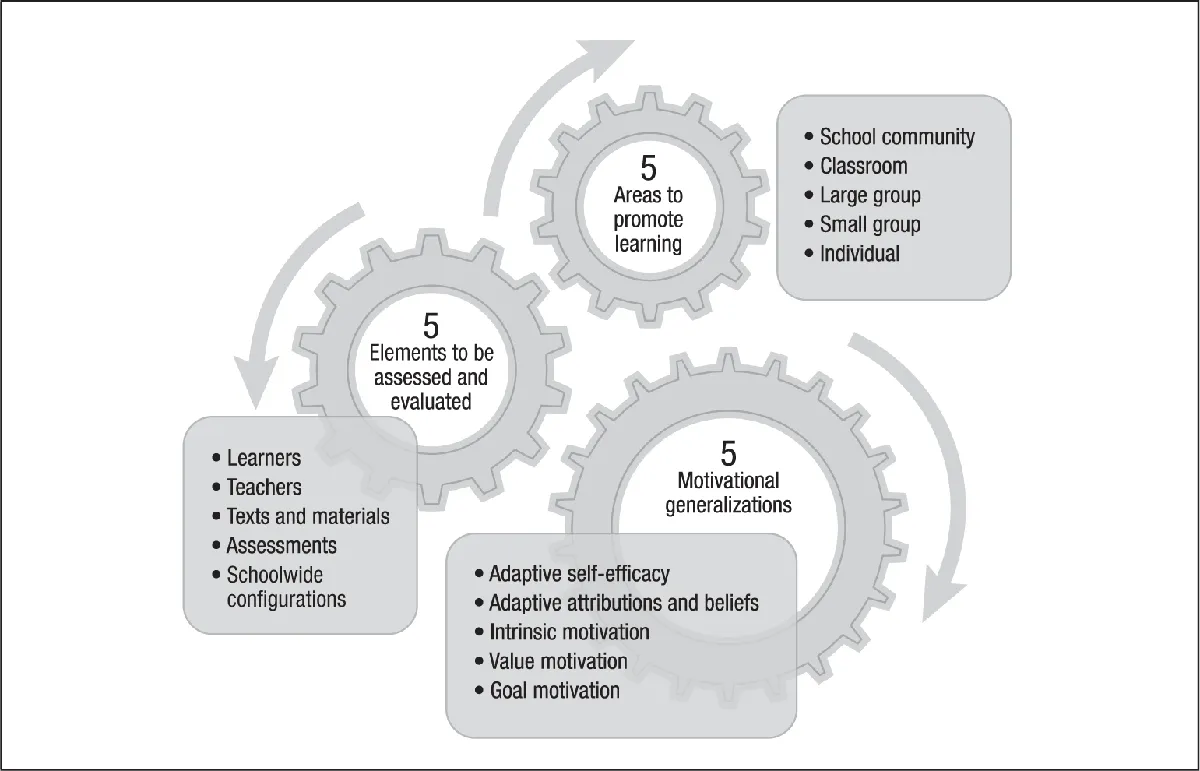
Opitz and Ford's (2014) review of the research and reflection on their own experiences led them to conclude that joy has everything to do with learning. What also became clear is that understanding why joyful learning is so important left questions about how to implement it unanswered. They saw the need to create a framework that would help teachers make decisions about joyful learning more systematic, intentional, and purposeful. The resulting framework consists of three parts (see Figure 1.1):
- Five motivational generalizations: adaptive self-efficacy and competence beliefs, adaptive attributions and beliefs about control, higher levels of interest and intrinsic motivation, higher levels of value, and goals.
- Five elements that need to be assessed and evaluated in order to get the most from joyful learning: learners, teachers, texts and materials, assessments, and schoolwide configurations.
- Five key areas in which to promote joyful learning: school community, physical environment, whole-group instruction, small-group instruction, and individual instruction.
FIGURE 1.1. Joyful Learning Framework
Source: From Engaging Minds in the Classroom: The Surprising Power of Joy (p. 14), by M. F. Opitz and M. P. Ford, 2014, Alexandria, VA: ASCD. © 2014 ASCD. Reprinted with permission.
This framework is the basis for planning and teaching and learning, to which we have applied our own research and experience in teaching math and science. To offer a practical extension of joyful learning, we also identify teaching activities in each of the five areas that are compatible with what we have learned (see Chapter 3), to illustrate how the framework comes to life in a classroom.
Motivation, Engagement, and Joy in Mathematics and Science
Joyful learning is strongly connected to "better" learning. In a recent study of middle school science students, Liu, Horton, Olmanson, and Toprac (2011) found a quantifiable relationship between student enjoyment of an activity and increases in content knowledge. Similarly, factors related to joyful learning are also critical to learning elementary and middle school mathematics (Schweinle, Meyer, & Turner, 2006).
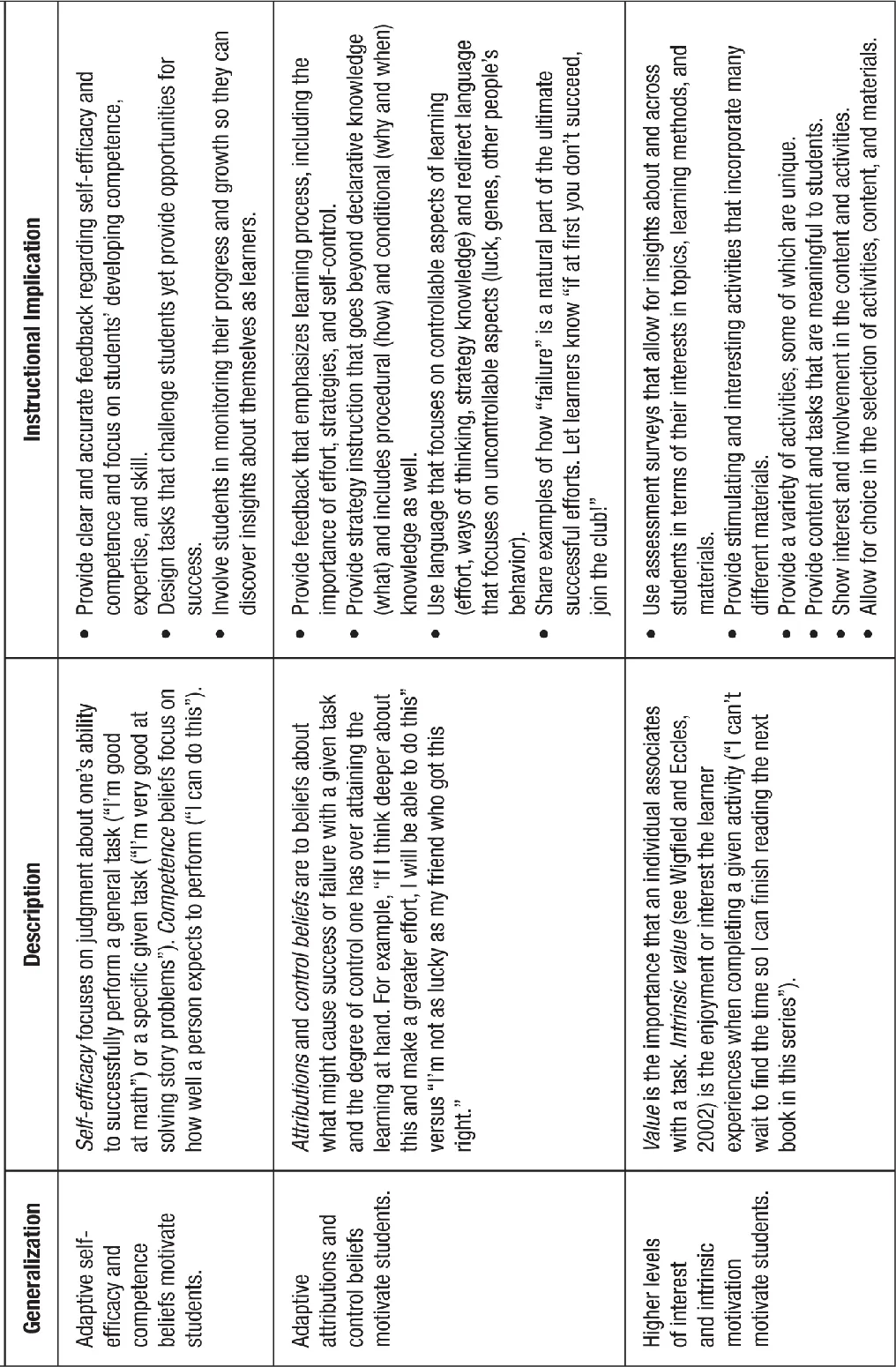
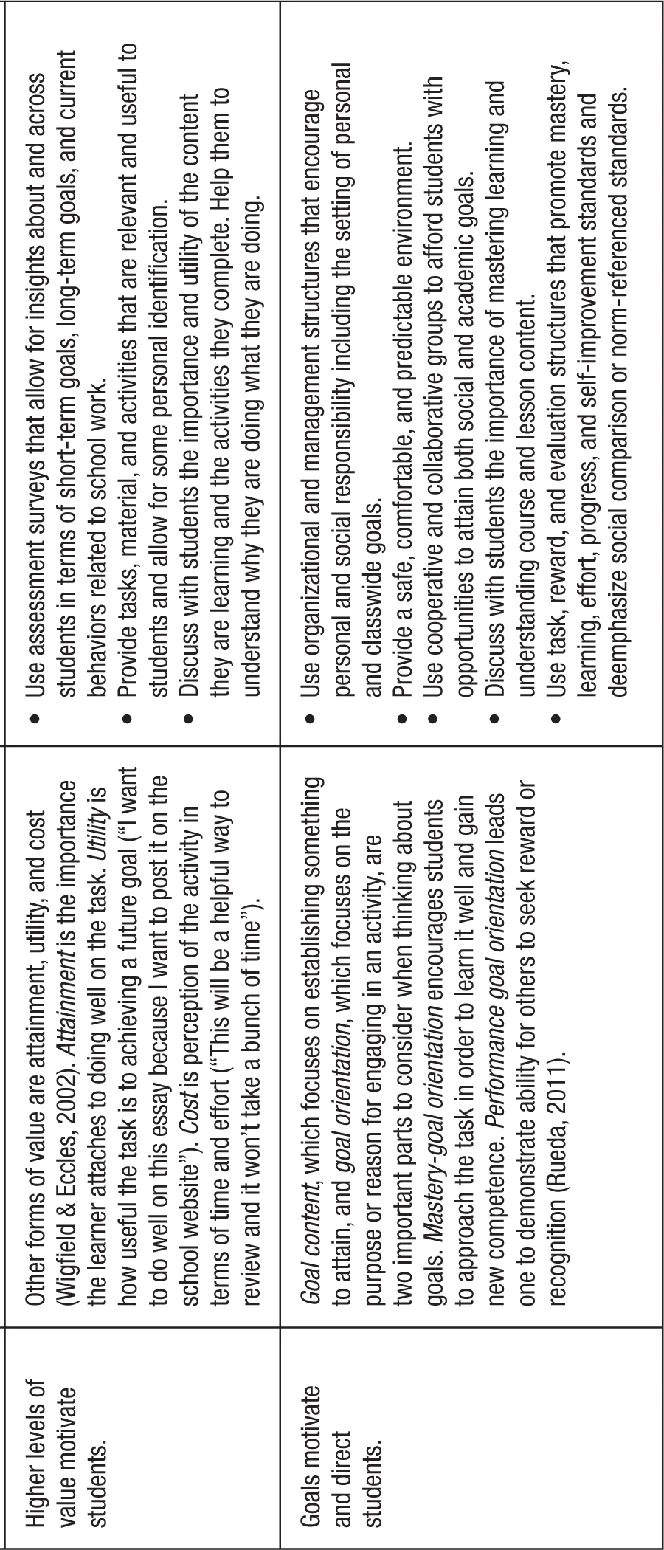
Opitz and Ford (2014) suggest that joyful learning begins with students who are motivated and engaged. Factors that influence motivation include self-efficacy and competence beliefs, attributions and control beliefs, interest and intrinsic motivation, perceptions of value, and goal orientation (see Figure 1.2). Self-efficacy is a measure of students' confidence in their ability to master a new skill, task, or content. Self-efficacy in one domain (e.g., science) can be different from the student's self-efficacy in another domain (e.g., math).
FIGURE 1.2. Generalizations About Motivation, and Instructional Implications
Source: From Engaging Minds in the Classroom: The Surprising Power of Joy (p. 12–13), by M. F. Opitz and M. P. Ford, 2014, Alexandria, VA: ASCD. © 2014 ASCD. Reprinted with permission.
Engagement—being attentive, committed, persistent, and seeking meaning—is closely related to motivation and often seen as the visible outcome of motivation. A five-year National Science Foundation (NSF) project (Fast et al., 2010) focusing on upper elementary mathematics found that many of the factors related to motivation and engagement are intertwined and have a positive influence on student achievement:
Students who perceived their classroom environments as more caring, challenging, and mastery-oriented classrooms had significantly higher levels of math self-efficacy than those in less caring, challenging, and mastery-oriented classrooms. In addition, we found that higher levels of math self-efficacy positively affected student math performance. (p. 736)
The NSF researchers found that "perceptions of the classroom environment indirectly affect math performance through self-efficacy [suggesting] that what teachers do in the classroom matters" (p. 738). Pintrich, Marx, and Boyle (1993) had also noted much earlier that students' motivational beliefs about themselves as learners (i.e., interests, goals, values, self-efficacy, and control beliefs) play an important role in science learning.
Implications for Teaching Science and Mathematics
The way that you approach teaching mathematics and science influences students' motivation, engagement, and self-efficacy. Understanding how to build on students' personal interests or generate situational interest can help you create a classroom culture where students' learning goals are focused on understanding concepts. Students' perception of the challenge of a learning task also affects their motivation, so we will discuss how you can minimize math anxiety. In addition, teacher feedback and student self-reflection (metacognition) can enhance self-efficacy and other affective factors.
Build on Student Interest
Andre and Widschitl (2003) described interest as either personal or situational. Personal interest is interest that occurs outside the classroom. Situational interest is generated within a specific classroom context (e.g., using a "hook" during instruction). Instruction that focuses on essential questions related to students' lives and authentic concerns increases student interest. In addition, providing opportunities for dialogue and sense making during class (as opposed to the unproblematic absorbing of information), using multiple representations of concepts, and allowing students to express their understanding using a variety of modes increase student interest.
The day after his 8th grade science students learn that bacteria would not grow in small areas around certain spices, Alex Martinez engages them in a sense-making activity. He starts class with the prompt "Cultures in warmer climates tend to cook with more spices than those in cold climates. Researchers also found that meat dishes use more spices than vegetable dishes. Why do you think this is the case?" Students discuss this in small groups and then write arguments that include a claim and supporting evidence. Although they do not yet use the scientific vocabulary, Mr. Martinez's students in effect use evidence from the laboratory to explain the concept of a zone of inhibition.
Focus on Mastery Goals
Although students' goals related to learning are multifaceted, they can generally be classified as either a mastery goal or a performance goal. Students as a group exhibit characteristics of both orientations, with individuals leaning more strongly in one direction than the other. Students who lean toward a mastery-goal orientation focus on learning and understanding content; they care more about understanding the topic than the grade they receive. Students with a performance-goal orientation focus on demonstrating their ability relative to others; they want an A, but don't really care if they understand the content. Linnenbrink and Pintrich (2003) found that students with mastery-goal orientation show greater science learning gains than those with a performance-goal orientation. Similar findings have been found in learning mathematics (Blackwell, Trzesniewski, & Dweck, 2007).
To promote mastery goals, emphasize learning and create situations where students can make choices and feel autonomous. Recognizing students for improvement also can help promote the adoption of mastery goals. Classrooms where teachers use normative grading and recognize students or their performance relative to others promote performance goals (Linnenbrink & Pintrich, 2003).
Tanya Schaffer challenges her 6th grade students to apply their understanding of mathematics to an authentic task from the website Math by Design—and her lesson incorporates choice and autonomy. Students can work individually or in small groups. They can choose between the website's two projects: designing a community park or an environmental center. Because the tasks involved in the scenarios do not have obvious solution pathways, students also have to choose how to solve the tasks. At the conclusion, Ms. Schaffer's students respond to a series of questions that focus on the mathematical concepts underlying their decisions. With this project, Ms. Schaffer effectively promotes her students' mastery goals, keeping the emphasis on their learning and progress over getting a "correct" answer.
Establish Appropriate Level of Challenge
A rewarding activity in math or science needs to be at an appropriate difficulty level so that students perceive that they have the skills to accomplish it. Students can quickly become unmotivated and disengaged if the challenge level and skill level are out of balance (Csikszentmihalyi & Nakamura, 1989). Schweinle and colleagues (2006) found that elementary students often perceive more challenging math problems as threatening, which can lead to decreased self-efficacy and increased math anxiety. O'Donnell's review of common practices among successful mathematics teachers (2009) provided a series of tips for helping students approach challenging mathematics activities. Her findings included activities that reinforce mastery, such as having students clarify their ideas, and asking questions that prompt deeper understanding; having students distill others' ideas or explanations; offering different representations of concepts; and embedding time in the lesson to allow students to digest new information or formulate ideas.
Sandra Kim has noticed that some students in her combined 2nd/3rd grade are struggling with the concept of regrouping during subtraction and addition problems and becoming frustrated. To allow students to use different representations of the problem and explore their own reasoning and that of their classmates, she introduces a "banking" activity. She gives some students (the "bankers") full sets of manipulatives consisting of multiple flats (equivalent to 100 blocks), rods (equivalent to 10 blocks), and individual blocks. The remaining students are paired up; one student from each pair has two rods and a flat (value: 120 blocks). Ms. Kim instructs these students to give their partners exactly 35 blocks. When they complain that it is not possible, she acts surprised: "But don't you have 120? Why can't you give your partner 35?"
She displays the problem (120 − 35) on an interactive whiteboard, which also includes images of base-10 blocks. The pairs of students work with bankers to make exchanges that will allow them to subtract the correct number of blocks; Ms. Kim shows the regrouping on the board, using both numbers and the virtual manipulatives. Afte...