Research confirms that the teacher makes the greatest difference in the learning success of students, so it's important that new teachers get off to a strong start. With help from veteran teacher and mentor Gini Cunningham, inexperienced teachers can better understand and successfully tackle the many daily challenges they will face in the classroom: /p>*Setting up classroom procedures and managing class time*Coordinating standards, curriculum, and textbooks*Developing manageable lesson and unit plans*Handling discipline problems and engaging students in learning*Using effective assessment practices and monitoring student achievementTeaching is a physically and emotionally demanding career, but Cunningham's practical advice and memorable anecdotes will help teachers prepare for and enjoy their work--even on the most difficult days. And administrators can use this accessible guide to support new professionals and avoid early burnout. The New Teacher's Companion is a valuable resource for any teacher who wants the classroom to be a rich and rewarding place for teachers and students alike.
eBook - ePub
The New Teacher's Companion
Practical Wisdom for Succeeding in the Classroom
- English
- ePUB (mobile friendly)
- Available on iOS & Android
eBook - ePub
About this book
Information
Topic
EducationSubtopic
Education GeneralChapter 1
Teaching—It's More Than a Job, It's Magic
Ideally, administrators have a vision for each new teacher they hire, characterized by teaching excellence and high levels of student achievement. In turn, new teachers need a clear vision for their teaching plans and the learning success of all students. Acknowledging beliefs about students and learning and establishing goals for student achievement help to refine instructional effort and turn the vision into reality.
By examining personal beliefs and goals and creating a vision, teachers clarify where they are headed so that they can efficiently design how to get there. This self-analysis and additional discussion with colleagues and administrators solidify the vision while creating positive school relationships.
The Challenge
I was loading cases of pop for the vending machine onto a cart in the tiny storage room when the disaster occurred. As I pulled one of the cartons down from the high stack, it ripped open, and soon one falling can led to another until soda was spewing everywhere around the room, dripping off the ceiling, dribbling down the walls, and puddling across the floor. There I stood, Dr Pepper trickling down my legs and off my nose and hair and a splattered display across my dress. If I had planned it, I could not have created a bigger, stickier mess! And the worst part was that all of this came on the heels of one of the most disappointing days of my teaching career.
A student had been withdrawn from my class. It sounds simple, but it was so terrible to have him removed from my roll. He was a very bright boy, but we had butted heads several times over assignments and classroom rules. The final blow came when he walked between idling school buses instead of going around them on our return from the public library. In this case, his disregard of the rules was simply dangerous.
To make the situation even more heart-wrenching for me, he was the son of teacher-colleagues. I really wanted to make things right with him. To have him leave my classroom reflected failure in my teaching, even though his parents had told me, "It is for the best." This stubborn streak, an inability to admit defeat, is something that runs deep in me. Sticking to it (literally and figuratively) is how I operate, even though this attitude is not always for the best.
As my anguished tears began to tumble and mix with my view of the mess in the storage room, I reevaluated my position and wondered about any other possible job that would not break my heart. At that precise instant coworker Todd Holden waltzed into the messy pool with a booming "Howdy!" His warm smile disintegrated into dismay as he surveyed the catastrophe. "How can I help?" he kindly asked. Those words of support changed my day and reversed my attitude almost immediately.
Lessons Learned
Teaching does not always run perfectly, but with reflection and the support of friendly colleagues, it all can be made right. Every day is a day of learning for students and teachers alike. On that day I learned to handle disappointments by facing them and then moving forward doing something I love—teaching. Realizing I could not please everyone all the time, I did know that I could make a difference for students who needed the knowledge and skills of reading, writing, and thinking I offered. That is what this profession is all about—teaching children, learning with them and from them, and accepting the responsibility of making a difference for their futures.
Planning for Excellence in Teaching
Being a teacher is far more than a job, a duty, or a paycheck. It is a calling. This calling provides the opportunity to work with learners as they advance through school. Teachers watch students grow and develop intellectually, guiding them as they tackle new concepts and ideas and leading them as they become self-sufficient and independent learners. The lessons that are taught, the methods that are incorporated, and the attitudes of teachers toward their students and toward learning have a lasting influence on life.
Teaching is definitely hard work. From preschoolers to seniors in high school, despite the difference in age, all students are just children full of potential and curiosity, waiting for their teacher to empower their learning and extend their knowledge. Good instruction from teachers who care promotes success in learning.
Vision for Teaching and Learning
Good teachers come to school and teach students who learn a little. Great teachers have clear goals and a big vision for students to learn and achieve at high levels. Creating a mind map of this vision of teaching provides a foundational guide for the year. Notes and descriptions can be added and adjustments made as needed. Figure 1.1 shows components essential for successful teaching. By studying and reflecting on each one, you will be better prepared for teaching. Knowing what you want students to know and to be able to do, and how you plan to get it done, guides you in a direction to arrive at the final destination—successful student learning.
Figure 1.1. The Big Vision of Teaching
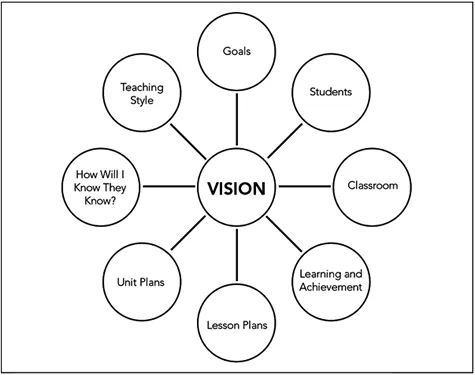
As you reflect on various components of the vision, consider questions such as these:
- Why is this important?
- How will I get this accomplished?
- What problems might I encounter and when?
- What indicators will tell me I have succeeded?
This vision acts as a reminder of the broad scope of responsibilities to be addressed during the school year.
Reflecting on the elements of the vision provides the self-knowledge necessary to fill in a sample chart, such as the one presented in Figure 1.2. In addition to your vision, use the basic grid to capture your beliefs, goals, and hoped-for achievements. Of course, experiences and unforeseen surprises will suggest changes as your first year of teaching progresses. The first year (and every ensuing year) will be bursting with learning. A truly great teacher learns and grows every day.
Figure 1.2. Sample Vision, Belief, Goals, and Achievement
Vision of Myself and My Teaching
- The classroom is organized.
- I understand the standards.
- I'm ready to teach.
- I have a sense of sanity because I have succeeded.
- I'm immensely smarter because of this experience.
Vision of My Students as They Learn
- Students are eager, excited, exhilarated by learning.
- Learning goals are accomplished at all levels.
- Students are independent learners and willing to challenge themselves.
Beliefs About Myself
- I can meet any challenge.
- I know and understand students, learning, and teaching.
- I know where to get help and when to ask for it.
- I will be a better person as a result of teaching students.
Beliefs About My Students and Learning
- All students are capable of learning.
- Students want to learn.
- All students want to succeed.
- Students need me.
Goals for Myself
- Teach and reach all students.
- Grow and develop teaching skills every day.
- Feel successful in what I have taught.
- Learn every day—from students, peers, reading, research, writing.
Goals for My Students
- All students will grow as learners.
- Students will expand their love of learning.
- Students will expand their academic knowledge.
- Students will gain skills and understand concepts that will bring them lifelong success.
How Will I Achieve It All?
- Have clear lesson and unit plans.
- Adjust lessons to meet the needs of my students.
- Assess during lessons so no student is lost.
- Learn everything I can about being a great teacher.
How Will I Help Every Student Achieve?
- Teach great lessons.
- Provide well-planned assessments.
- Constantly analyze lessons and learning.
- Carefully use the pacing calendar and curriculum so that learning goals can be met.
Although the detailed responses of different individuals will vary, the ultimate goal is always the successful learning of students through excellent instructional strategies and guidance by the teacher. Planning as well as reflection on vision and goals add certainty to success.
"These darn kids. They just do not want to learn!""By golly, I taught it, and still 20 out of 23 failed the test!""I'm counting the days until spring break. This is the worst bunch of students I have ever had!"If vacation is the only thing on a teacher's mind and the thought is not just the result of the exhaustive effort poured into every teaching moment, perhaps it is time to seek another job. If you hear negative words muttered by disgruntled colleagues, the best thing to do is to run! You must teach the students you have with the abilities and background that they possess when they arrive in your classroom. When you believe that every one wants to learn and succeed, you will find that students reflect your optimism.Every day in teaching, whether it is the most glorious or the toughest, is critical to the success of students. When you expect the best behavior, intellectual output, and scholarly interaction, your goals are more likely to be achieved. Faith in students' capabilities and their desire to grow empowers students as it strengthens your talents and expertise.Amber was a lovely little 1st grader, full of smiles but low in confidence. In kindergarten she had been labeled as a slow learner. Although the teacher had tried to disguise labeling, Amber sensed it, lived it, and suffered.Amber's new teacher demanded excellence while designing avenues of individualized learning to help students succeed. Each day Amber gained more confidence. In mid-September, she pulled her teacher aside and whispered, "Mrs. Janhunen, when I got here I wasn't very smart. But you are making me smart. Thanks." Then Amber gently kissed her teacher's hand.
Responsibility and Teaching
As you think about the various factors that affect the elements in the grid in Figure 1.2, a critical question to ask yourself is this: Are you responsible enough to be a teacher who makes a difference in the lives and learning of children?
The goal is not to be an all-right teacher or a good teacher, but the absolute best. To determine this, take the following true-or-false test. (Oh, yes. As a teacher you must love to take tests as well as give them!) The thinking behind each answer reveals much about you, your vision, and your beliefs about teaching.
Teachers are 100 percent responsible for
- Being organized and prepared for every lesson, every day.
- Preparing instruction that ensures learning for all.
- Designing lessons that educate students.
- Checking for understanding throughout the lesson.
- Finding and implementing a variety of activities, strategies, and teaching methods.
- Accepting that all students do not learn the same way or at the same rate.
- Reteaching as needed to help all students learn.
- Enriching each lesson to captivate and motivate learners.
- Caring deeply for every student.
- Realizing that some things just do not work, even with the best of planning.
- Picking up the pieces, loose ends, confusion, and misconceptions of learning and then uncovering ways to correct them.
- Starting each day fresh, excited, and dedicated to students.
- Ending each day by looking forward to tomorrow with enthusiasm and dedication.
- Knowing that what they say, do, teach, and model affects every student now and forever.
- Believing that no other job is as important as being a teacher.
Knowing that you have responded to each statement with a "true," I've saved the toughest question for last. True or false? Teachers are 100 percent responsible for
- Making all students learn.
Finally, a false! This one is impossible. No teacher can force students to do anything. However, students are relying on the expert knowledge and dedicated instruction of their teacher to help them learn. No child wants to be a failure or to appear incapable. Your students depend on you.
I spent many years "forcing" students to learn. Even though in my heart I knew that they had to want to learn, to see the value of learning, I still pushed them hard—almost relentlessly. With experience I figured out that I needed to provide students with more ways to own their learning, through opportunities like self-selected reading and writing for reflection on learning. With prodding and encouragement, my students grew in independence and competence, knowing that I not only acted as a guide for learning but also honored and respected their insight and feedback. When you ask your students about what they know, you receive so much information in return.
Owning learning is evidenced when students are allowed to solve problems, explain events, and create products that demonstrate their understanding. Allowing students to own their learning means that you must be ready to accept multiple ways of discovering answers—answers that are not necessarily the same but that are plausible, or responses that with adjustments to correct misconceptions lead to learning that develops independence. In math class, owning learning might be demonstrated through multiple ways of solving a problem; in poetry it might be evident in different interpretations of the author's meaning; in woo...
Table of contents
- Cover
- Table of Contents
- Dedication
- Foreword
- Acknowledgments
- Introduction
- 1: Teaching-It's More Than a Job, It's Magic
- 2: You've Got the Job! Now Deal with the Business Details
- 3: Standards, Curriculum, and Textbooks
- 4: Classroom Management
- 5: Meaningful Rewards and Awards
- 6: Procedures and Schedules for Flawless Classroom Operation
- 7: Lesson Plans and Unit Plans: The Basis for Instruction
- 8: Time Management
- 9: Every Moment Counts: Strategies for Student Engagement
- 10: Questions to Activate Thinking and Ignite Learning
- 11: Grading, Student Achievement, and Student Self-Evaluation
- 12: Final Notes for Teaching Success
- Appendix A
- Appendix B
- References
- Resources
- About the Author
- Study Guide
- Copyright
Trusted by 375,005 students
Access to over 1.5 million titles for a fair monthly price.
Study more efficiently using our study tools.
Frequently asked questions
Yes, you can cancel anytime from the Subscription tab in your account settings on the Perlego website. Your subscription will stay active until the end of your current billing period. Learn how to cancel your subscription
No, books cannot be downloaded as external files, such as PDFs, for use outside of Perlego. However, you can download books within the Perlego app for offline reading on mobile or tablet. Learn how to download books offline
Perlego offers two plans: Essential and Complete
- Essential is ideal for learners and professionals who enjoy exploring a wide range of subjects. Access the Essential Library with 800,000+ trusted titles and best-sellers across business, personal growth, and the humanities. Includes unlimited reading time and Standard Read Aloud voice.
- Complete: Perfect for advanced learners and researchers needing full, unrestricted access. Unlock 1.5M+ books across hundreds of subjects, including academic and specialized titles. The Complete Plan also includes advanced features like Premium Read Aloud and Research Assistant.
We are an online textbook subscription service, where you can get access to an entire online library for less than the price of a single book per month. With over 1.5 million books across 990+ topics, we’ve got you covered! Learn about our mission
Look out for the read-aloud symbol on your next book to see if you can listen to it. The read-aloud tool reads text aloud for you, highlighting the text as it is being read. You can pause it, speed it up and slow it down. Learn more about Read Aloud
Yes! You can use the Perlego app on both iOS and Android devices to read anytime, anywhere — even offline. Perfect for commutes or when you’re on the go.
Please note we cannot support devices running on iOS 13 and Android 7 or earlier. Learn more about using the app
Please note we cannot support devices running on iOS 13 and Android 7 or earlier. Learn more about using the app
Yes, you can access The New Teacher's Companion by Gini Cunningham in PDF and/or ePUB format, as well as other popular books in Education & Education General. We have over 1.5 million books available in our catalogue for you to explore.