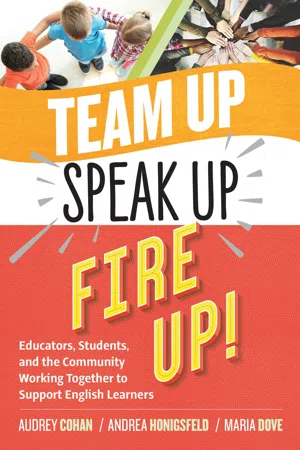
Cohan, Honigsfeld, and Dove bring together current research, authentic examples of best practices, and voices from the field to champion the power of purposeful collaboration and provide educators with resources that will empower them to support English learners (ELs) and their families. Guided by four core principles (common purpose, shared mindset, diverse team membership, supportive environment), the authors explain how to meet the challenges of collaborating with ELs and help all stakeholders—administrators, teachers, students, parents, community leaders—develop new and effective ways of working together for the success of each learner.
eBook - ePub
Team Up, Speak Up, Fire Up!
Educators, Students, and the Community Working Together to Support English Learners
- 176 pages
- English
- ePUB (mobile friendly)
- Available on iOS & Android
eBook - ePub
Team Up, Speak Up, Fire Up!
Educators, Students, and the Community Working Together to Support English Learners
About this book
Information
Topic
EducationSubtopic
Education Theory & PracticeChapter 1
The Power of Teamwork
. . . . . . . . . . . . . . . . . . . .
"But all that we do is not enough."Two weeks before the start of the new academic year, a large group of newly hired teachers spent the second morning of a three-day teacher orientation in conversations about the policies, programs, best practices, and resources concerning the school's large population of English learners (ELs). Their principal, Dr. Zoe Carrasco-Hernandez, began the morning meeting by outlining the federal, state, and local mandates for serving ELs; inviting discussions and feedback from the faculty; and sharing her strong commitment to careful curriculum planning and instructional designs for the success of this student population.Dr. Carrasco-Hernandez recounted how she strives to create a welcoming environment for ELs and their families, beginning each day by greeting them in as many languages as possible as they enter the building alongside teachers and administrators and visiting a number of classes each morning to have direct contact with teachers and students. She described how she instituted the use of a self-paced computer program for teachers and staff to develop basic communicative skills in languages other than English, and she even spoke a few sentences in Japanese to demonstrate her own progress in the program. Dr. Carrasco-Hernandez also shared how she maintains a collaborative decision-making philosophy and explained how she confers regularly with her teacher and leadership teams, as well as with parents and community leaders, with a particular emphasis on ELs. Then she paused for a moment and added, "But all that we do is not enough."We wonder what the teachers must have been thinking, and how they might have been feeling, when Dr. Carrasco-Hernandez uttered, "But all that we do is not enough." Interestingly, what happened next came as quite a surprise to all in attendance.Dr. Carrasco-Hernandez invited the new teachers to participate in a walking tour of the nearby community. The teachers, most of whom were unfamiliar with the neighborhood, walked together with the principal down to the main street in the town, and they all began to make selected stops at shops and businesses along the way. The teachers were impressed with how the community welcomed them as they walked alongside Dr. Carrasco-Hernandez and at how many people seemed to know the principal well. When the group returned to the building and settled in, Dr. Carrasco-Hernandez summarized their afternoon experience by simply saying, "Don't settle for simply what you can do with the students in your classroom or in this school; we—the administrators, faculty, and staff working together—must go into the greater community and must become an integral part of its fabric."
This book was born out of our passion and shared commitment over decades of our research, practice, and advocacy on behalf of ELs and their families. Our greatest takeaways from this commitment have been our interactions with many diverse people and their cultures, through which we have learned about their challenges and perseverance, hard work and commitment to education, beat-the-odds attitude often in the face of adversity, sense of community, and desire to learn. We have been humbled to see families who gave everything up to start their lives over for a better future for their children. Yet, we have always seen our work as a two-way street: we have dedicated our professional lives to English learners and have received so much more in return. Though we have written on this topic extensively, our goal is to offer our most compelling framework for advocacy and positive, authentic practices that will benefit ELs as well as all members of the school community. That's why the title of this book is Team Up, Speak Up, Fire Up!
The English Learner Landscape
Approximately 10 percent of all school-age children are English learners, with the highest concentration in California, Texas, Florida, New York, and Illinois, which combined total 60 percent of K–12 students (OELA, 2018). Ryan (2013) cited the 2011 Census Bureau data to report the top 10 languages spoken in U.S. households other than English are Spanish, Chinese, French, Tagalog, Vietnamese, Korean, German, Russian, Italian, and Portuguese. When looking at the top 10 languages spoken by English learners in the K–12 setting across the United States, a very different picture emerges, with the ranking being Spanish, Chinese, Arabic, Vietnamese, Haitian/Haitian Creole, Somali, Tagalog, Hmong, Portuguese, and Russian (Office of English Language Acquisition, 2017). Although language patterns in schools and heritage languages in neighborhoods may significantly vary from place to place, advocacy on behalf of multilingual communities must be a top priority.
Successful Teaming and Collaboration
Do you, as educators, ever wrestle with how to change the ways that many people feel about English learners and their families? When you work with colleagues or community members, do you focus on the individuals, their personalities, their different experiences and preferences, or the special synergy that emerges in the room? We have found that a team is always more than the sum of the individuals who make up the team.
We have also found that successful teaming depends heavily on four core principles that form the foundation of teamwork—common purpose, shared mindset, diverse team membership, and supportive environment. While there are many other contributing factors and variables that influence the formation of successful teams, these four principles help establish, build, and sustain teamwork from the bottom up. We derived these principles from multiple cross-referenced sources—the growing body of professional literature focusing on teaming, collaboration, and co-teaching, our collaborative research, and the practitioner knowledge and actions developed over decades of experience in the field of education. Writing this book has also been enriched through observing, interviewing, and interacting with successful collaborative educators—locally, regionally, nationally, and internationally—who generously shared their vast knowledge and transformative experiences about teamwork in support of ELs.
When we talk about teamwork in this chapter, we define collaboration and teaming in the broadest possible sense. In each community, we advocate for establishing shared goals of equity and access to the highest quality education for English learners. As the National Education Association (2015) reminds us, we all need to be in to work collaboratively and effectively in service of a growing population of English language learners:
English language learners deserve the same right to a great public school education as their English-speaking peers. They deserve access to a rich curriculum and validation of their home language and culture. They deserve educators who are trained to teach them, schools that welcome their families, and fair funding. They deserve an education community that shares a sense of urgency and responsibility for their well-being. They deserve the best we have to give them. These are America's students, and the nation can't afford to let them down. (p. 5)
In this book, we make the case for collaboration and show readers how to use it to provide access to high quality instruction and enriching learning experiences. English learners and their families need educators to work together. Therefore, consider this a call to team up to be fully inclusive and engage all students so they may live up to their unlimited potentials. Let's speak up when biases, prejudices, and deficits dominate the conversation and replace them with asset-based points of view and advocacy. Let's fire up others who might not yet recognize the strengths of all families and communities nor understand how this ever-growing student population is the future of our school systems. We need the talents, voices, and full participation of English learners.
Why Collaborate?
Have you ever said or heard anyone say, "It's faster if I just do it by myself"? When you are in a rush, when the task seems formidable, when resources are short, when getting a team together may take longer than getting the job done, what is your default decision? Is it easier to work alone at times than get others on board? We recognize these feelings and reactions may apply to a range of personal and professional choices that we make every day. Yet, when we collaborate, we have instant access to others' ideas. Woodrow Wilson famously said, "I not only use what brains I have but all I can borrow." When we collaborate, we form a multilevel support system that
- ➤ Combines expertise,
- ➤ Nurtures new and creative ideas,
- ➤ Makes task completion more efficient and effective,
- ➤ Offers feedback on the process and outcomes,
- ➤ Enhances motivation, and
- ➤ Creates opportunities for reflection.
The list goes on, but to achieve all these outcomes, we need to intentionally create and sustain a support system, as impactful teamwork does not just happen by itself. We must add a focus on underserved or marginalized students—together, as a team—to provide these students and their families with unparalleled opportunities inside and outside of the classroom.
Consider This
Have you ever thought of how members of the English learner community feel when
- ➤ A kindergartener walks into a new classroom where no one speaks her language and the sights and sounds feel overwhelming?
- ➤ A child walks into the cafeteria and nothing looks or smells familiar or even appetizing?
- ➤ A young man walks through the community and for the first time after taking some English classes, can read most of the store signs and street signs?
- ➤ The national headlines decry your race or religion with such frightening intensity that your family questions their decision to come to the United States?
- ➤ A refugee family arrives at the airport and is escorted to their new apartment, which was furnished by neighborhood parents and children they never met?
- ➤ A teacher becomes known in the community as a resource and trusted ally for navigating the home-to-school experience?
These examples may very well represent a cross-section of experiences that are common among immigrant children or children of immigrants and their families. The formidable task of responding to these challenges cannot fall on one person's shoulders. Rather, forming positive relationships and working in teams in the classroom, in the school, and in the larger community will create acceptance, plausible solutions to day-to-day challenges, a sense of belonging, and pathways to academic and linguistic success. Don't take our word for it. See the "Research to Watch" sections for examples of current findings on the importance of collaboration.
Research to Watch
- ➤ The National Education Association (NEA) (2015) reiterated their position statement from 50-odd years ago suggesting that there continues to be "a profound lack of urgency and understanding in the way in which schools perceive and educate ELL [English language learner] students" (p. 4). Yet, promising research reveals that through teacher collaboration, educators develop and embrace a shared responsibility for all learners.
- ➤ Epstein and Associates (2019) have been researching school–community partnerships for more than 30 years. They strongly recommend creating action teams for partnerships. Who should be on an action team? "Everyone with an interest in student success has a role to play in conducting productive partnership activities" (p. 87).
- ➤ Hattie (2015) has documented the importance of collaborative expertise among educators. He noted that a significant barrier to student learning is within-school variability. Meaningful teacher collaboration—such as shared exploration of successful instructional strategies, student data, and teaching practices—is imperative. When teachers collaborate, their collective efficacy—their belief in their shared effectiveness on impacting student outcomes—increases (Eells, 2011; Hattie, 2018).
Table of contents
- Cover
- Title Page
- Table of Contents
- Praise for Team Up, Speak Up, Fire Up!
- Dedication
- Foreword
- Preface
- Acknowledgments
- Chapter 1. The Power of Teamwork
- Chapter 2. Winning Student Teams in the Classroom
- Chapter 3. Teachers and Students on the Same Team
- Chapter 4. Teacher Teams at Their Best
- Chapter 5. Fired Up to Support ELs: Teams that Extend Beyond the Classroom
- Conclusion
- Bibliography
- About the Authors
- Related ASCD Resources
- Study Guide
- Copyright
Trusted by 375,005 students
Access to over 1.5 million titles for a fair monthly price.
Study more efficiently using our study tools.
Frequently asked questions
Yes, you can cancel anytime from the Subscription tab in your account settings on the Perlego website. Your subscription will stay active until the end of your current billing period. Learn how to cancel your subscription
No, books cannot be downloaded as external files, such as PDFs, for use outside of Perlego. However, you can download books within the Perlego app for offline reading on mobile or tablet. Learn how to download books offline
Perlego offers two plans: Essential and Complete
- Essential is ideal for learners and professionals who enjoy exploring a wide range of subjects. Access the Essential Library with 800,000+ trusted titles and best-sellers across business, personal growth, and the humanities. Includes unlimited reading time and Standard Read Aloud voice.
- Complete: Perfect for advanced learners and researchers needing full, unrestricted access. Unlock 1.5M+ books across hundreds of subjects, including academic and specialized titles. The Complete Plan also includes advanced features like Premium Read Aloud and Research Assistant.
We are an online textbook subscription service, where you can get access to an entire online library for less than the price of a single book per month. With over 1.5 million books across 990+ topics, we’ve got you covered! Learn about our mission
Look out for the read-aloud symbol on your next book to see if you can listen to it. The read-aloud tool reads text aloud for you, highlighting the text as it is being read. You can pause it, speed it up and slow it down. Learn more about Read Aloud
Yes! You can use the Perlego app on both iOS and Android devices to read anytime, anywhere — even offline. Perfect for commutes or when you’re on the go.
Please note we cannot support devices running on iOS 13 and Android 7 or earlier. Learn more about using the app
Please note we cannot support devices running on iOS 13 and Android 7 or earlier. Learn more about using the app
Yes, you can access Team Up, Speak Up, Fire Up! by Audrey Cohan,Andrea Honigsfeld,Maria G. Dove in PDF and/or ePUB format, as well as other popular books in Education & Education Theory & Practice. We have over 1.5 million books available in our catalogue for you to explore.