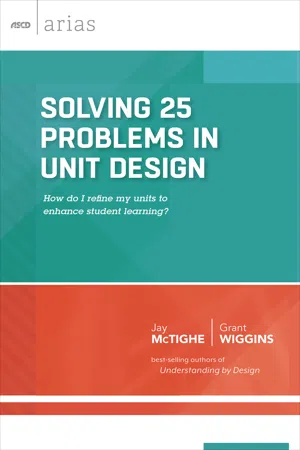
Curriculum design experts Jay McTighe and Grant Wiggins have reviewed thousands of curriculum documents and unit plans across a range of subjects and grades. In this book, they identify and describe the 25 most common problems in unit design and recommend how to fix them--and avoid them when planning new units. McTighe and Wiggins, creators of the Understanding by Design ® framework, help you use the process of backward design to troubleshoot your units and achieve tighter alignment and focus on learning priorities. Whether you're working with local or national standards or with other learning goals, you can rely on their practical and proven solutions to promote deeper and better learning for your students.
eBook - ePub
Solving 25 Problems in Unit Design
how do I refine my units to enhance student learning? (ASCD Arias)
- 64 pages
- English
- ePUB (mobile friendly)
- Available on iOS & Android
eBook - ePub
Solving 25 Problems in Unit Design
how do I refine my units to enhance student learning? (ASCD Arias)
About this book
Information
Topic
EducationSubtopic
Education General
Introduction
Together, we have more than 85 years of experience as professional educators. Much of this experience has involved work on curriculum design, based on a “backward design” approach that we have described in many publications. We developed the Understanding by Design curriculum design framework because we found that traditional lesson and unit plans too often failed to focus on enduring ideas and processes, promote deeper learning, engage students in authentic performance, and equip learners to transfer their learning.
Our design process proposes that effective curriculum is planned backward from long-term aims through a three-stage design process: (1) identify desired results; (2) specify assessment evidence; and (3) detail the learning plan. This backward design process helps to avoid the common twin problems of textbook coverage and activity-oriented teaching in which no clear priorities and purposes are apparent. The process helps teachers help students uncover important ideas of content while promoting meaningful student engagement around outcomes that matter.
Over the years, we have worked with thousands of teachers and design teams and reviewed countless curriculum documents and unit plans. Through our work, we have come to recognize common problems that recur in unit planning. In this book, we identify 25 of those problems, describe indications of each, offer recommendations to correct them, and suggest ways to avoid them in the future.
The book is organized around backward design: the problems are presented in the sequence of the three stages. Since we have found that many problems in unit design are multifaceted, we have referenced related problems and concomitant solutions within this publication. We have also referenced two ASCD publications, Understanding by Design Guide to Creating High Quality Units and Understanding by Design Guide to Advanced Concepts in Creating and Reviewing Units where more information on unit design can be found. Readers interested in a more thorough treatment of unit design are encouraged to consult these books and related sources.
Problems with Unit Goals (Stage 1)
Problem #1. The unit is overly activity oriented.
When reviewing unit plans or speaking with teachers about them, we frequently see (or hear about) the various activities that their students will do. Not surprisingly, activity-oriented curriculum units are familiar in the visual and performing arts, physical education, and career/technology programs. They are also commonly found in most subjects at the elementary and middle school levels.
The activities listed in these units often seem to be engaging and kid-friendly—fine qualities as long as the activities are purposefully focused on clear and important goals and if they yield appropriate evidence of important learning. We have noticed, however, that many activities are not linked to clear outcomes. In other words, they can be engaging and “hands-on” without being purposeful or “minds-on.”
Here’s how you can check to see if your unit activities are purposeful and effective:
- Show your learning activities to one or more colleagues and ask them to infer your targeted standards. Can they determine the outcomes that you intended?
- Carefully examine the student work that results from the activities. Does this work provide evidence that students have developed and deepened their understanding of important ideas and can apply their learning in meaningful ways?
- Ask yourself if the time that students spend on specific activities yield significant learning. In other words, is the juice worth the squeeze?
- Ask your students to tell you the purpose underlying the activities. Can they describe the key learning outcomes or are they merely completing the activities as directed?
If you answer “no” to any of those questions, then revise or drop the activities.
When planning a unit, try the following ideas to help focus the learning activities on worthwhile outcomes:
- Consider how students will process the activity. Why? It’s typically not the activity that causes deep learning, it’s the processing of the activity. Give students ample time to consider the meaning of the activity and ask them probing questions that will prompt them to make connections and generalizations that link to other learning and broad goals.
- Explain the purpose of the activity. If you ask students why they are doing an activity, would they know? As students work on the activity, ask them. Or use exit slips to see if the larger lessons were learned.
- Ask yourself, “What are the enduring, big ideas in this unit?” “What do I want students to really understand about this content?” “How can I best structure activities to help learners come to these understandings?”
- Think of your unit as a story and figure out the moral of it.
- Frame the content of your unit around one or more essential questions.
- Complete this statement: If students really understand this content and have developed the targeted skills, they will be able to _____________. Your answer should help you develop performance assessments that will provide evidence of students’ abilities to apply their learning.
(See Wiggins & McTighe, 2011, Module A.)
Problem #2. The unit is coverage oriented.
Covering the content is a time-honored error in planning, teaching, and assessing. It is famously mocked in the movie, Ferris Bueller’s Day Off, where the economics teacher drones on and on, answers his own questions, and seems oblivious to his bored students. As we are using the word here, coverage is a negative term.
Coverage involves marching through content, topic by topic, without opportunities for students to seriously interact with the material. What is too little appreciated is that coverage, strictly speaking, is thus not really a plan for causing learning at all. It is merely a plan for what the teacher will talk about. The “coverer” naively assumes that teaching is telling and that clear lectures or minilessons lead automatically to learning if the learners will just pay attention.
But given how people learn (by processing what they hear or read in terms of prior learning), the real need in planning and teaching for understanding is to “uncover” the material. To understand is to understand the why? the so what? and the how so? That is, the teacher must routinely stop talking to find out what students are hearing and to give them opportunities to make sense of what is being presented. Any effective plan—even when there is a lot of content to be mastered—must build over time for the students to actively “make meaning” and for the teacher to tease out inevitable learner confusions, questions, and misconceptions that straight lecturing ignores.
A unit plan features excessive or inappropriate coverage if it does not
- Include time for questions, investigations, discussions, or applications of the content. In other words, the plan is only about inputs, not how learner understanding will be achieved.
- Prioritize topics (i.e., each topic seems equivalent to the other topics and is addressed once).
- Allow genuine opportunities for students to ask and pursue in-depth inquiry. In fact, the subtle message is that questions interrupt the flow of coverage.
- Include wait time and genuine opportunities for students to ask questions.
- Deviate from the textbook pages.
- Seek evidence that students have understood what was presented; does not include formative assessments.
Here are some tips on avoiding mere coverage and engaging in uncoverage:
- Pause every 10 to 15 minutes to engage students in actively processing information.
- Include prompts, questions, activities, and formative assessments to determine whether students are “getting” what is being presented.
- Plan the unit around recurring essential questions and key performances that help prioritize the content and focus the learning.
- Code your teaching and learning events using the letters T (transfer), M (meaning making), and A (acquisition) to ensure that the M and T are emphasized, not just acquisition.
(See Wiggins & McTighe, 2011, Module A.)
Problem #3. The unit is test-prep oriented.
The pressures of high-stakes accountability testing have led many well-intentioned school administrators to encourage staff to focus teaching and assessments on those topics and skills that are likely to be tested on standardized tests. Moreover, since standardized tests primarily rely on selected-response (multiple-choice) items, this assessment format is being widely used in unit assessments. The logic is understandable: If we want students to do well on these important measures, they need lots of practice.
However, we caution against limiting the goals of a unit to only those topics and skills that may be found on external tests. To narrow the curriculum in this way undermines the intent of standards and allows important outcomes to slip through the cracks. As an example, Listening and Speaking are included in all English/Language Arts (E/LA) Standards, and yet these are typically not assessed on state/provincial tests. However, Listening and Speaking are underpinnings of Reading and Writing and need to be taught, practiced, and assessed. For example, practice in making arguments in student-led discussion enhances their ability to meet the key standards in E/LA and math on argumentation. Many other valued outcomes, including extended writing, multimedia presentation, use of technology, creative thinking, and teamwork, should be an explicit part of the curriculum and evident within unit plans.
Ironically, the widespread use of narrow, inauthentic assessments and test prep instruction can unwittingly undermine the very competencies called for by Common Core State Standards and 21st Century Skills. It is unlikely that students will be College and Career Ready or equipped to handle the sophisticated work expected in higher education and in much of the workforce if teachers simply march through a coverage of discrete grade-level standards and assess learning primarily through multiple-choice tests of decontextualized items.
Here are specific indicators that unit plans are inappropriately focused on tested content and have a narrow assessment format:
- Learning outcomes that are not featured on standardized tests do not appear in unit goals.
- Unit goals are framed as lists of discrete knowledge and skills.
- Unit assessments mimic the format of standardized tests that primarily use selected-response items (e.g., multiple choice, true or false, matching) often without adequate rigor.
- Learning activities feature lots of decontextualized learning (e.g., skill worksheets) and use of test-prep materials.
- Content is said to be important because students will “need it for the state/provincial test.”
- Bored students. Students may be compliant but unenthusiastic about their learning—test prep is not inherently interesting to most learners.
Our tips for averting this problem are straightforward:
- Focus your units around all valued outcomes, not just those things that are easily tested on large-scale tests.
- Frame the content of units around big ideas, core processes, and essential questions to focus on understanding. Think of the more discrete content objectives as the means to larger performance ends.
- Include a variety of unit assessments, including performance tasks and skill checks, not just multiple-choice items, to obtain valid evidence of understanding and transfer.
- Engage students in meaningful learning activities, including inquiry, problem-based learning, critical thinking, research, and developing authentic products and performances.
- Introduce students to the format of standardized tests, but do not fixate on it. The best test prep is engaging and meaningful learning of outcomes that matter.
(See Wiggins & McTighe, 2011, Module D.)
Problem #4. The unit targets too many standards.
A standard specifies a learning goal—what students are expected to know, understand, and be able to do—and is targeted in unit and lesson planning. A common problem in unit design, however, involves identifying too many standards as goals for a unit. The tendency to identify numerous standards is abetted by electronic unit/lesson planners containing preloaded lists of district, state, and national standards. Such software makes it easy to check off standards. Indeed, we often see unit plans that contain two to four pages of targeted standards! When too many standards are listed as outcomes, the unit loses focus and depth. It is impossible to fully address a multitude of standards in a typical unit that lasts from two to four weeks.
The root of this problem is in the distinction between standards that have been previously taught and will be applied by students within a unit and those standards that are targeted for new learning. Here is an example for a mathematics unit on fractions: During the unit, students will be adding, multiplying, and dividing fractions. Most students, however, have already learned the arithmetic procedures of addition, multiplication, and division, so those processes should not be checked as unit outcomes. More generally, prerequisite skill and knowledge should not be identified as unit goals; the unit should target new learning.
Our fix for the problem of too many standards is straightforward: Only identify those standards that will be explicitly taught and assessed within the unit. Here’s a practical way to check to see if you have too many standards in a unit plan. Show your planned unit assessments to one or more colleagues and ask them to tell you what standards or outcomes they think are the unit goals. If they can only identify a few, that feedback will enable you to drop the extraneous standards or show you that you need to add one or more assessments.
Another technique to check for a...
Table of contents
- Cover
- Title Page
- Table of Contents
- Introduction
- References
- Related Resources
- About the Author
- Copyright
Trusted by 375,005 students
Access to over 1.5 million titles for a fair monthly price.
Study more efficiently using our study tools.
Frequently asked questions
Yes, you can cancel anytime from the Subscription tab in your account settings on the Perlego website. Your subscription will stay active until the end of your current billing period. Learn how to cancel your subscription
No, books cannot be downloaded as external files, such as PDFs, for use outside of Perlego. However, you can download books within the Perlego app for offline reading on mobile or tablet. Learn how to download books offline
Perlego offers two plans: Essential and Complete
- Essential is ideal for learners and professionals who enjoy exploring a wide range of subjects. Access the Essential Library with 800,000+ trusted titles and best-sellers across business, personal growth, and the humanities. Includes unlimited reading time and Standard Read Aloud voice.
- Complete: Perfect for advanced learners and researchers needing full, unrestricted access. Unlock 1.5M+ books across hundreds of subjects, including academic and specialized titles. The Complete Plan also includes advanced features like Premium Read Aloud and Research Assistant.
We are an online textbook subscription service, where you can get access to an entire online library for less than the price of a single book per month. With over 1.5 million books across 990+ topics, we’ve got you covered! Learn about our mission
Look out for the read-aloud symbol on your next book to see if you can listen to it. The read-aloud tool reads text aloud for you, highlighting the text as it is being read. You can pause it, speed it up and slow it down. Learn more about Read Aloud
Yes! You can use the Perlego app on both iOS and Android devices to read anytime, anywhere — even offline. Perfect for commutes or when you’re on the go.
Please note we cannot support devices running on iOS 13 and Android 7 or earlier. Learn more about using the app
Please note we cannot support devices running on iOS 13 and Android 7 or earlier. Learn more about using the app
Yes, you can access Solving 25 Problems in Unit Design by Jay McTighe,Grant Wiggins in PDF and/or ePUB format, as well as other popular books in Education & Education General. We have over 1.5 million books available in our catalogue for you to explore.