eBook - ePub
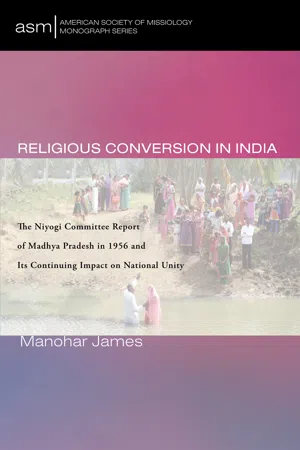
Religious Conversion in India
The Niyogi Committee Report of Madhya Pradesh in 1956 and Its Continuing Impact on National Unity
- 302 pages
- English
- ePUB (mobile friendly)
- Available on iOS & Android
eBook - ePub
Religious Conversion in India
The Niyogi Committee Report of Madhya Pradesh in 1956 and Its Continuing Impact on National Unity
About this book
In this book, Dr. Manohar James explores how Hindu intolerance has contributed to anti-Christian propaganda over the centuries, how such intolerance has informed the conclusions of the Niyogi Committee Report, and how the Report's ongoing publications, redactions and recessions have intensified anti-Christian rhetoric in India over the last six decades.
Information
Topic
Theology & ReligionSubtopic
Indian & South Asian History1
Overview of the Research
Christians in India relished a culture of religious tolerance and non-violence for centuries. However, the notion of Hindu tolerance, which was once thought of as a national identity, a hallmark of multi-religious harmony and an integral part of India’s tradition, appears endangered by radical Hindutva1 movements. While portraying themselves as self-dedicated, culturally patriotic, and guardians of national integrity, these movements tend to ethnicize religious categories, politicize identities, and demonize “the religious others.”
Prominent Hindu leaders like Vivekananda and Gandhi often boasted about the Hindu dynamic of tolerance which they said was absent in other religions. Historically, Hindus were believed to never have launched a religious war against other nations. On the other hand, Peter van der Veer contends that the popular notion of Hindu tolerance is a misconception and a byproduct of orientalist discourse. It was categorically attributed to Hindus to differentiate them from fanatic Muslims who were religiously and politically aggressive and it has gradually come to dominate the Hindu discourse on Hinduism.2 Building on the same premise, Thomas B. Hansen notes that Hindu reformers codified this imaginary cultural category to show that it is a key characteristic of Hindu faith.3
It is true that Christians throughout history faced obstacles, opposition, and even persecution from local Rajas and religious leaders. However, such conflicts rarely turned into the widespread antagonism seen today.4
Since the last quarter of the twentieth century, Christians and their conversion activities have begun to come under the strict surveillance of the radical Hindu nationalism of the Sangh Parivar, that is, Hindu nationalist organizations which operate under the ideological guidance of Rashtriya Swayamsevak Sangh (RSS). Conversions, which have met with strong criticism since the explosion of mass conversions in the pre-independent era, are systematically problematized by the exigencies of Hindu nationalist politics in post-independent India. By underscoring the cultural, economic, and political motivations behind Christian conversions, Hindu right-wing activists seek to create a consensus against Christianity, stereotyping it as a hostile, foreign, and anti-national religion which poses a serious threat to Hindu society and national security. Such widespread anti-Christian propaganda contributes to the ongoing Hindu-Christian disharmony, communal tensions, and violence in various parts of India. Since the last decade of the twentieth century, Christians in many parts of India have undergone persecution, killings, burning of churches, destruction of institutions, and displacement of families.5
Historical Setting
There are several historical dynamics that have contributed to the present-day Hindu extremist reactions to Christianity. They can be traced to the contexts of colonization, certain foreign missionary deeds, and the rise of Hindutva6 ideology.
With the arrival of Muslim conquerors, India witnessed serious political upheavals from the eighth century onwards. Political invasions which often came hand in glove with the religion of the invaders affronted and affected Hindu society and Hinduism. In the process, conquerors destroyed several Hindu temples, idols, and local shrines, and converted many Hindus to Islam.7 Ever since, religious conversions have become repugnant in the eyes of Hindu fundamentalists.
Just as Hindus resisted religious conversions associated with Islamic invasions, they similarly responded to the conversions sought and wrought by Europeans, as it was apparent to them that the comportment and the strategies employed by these colonizers and convert-seeking missionaries were not so different from that of their former Muslim aggressors. Historian T. R. De Souza mentions Sasetti, who was in India from 1578 to 1588. De Souza argues, “The fathers of the Church forbade the Hindus under terrible penalties the use of their own sacred books, and prevented them from all exercise of their religion. They destroyed their temples, and so harassed and interfered with the people that they abandoned the cities in large numbers, refusing to remain any longer in a place where they had no liberty, and were liable to imprisonment, torture and death if they worshipped after their own fashion the gods of their fathers.”8 While British colonization and western ideals gave rise to the spirit of nationalism among Indians, ...
Table of contents
- Title Page
- Foreword
- Preface
- Acknowledgments
- Abbreviations
- Introduction
- Chapter 1: Overview of the Research
- Chapter 2: The Historical Antecedents of Anti-Missionary Attitudes and Hindu Awakening
- Chapter 3: The Advance of Hindu Nationalism and Religious Antagonism
- Chapter 4: The Christian Missionary Activities Enquiry Committee and its Report
- Chapter 5: The Significance of the Niyogi Report on Hindu Nationalism
- Chapter 6: Summary and Conclusion
- Appendix A
- Appendix B
- Appendix C
- Appendix D
- Appendix E
- Appendix F
- Appendix G
- Bibliography
Trusted by 375,005 students
Access to over 1.5 million titles for a fair monthly price.
Study more efficiently using our study tools.
Frequently asked questions
Yes, you can cancel anytime from the Subscription tab in your account settings on the Perlego website. Your subscription will stay active until the end of your current billing period. Learn how to cancel your subscription
No, books cannot be downloaded as external files, such as PDFs, for use outside of Perlego. However, you can download books within the Perlego app for offline reading on mobile or tablet. Learn how to download books offline
Perlego offers two plans: Essential and Complete
- Essential is ideal for learners and professionals who enjoy exploring a wide range of subjects. Access the Essential Library with 800,000+ trusted titles and best-sellers across business, personal growth, and the humanities. Includes unlimited reading time and Standard Read Aloud voice.
- Complete: Perfect for advanced learners and researchers needing full, unrestricted access. Unlock 1.5M+ books across hundreds of subjects, including academic and specialized titles. The Complete Plan also includes advanced features like Premium Read Aloud and Research Assistant.
We are an online textbook subscription service, where you can get access to an entire online library for less than the price of a single book per month. With over 1.5 million books across 990+ topics, we’ve got you covered! Learn about our mission
Look out for the read-aloud symbol on your next book to see if you can listen to it. The read-aloud tool reads text aloud for you, highlighting the text as it is being read. You can pause it, speed it up and slow it down. Learn more about Read Aloud
Yes! You can use the Perlego app on both iOS and Android devices to read anytime, anywhere — even offline. Perfect for commutes or when you’re on the go.
Please note we cannot support devices running on iOS 13 and Android 7 or earlier. Learn more about using the app
Please note we cannot support devices running on iOS 13 and Android 7 or earlier. Learn more about using the app
Yes, you can access Religious Conversion in India by Manohar James in PDF and/or ePUB format, as well as other popular books in Theology & Religion & Indian & South Asian History. We have over 1.5 million books available in our catalogue for you to explore.