This book is available to read until 5th July, 2026
- 216 pages
- English
- ePUB (mobile friendly)
- Available on iOS & Android
eBook - ePub
Available until 5 Jul |Learn more
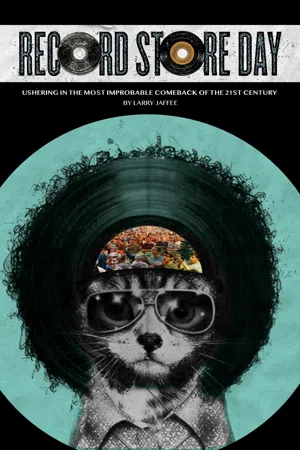
Record Store Day
About this book
Record Store Day: the Most Improbable Comeback of the 21st Century provides the official inside story on how Record Store Day managed to revive the vinyl format from oblivion over the past fifteen years with some of the biggest artists jumping at the chance to sup-port independent record stores. This alliance and renewed camaraderie between artists and record stores set in motion the world's largest annual music event: Record Store Day. The voices of numerous artists, record store owners, and the creators of Record Store Day take the reader from this phenomenon's shaky beginnings through the crisis of 2020, illustrating how record stores went from irrelevance to irrevocably changing the music industry forever. Record Store Day is sure to appeal to record collectors who line up the night before in a quest to snare limited-edition collectibles on vinyl, while capturing the important role that independ-ent record stores play in their communities.
Tools to learn more effectively

Saving Books

Keyword Search

Annotating Text

Listen to it instead
Information
Subtopic
MusicChapter One
The Report of My Death Was an Exaggeration
âI saw it dying. I saw it dead. And I saw it coming out of the grave, rising from the ashesâŚâ
âGerhard Blum, Sony Music Entertainment
[Vinyl emerges from oblivion, providing the most unlikely comeback story of the digital age.]
The Billboard headline on May 11, 1991, screamed somewhat ominously, âThe LPâs Passage to Oblivion,â announcing that the distribution companies owned by the major labels Warner/Elektra/Atlantic and Sony Music were no longer accepting returns from retailers on vinyl albums. Universalâs distribution group wasnât either. Twenty years ago, six major record conglomerates (EMI, BMG, and Polygram since folded into threeâUniversal, Sony, and Warner) rode the compact disc (CD) as the cash-cow music format of choice. The internet, as a means of electronic distribution, still was a decade away from being a commercial option, playing catch-up from Napsterâs illicit wakeup call.
Looking back on the past three decades, two popular analog home entertainment formats (vinyl and cassette, which were actually the most popular formats in the late 1980s) were quickly replaced by supposed advanced digital technologies in fast succession (CD, digital downloads, and streaming). Thenâno doubt thanks to Record Store Dayâs emergence in 2008âvinyl reemerges as a deluxe product where consumers are willing today to pay twice as much for a newly pressed vinyl LP than they did for a CD!?!
Did RSDâs cofounders know for sure what they were doing? Of course not, and they were largely making it up as they went along. Record stores were selling mostly CDs in 2007 and some couldnât fathom stocking new vinyl once again in any kind of meaningful numbers, even though regular customers would always buy the three-dollar records in the used bins. But Michael Kurtz, whoâs become the face of the movement, and his band of RSD misfits persevered, mustering enough support to make a much bigger splash by 2009, only to continue to build year after year the monumental achievement that Record Store Day has become fifteen years later.
Record Store Day is a celebration of record storesâthus the ârecord storeâ in the nameâbut it is full of misconceptions, such as it was started as a ploy of the major labels, or the RSD cofounders and the record stores that sell the exclusive records all get rich off these limited editions, or RSD releases clog up the pressing plants so that other vinyl records canât get manufactured. All completely untrue.
Vinylâs rebirth in the digital age defies all economic, technological, and ecological logic. Firstly, itâs expensive to manufacture an LP that, secondly, relies on mostly antique pressing equipment and processes, which largely havenât changed in a half century. And thirdly, records are made from polyvinyl (PVC), which is not the most green-friendly raw material, although todayâs pressing plants are far more conscious about sustainability than their 1970s counterparts, using modern processes and new equipment that reduce carbon emissions.
Record Store Day deserves substantial praise for kickstarting the entire vinyl supply chain, creating new opportunities for distribution companies, mastering and cutting facilities, raw material suppliers, packaging firms and printers, designers who create album graphics, turntable manufacturers, and ancillary products such as record sleeves and disc cleaning kits. Itâs no coincidence that vinylâs exponential growth year-to-year over the past fifteen years syncs up exactly with RSDâs launch and the positive impact the 1,400 indie record stores feel in their communities.

Speaking at the Making Vinyl conference in Hollywood in October 2019, David Bakula, senior vice president of Analytics, Insights, and Research for Nielsen Music/MRC Data, credited Record Store Day with âincredible foresightâ to kickstart the vinyl comeback in 2008 when Bakula worked for a large distribution company. âAfter the [first] Record Store Day numbers came out, I went to my [boss] and said, âIâm telling you, man, this vinyl thing, thereâs something here. This isnât just about Record Store Day. These numbers are overperforming every single week.â And he said to me, âItâs a rounding error, come back to me when it matters.â Well, it sure didnât take very long for it to matter.â
By 2012, Nielsen reported vinyl represented 2.4 percent of the physical music business with 3.3 million units (with CDs accounting for the balance). In 2013, it grew to 3.5 percent of the physical business and 4.3 million units. In 2014, the jump went to 6.2 percent and 6.4 million units. In 2015, the steady growth went to 8.8 percent and 8.4 million units, followed by 11.2 percent and 9.5 million units in 2016. In 2017, the vinyl jump rose to 14 million units, and again in 2018 to more than 16 million units. In 2019 Bakula forecasted that vinyl was trending at 24 percent of the physical business. And in 2020, the Record Industry Association of Americaâs (RIAA) reported that vinyl grew 28.7 percent to $626 million, which was more revenue that came in for CDs for the first time since 1986.
These numbers tell a positive story. But the problem is most record stores do not report their sales, so both Nielsen and RIAA estimate figures that unfortunately donât jibe with the large volumes pressing plants crank out these days or pumped through the retail supply chain. Yet the mediaâs spread vinyl sales numbers that severely underestimate the market. In the US, record stores only buy titles that they are certain will be bought by music fans because they cannot be returned. Furthermore, only about 250 independent record stores in the United States report their sales to MRC Data, who clearly is estimating sales, since approximately 1,400 US stores participate in Record Store Day.
Sitting in the audience in the October 2018 Making Vinyl conference were representatives of the industryâs leading pressing plants and distribution companies. When my PowerPoint presentation flashed an RIAA slide from two weeks earlier that reported 8.1 million vinyl units were sold in the first six months of that year, yells echoed throughout the ballroom that it was âway low.â Afterward, Steve Sheldon, owner of the Rainbo, one of the worldâs largest vinyl pressing plants, said his California pressing plant at that point was cranking out 7 million units a year alone. United Record Pressing in Nashville, the nationâs largest manufacturer, produced more LPs than Rainbo (which closed in January 2020 due to the high cost of doing business in California). Then thereâs additional output from twenty-seven other smaller US facilities, not to mention the sixty-three other plants around the world also making records, a good portion no doubt being imported for American consumers. Globally, 160 million records were pressed in 2021, estimated Making Vinyl.
Now put those numbers into perspective: Back in 2008 when Record Store Day launched, there were only fourteen pressing plants in the United States and eight more elsewhere in the world for a total of twenty-two operated with a last-man standing attitude. New operations sprung up during the past decade to meet the demand. But current pressing capacities globally add up to 160 million LPs a year, but demand by June 2021 required twice that amount, creating a backlog as much as ten months, Billboard reported.
Market research firm Deloitte nearly broke the internet in 2017 by estimating vinyl that year would be a $1 billion industry for the first time in decades. The firm took into account not only newly pressed vinyl, but also the sale of used records, turntables, and accessories. Since then, vinyl and ancillary revenue demonstrated, as of this writing, more than three yearsâ worth of substantial growth. But Deloitteâs Duncan Stewart, one of the 2017 reportâs two authors, wonât quantify the marketâs current worth. âI canât just âupdateâ the number. Deloitte has rules and processes around this kind of thing,â he says.
At Making Vinyl Virtual in December 2020, though, Stewart stated, âWe think that the US number for [new vinyl sales] will be well over $500 million this year,â partly based on flawed RIAA numbers, which âunderstate actual vinyl sales. They donât capture a lot of the small record shops; they donât capture sales of used vinyl. So the actual number, of course, would be even higher still.â
However questionable RIAAâs methodology might be, the organizationâs report for the first half of 2020 found vinyl album revenues of $232 million to comprise nearly two-thirds (62 percent) of total physical music revenues. That was quite a milestone, marking the first-time vinylâs dollar amounts exceeded that for CDs since the 1980s. (Interestingly, the report stated the volume of CD units still exceeded that of vinyl.)
Meanwhile, Deloitteâs Stewart estimated in December 2020 that the US is 40 percent of the global vinyl market, which the firm in 2017 reported âcame very close to a billion dollars [in 2017]⌠Our prediction came true.â The researcher cited vinylâs âdecent growthâ in 2018 and 2019, and âa big jump even in the middle of a pandemic for 2020âŚEven post-pandemic, weâll be spending considerably more time at home. People are setting up their home offices, they are putting in sound systems, they are buying vinyl, and pulling vinyl out of storage.â
Vinyl 2.0 is not your fatherâs record business. New machinery suppliers have perfected nearly century-old processes with higher yields, sustainability, better-sounding, heavier, and creatively packaged records. âThis is craftsman-level stuff,â Jeff Truhn, operations manager of Cascade Record Pressing in Milwaukie, Oregon, told the Making Vinyl audience in 2018.
LPs produced for Record Store Day are pressed in fairly small quantities, which then creates a frenzy of consumer demand. Scores of people in any city where thereâs an RSD-participating record store line up the night before, in hopes of snaring a particular record, and often they walk out with many other impulse purchases not on their original list. So what if youâre several hundred dollars poorer?
Today, consumers gladly shop at approximately 1,400 independent US record stores and another 3,000 doing business globally; Record Store Day is celebrated on every continent but Antarctica. While vinyl admittedly registered a negligible sales blip in the 1990s, the format never really went away, thanks to old-school DJs spinning dance records, audiophiles with their thousand-dollar-plus stereos supported by a few labels catering to that market, and flea-market crate diggers looking for collectibles. One personâs trash is anotherâs treasure, indeed. Those well-combed-over used record bins gave indie retailers confidence that perhaps vinyl still had some life in it.
Although Record Store Day exclusive releases are pressed in relatively low quantities of 15,000 or less, a non-RSD title like Jack Whiteâs 2014 solo record, Lazaretto, proved that a new, non-reissue album can sell 230,000 units on vinyl. Third Man Records head Ben Blackwell gave me the sales figure, as of March 2020. The Arctic Monkeysâ AM was the second best-selling album on vinyl with 29,000 units that year. But the vinyl world was not nearly as large in 2014 as it is 2022. I have no doubt that a new album from Taylor Swift or Beyonce, who appeal to a younger demographic, could sell hundreds of thousands of copies in the new decade ahead.
Theory #1: The CD Made Vinylâs Comeback Possible
Isnât it interesting that record stores never ceased to be called ârecord storesâ even when they were selling mostly compact discs? To understand why Vinyl 2.0 is working, we must hark back to the early 1980s when the industry replaced the LP with the shiny little disc known as the CD. As noted at the beginning of the chapter, retailers could return unsold CDs, which gave them an incentive to usher in a new format, but no longer would labels and distributors accept vinyl.
Nearly a quarter century later, when approached by the RSD cofounders about their vision, the major labels attached strings for the indie retailers and distributors if they were going to insist on bringing back v...
Table of contents
- Foreword
- Chapter One
- Chapter Two
- Chapter Three
- Chapter Four
- Chapter Five
- Chapter Six
- Chapter Seven
- Chapter Eight
- Chapter Nine
- Chapter Ten
- Chapter Eleven
- Chapter Twelve
- Chapter Thirteen
- Epilogue
- Acknowledgments
- Cast of Characters
Frequently asked questions
Yes, you can cancel anytime from the Subscription tab in your account settings on the Perlego website. Your subscription will stay active until the end of your current billing period. Learn how to cancel your subscription
No, books cannot be downloaded as external files, such as PDFs, for use outside of Perlego. However, you can download books within the Perlego app for offline reading on mobile or tablet. Learn how to download books offline
Perlego offers two plans: Essential and Complete
- Essential is ideal for learners and professionals who enjoy exploring a wide range of subjects. Access the Essential Library with 800,000+ trusted titles and best-sellers across business, personal growth, and the humanities. Includes unlimited reading time and Standard Read Aloud voice.
- Complete: Perfect for advanced learners and researchers needing full, unrestricted access. Unlock 1.4M+ books across hundreds of subjects, including academic and specialized titles. The Complete Plan also includes advanced features like Premium Read Aloud and Research Assistant.
We are an online textbook subscription service, where you can get access to an entire online library for less than the price of a single book per month. With over 1 million books across 990+ topics, weâve got you covered! Learn about our mission
Look out for the read-aloud symbol on your next book to see if you can listen to it. The read-aloud tool reads text aloud for you, highlighting the text as it is being read. You can pause it, speed it up and slow it down. Learn more about Read Aloud
Yes! You can use the Perlego app on both iOS and Android devices to read anytime, anywhere â even offline. Perfect for commutes or when youâre on the go.
Please note we cannot support devices running on iOS 13 and Android 7 or earlier. Learn more about using the app
Yes, you can access Record Store Day by Larry Jaffee in PDF and/or ePUB format, as well as other popular books in Media & Performing Arts & Music. We have over one million books available in our catalogue for you to explore.