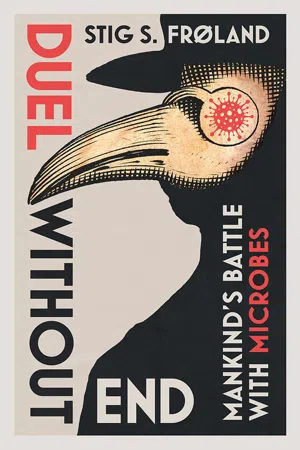
In this panoramic and up-to-date account, we learn how the Black Death, smallpox, the Spanish flu and other great epidemics have led to enormous suffering and mass death, as well as contributing to the fall of empires and changing the course of history. We also discover how new infectious diseases such as HIV/AIDS and COVID-19 emerge.
Man has struck back at microbes – antibiotics and vaccines have saved millions of lives – but the battle with these relentless, silent enemies is far from won. We face increasing threats from new and unavoidable pandemics, antibiotic resistance and extra-terrestrial microbes. Duel Without End is a fascinating journey through the long history of infection, from the dawn of life to humanity's future exploration of deep space.
- English
- ePUB (mobile friendly)
- Available on iOS & Android
eBook - ePub
About this book
Information
Topic
MedicineSubtopic
Diseases & AllergiesFOUR
Major Epidemics and Pandemics: Examples from History
For hundreds of thousands of years, the duel between man and microbes has swayed back and forth. For shorter or longer periods, the duellists have at any rate apparently kept each other in check, without any obvious drama. But then the microbes more or less suddenly gained the upper hand, resulting in epidemics. An epidemic is a considerable increase of an infectious disease in a population over a relatively short time. Epidemics can only develop in fairly large population groups, where the microbe is able to infect a considerable number of individuals. That is why we do not see epidemics until after the first transition in Homo sapiens’ history of infection, after people began to settle and engage in agriculture and animal husbandry. There is little agreement about how many instances of disease are needed in order to speak of an epidemic, or how rapidly it has to develop. If an epidemic strikes a whole continent or several continents, we use the term ‘pandemic’.
Many infectious diseases such as measles, mumps and smallpox follow a quite typical course, rapidly spreading to a large number of individuals who are not immune, after which they disappear for a while when there are no longer any receptive individuals in the population. These are examples of classic epidemics, with microbes that cause what I call ‘crowd infections’. But we also use the terms ‘epidemic’ and ‘pandemic’ about a number of non-acute infections that spread much more slowly and do not necessarily retreat after a certain period of time. Examples of such infections are tuberculosis, leprosy, malaria and HIV. These epidemics also change their profile over time, return to previously afflicted regions and then spread further.
In former times, when microbes were not known to be a cause of disease, we naturally had no clear conception of the causes of epidemics and pandemics. And it was not until the last few decades that we clarified the many mechanisms – the ecological and environment-related factors – that have a crucial influence on the interaction between man and microbes. Extremely often, it is significant changes in these factors that underlie the many epidemics we know from history. A number of factors are frequently in operation at the same time.
But we also have examples of changes to the pathogenic qualities of the microbes that have been crucial: microbes use many methods to alter their genetic characteristics when this is favourable for adapting to their surroundings. Changes in human behaviour, which we can refer to as human ecology, also often play an important role in epidemics, whereas the process involved for humans to change genetic characteristics is far more cumbersome than that of microbes.
With all this recently acquired knowledge, we can now look back at history and try to analyse the background of the many epidemics of which we have accounts, and which have definitely had major consequences for humanity within many areas. The insight we can gain from such studies can also prove extremely valuable for our future duel with microbes.
How can we state anything with any degree of certainty, however, about the epidemics and infections of the past, since knowledge of microbes only came at the end of the nineteenth century? How can we be sure that the epidemics of earlier ages were caused by microbes? These are perfectly natural questions to which we are actually able to provide good answers. Before dealing with some important examples of epidemics and pandemics, we should therefore take a look at the basis of what, to a great extent, is historical detective work using what in criminology are called ‘cold trails’.
How can one follow the cold trails of history?
For as long as we have had written accounts, about the past 4,000–5,000 years, we have also had accounts of major epidemics. These descriptions are of course important sources for studying the epidemics of former times. Many of those that struck humanity, however, are not mentioned in ancient writings. Some descriptions may also have been lost. In surviving accounts there may also be additional interpretative problems that make the work more difficult. Often the writers of chronicles are not representatives of the physicians of the time, but are historians or monks, so they are not necessarily familiar with the specialized concepts of medicine in their own time. Translation thus often involves considerable problems, since one is at a loss to know what the authors mean by the medical concepts they use to describe the disease in question. Furthermore, the conceptual apparatus of former medicine differs from that of the present day. One example of this is the description of rashes, which are an important sign of a number of epidemic diseases and may provide the key to a diagnosis. Ecclesiastical writers often concentrate on religious considerations in theories about the causes of diseases and are less inclined to give a sober description of possibly more prosaic aspects.
Even so, we do have some excellent examples of thorough analysis of epidemics in the past. A classic example we have already touched on is the description by Thucydides of the Athenian plague during the war between Athens and Sparta in 431–404 BC.1 This description has been studied closely down through the centuries and often influences descriptions of epidemics by later writers, since they use the same vocabulary in their accounts and interpretation of disease as Thucydides.
Despite the many problems involved in translating and interpreting the ancient accounts of epidemics, they are nevertheless invaluable for our understanding of both the geographical occurrences and spread of the epidemics, and tell us a great deal about pathological pictures and mortality.
A valuable supplement to the ancient chronicles are other written sources such as wills, contracts of employment, sales contracts and other non-literary registers and records. These sources are probably not gripping reading for the layman, but for historians they can provide invaluable information about the course, spread and consequences of major epidemics. This source material has also been the subject of intensive studies.
Although this historical approach can often give us a good picture of many of the epidemics of the past and their probable microbial causes, it can of course seldom provide a completely sure basis for analysis on its own. With many epidemics the various sources on which historians build do not enable any definite conclusions to be made. A number of famous epidemics from the past belong to this group. We will later look at a few of these enigmatic epidemics, including the Athenian plague already mentioned.
In the studies of infections of past ages, historians have been helped by archaeologists.2 Archaeological excavations often uncover human remains from various epochs in the development of Homo sapiens. Normally, there are only skeletal remains, since the soft parts (skin, muscles, inner organs) usually decay quickly as a result of bacteria. Under special circumstances, such as desiccation, low temperature, lack of oxygen or chemical influence, this decaying process may be prevented, resulting in what we call mummification. In that case the soft parts may be quite well preserved, which means that the tissues and organs of the body can be studied using ordinary microscopic methods as used in present-day medicine, for example when carrying out autopsies. Such mummification is most frequently man-made. It is primarily the several thousand-year-old burial customs of the ancient Egyptians that have given us the term ‘mummy’. Certain other cultures, however, have also embalmed their dead. Under special climatic conditions such mummification can also take place spontaneously. A famous example of this is the 5,000-year-old ‘Ötzi the Iceman’, who was found frozen in the Alps. In such instances, the content of the intestines can also provide valuable information, for example about chronic infection due to parasites. This was the case with Ötzi.
The mummification of human remains is unfortunately the exception. In most cases only the remains of skeletons are found. With various processes of chronic diseases, however, changes take place in the skeleton that can provide valuable information about the state of health of former humans.3 This applies, for example, to tuberculosis and syphilis, which can cause characteristic changes. The great majority of the microbes that have caused widespread epidemics, however, attack only the soft parts of the body, not the skeleton. For that reason, examining the skeletons will not tell us anything about the occurrence of these infections.
Fortunately, modern science has come to the rescue of historians and archaeologists. The major breakthroughs in molecular biology after James Watson and Francis Crick’s discovery of the structure and role of the DNA molecule in 1953 have also revolutionized research within the history of infection and epidemics. DNA molecules are carriers of the genetic information of all living creatures (with the exception of certain viruses that have RNA instead, and prions – if they are to be counted as living). Modern molecular-biological methods can be used to detect microbe DNA in remains from humans and animals from thousands of years ago that show signs of infection. These new methods can also be used to study the DNA from humans and animals, leading to sensational new data that also provide information about the process of evolution.
There is first and foremost one method, PCR (polymerase chain reaction), which has been used when examining ancient DNA. Using this method, which has revolutionized diagnostics within many areas of medicine, one can detect extremely small amounts of DNA and increase the original amount to such an extent that one has enough material for further studies using other methods.4
Although the new methodology for detecting old DNA has been an important breakthrough, such studies are extremely demanding with a number of sources of error. Ancient DNA can be damaged to varying degrees, depending to a great extent on outer, climatic conditions. DNA is best preserved under dry, cool conditions. Unfortunately, these conditions do not exist in many of the most important areas where human remains from major epidemics are found, such as the Mediterranean. DNA, however, is often well preserved after mummification, so it is no coincidence that some of the first successful detections of old microbial DNA were of the tuberculosis bacteria (Mycobacterium tuberculosis) in mummies from Egypt and Peru. This took place in the 1990s. Later, it proved possible to identify DNA from a number of other microbes, including the leprosy bacterium, Mycobacterium leprae, and the plague bacterium, Yersinia pestis. The finds of the plague bacterium in human remains from various ages have given us probable answers to previously unanswered questions concerning the major plague epidemics.
DNA studies using the PCR method are very susceptible to sources of error because of pollution from other irrelevant DNA, such as from naturally occurring microbes at the site of the find or in the laboratory when the investigation is being carried out. For this reason, particular demands are made of these laboratories.
The methods used to examine ancient DNA have become increasingly sophisticated over the years. In addition, we now have methods that can detect proteins in archaeological material. Such methods will probably be of considerable use, since protein molecules, under favourable conditions, can stay unchanged for hundreds of thousands of years, whereas DNA has a limited ‘shelf-life’. However, neither of these methods can be used exclusively when studying infection problems of the past. The finds must always be combined with solid archaeological assessments, including the dating of the remains in question, along with other conditions at the site.
It is highly likely that the rapid development of modern molecular biology will also come up with other methods that can be used when studying epidemics from former ages and old microbial material. The methods we already have, however, are only in their infancy and a great many interesting archaeological finds have yet to be investigated using modern DNA methods.
The Plague Epidemics
In everyday speech few words are as negatively charged as ‘plague’. The word is often used to characterize a phenomenon or a person as quite horrible. The term is also used when one is faced by a choice between two equally frightful alternatives: in Germanic and Romance languages, choosing between the Devil and the deep blue sea, or between Scylla and Charybdis, can be called ‘a choice between plague and cholera’. This use of the word is derived from the memory of terrifying historical epidemics. In purely medicinal usage, the word ‘plague’ is solely the term for infection caused by the bacterium Yersinia pestis, not for epidemics with other microbes. However, ‘plague’ has often also been applied less precisely to other epidemics.
The best-known plague epidemic, one that most people have heard about while still at school, is the Black Death, which raged in the mid-fourteenth century.5 In the history of infection, we also include two other comprehensive plague epidemics.6...
Table of contents
- Front Cover
- Half Title
- Title Page
- Copyright
- Contents
- Foreword
- Prologue: The Invisible Enemy
- ONE: The Duellists
- TWO: The Third Factor: Ecology and the Environment
- THREE: A Bird’s-eye View of the History of Human Infection
- FOUR: Major Epidemics and Pandemics: Examples from History
- FIVE: Mysterious Epidemics in History
- SIX: The Contribution Made by Epidemics to the Fall of Empires
- SEVEN: New Infections, New Challenges
- EIGHT: When Microbes Are Used as Weapons
- NINE: Homo sapiens Strikes Back
- TEN: New Challenges from the Microbes – and Possible Countermeasures
- Epilogue: The Never-ending Duel
- REFERENCES
- SELECT BIBLIOGRAPHY
- PHOTO ACKNOWLEDGEMENTS
- INDEX OF NAMES
Trusted by 375,005 students
Access to over 1.5 million titles for a fair monthly price.
Study more efficiently using our study tools.
Frequently asked questions
Yes, you can cancel anytime from the Subscription tab in your account settings on the Perlego website. Your subscription will stay active until the end of your current billing period. Learn how to cancel your subscription
No, books cannot be downloaded as external files, such as PDFs, for use outside of Perlego. However, you can download books within the Perlego app for offline reading on mobile or tablet. Learn how to download books offline
Perlego offers two plans: Essential and Complete
- Essential is ideal for learners and professionals who enjoy exploring a wide range of subjects. Access the Essential Library with 800,000+ trusted titles and best-sellers across business, personal growth, and the humanities. Includes unlimited reading time and Standard Read Aloud voice.
- Complete: Perfect for advanced learners and researchers needing full, unrestricted access. Unlock 1.5M+ books across hundreds of subjects, including academic and specialized titles. The Complete Plan also includes advanced features like Premium Read Aloud and Research Assistant.
We are an online textbook subscription service, where you can get access to an entire online library for less than the price of a single book per month. With over 1.5 million books across 990+ topics, we’ve got you covered! Learn about our mission
Look out for the read-aloud symbol on your next book to see if you can listen to it. The read-aloud tool reads text aloud for you, highlighting the text as it is being read. You can pause it, speed it up and slow it down. Learn more about Read Aloud
Yes! You can use the Perlego app on both iOS and Android devices to read anytime, anywhere — even offline. Perfect for commutes or when you’re on the go.
Please note we cannot support devices running on iOS 13 and Android 7 or earlier. Learn more about using the app
Please note we cannot support devices running on iOS 13 and Android 7 or earlier. Learn more about using the app
Yes, you can access Duel Without End by Stig S. Frøland, John Irons in PDF and/or ePUB format, as well as other popular books in Medicine & Diseases & Allergies. We have over 1.5 million books available in our catalogue for you to explore.