Almost since the beginning of the republic, America's rigorous separation of powers among Executive, Legislative, and Judicial Branches has been umpired by the federal judiciary. It may seem surprising, then, that many otherwise ordinary cases are not decided in court even when they include allegations that the President, or Congress, has violated a law or the Constitution itself. Most of these orphan cases are shunned by the judiciary simply because they have foreign policy aspects. In refusing to address the issues involved, judges indicate that judicial review, like politics, should stop at the water's edge--and foreign policy managers find it convenient to agree! Thomas Franck, however, maintains that when courts invoke the "political question" doctrine to justify such reticence, they evade a constitutional duty. In his view, whether the government has acted constitutionally in sending men and women to die in foreign battles is just as appropriate an issue for a court to decide as whether property has been taken without due process. In this revisionist work, Franck proposes ways to subject the conduct of foreign policy to the rule of law without compromising either judicial integrity or the national interest. By examining the historical origins of the separation of powers in the American constitutional tradition, with comparative reference to the practices of judiciaries in other federal systems, he broadens and enriches discussions of an important national issue that has particular significance for critical debate about the "imperial presidency."
eBook - ePub
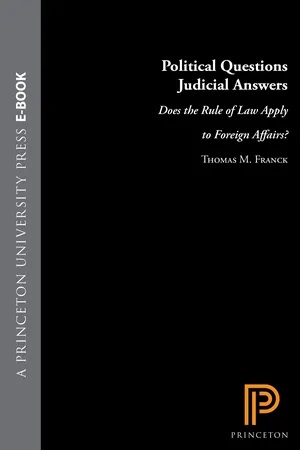
Political Questions Judicial Answers
Does the Rule of Law Apply to Foreign Affairs?
- 212 pages
- English
- ePUB (mobile friendly)
- Available on iOS & Android
eBook - ePub
About this book
Information

Introduction
By the constitution of the United States, the President is invested with certain important political powers, in the exercise of which he is to use his own discretion, and is accountable only to his country in his political character and to his own conscience. . . .
The application of this remark will be perceived by adverting to the act of congress for establishing the department of foreign affairs. . . . The acts of such an officer, as an officer, can never be examinable by the courts.
—Chief Justice John Marshall, Marbury v. Madison (1803)
WITH THAT seemingly offhand remark, Chief Justice Marshall introduced into American jurisprudence a theory that continues to affect profoundly the way power is exercised in the United States. Whatever Marshall’s intent in these paragraphs, the effect was to initiate a constitutional theory, still asserted by many lawyers and judges, that foreign affairs are different from all other matters of state in some crucial fashion. From this is sometimes derived the conclusion, one with which Marshall might well have disagreed,1 that the conduct of foreign affairs by the political agencies should be immune to judicial scrutiny. What a paradoxical by-product of the very decision that made judicial review the touchstone of the American system of government! How odd that Marshall should have sounded this uncertain note with the same breath as Marbury’s2 clarion call to judicial activism.
In The Federalist No. 78, Alexander Hamilton had foreseen this activist role. He had designated the judiciary as the guarantor of the new Constitution, “the best expedient which can be devised in any government, to secure a steady, upright and impartial administration of the laws.”3 Moreover, in a system of deliberately divided and limited power the judiciary, the “least dangerous” branch, must be vested with the authority “to declare all acts contrary to the manifest tenor of the constitution void. Without this, all the reservations of particular rights or privileges would amount to nothing.”4
Marbury is justly celebrated for establishing the authority of the federal judiciary as umpire of a new system of divided authority and as guardian of an unprecedented process in which political power is not merely divided and distributed but also limited. Yet, incongruously, the chief justice seems to accord a deference to executive officials engaged in the conduct of foreign affairs that effectively exempts them from the normal judicial umpiring process. As for foreign affairs, the chief justice may be understood to have said, the judiciary’s guardianship of the limits of political power are suspended.
These thoughts are but sketched in Marshall’s divertissement to the majestic theme of Marbury. No effort is made to explain why foreign affairs should be placed beyond the reach of judicial review. Nor is it self-evident what is meant by placing foreign-affairs “acts” outside the ambit of what is “examinable by the courts.” In practice, however, some courts have taken the theory of inviolability to mean that judges must refrain from examining either the legality or even the constitutionality of actions taken by the president and his subordinates once it has been asserted that they acted in the name of foreign policy or national security. According to this line of reasoning, courts may not inquire whether soldiers are being sent lawfully into combat or whether members of Congress have been deprived of their constitutional role in the decision to go to war. Aliens arbitrarily excluded or deported from the United States on executive fiat in the name of national security may not look to judges for help; neither are businesspeople whose assets are requisitioned to advance foreign-policy purposes. In this view, levying taxes or disposing of government property without congressional authority is not open to challenge in courts of law if the avowed purpose is to promote international policies. Carried to its logical extreme, this doctrine holds that the political authorities are suit-proof as long as they purport to act in pursuance of their “foreign-affairs” power.
Fortunately, the courts’ abdication usually has not gone this far—not quite. But some decisions, including pithy paragraphs in several Supreme Court opinions we shall be examining, come uncomfortably close. One central theme of this study is that the abdicationist tendency, primarily expounded in what has become known as the “political-question doctrine,” is not only not required by but wholly incompatible with American constitutional theory. What is the point of a carefully calibrated system of divided and limited power if those who exercise authority can secure an automatic exemption from its strictures merely by playing the foreign-affairs trump?
Lawyers and judges who defend the doctrine, however, usually do so less by pleading theoretical justification than by arguing practical necessity or “prudential considerations.” They insist that because of the very nature of “foreign affairs,” the nation must operate with a single voice—by which they mean the president’s—and that only the executive branch has the information and expert experience necessary to make informed choices in matters crucial to national security. Or they argue that the controversies bearing on foreign affairs raise issues regarding which no legal standards are applicable or involve policy choices that are too political, complex, or specialized for resolution by courts. It is another theme of this book that these arguments, persuasive to many courts, are both alien to the U.S. system and unfounded.
In a system of divided powers, there cannot be a “single voice,” as there is in the British parliamentary system, that concentrates all authority in the executive (so long as it commands the allegiance of the Commons) and in which no written constitution limits the political writ. In such a system, the role of courts is bound to be different and less. In our system, however, courts may and do speak in dissonant tones, even sometimes in questions affecting “foreign affairs.” Indeed, it may be argued that in our system only courts can end disputation, thereby helping the nation to find its single voice.
This does not mean, however, that American courts have, or should have, license to make foreign policy. When courts speak in cases and thereby incidentally affect some aspect of foreign relations, they do not make foreign policy. They make judicial policy. What may at first appear a mere semantic quibble is an important distinction that this study will seek to elucidate. The frequent failure of the judicial and political branches to make that distinction has contributed to the conceptual chaos that surrounds judicial treatment of cases with foreign-affairs implications.
For example, when a U.S. court is faced with a divorce decree issued by the authorities of the Lithuanian Soviet Socialist Republic, the argument whether to give judicial effect to that decree tends to slip into the courtroom as a debate about whether the Soviet authorities’ decree should be “recognized.” The court is likely to be told that in a question of recognition, it must not contradict the voice of the State Department, which has not accepted the bona fides of the Soviet regime to speak for Lithuania. That argument, however, is spurious. It confuses the judicial with the diplomatic process. If the court decides to treat the Lithuanian divorce as valid, it is not “recognizing” the issuing government. Only the State Department recognizes governments or withholds recognition. Whether to give effect to a Lithuanian divorce in private litigation in our system should be the outcome of a judicial process that decides a justiciable matter on the evidence before it. The resultant judicial decision does not extend diplomatic recognition but does acknowledge an authority’s domestic lawmaking competence. This judicial function is both separate and of an entirely different kind from the executive’s prerogative to determine which foreign governments to recognize. The executive’s decision turns on many factors other than whether the regime exercises authority over its population, being colored by such questions as how the government came to power, how it respects its nation’s commitments, whether it abides by international law, whether it respects human rights. These are considerations that have little to do with whether divorces granted by its magistrates are entitled to judicial notice in a New York court. Even foreign governments, let alone our own, can be expected to respect that difference.
Indeed, this study will show that in several important foreign-affairs areas of adjudication—cases concerning title to property expropriated by foreign governments and cases in which foreign governments claim immunity from judicial process—the U.S. political branches have actually taken the initiative to ask the courts to stop abdicating and start adjudicating precisely in order to remove the foreign-policy implications from the outcome of these disputes by having them decided by the judicial process. As for recognition, the State Department has recently taken the position that it will normally refrain from recognizing regimes precisely to give itself greater flexibility to conduct pragmatic foreign relations.5 If that decision is carried out in practice, it will be further encouragement to judges to perform their judicial tasks without constantly looking over their shoulders to those in another branch engaged in a different, political, pursuit.
If the “single-voice” polemic is misleading, so is the argument that judges are untrained to handle cases with foreign implications. Judges are much better suited than is sometimes alleged to make decisions incidentally affecting foreign relations and national security. It is the business of the courts to understand any issue of fact or law, aided by exposure to the relevant evidence. Contrary to popular myth, the evidenciary matrix of foreign-relations cases is neither more difficult to present nor harder to understand than other technical data. This study will seek to demonstrate this point by examining the many complex foreign-affairs cases judges have handled successfully. It will also look at the experience of the German Constitutional Court, which has rejected the political-question doctrine explicitly. Special judicial procedures may be needed to illuminate judges and protect secrets, but this is also true of other kinds of litigation—for example, suits involving trade secrets or criminal actions in which sources or witnesses require special protection. Moreover, as the study will demonstrate, procedures are available to balance the special needs of confidentiality with other legitimate interests.
In sum, what this study tries to show is that there are no valid reasons—constitutional, prudential, technical, or policy-driven—for treating foreign-relations cases differently from any others. If there is a genuine, that is, a “ripe” dispute between parties with standing, courts can and should always offer the parties due process of law. In defending that proposition, this study will also seek to refine and explicate it; for example, by examining the experience of German courts in fashioning applicable rules of evidence and standards for reviewing foreign-affairs cases in which judicial deference may sometimes be appropriate to give the political branches the discretion authorized by laws or a constitution and to take into account any expert knowledge of the government’s foreign-affairs specialists.
The German courts’ experience demonstrates that it is possible to do this without judicial abdication. The German experience is also valuable in demonstrating to those who need reassurance that rejection of the political-question doctrine does not lead to wholesale judicial interference with the political branches’ discretion to set and execute foreign policy or protect national security.
In proposing that the U.S. federal courts stop abdicating in foreign-affairs cases, this study does not propose a radical renunciation of a magisterial jurisprudence grown from the seeds of foreign-affairs dicta sown in Marbury v. Madison. Rather, it will become apparent that despite the didactic rhetoric of some abdicationist judges, there is no consistent jurisprudence but only a welter of contradictory cases and that the state of the law governing the judicial role in foreign-affairs cases is essentially incoherent. The American courts’ tendency to abdicate in matters of foreign affairs is not only wrongly conceived but has been applied only fitfully and erratically.
Barring the way to reform is not a firm if pernicious principle of abdication but a state of jurisprudential chaos. For example, two hundred years after confederation we still do not know whether the president may terminate treaties on his own initiative or must obtain the consent of the Senate or Congress. The courts have been unable to tell us. That is less the consequence of a deliberate doctrine of abstention than the product of judicial fragmentation and doctrinal disagreement that renders judges unable to speak coherently to policymakers. Some judges practice abdication; others do not. Still more proclaim their continence but do not practice it. Some courts interpret the political-question doctrine as requiring them only not to question the political branches’ right to make policy within their allotted area of jurisdiction, but others see the doctrine as granting those political branches the right to define conclusively their jurisdiction. Often a court will treat the political-question doctrine as applicable to a case for reasons that fail to distinguish it from similar litigation in which judges felt entitled to decide without deferring to the doctrine. In still other instances, judges have simply ignored the doctrine, passing it in silence while slouching to a decision.
Such incoherence should not be surprising. In seeking to demarcate an entire class of disputes, foreign affairs, as exempt from judicial review, the political-question doctrine and its conceptual penumbra has brought not order, the nation speaking with a “single voice,” but doctrinal cacophony. This is to be expected of a notion that so ferociously wars against the basic organizing principle, the peculiar genius, of the American system of government under law. Judicial deference ignores the evident truth that in our system a law that is not enforceable by adjudicatory process is no law at all. A foreign policy exempt from judicial review is tantamount to governance by men and women emancipated from the bonds of law.
It is the argument of this study that “foreign affairs” does not need, and dare not be entrusted with, such a special jurisprudential dispensation. The category itself is highly suspect. Foreign affairs have become inextricably interwoven with the fabric of American life and ought to be treated holistically, especially by the only disinterested party, the judiciary. Every action taken in the name of foreign policy, defense strategy, or national security has a broad range of consequences that are not necessarily limited to, or felt by, the Departments of State and Defense, the CIA, or the National Security Council. Even the White House is rarely an impartial arbiter between the advocates of national security and competing interests. In this century, presidents have tended to emphasize the paramountcy of national security over competing national values. This may be a defensible value judgment, but it disqualifies the presidency from claiming to be the final arbiter of those values enshrined in the nation’s basic charter. If competing constitutionally or legally protected interests of private citizens, businesses, and legislators are to be accorded their fair weight, it is in the courts that credible weighing must occur.
In any event, Marshall’s “foreign-affairs” category no longer describes a much more complex reality. At the end of the twentieth century, in a world so interdependent that the flow of persons, goods, and ideas between states is almost as ordinary as between states of our Union, no “affair” is any longer exclusively denominable as “foreign.” Every “foreign” initiative, every foreign expenditure of lives and treasure, has significant domestic repercussions. The elements of these mixed domestic-foreign affairs often cannot be disentangled even in theory, let alone in practice. Whatever the global conditions in which Chief Justice Marshall wrote, there is now scarcely such a thing as a discrete “foreign-affairs” enterprise, certainly not one so distinct as to warrant an entire, radically different jurisprudence of its own.
The current state of jurisprudential incoherence presents both a problem and an opportunity. After two centuries, there is still no single, clear judicial guidance in the matter. It is time, surely, to examine the history, theory, and practice that have shaped the way we treat foreign affairs in our courts and to explicate a principled role for the courts that comports with the nation’s highest purposes.
How Abdication Crept into the Judicial Repertory
THE FAUSTIAN PACT
THERE ARE hundreds of cases today in which federal courts face “political questions.” Stalwart federal judges think nothing of deciding such hot-potato issues as the constitutionality of the lines on maps demarking congressional1 or school districts,2 the hiring practices of fire departments,3 or standards for admission to medical schools.4 Yet these same jurists tend to ...
Table of contents
- Cover Page
- Title Page
- Copyright Page
- Dedication
- Contents
- Acknowledgments
- Chapter One: Introduction
- Chapter Two: How Abdication Crept into the Judicial Repertory
- Chapter Three: Two Principled Theories of Constitutionalism
- Chapter Four: Prudential Reasons for Judicial Abdication
- Chapter Five: When Judges Refuse to Abdicate
- Chapter Six: Mandated Adjudication: Act of State and Sovereign Immunity
- Chapter Seven: Abolishing Judicial Abdication: The German Model
- Chapter Eight: A Rule of Evidence in Place of the Political-Question Doctrine
- Chapter Nine: The Special Cases: In Camera Proceedings and Declaratory Judgments
- Chapter Ten: Conclusions: Does the Rule of Law Stop at the Water’s Edge?
- Notes
- Index
Trusted by 375,005 students
Access to over 1.5 million titles for a fair monthly price.
Study more efficiently using our study tools.
Frequently asked questions
Yes, you can cancel anytime from the Subscription tab in your account settings on the Perlego website. Your subscription will stay active until the end of your current billing period. Learn how to cancel your subscription
No, books cannot be downloaded as external files, such as PDFs, for use outside of Perlego. However, you can download books within the Perlego app for offline reading on mobile or tablet. Learn how to download books offline
Perlego offers two plans: Essential and Complete
- Essential is ideal for learners and professionals who enjoy exploring a wide range of subjects. Access the Essential Library with 800,000+ trusted titles and best-sellers across business, personal growth, and the humanities. Includes unlimited reading time and Standard Read Aloud voice.
- Complete: Perfect for advanced learners and researchers needing full, unrestricted access. Unlock 1.5M+ books across hundreds of subjects, including academic and specialized titles. The Complete Plan also includes advanced features like Premium Read Aloud and Research Assistant.
We are an online textbook subscription service, where you can get access to an entire online library for less than the price of a single book per month. With over 1.5 million books across 990+ topics, we’ve got you covered! Learn about our mission
Look out for the read-aloud symbol on your next book to see if you can listen to it. The read-aloud tool reads text aloud for you, highlighting the text as it is being read. You can pause it, speed it up and slow it down. Learn more about Read Aloud
Yes! You can use the Perlego app on both iOS and Android devices to read anytime, anywhere — even offline. Perfect for commutes or when you’re on the go.
Please note we cannot support devices running on iOS 13 and Android 7 or earlier. Learn more about using the app
Please note we cannot support devices running on iOS 13 and Android 7 or earlier. Learn more about using the app
Yes, you can access Political Questions Judicial Answers by Thomas M. Franck in PDF and/or ePUB format, as well as other popular books in Law & Legal History. We have over 1.5 million books available in our catalogue for you to explore.