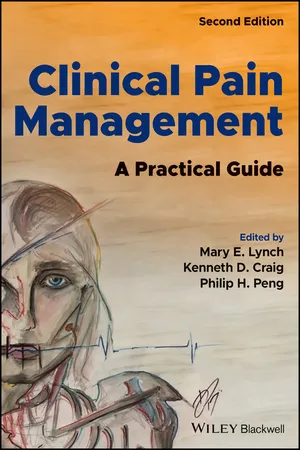
Clinical Pain Management
eBook - ePub

Clinical Pain Management

A Practical Guide

  1. English
  2. ePUB (mobile friendly)
  3. Available on iOS & Android
eBook - ePub

About this book

Clinical Pain Management

Pain has many dimensions; biological, psychological and social. All of these warrant attention in clinical management and research. Despite advances in pain management and understanding, chronic pain in particular continues to be a major health concern. Many challenging problems persist in our efforts to understand and manage chronic pain. This revised and updated second edition of Clinical Pain Management: A Practical Guide draws attention to the challenges that exist for people living with chronic pain conditions, for the clinician trying to provide effective management of the patient's pain, for the scientist seeking to unravel the mechanisms underlying pain, and for society as a whole.

This book offers the opportunity for clinicians to improve their knowledge about pain and apply that knowledge for the benefit of their patients. This second edition has built upon the first edition, which was distinctive in its integration of the clinical, psychosocial and basic science topics related to the different types of pain and their management. With up-to-date information throughout the 44 chapters of this second edition, this book provides a valuable resource about pain from a variety of perspectives.

Clinical Pain Management: A Practical Guide, Second Edition, will be particularly valuable not only for clinicians to help them assist with their patients experiencing an acute pain or suffering from chronic pain, but also for scientists who wish to gain more insights into these pain conditions and their underlying processes.

Information

Year
2022
Print ISBN
9781119701156
eBook ISBN
9781119701163

Part 1
Basic Understanding of Pain Medicine

Chapter 1
The challenge of pain: a multidimensional phenomenon

Mary E. Lynch1, Kenneth D. Craig2, & Philip W. Peng3
1Department of Anesthesia, Pain Management and Perioperative Medicine, Department of Psychiatry, Department of Pharmacology, Dalhousie University, Halifax, Nova Scotia, Canada
2Department of Psychology, University of British Columbia, Vancouver, Canada
3Professor, Department of Anesthesiology and Pain Medicine, University Health Network and Sinai Health System, University of Toronto, Toronto, Canada
Pain is one of the most challenging problems in medicine and biology. It is a challenge to the sufferer who must often learn to live with pain for which no therapy has been found. It is a challenge to the physician or other health professional who seeks every possible means to help the suffering patient. It is a challenge to the scientist who tries to understand the biological mechanisms that can cause such terrible suffering. It is also a challenge to society, which must find the medical, scientific and financial resources to relieve or prevent pain and suffering as much as possible. (Melzack & Wall The Challenge of Pain, 1982)

Introduction

Last year, the International Association for the Study of Pain (IASP) introduced a revised definition of pain stating that pain is ā€œan unpleasant sensory and emotional experience associated with, or resembling that associated with, actual or potential tissue damage [1]. Pain is divided into two broad categories: acute pain, which is associated with ongoing tissue damage, and chronic pain, which is generally taken to be pain that has persisted for longer periods of time. Many injuries and diseases are capable of instigating acute pain with sources including mechanical tissue damage, inflammation and tissue ischemia. Similarly, chronic pain can be associated with other chronic diseases, terminal illness, or may persist after illness or injury with uncertain biological mechanisms. The point at which chronic pain can be diagnosed may vary with the injury or condition that initiated it; however, for most conditions, pain persisting beyond 3 months is reasonably described as a chronic pain condition. In some cases, one can identify a persistent pain condition much earlier, for example, in the case of post‐herpetic neuralgia subsequent to an attack of shingles, if pain persists beyond rash healing it indicates a persistent or chronic pain condition is present.
Exponential growth in pain research in the past five decades has increased our understanding regarding underlying mechanisms of the causes of chronic pain, now understood to involve a neural response to tissue injury. In other words, peripheral and central events related to disease or injury can trigger long‐lasting changes in peripheral nerves, spinal cord and brain such that the system becomes sensitized and capable of spontaneous activity or of responding to non‐noxious stimuli as if painful. By such means, pain can persist beyond the point where normal healing takes place and is often associated with abnormal sensory findings. In consequence, the scientific advances are providing a biological basis for understanding the experience and disabling impact of persistent pain. Table 1.1 presents definitions of pain terms relevant to chronic pain.
Traditionally, clinicians have conceptualized chronic pain as a symptom of disease or injury. Treatment was focused on addressing the underlying cause with the expectation that the pain would then resolve. It was thought that the pain itself could not kill. We now know that the opposite is true. Pain persists beyond injury and there is mounting evidence that ā€œpain can kill.ā€ In addition to contributing to ongoing suffering, disability and diminished life quality, it has been demonstrated that uncontrolled pain compromises immune function, promotes tumor growth and can compromise healing with an increase in morbidity and mortality following surgery [2, 3], as well as a decrease in the quality of recovery [4]. Clinical studies suggest that prolonged untreated pain suffered early in life may have long‐lasting effects on the individual patterns of stress hormone responses. These effects may extend to persistent changes in nociceptive processing with implications for pain experienced later in life [5, 6]. Chronic pain is associated with the poorest health‐related quality of life when compared with other chronic diseases such as emphysema, heart failure or depression [7] and has been found to double the risk of death by suicide compared to controls [8] and suicide rates remain higher even when controlling for mental illness [9]. Often chronic pain causes more suffering and disability than the injury or illness that caused it in the first place [10]. The condition has major implications not only for those directly suffering, but also family and loved ones become enmeshed in the suffering person’s challenges, the work place suffers through loss of productive employees, the community is deprived of active citizens and the economic costs of caring for those suffering from chronic pain are dramatic.
Table 1.1 Definitions of pain terms.
Source: Based on Merskey H, Bogduk N, eds. (1994) Classification of Chronic Pain, Descriptions of Chronic Pain Syndromes and Definitions of Pain Terms, 2nd edn. Task Force on Taxonomy, IASP Press, Seattle.
Allodynia Pain due to a stimulus that does not normally provoke pain
Anesthesia dolorosa Pain in a region that is completely numb to touch
Dysesthesia An unpleasant abnormal sensation, whether spontaneous or evoked
Hyperalgesia An increased response to a stimulus that is normally painful
Hyperpathia A painful syndrome characterized by an abnormally painful reaction to a stimulus, especially a repetitive stimulus as well as an increased threshold
Neuropathic Pain initiated or caused by a primary pain lesion or dysfunction in the nervous system
Nociceptor A receptor preferentially sensitive to a noxious stimulus or to a stimulus that would become noxious if prolonged
Paresthesia An abnormal sensation, whether spontaneous or evoked (use dysesthesia when the abnormal sensation is unpleasant)
Chronic pain is an escalating public health problem which remains neglected. Alarming figures demonstrate that more than 50% of patients still suffer severe intolerable pain after surgery and trauma [11–13]. Inadequately treated acute pain puts people at higher risk of developin...

Table of contents

  1. Cover
  2. Table of Contents
  3. Title Page
  4. Copyright Page
  5. dedication
  6. List of Contributors
  7. Foreword to First Edition
  8. Foreword to Second Edition
  9. Part 1: Basic Understanding of Pain Medicine
  10. Part 2: Assessment of Pain
  11. Part 3: Management
  12. Part 4: Pharmacotherapy
  13. Part 5: Interventional
  14. Part 6: Psychological
  15. Part 7: Complementary Therapies
  16. Part 8: Specific Clinical States
  17. Part 9: Special Populations
  18. Index
  19. End User License Agreement

Trusted byĀ 375,005 students

Access to over 1.5 million titles for a fair monthly price.

Study more efficiently using our study tools.

Frequently asked questions

Yes, you can cancel anytime from the Subscription tab in your account settings on the Perlego website. Your subscription will stay active until the end of your current billing period. Learn how to cancel your subscription
No, books cannot be downloaded as external files, such as PDFs, for use outside of Perlego. However, you can download books within the Perlego app for offline reading on mobile or tablet. Learn how to download books offline
Perlego offers two plans: Essential and Complete
  • Essential is ideal for learners and professionals who enjoy exploring a wide range of subjects. Access the Essential Library with 800,000+ trusted titles and best-sellers across business, personal growth, and the humanities. Includes unlimited reading time and Standard Read Aloud voice.
  • Complete: Perfect for advanced learners and researchers needing full, unrestricted access. Unlock 1.5M+ books across hundreds of subjects, including academic and specialized titles. The Complete Plan also includes advanced features like Premium Read Aloud and Research Assistant.
Both plans are available with monthly, semester, or annual billing cycles.
We are an online textbook subscription service, where you can get access to an entire online library for less than the price of a single book per month. With over 1.5 million books across 990+ topics, we’ve got you covered! Learn about our mission
Look out for the read-aloud symbol on your next book to see if you can listen to it. The read-aloud tool reads text aloud for you, highlighting the text as it is being read. You can pause it, speed it up and slow it down. Learn more about Read Aloud
Yes! You can use the Perlego app on both iOS and Android devices to read anytime, anywhere — even offline. Perfect for commutes or when you’re on the go.
Please note we cannot support devices running on iOS 13 and Android 7 or earlier. Learn more about using the app
Yes, you can access Clinical Pain Management by Mary E. Lynch, Kenneth D. Craig, Philip H. Peng, Mary E. Lynch,Kenneth D. Craig,Philip H. Peng in PDF and/or ePUB format, as well as other popular books in Medicine & Anesthesiology & Pain Management. We have over 1.5 million books available in our catalogue for you to explore.