Project Management For Dummies
eBook - ePub

Project Management For Dummies

  1. English
  2. ePUB (mobile friendly)
  3. Available on iOS & Android
eBook - ePub

Project Management For Dummies

About this book

Improve your project management skills and accomplish more in no time at all

In these days when projects seem to be bigger and more challenging than ever before, you need to make sure tasks stay on track, meet the budget, and keep everyone in the loop. Enter Project Management For Dummies. This friendly guide starts with the basics of project management and walks you through the different aspects of leading a project to a successful finish. After you've navigated your way through a couple of projects, you'll have the confidence to tackle even bigger (and more important) projects!

In addition to explaining how to manage projects in a remote work environment, the book offers advice on identifying the right delivery approach, using social media in project management, and deploying agile project management. You'll also discover:

  • What's new in project management tools and platforms so you can choose the best application for your team
  • How to perfect your project management business document with an emphasis on strategy and business knowledge
  • Details on the shift from process-based approaches to more holistic, principle-based strategies focused on project outcomes
  • Examples of how to turn the strategies into smooth-flowing processes
  • Best practices and suggestions for dealing with difficult or unexpected situations

If you're planning to enroll in a project management course or take the Project Management Professionals Certification exam, Project Management For Dummies is the go-to resource to help you prepare. And if you simply want to improve your outcomes, this handy reference will have you and your team completing project goals like ninjas!

Frequently asked questions

Yes, you can cancel anytime from the Subscription tab in your account settings on the Perlego website. Your subscription will stay active until the end of your current billing period. Learn how to cancel your subscription.
No, books cannot be downloaded as external files, such as PDFs, for use outside of Perlego. However, you can download books within the Perlego app for offline reading on mobile or tablet. Learn more here.
Perlego offers two plans: Essential and Complete
  • Essential is ideal for learners and professionals who enjoy exploring a wide range of subjects. Access the Essential Library with 800,000+ trusted titles and best-sellers across business, personal growth, and the humanities. Includes unlimited reading time and Standard Read Aloud voice.
  • Complete: Perfect for advanced learners and researchers needing full, unrestricted access. Unlock 1.4M+ books across hundreds of subjects, including academic and specialized titles. The Complete Plan also includes advanced features like Premium Read Aloud and Research Assistant.
Both plans are available with monthly, semester, or annual billing cycles.
We are an online textbook subscription service, where you can get access to an entire online library for less than the price of a single book per month. With over 1 million books across 1000+ topics, we’ve got you covered! Learn more here.
Look out for the read-aloud symbol on your next book to see if you can listen to it. The read-aloud tool reads text aloud for you, highlighting the text as it is being read. You can pause it, speed it up and slow it down. Learn more here.
Yes! You can use the Perlego app on both iOS or Android devices to read anytime, anywhere — even offline. Perfect for commutes or when you’re on the go.
Please note we cannot support devices running on iOS 13 and Android 7 or earlier. Learn more about using the app.
Yes, you can access Project Management For Dummies by Jonathan L. Portny,Stanley E. Portny in PDF and/or ePUB format, as well as other popular books in Business & Project Management. We have over one million books available in our catalogue for you to explore.

Information

Publisher
For Dummies
Year
2022
Print ISBN
9781119869818
eBook ISBN
9781119869917
Edition
6
Part 1

Getting Started with Project Management

IN THIS PART …
Discover what project management is all about and whether you have what it takes to be a successful project manager.
Learn about the changes to A Guide to the Project Management Body of Knowledge, 7th Edition (PMBOK 7) from the prior edition and the rationale for the substantial overhaul.
Check out the documents you need to assess a project’s feasibility and desirability, including the business case, the project charter, the preliminary stakeholder register, and the preliminary assumptions list. Consider how the data generated from a preliminary needs assessment, a feasibility study, and a cost-benefit analysis generate information needed to support the decision of whether to consider a proposed project further.
Find out how to identify people who may need to be involved in your project, and decide whether, when, and how to involve them. After you know who should be involved, determine who has the authority, power, and interest to make critical decisions along the way.
Think about the big picture of what your project is trying to accomplish (and why). Then get the scoop on writing a scope statement to confirm the results your project will produce and the constraints and assumptions under which everyone will work.
Outline the work you have to do to meet the expectations for your project, and find out how to break that work down into manageable chunks.
Chapter 1

Project Management: The Key to Achieving Results

IN THIS CHAPTER
Bullet
Defining a project and its four phases
Bullet
Breaking down project management
Bullet
Shifting from process-based to principles-based project management
Bullet
Determining whether you have what you need to be successful
Successful organizations create projects that produce desired results in established timeframes with assigned resources. As a result, businesses are increasingly driven to find individuals who can excel in this project-oriented environment.
Because you’re reading this book, chances are good that you’ve been asked to manage a project (or multiple projects!). So, hang on tight — you’re going to need a new set of skills and techniques to steer that project to successful completion. But not to worry! This chapter gets you off to a smooth start by showing you what projects and project management really are and by helping you separate projects from non-project assignments. This chapter also offers rationale for why projects succeed or fail and gets you into the project management mindset.
Remember
We are hopeful that you read this book’s Introduction but, if not, don’t worry, we can bring you up to speed. Whether you read the Introduction or not, keep in mind as you’re reading that one of our intentions with this book is to help you navigate the Project Management Institute (PMI)-published A Guide to the Project Management Body of Knowledge, 7th Edition (we use the abbreviation PMBOK 7 throughout the book) and prepare you for the PMI-administered Project Management Professional (PMP) certification exam.
Since PMI’s first edition of the Project Management Body of Knowledge (PMBOK) in 1987, The Standard for Project Management included in and explained by the PMBOK Guide has remained a process-based standard aimed at enabling consistent and predictable outcomes…until now. PMBOK 7 introduces a fundamental shift from the process-based standard of the previous versions to the now principles-based approach of PMBOK 7, with a newly refined focus on intended outcomes rather than project phases and deliverables.
PMI has ensured that nothing in PMBOK 7 negates any of the processes, terminology, or concepts of PMBOK 6 and prior, but rather complements the content of the previous versions, with an updated and more holistic view of project management and its ability to deliver valuable outcomes to stakeholders. A few of the most fundamental concepts from the prior PMBOK editions (Editions 1 through 6), discussed in earlier editions of this For Dummies book (Editions 1 through 5), will always be true even if not explicitly referenced by name in PMBOK 7. We review those in the next few sections. You’ll know that we’ve transitioned to PMBOK 7 concepts and terminology when you reach the ā€œAdopting a Principled Approach to Project Managementā€ section of this chapter.

Determining What Makes a Project a Project

No matter what your job is, you handle a myriad of assignments every day. For example, you may prepare a status report, conduct a meeting, design a marketing campaign, or relocate to new offices. Or you may make your company’s information systems more user-friendly, develop a research compound in the laboratory, or improve the organization’s public image. Not all these assignments are projects. How can you tell which ones are and which ones aren’t? This section is here to help.

Understanding the three main components that define a project

A project is a temporary undertaking performed to produce a unique product, service, or result. Large or small, a project always has the following three components:
  • Specific scope: Desired results or products (check out Chapter 5 for more on describing desired results)
  • Schedule: Established dates when project work starts and ends (see Chapter 7 for how to develop responsive and feasible project schedules)
  • Required resources: Necessary number of people, funds, and other supporting elements like lab space, test equipment, manufacturing facilities, computer hardware and software, and so on (see Chapter 8 for how to establish whom you need for your project and Chapter 9 for how to set up your budget and determine any other resources you need)
Remember
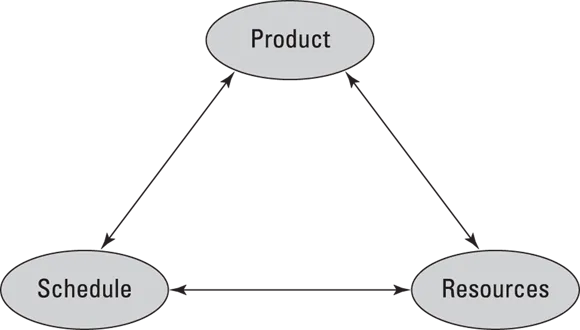
As illustrated in Figure 1-1, each component affects the other two. For example: Expanding the type and characteristics of desired outcomes may require more time (a later end date) or more resources. Moving up the end date may necessitate paring down the scope or increasing project expenditures (for instance, by paying overtime to project staff). It is within this three-part project definition that you perform work to achieve your desired results.
Schematic illustration of the relationship between the three main components of a project.
Ā© John Wiley & Sons, Inc.
FIGURE 1-1: The relationship between the three main components of a project.
Although many other considerations may affect a project’s performance, these three components are the basis of a project’s definition for the following three reasons:
  • The only reason a project exists is to produce the results specified in its scope.
  • The project’s end date is an essential part of defining what constitutes successful performance, as the desired result must be achieved by a certain time to meet its intended need.
  • The availability of resources shapes the nature of the results the project can produce.
A Guide to the Project Management Body of Knowledge, 7th Edition (PMBOK 7), elaborates on these components by:
  • Emphasizing that product includes both the basic nature of what is to be produced (for example, a new software program or a new prescription drug) and its required characteristics (for example, the features and functions the software program must include), which are defined as the product’s quality.
  • Noting that resources refers to funds, as well as to other, nonmonetary resources, such as people, equipment, raw materials, and facilities.
PMBOK 7 also emphasizes that risk (the likelihood that not everything will go exactly according to plan) plays an important role in defining a project and that guiding a project to success involves continually managing trade-offs among the three main project components — the products to be produced and their characteristics, the schedule, and the resources required to ...

Table of contents

  1. Cover
  2. Title Page
  3. Copyright
  4. Table of Contents
  5. Introduction
  6. Part 1: Getting Started with Project Management
  7. Part 2: Planning Time: Determining When and How Much
  8. Part 3: Group Work: Putting Your Team Together
  9. Part 4: Steering the Ship: Managing Your Project to Success
  10. Part 5: Taking Your Project Management to the Next Level
  11. Part 6: The Part of Tens
  12. Appendix: Combining the Techniques into Smooth-Flowing Processes
  13. Index
  14. About the Author
  15. Connect with Dummies
  16. End User License Agreement