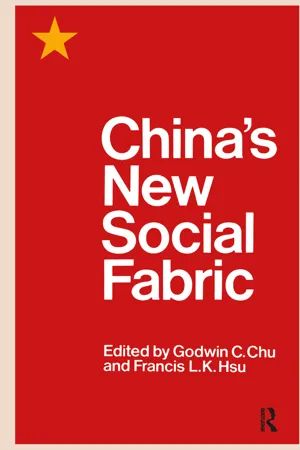
First published in 1983.China has undergone tumultuous changes in the last thirty years, yet Chinese society as not only stayed intact, but has made progress. The pace at which the country has reunited following the death of Chairman Mao has taken the outside world by surprise. The contributors to this book ask what are the integrative factors in contemporary China that have held the society together during the course of its revolutionary transformation and examine various aspects of the Chinese social system for clues to the answer. What they have found is a new Chinese social fabric that in part has its roots in China's traditional social and cultural foundations. they show how the Chinese system draws its strength from the local communities and is integrated through an intricate web of communication channels, mostly laid down since the founding of the People's republic in 1949. The downfall of the radicals after the death o Mao has altered the policy regarding the interim objectives of the system, but not its basic structural processes. China's experience in the last thirty years, both in its success and setbacks, will be interest to many developing societies.
- 256 pages
- English
- ePUB (mobile friendly)
- Available on iOS & Android
eBook - ePub
China's New Social Fabric
About this book
Information
IV. Conflict Resolution
DOI: 10.4324/9781003209577-11
Conflicts and contradictions are very much a part of China’s process of societal transformation. One of the legitimate ways in which the system encourages citizens to bring conflictual issues to the attention of the public for resolution is the letters to the editor column in the press.
Godwin Chu and Leonard Chu analyze the letters in the official People’s Daily over a twelve-year period, covering 1967-1968 during the Cultural Revolution and 1976-1978 in the aftermath of the Gang of Four. The different political climates apparently affected the functioning of the letters column. Instead of a tone of restraint as in the Cultural Revolution years, now the Chinese are speaking out in unprecedented numbers, and with unprecedented candor. Tens of thousands of Chinese, from peasants to middle-echelon cadres, each month write to the editor. They raise policy issues, complain of human rights violations, argue ideological points, and criticize local officials. In this sense, the letters column in the People’s Daily has become a forum for public discussion. Through this channel the central leadership orients itself toward the divergent views and conflictual issues at the grassroots level.
Resolution of local conflicts, which used to be mediated through the clan networks, now follows a different route. Mitch Meisner uses the Tachai case to illustrate how local cadres like Ch’en Yung-kuei might appeal to personal prestige, acquaintance connections, and other types of local loyalties to forge horizontal channels of communication. These channels are then used as a basis for political alliance to counter hierarchical disposition of power during periods of political conflict. In the Tachai case the internal solidarity among the peasants enabled Ch'en to take a stand against the county hierarchy. Recent revelations about false production records and abuse of power have ended the stellar status that Ch’en once enjoyed during the days of the Gang of Four. However, the importance of informal, horizontal communication to counterbalance the official vertical channels, as illustrated by theTachai experience in its early days, deserves further study.
8
Mass Media and Conflict Resolution: An Analysis of Letters to the Editor
DOI: 10.4324/9781003209577-12
Conflict, according to Simmel, is a form of social life in the sense that no group can be entirely harmonious.1 Any group will show harmony and disharmony, association and disassociation. The question is, how are these two types of social processes structured in a society either to maintain cohesion or to foster disruption?
Elaborating on the theoretical writings of Simmel, Coser has suggested that social conflict may serve to establish the identity and maintain the boundaries of a society, and thus may be functional instead of dysfunctional.2 This proposition rests on one basic assumption: That the social structure will provide adequate institutions through which conflict may be channeled and resolved in a socially sanctioned manner without serious disruptive consequences. Such institutions of conflict resolution, Coser points out, should be distinguished from what are general ly known as safety-valve institutions.3 The latter have the function of diverting hostility onto substitute targets or providing a mechanism for tension release, and thus may alleviate or postpone conflict. They do not, however, necessarily provide a socially recognized channel through which conflict may be expressed and resolved.
Even though the pursuit of conflict and conflict resolution following regulated social patterns may be considered a functional prerequisite, the manner in which this function is fulfilled would appear to vary with the nature of the social structure. In other words, structural alternatives would exist in different social systems.4 In a society like the United States, for instance, a number of such structural mechanisms permit the expression of rival claims and opposite views by the free press system, by town hall meetings, by debates in legislative councils, and, in the sixties, by the behavioral enactment of dissent.
Such structural mechanisms are apparently not developed to the same extent in a country like the People’s Republic of China. Following Simmel and Coser, however, we assume that some mechanisms must exist for the pursuit and resolution of conflict. In this chapter we shall attempt to demonstrate that the “Letters to the Editor” column in the People’s Daily, the official newspaper of the People’s Republic, provides such an institutionalized mechanism.
This thesis is inspired by the pioneering work of Inkeleson the Soviet system of mass media.5 Inkeles and Geiger took note of the letters published in Pravda and other major newspapers in the form of samokritika, that is, self-criticism. The purpose of the letters, according to Inkeles, was to expose errors in the work of others as well as to acknowledge one’s own mistakes and learn from them. Inkeles appeared to regard the letters more or less as a safety-valve institution for releasing tension and channeling aggression toward permissible targets. Inkeles’ model was followed in Yu’s analysis of the media system of the People’s Republic, in which he made references to letters published in Communist Chinese newspapers.6
We recognize that some of the letters could serve the late...
Table of contents
- Cover
- Title
- Copyright
- Table of Contents
- Preface
- I INTRODUCTION
- II MASS-LEADER RELATIONS
- III COORDINATION AND INTEREST ARTICULATION
- IV CONFLICT RESOLUTION
- V EPILOGUE
- Contributors
- Index
Trusted by 375,005 students
Access to over 1.5 million titles for a fair monthly price.
Study more efficiently using our study tools.
Frequently asked questions
Yes, you can cancel anytime from the Subscription tab in your account settings on the Perlego website. Your subscription will stay active until the end of your current billing period. Learn how to cancel your subscription
No, books cannot be downloaded as external files, such as PDFs, for use outside of Perlego. However, you can download books within the Perlego app for offline reading on mobile or tablet. Learn how to download books offline
We are an online textbook subscription service, where you can get access to an entire online library for less than the price of a single book per month. With over 1.5 million books across 990+ topics, we’ve got you covered! Learn about our mission
Look out for the read-aloud symbol on your next book to see if you can listen to it. The read-aloud tool reads text aloud for you, highlighting the text as it is being read. You can pause it, speed it up and slow it down. Learn more about Read Aloud
Yes! You can use the Perlego app on both iOS and Android devices to read anytime, anywhere — even offline. Perfect for commutes or when you’re on the go.
Please note we cannot support devices running on iOS 13 and Android 7 or earlier. Learn more about using the app
Please note we cannot support devices running on iOS 13 and Android 7 or earlier. Learn more about using the app
Yes, you can access China's New Social Fabric by Godwin C. Chu,Francis L.K. Hsu in PDF and/or ePUB format, as well as other popular books in Social Sciences & Ethnic Studies. We have over 1.5 million books available in our catalogue for you to explore.