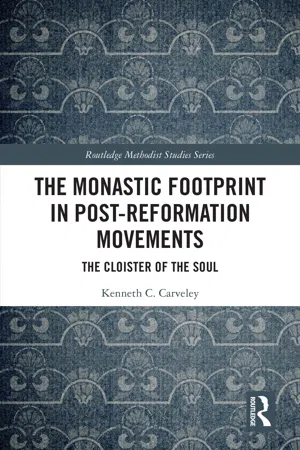
This book examines the influence of the monastic tradition beyond the Reformation. Where the built monastic environment had been dissolved, desire for the spiritual benefits of monastic living still echoed within theological and spiritual writing of the seventeenth and eighteenth centuries as a virtual exegetical template. The volume considers how the writings of monastic authors were appropriated in post-Reformation movements by those seeking a more fervent spiritual life, and how the concept of an internal cloister of monastic/ascetic spirituality influenced several Anglican writers during the Restoration. There is a careful examination of the monastic influence upon the Wesleys and the foundation and rise of Methodism. Drawing on a range of primary sources, the book will be of particular interest to scholars of monastic and Methodist history, and to those engaged in researching ecclesiology and in ecumenical dialogues.
eBook - ePub
The Monastic Footprint in Post-Reformation Movements
The Cloister of the Soul
- 280 pages
- English
- ePUB (mobile friendly)
- Available on iOS & Android
eBook - ePub
About this book
Information
1The monastic impulse
DOI: 10.4324/9781003226734-1
This text examines the influence of the monastic tradition beyond the Reformation, how it finds common expression in writers, communities and societies drawing upon sources of ascetic spirituality principally from the early and medieval periods of Christian belief and practice and how these were applied to their own life and habitus. Where the built monastic environment had been dissolved, desire for the spiritual benefits of monastic living remained within theological and spiritual writings of the seventeenth and eighteenth centuries as a virtual exegetical template. This interiorisation of the monastic structure resembled in many forms the interiorisation of pilgrimage in earlier writers, yet the consequence was the inevitable formation of societies and communities which in many respects emulated the claustral context. In this, we can find a process of internalisation of ecclesiological perspectives from the hierarchical church through to the interior church of the soul. This perspective can shift from the visible to the invisible church, in some instances cast more as the unseen alliance of true believers rather than the church in heaven. Beyond political and secular contexts, this search for authentic Christian living reached beyond the Protestant-Catholic divide, yet for all its affective spirituality it rarely managed to span ecumenically the visible circumstances of confessional identity to reach communio in sacris.
The recurrent problem that such appeal to monastic spirituality entailed was that it could form a docetic church, an invisible reality which will relegate incarnational form to an a-historical perspective in a process of constant interior refinement. What extra-claustral ascetic desire can affirm is that it will constantly seek visible structures, individually and corporately in ecclesiolae of serious commitment. This often resulted in regulae, sometimes more informal structures of oversight and counsel, particularly in texts promoting piety and affective devotion, many of which mirror (and are called such) monastic rules, even claustral structures. It could also lead to the reinterpretation of monastic ideals, such as unceasing prayer recast in writers such as Bayly and Horneck as prayer texts providing for almost all the minutiae of human life.
These begin to create new normative expectations beyond church orders for those who feel called to be guided by them.
Some, ostensibly following Erasmus, may regard this as the inevitable monasticisation of the whole Church; however, this, rarely if ever, managed to reach beyond the implicit binary perspective on what is regarded as ‘true’ Christian living vis-à-vis the generality of Christian adherents.
In the recognition of this monastic imprint, there are some unexpected connections, which should occasion some rethinking of familiar theological and ecclesial traditions and the constructs of confessional identity.
This is particularly the case with John Wesley’s appropriation of monastic writings and other authors such as Horneck; in these sources we can glimpse what Wesley was commending to the Methodist societies.
Acts and ascesis
In interpreting the early Christian community much has been made of Luke’s description of the common life in the book of Acts (Acts. 2.42–47; 4. 32–35). Luke’s idealistic picture raises questions as to whether we are being afforded an historical snapshot of the early Jerusalem Church, possibly a summary of attitudes and practices inspired by faith, or a descriptive template which shows early believers as equal to the commitment of other known communities living a common life, as recorded by Eusebius.1
The issue remains as to whether the community of Luke’s text is one of common residence and mutual support, a temporary phase, or the establishment of what from a later perspective is a form of proto-monasticism, refining a supposedly egalitarian sharing into something more on the lines of existing communities such as the Essenes, taking their cue from familiar ascetic arrangements.
The Acts passages sow the question of what in Christian commitment is for the many, a pattern of living expected from all, and what is for the few, a vocation to dedicated living forgoing personal possessions and ownership in a common life. These passages give us a glimpse of the developing strata of leadership in the early Christian community, although it is questionable as to whether this might be described as the embryonic construction of hierarchy.
These texts are used as a prescriptive template for Christian living and believing in writers and communities of later centuries reaching for a form of the common life within the Church, sometimes excluded from it, often reading Acts through an imaginative lens. These reinterpretative perspectives recur throughout the Christian tradition in the appeal to primitivism and originality, authenticity and apostolicity, and in the construction of communities, in particular as a foundation for monasticism.
Hendrik Dey analyses how what he describes as a hodgepodge of ascetic experiences and practices within Christian ascesis are eventually focused into the cenobitic model:
The ascetic movement originally embraced all sorts of solitary and/or peripatetic modes of living that fell well outside the pale of the cenobitic model. The triumph of the latter model was accompanied by the gradual devaluation of other modes and their ultimate near-disappearance from the written sources upon which historians of monasticism have traditionally relied until recently, to the near-exclusion of material evidence.2
Early Christian ascetic beginnings were a varied collection of people and movements, not necessarily fleeing persecution, and often not isolated from the common life of others, even when committed to solitude, chastity, renunciation of property or intentional holy homelessness.3
This leads us by degrees to the question ‘what is monasticism?’ Is it an interior disposition following the authentic life of the primitive church as described in Acts? Is the formal establishment of a boundary between the Church and monastic institutions a visible marker between nominal Christian belief and wholehearted commitment? In this, there is a perpetual challenge to nominal belief found in the promotion of ascesis for all, particularly within the later Anglican schola of ‘holy living’,4 as also proposed and encouraged by writers such as Anthony Horneck in his The Happy Ascetick (1681) and Luke de Beaulieu’s Claustrum Animae: The Reformed Monastery (1677).5
Such ascesis inevitably resulted in religious societies for the more committed leading them to access monastic sources, something perceptively recognized by Samuel Wesley. Among post-Reformation Catholic writers, it is often evident in the nostalgic longing for a return of the dissolved monasteries or their replacement. As the Church developed its life there is an underlying issue, particularly in Protestantism, in the desire for a more fervent commitment akin to a virtual monastery, and the discernment of what is for the many and what is for the few. This can relate to the issue of God’s favour and election as in Calvin, but more to the question of whether there is one common Christian life for all entered at baptism, or more subtle and often informal and less visible definitions, degrees of refinement and holy selectivity, as well as formal community construction. This is a question encountered in the Reformers and their particular antipathy to monks, somewhat mitigated by their selective appreciation for some monastic authors, particularly Bernard of Clairvaux.6
This raises the ecclesiological issue of how interior affective devotion relates to the Church as the continuing visibility of the Incarnation, and occasionally whether personal inspiration takes priority over consensus in formal dogma and institutions. What are the parameters and instruments of discernment, ecclesial, conciliar and personal? What, occasionally who, are the guides to the authenticity of truth before and beyond canon, text and regulae? If for such as Augustine there is interior knowing which reaches to the heart of things in a living encounter with truth, is not this what both the true ascetic desires and what the grace of the font initiates for all?
As Dey suggests, ascetic separation consisted not so much in buildings, but in imbuing buildings and things monastic with meaning.7 In this, the inner space of the monk himself mirrored the claustral boundary and its internal purpose.
Mapping of monastic spaces and the re-interpretation of time were not simply communal practices. The particular qualities of monastic life – separation from ordinary society, constructing an ambience conducive to spiritual reflection – were meant to be embodied in each monastic person….individuals were expected to internalise monastic values, even when away from the monastery itself.The protected space of the monastery becomes a metaphor for the strictly guarded self, though now inverted to become a means to containing evil rather than to keep it out.The conceptual framework for anticipated heaven was constructed from biblical motifs, and those trying to inhabit that alternative reality needed to be able to employ those motifs to interpret their own experience.8
It is this legacy of internalisation of the monastic ethos which survives, particularly in the re-appropriation of monastic sources by charismatic individuals and religious movements beyond late antiquity and the Middle Ages into the modern period and beyond.
As the Christian monastic tradition developed from the early desert hermits and coenobia to the settlements related to Augustine, and the movement of monastic communities into the life of the city, it related the structure of communities to interior spirituality and ascesis. In particular, the construction of the monastic enceinte itself came to be used as an interpreted exegeted text to explicate the inner life it served, in which the cloister becomes a synecdoche for monasticism.
In the reinterpretation of monasticism as an interior disposition of affective piety, later religious societies and movements sought to appropriate what they considered the heart of monastic spirituality beyond the monastic construct as a form of virtual cloister. This raises the issue of ...
Table of contents
- Cover
- Half Title
- Series Page
- Title Page
- Copyright Page
- Dedication
- Table of Contents
- List of figures
- Acknowledgments
- List of abbreviations
- Foreword
- 1 The monastic impulse
- 2 Pietism and the interior monastery
- 3 Anthony Horneck: the Happy Ascetick (1681 & editions) an analytical reading
- 4 Luke de Beaulieu: Claustrum Animae, the Cloister of the Soul or the Reformed Monastery
- 5 Monks and Methodists
- 6 The monastic imprint: refining the soul
- Appendix I: John Wesley’s Christian Library and the Homilies of Macarius
- Appendix II: Anthony Horneck: The Happy Ascetick
- Index
Trusted by 375,005 students
Access to over 1.5 million titles for a fair monthly price.
Study more efficiently using our study tools.
Frequently asked questions
Yes, you can cancel anytime from the Subscription tab in your account settings on the Perlego website. Your subscription will stay active until the end of your current billing period. Learn how to cancel your subscription
No, books cannot be downloaded as external files, such as PDFs, for use outside of Perlego. However, you can download books within the Perlego app for offline reading on mobile or tablet. Learn how to download books offline
Perlego offers two plans: Essential and Complete
- Essential is ideal for learners and professionals who enjoy exploring a wide range of subjects. Access the Essential Library with 800,000+ trusted titles and best-sellers across business, personal growth, and the humanities. Includes unlimited reading time and Standard Read Aloud voice.
- Complete: Perfect for advanced learners and researchers needing full, unrestricted access. Unlock 1.5M+ books across hundreds of subjects, including academic and specialized titles. The Complete Plan also includes advanced features like Premium Read Aloud and Research Assistant.
We are an online textbook subscription service, where you can get access to an entire online library for less than the price of a single book per month. With over 1.5 million books across 990+ topics, we’ve got you covered! Learn about our mission
Look out for the read-aloud symbol on your next book to see if you can listen to it. The read-aloud tool reads text aloud for you, highlighting the text as it is being read. You can pause it, speed it up and slow it down. Learn more about Read Aloud
Yes! You can use the Perlego app on both iOS and Android devices to read anytime, anywhere — even offline. Perfect for commutes or when you’re on the go.
Please note we cannot support devices running on iOS 13 and Android 7 or earlier. Learn more about using the app
Please note we cannot support devices running on iOS 13 and Android 7 or earlier. Learn more about using the app
Yes, you can access The Monastic Footprint in Post-Reformation Movements by Kenneth C. Carveley in PDF and/or ePUB format, as well as other popular books in Theology & Religion & Religion. We have over 1.5 million books available in our catalogue for you to explore.