This book covers a range of important topics and recent advances in metagenomics, microbiomes and their emerging applications, including microbiota transplantation and its health implications. It also discusses microbiome composition and development in humans. The contributors of this volume provide detailed information on prebiotics and probiotics for enhanced human health. They also introduce microbiomes as the next frontiers in medicine, agriculture, industry and environment. A chapter is presented that discusses probiotic research studies in Nigeria and Canada that led to the discovery of Lactobacillus pentosus KCA1. The book contains timely knowledge and will be useful reference material for scientists and researchers working in the fields of food and agricultural biotechnology, biopharmaceuticals and medical biotechnology, fermentation technology, environmental biotechnology, microbiomes and microbial biotechnology and health care.
Emphasizes recent advances in metagenomics and microbiomes and their emerging applications in medicine, agriculture, industry and environment
Provides detailed information on prebiotics and probiotics for enhanced human health
Introduces microbiomes as the next frontiers in medicine, agriculture, industry and environment
Reviews microbiota transplantation, health implications and the way forward
Discusses microbiome-epigenetic-host interactions essential for the physiological functions of the body in health and disease
Nwadiuto (Diuto) Esiobu, Ph.D., is a Professor of Microbiology and Biotechnology at Florida Atlantic University, Boca Raton, FL, USA, and the President and Founder, of Applied Biotech Inc. and ABINL.
James Chukwuma Ogbonna, Ph.D., is a Professor of Microbiology and Biotechnology, and Director, National Biotechnology Development Agency, South East Zonal Biotechnology Centre, University of Nigeria, Nsukka, Nigeria.
Charles Oluwaseun Adetunji, Ph.D., is an Associate Professor of Microbiology and Biotechnology, and Director of Intellectual Property and Technology Transfer, Edo State University Uzairue, Nigeria.
Olawole O. Obembe, Ph.D., is a Professor of Plant Biotechnology and UNESCO Chair, Plant Biotechnology, Covenant University, Ota, Nigeria.
Ifeoma Maureen Ezeonu, Ph.D., is a Professor of Medical Microbiology and Molecular Genetics in the Department of Microbiology, University of Nigeria, Nsukka, Nigeria.
Abdulrazak B. Ibrahim, Ph.D., is a Capacity Development Expert at the Forum for Agricultural Research in Africa (FARA) and Associate Professor of Biochemistry, Ahmadu Bello University, Zaria, Nigeria.
Benjamin Ewa Ubi, Ph.D., is a Professor of Plant Breeding and Biotechnology and Director, Biotechnology Research and Development Centre, Ebonyi State University, Abakaliki, Nigeria..
Frequently asked questions
Yes, you can cancel anytime from the Subscription tab in your account settings on the Perlego website. Your subscription will stay active until the end of your current billing period. Learn how to cancel your subscription.
No, books cannot be downloaded as external files, such as PDFs, for use outside of Perlego. However, you can download books within the Perlego app for offline reading on mobile or tablet. Learn more here.
Perlego offers two plans: Essential and Complete
Essential is ideal for learners and professionals who enjoy exploring a wide range of subjects. Access the Essential Library with 800,000+ trusted titles and best-sellers across business, personal growth, and the humanities. Includes unlimited reading time and Standard Read Aloud voice.
Complete: Perfect for advanced learners and researchers needing full, unrestricted access. Unlock 1.4M+ books across hundreds of subjects, including academic and specialized titles. The Complete Plan also includes advanced features like Premium Read Aloud and Research Assistant.
Both plans are available with monthly, semester, or annual billing cycles.
We are an online textbook subscription service, where you can get access to an entire online library for less than the price of a single book per month. With over 1 million books across 1000+ topics, weāve got you covered! Learn more here.
Look out for the read-aloud symbol on your next book to see if you can listen to it. The read-aloud tool reads text aloud for you, highlighting the text as it is being read. You can pause it, speed it up and slow it down. Learn more here.
Yes! You can use the Perlego app on both iOS or Android devices to read anytime, anywhere ā even offline. Perfect for commutes or when youāre on the go. Please note we cannot support devices running on iOS 13 and Android 7 or earlier. Learn more about using the app.
Yes, you can access Microbiomes and Emerging Applications by Nwadiuto (Diuto) Esiobu,James C. Ogbonna,Charles Oluwaseun Adetunji,Olawole O. Obembe,Ifeoma Maureen Ezeonu,Abdulrazak B. Ibrahim,Benjamin Ewa Ubi in PDF and/or ePUB format, as well as other popular books in Medicine & Genetics & Genomics. We have over one million books available in our catalogue for you to explore.
1 Microbiome and Metagenomics Researches in NigeriaEvolution, Current Status and Prospects
Francisca O. Nwaokorie
University of Lagos
Ime R. Udotong
University of Uyo
Nwadiuto (Diuto) Esiobu
Applied Biotech International Nigeria Ltd
Florida Atlantic University
Ifeoma Enweani-Nwokelo
Nnamdi Azikiwe University
DOI: 10.1201/9781003180241-1
Contents
1.1 Introduction
1.2 Microbiome
1.3 Metagenomics
1.4 Application of Metagenomics
1.5 Products from Microbiomes and Metagenomics
1.6 History and Evolution of Microbiomes and Metagenomics Researches in Nigeria
1.7 Metagenomic Sequencing Approaches for Investigating Animal, Human and Soil Microbes in Nigeria
1.8 Status of Metagenomics Services in Nigeria
1.9 Current Academic, Health and Industrial Structures Supporting Microbiome and Metagenomics Research in Nigeria
1.10 Challenges of Microbiome and Metagenomics Research in Nigeria
1.11 Prospects of Human Microbiome and Metagenomics Research
1.12 Recommendations
1.13 Conclusion
References
1.1 Introduction
Microbiomes and metagenomics researches have come to revolutionize microbial ecology in particular and microbiological researches in general. Though it is as old as over three decades, it is still considered new and novel in Nigeria. Till date, many are unaware of its vast applications in medicine, agriculture, food, biotechnology, environmental remediation and sustainability and indeed all spheres of human endeavours, and the importance aspiration that it holds for the future. Following trends, the quantum of research on human and environmental microbiomes and metagenomics researches is underscored by very little data emanating from Nigeria. Globally, thousands of microbiome research projects have been carried out by various researchers.
Metagenomic analyses are applied in the fields of agriculture, biofuel, biotechnology, ecology, environmental remediation, and pharmaceutical and medical sciences (human microbiome characterization and infectious disease diagnosis). Important reviews and presentations of some seminal microbiome projects include the human microbiome (Gevers et al., 2012), the earth microbiome (Thompson et al., 2017), ocean microbiome (Zehr et al., 2017), foetal microbiome (Ma et al., 2014), newborn microbiome (Groer et al., 2014), and cadaver microbiome (Gilbert and Lynch, 2019), among similar projects in various countries. The benefits of the research emanating from this field consist of products available in human microbiome market. This includes prebiotics, probiotics, foods, and medical diagnostic tests and drugs. In addition, this technology has wide application in therapeutics and management of infectious diseases, metabolic/endocrine disorders, inflammatory and cardiovascular disease, cancer, blood and neurological disorders. Moreover, there are products for research technology in use for sequencing, genomics, proteomics, metabolomics and other āOMICS.
By using next-generation sequencing (NGS) technologies in Nigeria, some researchers have successfully brought to light the actual composition of microorganisms in different environments in Nigeria (Olukunle and Boboy, 2013; Udotong et al., 2015; Ogbulie and Nwaokorie, 2016; Udotong et al., 2017; Ezekoye et al., 2018; Uko et al., 2019, Anika et al., 2020). Microbiomes and metagenomic studies are pivotal to unlocking the agricultural potential of Nigeria in a renewable, climate-smart and sustainable approach. Understanding the microbiomes of Nigerian soils and how these could be manipulated for prime fertility and soil quality has also been addressed through these types of studies (Bukar et al., 2019). Studies in the area of basic medical sciences including that on vagina, gut and oral microbiome also exist (Ayeni et al., 2018; Anukam and Agbakoba, 2017; Anukam et al., 2019; Nwaokorie et al., 2020).
Most of Nigerian researchers acquired the skills through hands-on training on DNA extraction and standardization in local institutions. However, the core metagenomic sequencing experiences are obtained in foreign laboratories through collaborative research, personal sponsorship, fellowships and grants. Looking at institutional capacity, African Centre of Excellence for Genomics of Infectious Diseases (ACEGID) at Redeemerās University, Ede, is drawing synergistically on the intersection between training, research and health (Dudas et al., 2017; Ajogbasile et al., 2020). The African Centre of Excellence for Phytomedicine Research and Development (ACEPRD), University of Jos, functions under similar mandate. Irrespective of the contributions made so far, accessibility to these centres remains limited as most samples still find their ways outside Nigeria for NGS analysis showing that the available infrastructure is far below the national needs required to facilitate metagenomics researches. Till date, outputs recorded have not translated these basic researches to patent, industrialization and commercialization for national development.
1.2 Microbiome
Microbiome refers to the collection of genomes of microorganisms (microbiota) living in a particular environment. Virtually everything in nature, both living and non-living things, harbour microorganisms and can therefore be referred to as āmicrobiomesā. Microbiomes is used to describe communities of various types of microbes, their gene and gene products collectively in a selected habitat be it on humans, animals, vegetation, soils, oceans or even buildings (Blaser et al., 2016). Microbiomes describe the well-studied bacteria consortia, while virobiomes and mycobiomes apply to viruses and fungi, respectively. The scientific concept of metagenomic approach evolved in an effort to discover more about the diversity of these microbes in natural environments (López-GarcĆa and Moreira, 2008).
1.3 Metagenomics
Metagenomics is a molecular biology tool that involves simultaneous sequencing and analysis of a wide range of genomes in a niche, including functional analysis following gene annotation. The discipline involves the use of culture-independent genomic analysis to provide information on the microbial diversity and ecology of a specific environment (Handelsman et al., 1998). Taxonomic profiling, characterization and analysis of these microbial communities are performed using NGS platforms. The most common platforms are 454 Life Sciences (Roche) and Illumina systems (Solexa) (Oulas et al., 2015). Others include SOLiD 5500 W Series (Applied Biosystems), single-molecule real-time (SMRT) DNA sequencing (Pacific Biosciences), Ion Torrent semiconductor sequencing and Strand sequencing technologies (Oxford Nanopore technologies) as well as Irys Technology (BioNano Genomics) (Oulas et al., 2015; Jain et al., 2016).
1.4 Application of Metagenomics
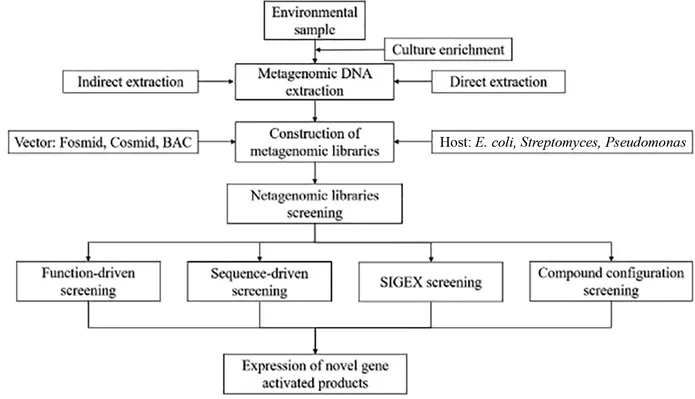
The most widely employed sequencing technology is the amplicon metagenomics where sub-genomes or genes (partial or entire) are studied using universal primers. Whole genome metagenomics reveals the entire microbial makeup of a niche and is often used in public health risk assessment food safety and in discovering and mining bioresources (Mercer et al., 2020). The tools for metagenomic analysis are the DNA processed through workflow of library preparation, sequencing and bioinformatics analysis (Figure 1.1).
FIGURE1.1 General process of metagenomic workflow. (Source: Awasthi et al., 2020)
Metagenomic analyses are applied in the field of agriculture, biofuel, biotechnology ecology, environmental remediation, pharmaceutical and medical sciences (human microbiome characterization and infectious disease diagnosis). The technology has been used extensively to define microbial diversity, bioremediation, pollution monitoring, enzyme and drug discovery. Its applications entail the identification of novel bacteria or gene clusters encoding for enzymes that degrade substrates. In addition, this technology is very useful in the diagnosis and monitoring of pathogens (Datta et al., 2020).
1.5 Products from Microbiomes and Metagenomics
Available products in human microbiome market include prebiotics, probiotics, foods, and medical diagnostic tests and drugs. They are in use for therapeutics and management of infectious diseases, metabolic/endocrine disorders, inflammatory and cardiovascular disease, cancer, blood and neurological disorders. Similarly, in soil metagenomics, activity-based screening has the potential to detect entirely new genes encoding for novel types and classes of enzymes. Such an approach is also used to identify new bioactive compounds and functional gene products. To support this, cellulases, lipases and xylanase enzymes and antibiotics with appreciable commercial values have been isolated from various natural environments like soil, rumen, compost soil and plants, among others (Shrinivas et. al., 2019; Amao et al., 2019).
1.6 History and Evolution of Microbiomes and Metagenomics Researches in Nigeria
Embracing microbiome and metagenomic research in Nigeria was initially challenged by lack of skills, project design, funding and opportunity to collaboration with experts in these fields. This was somehow bridged by the involvement of researchers in-country. Around 2010, Adelekan and Esiobu (2012) employed amplicon metagenomics to analyse a local solid-state fermentation product, with the aim of improving its quality and extending its shelf life. Udotong et al. (2015) evaluated the microbial diversity of a remote aviation fuel contaminated sediment of a lentic ecosystem in Ibeno, Nigeria. This study was followed by the determination of procaryotic diversity of the remote aviation fuel-polluted lentic ecosystem in Ibeno, Nigeria (Udotong et al., 2017). They later worked on homology-dependent metagenomics study of agricultural soils in Akwa Ibom State, Nigeria (Uko et al., 2019). Other metagenomic studies focusing on environmental microbiome include the study on microbial community diversity and genetic functions of environmental microbes capable of degrading relevant substrates (Ogbulie and Nwaokorie, 2016); metagenomic insights into effects of spent engine oil perturbation on the microbial community composition and function in a tropical agricultural soil (Salam et al., 2017); and metagenomics of bioslurry obtained from a biogas plant and anaerobic digester using next-generation DNA sequencing (Akubuenyi et al., 2019; Anika et al., 2020). Other studies in that line looked at the correlation and distribution of xenobiotic genes and metabolic activities with the level of total petroleum hydrocarbon in soil, sediment and estuary water in the Niger Delta (Edet et al., 2018a), and evaluation of microbial diversity of epipelic and benthic sediment using cultural and metagenomics techniques (Edet et al., 2018b) as well as that on the potential benefits of applying āOMICSā technology in cleaning up crude oil spillages in the Niger Delta region of Nigeria (Udofia et al., 2018).
The trend in the area of human microbiome is not left out. Indigenous researchers provided earlier information on metagenomic assessment of antibiotic resistance genes from an ecosystem (Edet et al., 2017a, b) and implication of human microbiome diversity in health and disease (Mboto et al., 2018). Other researches like the works of Anukam and Agbakoba (2017) and Anukam et al. (2019) in the area of oral and vaginal microbiomes are well d...
Table of contents
Cover
Half Title
Series Page
Title Page
Copyright Page
Dedication Page
Table of Contents
Foreword
Preface
Editors
Contributors
Chapter 1 Microbiome and Metagenomics Researches in Nigeria: Evolution, Current Status and Prospects
Chapter 2 Microbial Biotechnology: Expanding the Frontiers of Microbiomes for Innovation in Agriculture and Medicine
Chapter 3 The Need for Probiotics in Nigeria
Chapter 4 Development and Composition of the Human Microbiome from Birth
Chapter 5 Microbiota Transplantation, Health Implications, and the Way Forward
Chapter 6 Microbiome Reshaping and Epigenetic Regulation
Chapter 7 Probiotic Research Studies That Led to the Discovery of Lactobacillus pentosus KCA1
Chapter 8 A Brief Review of Earth Microbiomes and Applications