This book studies young people who are Not in Education, Employment, or Training (NEET); a prime concern among policymakers. Moving past common interpretations of NEETs as a homogeneous group, it asks why some youth become NEET, whereas other do not. The authors analyse diverse school-to-work patterns of young NEETs in five typical countries and investigate the role of individual characteristics, countries' institutions and policies, and their complex interplay. Readers will come to understand youth marginalization as a process that may occur during the transition from school, vocational college, or university to work. By studying longitudinal analyses of processes and transitions, readers will gain the crucial insight that NEETs are not equally vulnerable, and that most NEETs will find their way back to the labour market. However, they will also see that in all countries, a group of long-term NEETs exists. These exceptionally vulnerable young people are sidelined from society and the labour market. The country cases and cross-national studies illustrate that policies intended to help long-term NEETs to find their way in society are very limited. The book provides useful theoretical and empirical insights for scholars interested in the school-to-work transition and marginalized youth. It also provides helpful insights in vulnerability to policymakers who aim to combat youth marginalization. The Open Access version of this book, available at www.taylorfrancis.com, has been made available under a Creative Commons Attribution-Non Commercial-No Derivatives 4.0 license.
eBook - ePub
The Dynamics of Marginalized Youth
Not in Education, Employment, or Training Around the World
- 294 pages
- English
- ePUB (mobile friendly)
- Available on iOS & Android
eBook - ePub
The Dynamics of Marginalized Youth
Not in Education, Employment, or Training Around the World
About this book
Information
1Not in Employment, Education, or Training around the World
Mark Levels, Christian Brzinsky-Fay, Craig Holmes, Janine Jongbloed and Hirofumi Taki
DOI: 10.4324/9781003096658-1
1.1 Understanding NEET
During the economic crises in the years following 2008, policymakers of various governments regularly hit the alarm bells about the dire situation of marginalized youth in various European countries. Indeed, young people seemed particularly vulnerable during the Great Recession. In 2012, no less than 15% of young people aged 15–29 in OECD countries were Not in Education, Employment, or Training (so-called NEETs). These NEETs were regularly portrayed as an essential challenge for many Western countries (European Commission, 2010a, 2010b, 2011; Eurofound, 2012). Not without reason: NEETs are, in many ways, the most vulnerable of all youth. Early-career inactivity turns NEETs into the most likely candidates for long-term socioeconomic marginalization, criminal careers, and grave mental and physical health problems (Bynner and Parsons, 2002; Coles et al., 2002; OECD, 2010; Chen, 2011). Escaping a life as NEET is hard. NEETs are also economically costly, both because of costs of policies associated with NEET, but also because of lost outputs and unfulfilled potential. Total yearly costs associated with European NEETs surpassed €153 billion in 2011 (Eurofound, 2012).
But, as Figure 1.1 demonstrates, there are large differences between countries. In Turkey, almost 30% of all young people were NEETs. Even in the Netherlands – the country with the lowest rate – the NEET rate is 7%. This has prompted the expectation that the extent to which young people are prone to become NEETs at least partly depends on countries’ institutional configurations and policies. However, whether this is actually the case remains an open question. Despite the apparent societal urgency, scientific attention to NEETs has remained rather modest. Consequently, our theoretical understanding of NEETs is still limited. We know too little about NEETs, whether being NEET is a transitory or long-lasting period, about differences in the timing of becoming NEET, or about the heterogeneity of the NEET population. Most studies use cross-sectional NEET rates, but it is very likely that more young people are affected by NEET periods between 15 and 29 than appears from cross-sectional studies, and that relatively few remain NEET for long (Furlong, 2006; Quintini and Martin, 2006; Quintini et al., 2007; Chen, 2011). Longitudinal studies would shed light on this. However, few such studies exist, and none examine age-specific NEET patterns (Furlong et al., 2003; Cusworth et al., 2009; Chen, 2011).
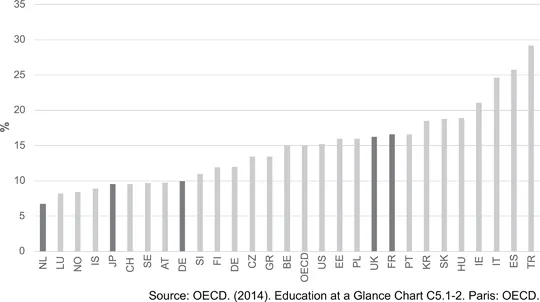
Figure 1.1 Percentage NEETs in population (15–29 years) in Europe and Japan (2012).
Although they are thought paramount in improving youth participation in education and the labour market, the role of institutional contexts and policies is poorly understood. Like youth unemployment, NEET risks plausibly arise from interactions between individual (life-course) characteristics and countries’ education and labour market institutions and policies (Hodkinson, 1996; Müller, 2005). The effectiveness of institutions and policies thus differs for different types of NEET. Completely disillusioned and disengaged youth probably react very differently to institutional incentives than, for instance, young mothers. These interactions are seldom studied.
This book aims to fill these gaps. We investigate the patterns, determinants, and consequences of being NEET to reveal and understand country similarities and differences. The goal is to provide new theoretical and empirical insights on the temporal patterns of NEETs, the impact of individual and institutional characteristics, and the interplay between institutions and individual characteristics on young people’s transitions into and out of NEET. The book addresses three main research questions:
- What are typical school-to-work trajectories that NEETs experience in different countries? Answering this question will also help us to understand to what extent NEET is a long-lasting or just a transitory stage in school-to-work transitions and paint a realistic picture of the extent to which NEETs are vulnerable. It also allows us to focus our explanatory work on the most vulnerable NEETs.
- We also want to explain how cross-national differences in typical NEET trajectories between countries can be explained and study the role of institutions and policies. Are they relevant? Do they work differently for different people? We ask specifically: To what extent can (a) individual characteristics, (b) countries’ institutions and policies, and (c) their interactions explain why young people are more likely to become NEET in certain countries, and less in others?
- We know that early-career joblessness or inactivity can have cumulative negative effects in the medium and longer terms. In this book, we focus on the most vulnerable NEETs and ask: What are the consequences of being vulnerable NEET in different countries?
To answer these questions, we use various research methods and modes of inference. The core of the book is formed by five in-depth longitudinal analyses of five relevant country cases – Germany, France, Japan, the Netherlands, and the United Kingdom. These quantitative country case studies rely on sequence analyses (Abbott, 1995) and various type of regression techniques to explain sequences. This enables us to study the situation of NEETs in these countries in-depth and get a good grip on the extent to which typical labour market conditions, educational institutions, and policies generate different trajectories into and out of NEET. The country case studies also help us to understand the relevance of individual and family backgrounds for these trajectories in different institutional contexts, and the consequences of experiencing NEET status in various countries. But the chapters cannot be formally compared, and conclusions we may draw from comparing findings from these case studies are limited to the countries that are studied. Additional cross-national analyses of 24 advanced economies serve to examine the relevance of institutions and policies and draw conclusions about the interaction between individual circumstances and institutional contexts. While the data we use do not allow for strict causal analyses, multilevel analyses will provide insights into generally observable patterns of interactions between institutional and individual characteristics.
The book contributes to research on youth marginalization and school-to-work transitions. It aims to:
- Increase our understanding of NEETs by building on common theoretical explanations for youth unemployment and long-term economic inactivity,
- Use data that allow for distinguishing different NEET categories and age groups and conduct analyses on assumptions behind the NEET concept,
- Analyse individuals becoming NEET as a dynamic process and not a single event, using longitudinal studies and sequence analyses,
- Study the interplay of individual and institutional factors, which might affect the incidence and the age-specific risks of NEET periods, as well as the probabilities of short- and long-term durations of NEET-status.
1.2 NEET: Policy definition or social group?
One of the main challenges with studying NEETs lies in the heterogeneity of the category. NEET is a negative definition; whether someone is characterized as NEET follows from a list of things they are not. As such, the term does not delineate a sociologically meaningful social group. However, they are commonly regarded in research literature and policy white papers as a social category. And one that is fundamentally different from the “normally” unemployed youth. NEETs are commonly painted as much more vulnerable, much more persistently inactive, and much less responsive to policy initiatives (Eurofound, 2012; Holte, 2018). The label “NEET” suggests problematic youth that has to be taken care of or, as Holte mentioned, “the concept conjured images of teenage boys who were engaged in petty crime, youth gangs or drug usage, or considered at risk of becoming religiously or politically extreme” (Holte, 2018: p. 11). This image is almost certainly incorrect. The NEET concept certainly lumps together many different forms of youth inactivity and explanations (and thus solutions) for NEETs vary widely. There are also cross-national differences. Japanese NEET who have completely retreated from society, are from different social backgrounds and face different circumstances from German immigrant children who have trouble finding a job, who in turn differ from Dutch low-ability adolescents who fail to graduate from vocational education. Patterns in and out of NEET might also vary distinctly between groups. Also, not all those classified as NEETs might actually be or become disadvantaged.
Research that treats NEETs as a homogenous category ignores these within-group differences and may thus very well obscure important explanations for youth inactivity. Which begs the question: why are researchers using this category in the first place? The NEET definition was initially coined by policymakers to capture the group of young people under the age of 18 who were out of work and education or training but ineligible for unemployment benefits. It has subsequently been expanded in terms of ages covered and fills an important role for policymakers and researchers who are interested in youth inactivity beyond on youth unemployment (Ryan, 2001; Breen, 2005). In particular, youth employment systems and their ability to integrate school leavers in labour market are traditionally described and measured by the youth unemployment rate, which is the ratio of those young people who actively search for but don’t find a job to the economically active population in the respective age group. Thus, youth unemployment rates cover the share of young people who are part of the labour market but currently out of work (i.e. the share of those searching for jobs). Inactive youths are excluded by definition. However, because school-to-work transitions are often not straightforward and characterized by detours or erroneous periods or interim solutions of varying duration, the status of inactivity has a higher relevance for young people compared to adult persons. The concept of youth unemployment is not able to capture the situation of young people who are inactive and, therefore, incompletely represents the activity dynamics of school leavers (Dietrich, 2013).
Since the 1990s, various alternative concepts emerged in labour market research as well as among policymakers. One of these concepts is NEET, which was first used in the UK (Rees et al., 1996; Furlong, 2006; Yates and Payne, 2006) and is closely connected to the theoretical concept of social exclusion. NEET is conceptually related to youth unemployment but also differs fundamentally. The NEET definition is broader; it includes the share of all young people who are disengaged from both the labour market and education, whether they search for jobs or not. The NEET rate thereby overcomes two critical aspects of the youth unemplo...
Table of contents
- Cover Page
- Half-Title Page
- Series Page
- Title Page
- Copyright Page
- Contents
- List of illustrations
- List of contributors
- Preface
- 1 Not in Employment, Education, or Training around the World
- 2 NEET during the School-to-Work Transition in the Netherlands
- 3 NEET in Germany: Labour Market Entry Patterns and Gender Differences
- 4 Patterns in NEET Statuses during the School-to-Work Transition in France
- 5 NEETs in England
- 6 NEET in Japan: Focusing on Gender and Cohort
- 7 Policy Interventions Targeting NEETs in Different Institutional Settings
- 8 The Role of Education Systems in Preventing NEETs
- 9 Can Labour Market Policies Help to Reduce Long-term NEETs?
- 10 How Long-term NEET are Explained by Family Policies in OECD Countries
- 11 Conclusions and Discussion
- References
- Index
Trusted by 375,005 students
Access to over 1.5 million titles for a fair monthly price.
Study more efficiently using our study tools.
Frequently asked questions
Yes, you can cancel anytime from the Subscription tab in your account settings on the Perlego website. Your subscription will stay active until the end of your current billing period. Learn how to cancel your subscription
No, books cannot be downloaded as external files, such as PDFs, for use outside of Perlego. However, you can download books within the Perlego app for offline reading on mobile or tablet. Learn how to download books offline
Perlego offers two plans: Essential and Complete
- Essential is ideal for learners and professionals who enjoy exploring a wide range of subjects. Access the Essential Library with 800,000+ trusted titles and best-sellers across business, personal growth, and the humanities. Includes unlimited reading time and Standard Read Aloud voice.
- Complete: Perfect for advanced learners and researchers needing full, unrestricted access. Unlock 1.5M+ books across hundreds of subjects, including academic and specialized titles. The Complete Plan also includes advanced features like Premium Read Aloud and Research Assistant.
We are an online textbook subscription service, where you can get access to an entire online library for less than the price of a single book per month. With over 1.5 million books across 990+ topics, we’ve got you covered! Learn about our mission
Look out for the read-aloud symbol on your next book to see if you can listen to it. The read-aloud tool reads text aloud for you, highlighting the text as it is being read. You can pause it, speed it up and slow it down. Learn more about Read Aloud
Yes! You can use the Perlego app on both iOS and Android devices to read anytime, anywhere — even offline. Perfect for commutes or when you’re on the go.
Please note we cannot support devices running on iOS 13 and Android 7 or earlier. Learn more about using the app
Please note we cannot support devices running on iOS 13 and Android 7 or earlier. Learn more about using the app
Yes, you can access The Dynamics of Marginalized Youth by Mark Levels, Christian Brzinsky-Fay, Craig Holmes, Janine Jongbloed, Hirofumi Taki, Mark Levels,Christian Brzinsky-Fay,Craig Holmes,Janine Jongbloed,Hirofumi Taki in PDF and/or ePUB format, as well as other popular books in Economics & Business Education. We have over 1.5 million books available in our catalogue for you to explore.