Cultural tourism is an experiential tourism based on searching for and participating in new and deep cultural experiences. This book enhances the tourism literature by testing the tourist attitude toward related issues of Cantonese Opera as a cultural product of the Greater Bay Area.
This book starts with a general introduction to the background of Cantonese Opera. Chapter 2 is a historical review of Cantonese Opera development in the GBA. Chapter 3 introduces the concept of the Cantonese Opera as a cultural product. Chapter 4 discusses the related Cantonese Opera on tourism development in the GBA. Chapter 5 describes the trends of modernisation and integration of Cantonese Opera in the GBA. Lastly, Chapter 6 is a case study in Macau.
This book focuses on Cantonese Opera and cultural tourism. This means tourism practitioners and arts administrators should be the primary source of market and while people in the rest of the world who are interested in Cantonese Opera and cultural tourism should find this book useful. This book is a valuable resource not only for social science researchers, but also for those in related fields, for example, arts administrators and tourism officers, among many others. This book could serve as a text for an advanced level undergraduate course for students in many of the arts administration and tourism fields. Additionally, this book is a valuable resource for teaching graduate students not only in tourism, but also in related fields. Furthermore, government or practitioners can improve the management of city and tourism service using this book.
Cantonese opera is a traditional Chinese art form that transforms music, singing, martial arts, acrobatics and acting into a performance with rich symbolic meaning (Zhang, 2007). However, the language for delivering the performance is Cantonese, as the name suggests. The story in the opera usually involves history, traditions, culture and philosophies. The origin of Cantonese opera can be traced back 300 years. The influence of Cantonese opera in Southern China is massive. It is considered the Masterpiece of the Oral and Intangible Heritage of Humanity by UNESCO in 2009 (Macao Government Tourism Office, 2021). The primary language used in Macau is Cantonese. Thus, Cantonese opera is also popular in Macau. The total number of troupes in Macau is 260 (CNTV, 2014).
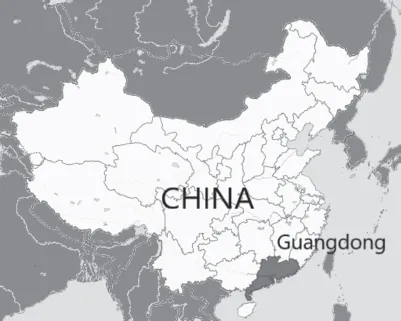
Chinese opera or xiqu comprises more than 350 kinds (Leung, 2017). Cantonese opera, a type of Chinese opera, is defined as ‘story-telling through singing and dancing’ (Tai, 2020). It tells a story using different instruments, dancing techniques and music (Tai, 2020). Cantonese opera is also known as Guangdong Drama because it is mainly performed and found in the Guangdong area. However, it is also extremely popular in Hong Kong, Macau, Malaysia and Singapore. The stories in Cantonese operas are usually based on historical figures and legends. These stories deliver not only Chinese culture and philosophy, such as loyalty, faith and patriotism (Wertz, 2016), but also distinct characteristics of the Lingnan (Cantonese) culture. The music, as well as the lyrics, demonstrates the expressiveness and beauty of Cantonese opera. The martial art performance is performed as a form of fighting arts (The Academy of Chinese Studies, 2020) (see Figure 1.1).
Figure 1.1 Map of Guangdong Province
1.1.2 Origin of Cantonese Opera
Various speculations on the origins of Cantonese opera exist. Duhalde et al. (2019) suggested that the origin of Cantonese opera can be traced back to the reign of Emperor Ming-Huang Tang (713–756 ad). However, Tai (2020) suggested that Cantonese opera started during the reign of Emperor Qianlong (1735–1796 ad). The research team at the City University of Hong Kong argued that Cantonese opera originated in the Ming dynasty (The City University of Hong Kong, 2020). Ng (2015) provided a detailed description of the development of Cantonese opera from a historical perspective. According to Ng (2015), Cantonese opera evolved from Zaju (a poetic music drama) and Chuanqi (a short legend telling act). Both acts are active in the Song (960–1279) and Yuan (1279–1368) dynasties. After the Yuan dynasty was taken over by the Ming dynasty (1368–1644), theatres become popular. The following are the three main branches that developed in this period: Yiyang developed in Jiangxi; Bangzi developed in Shanxi, Shenxi and Hebei; and Kunqu developed in Jiangnan. All branches are very popular in China. However, Cantonese opera does not begin in Guangdong. According to Song (1994) and Zhong (2014), Cantonese opera became popular in Shanghai in the 1840s. Many Guangdong businessmen travel to Shanghai for business purposes. However, as they became influential in Shanghai, they began to sponsor some cultural activities, including Cantonese opera. They started with small sponsor activities, but later, they also opened Cantonese opera companies. Many businessmen invite their friends, relatives or business partners to enjoy Cantonese opera. The development of Cantonese opera in Shanghai was highly successful in the 1920s to 1930s (Song, 1994; Zhong, 2014; Cheng, 2007).
Despite the academic debate of the origin of Cantonese opera, the influence of Cantonese opera is massive. During the Qing dynasty, particularly under Emperor Qianlong (1736–1795), many Cantonese troupes were in Foshan. However, the Qing government decided to ban Cantonese opera because of a political movement led by a Cantonese opera artist during the Taiping Rebellion. Many Cantonese opera troupes were renamed or repackaged as Peking Opera troupes to continue their performance. Later, when the ban was lifted, many troupes moved their base from Foshan to Guangzhou. An artist association named Pak Wo Association (or Chinese Artistic Association) was formed in 1889. Cantonese opera began to spread to Guangxi, and the primary language used to deliver the act gradually changed to Cantonese instead of Mandarin (Hong Kong Memory, 2020).
Cantonese opera is an important icon for the Cantonese (Lingnan) culture. Many famous Cantonese operas were filmed as movies in the 1940s. Cantonese opera is an essential element in Cantonese culture. Nearly all Cantonese people have heard Cantonese operas somehow, such as Tang Disheng’s Princess Chang Ping and Legends of Purple Hairpin. The later Cantonese dramas and Cantonese songs are said to develop from Cantonese opera. Cantonese opera is a very representative traditional culture of highly native characteristics in Cantonese culture. Recently, many Hong Kong movies have been based on stories related to Cantonese opera. Here are a few examples:
Hu Du Men
Hu Du Men was produced by Golden Harvest Entertainment in 1996. Hu Du Men refers to an imaginary ‘door’ dividing the stage and the real world. According to the movie, actors or actresses should completely forget about themselves and become the characters they perform once they have passed this door. The story is about how a famous Cantonese opera actress (who pretends to be male in the opera character) has performed on stage for more than 30 years. She struggles between family, love, kids and her career. The film also discusses the challenges and difficulties of the modernisation of Cantonese opera.
The Mad Phoenix
The Mad Phoenix was also produced in 1996. The main character, Jiang Yu Liu, is a legendary Cantonese opera script writer in the 1930s. The movie shows the development of Cantonese opera during the same period in Hong Kong and Guangzhou. Jiang Yu Liu enjoys opera very much. He skips school to go watch opera every day. He is exceptionally talented in script writing and produces many famous Cantonese opera plays (The City University of Hong Kong, 2020)
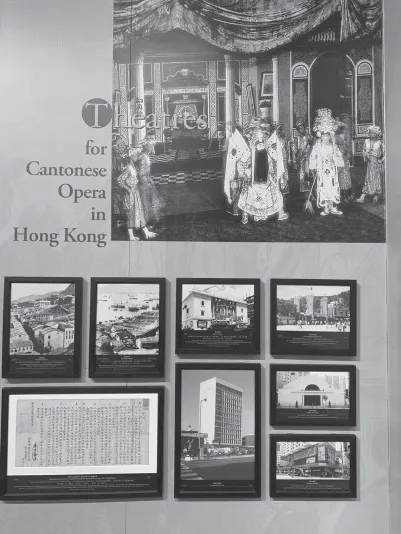
Despite being a prevalent form of entertainment, Cantonese opera often carries certain messages or lessons. This feature was vital before formal education was common across the country (Wertz, 2016). The government sometimes uses this platform to deliver the idea of ‘being loyal to the emperor and love the kingdom’. Hence, opera scripts, which are highly scrutinised, may be banned if the government does not approve the message delivered (Wertz, 2016). In addition, Cantonese opera reflects society and is closely related to people’s identity (Chung, 2017). In the 20th century, many troupes mainly performed in Guangzhou, Hong Kong and Macau, whilst others mainly performed in the rural areas in mainland China. The former is called Sheng Gang daban, whereas the latter is called Guo Shan ban (Zhuhai College of Jilin University, 2020). During the civil wars in China of 1927–1949, many people fled from Guangdong to Hong Kong to seek a stable and comfortable life. This movement provided opportunities for the development of Cantonese opera in Hong Kong. During that period, Hong Kong was a British colony. Troupes in Hong Kong were allowed to be exposed to many Western cultures and presentation methods. This situation was crucial to the development of Cantonese opera (Chung, 2017; Zhuhai College of Jilin University, 2020). Many new plays, such as The Purple Hairpin and Di Nu Hua, were written during this period (Zhuhai College of Jilin University, 2020). At the same time, many influential actors, actresses or troupes were discovered. Yam Kim Fai, Pak Suet Sin, Fong Yim Fun and Leung Sin Poh are the representative actors and actresses (Tai, 2020). Yam Kam Fai and Pak Suet Sin developed Sin Fung Ming Opera Troupe and Chor Fung Ming Opera Troupe, which are the most influential troupes in the history of Cantonese opera in Hong Kong (Zhuhai College of Jilin University, 2020). Xue Juexian, Sun Ma Sze Tsang and Hung Sin Nui developed Chun Sin Mei Opera Troupe, aiming at reviving Cantonese opera. This period is the golden age of Cantonese opera in Hong Kong (Education University in Hong Kong, 2015) (see Figure 1.2).
Figure 1.2 Cantonese Opera in Hong Kong
1.1.3 Current status of Cantonese Opera
Cantonese opera was very popular in the 19th century. However, on the one hand, people’s enthusiasm for Cantonese opera diminished as other forms of entertainment, such as movies, music and video games, emerged. On the other hand, the number of audiences declined because many young people do not have the interest and the knowledge to appreciate Cantonese opera (Leung, 2017; Mei et al., 2018). Moreover, the lack of interest from younger generations leads to a drop in new participants. Many plays and scripts are relatively old, and no new play or script is written. Princess Chang Ping, Flirting Scholar and Parted Lovers are certainly famous plays to the older generations, but they lack attraction to the younger generation. Some of the classic plays have been reproduced several times throughout history. In addition, when an existing play is reproduced, people compare the new version with the old. If the latest version does not meet the expectation of the audiences, particularly when the old version is legendary, then even the existing viewers gradually lose interest. This scenario also causes the industrial producers’ lack of interest to create (Mei et al., 2018). Hence, the number of Cantonese opera performances in bamboo shed theatres in Hong Kong dwindled from 158 in 1970 to 34 in 2010. The traditional bamboo sheds where operas are performed and the accompanying communal rituals are also under threat (The University of Hong Kong Knowledge Exchange, 2020).
Numerous actions have been taken to restore or preserve this significant and influential art form. Since Hong Kong was returned to China in 1997, the Education Bureau in Hong Kong has been updating the education system of primary and secondary schools. Chinese music has been recently included in the Hong Kong Diploma of Secondary Education, and opera is a part of the listening paper. Teachers are encouraged to use Cantonese opera as a...
Table of contents
Cover
Half Title
Series
Title
Copyright
Contents
List of Figures
List of Tables
Preface
Acknowledgements
1 An Introduction to Cantonese Opera
2 Development of Cantonese Opera in the Greater Bay Area
3 Cantonese Opera as a Cultural Product
4 Cantonese Opera and Cultural Heritage Tourism in the Greater Bay Area
5 Modernisation and Integration of Cantonese Opera
6 Residents’ Attitudes Towards Cultural Heritage Products: A Case Study of Cantonese Opera in Macau
Index
Trusted by 375,005 students
Access to over 1.5 million titles for a fair monthly price.
Study more efficiently using our study tools.
Frequently asked questions
Yes, you can cancel anytime from the Subscription tab in your account settings on the Perlego website. Your subscription will stay active until the end of your current billing period. Learn how to cancel your subscription
No, books cannot be downloaded as external files, such as PDFs, for use outside of Perlego. However, you can download books within the Perlego app for offline reading on mobile or tablet. Learn how to download books offline
Perlego offers two plans: Essential and Complete
Essential is ideal for learners and professionals who enjoy exploring a wide range of subjects. Access the Essential Library with 800,000+ trusted titles and best-sellers across business, personal growth, and the humanities. Includes unlimited reading time and Standard Read Aloud voice.
Complete: Perfect for advanced learners and researchers needing full, unrestricted access. Unlock 1.5M+ books across hundreds of subjects, including academic and specialized titles. The Complete Plan also includes advanced features like Premium Read Aloud and Research Assistant.
Both plans are available with monthly, semester, or annual billing cycles.
We are an online textbook subscription service, where you can get access to an entire online library for less than the price of a single book per month. With over 1.5 million books across 990+ topics, we’ve got you covered! Learn about our mission
Look out for the read-aloud symbol on your next book to see if you can listen to it. The read-aloud tool reads text aloud for you, highlighting the text as it is being read. You can pause it, speed it up and slow it down. Learn more about Read Aloud
Yes! You can use the Perlego app on both iOS and Android devices to read anytime, anywhere — even offline. Perfect for commutes or when you’re on the go. Please note we cannot support devices running on iOS 13 and Android 7 or earlier. Learn more about using the app
Yes, you can access Cultural Tourism and Cantonese Opera by Jian Ming Luo in PDF and/or ePUB format, as well as other popular books in Business & Hospitality, Travel & Tourism Industry. We have over 1.5 million books available in our catalogue for you to explore.