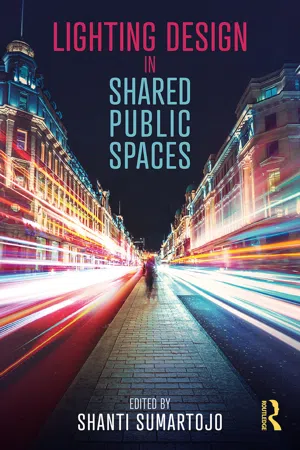
This book advocates an approach to lighting design that focuses on how people experience illumination. Lighting Design in Shared Public Spaces contextualises light, dark and lighting design within the settings, sensations, ideas and imaginaries that form our understandings of ourselves and the world around us.
The chapters in this collection bring a new perspective to lighting design, arguing for an approach that addresses how lighting is experienced, understood and valued by people. Across a range of new case studies from Australia, Germany, Denmark, and the United Kingdom, the authors account for lighting design's crucial role in shaping our dynamic and messy experiential worlds. With many turning to innovative ethnographic methodologies, they powerfully demonstrate how feelings of comfort, safety, security, vulnerability, care and well-being can configure in and through how people experience and manipulate light and dark. By focusing on how lighting is improvised, arranged, avoided and composed in relation to the people and things it acts upon, the book advances understandings of lighting design by showing how improved experiences of the built environment can result from more sensitive and context-specific illumination.
The book is intended for social scientists who are interested in the lit or sensory world, as well as designers, architects, urban planners and others concerned with how the experience of light, dark and lighting might be both better understood and implemented in our shared public spaces.
Chapter 1Light, dark and lighting design for shared public spacesNew perspectives on experiences of the lit world
Shanti Sumartojo
DOI: 10.4324/9781003182610-1
Introduction
Light is central to how we experience our worlds. It shapes how we feel about and are affected by our surroundings, what we are able to do in them, and how we relate to the people, things, materials and spaces around us. It is central to how we imagine, remember and anticipate our lives and, as such, is far more than a means for visual apprehension; indeed, ‘the perception of luminous and gloomy space is a key existential dimension of living in the world, of the experience of space and time’ (Edensor 2017: vii; see also Pink and Sumartojo 2018).
If light profoundly affects how we feel, then this means that lighting design is also bound up in and responsible for the distinctive ways that these feelings emerge as we inhabit or move through the places subject to the practice of lighting design. Accordingly, this book advocates for an approach to lighting design that focuses on how people experience illumination: how it feels, what it makes possible or imaginable and what it shuts down or limits. Across a range of new work from Australia, Germany, Denmark, and the UK, the authors seek to account for complex, dynamic and messy experiential worlds, and to directly address lighting design’s crucial role in shaping these. The book deliberately draws together authors from a range of fields and, as such, is intended for social scientists who are interested in the lit or sensory world, but also designers, architects and others interested in how the experience of light and lighting might be both better understood and implemented in professional practice.
Taken together, the chapters in the book powerfully demonstrate how feelings of comfort, safety, security, vulnerability, care and well-being can configure in and through how people experience and manipulate light, and that improved experiences of the built environment can result from more sensitive and context-specific lighting design. As such, it builds on existing research in lighting design that seeks to understand the feelings, sensations, impressions and thoughts of the users of technology as they interact with it (Simonsen 2018; Jensen et al. 2018). However, while this large and varied body of work has developed robust methodologies, much of it occurs in lab-based settings where variables can be controlled and aspects of technologies rigorously tested. Some lighting design research has addressed responses to or interactions with technology ‘in the wild’, but even here, in the main, research focuses on lighting technologies themselves, implementing well-established research processes focused on specific improvements.
In contrast, we advance a research approach that contextualises this technology in the dynamic and emergent everyday worlds of people, and that considers how we understand and make use of technology as part of everything else we do. Although lighting designers require specific insights into technologies as part of design processes, we argue that the spatial, social and experiential contexts of light are vital in terms of how people address, make use of and modify or improvise with technologies to get the best from them. As such, the book treats lighting design as agential in helping to configure an experiential lit world in which we all dwell and move, and many of the chapters grapple with this by adopting an ethnographic approach to investigating light and lighting.
This means that we tend to move away from defining people as ‘users’ of lighting, arguing that such a perspective casts people in a particular type of relationship with technology. To speak of ‘users’ defines design not in the terms that people themselves may use to understand it, but in terms that speak to the designers’ intentions and goals. While this is valuable in terms of design development and testing processes, it can risk overlooking important aspects that are not directly related to people but instead are part of their environments, which often include other technologies (including, as discussed in this book, light sources).
This book, therefore, adopts an expansive stance in terms of light and lighting technology by approaching it as it exists in relation to other things, feelings, ideas and processes already in place and that form part of how people understand themselves and the world around them. Across its ten chapters, this book focuses on many different aspects of light and lighting design as it is part of our everyday lives. This is because light – which by its nature can seep, infuse, dissipate or mingle with other aspects of our surroundings – is part of the messy and ongoing nature of experience, its moods and atmospheres, and its material, sensory and affective qualities (Jensen et al. 2018). The chapters bring social scientific concepts, research methods and critical analysis together with design methods that focus on lighting use and manipulation, thus opening the way to valuable new insights. The book focuses on how lighting is experienced and understood but also improvised, arranged, avoided and composed in relation to the people and things proximate to it. While we hope that the book can help improve understanding of lighting design and its use in built environments, it is also intended to help frame the possibilities and limits of lighting by showing how it relates to people’s lives, activities and feelings.
Figure 1.1 The complexity of the lit world: a small boat moves across the surface of the Yarra River in Melbourne, an environment enlivened by the sparkle of light reflected in the water, the illumination of surrounding buildings and the pilot lights of the boat itself.
Photo: Shanti Sumartojo.
In the rest of this introduction, I draw together recent research on experience in lighting design with scholarship on light in anthropology and human geography, fields with a shared interest in the experiential world. I develop this by way of an important concept that informs this book and that underpins the methodologies that appear in it: the ‘lit world’ (Pink and Sumartojo 2018). Following this, I explain the structure and various contributions of the book’s chapters.
Accounting for the experiential world in lighting design research
Research directed at understanding the perceptions and responses of people to designed objects or processes often aims to understand the effects of these design artefacts and, ultimately, improve their performance for an intended function. However, such a focus on discrete aspects of interaction between people and technologies, objects, or processes often requires the partitioning of human experience into measurable or describable units of analysis, such as aesthetics, emotion or ergonomics; indeed, researchers themselves sometimes question the emphasis on measurement of ambiguous or ineffable qualities of feeling (Simonsen 2018: 199) or raise ethical concerns about the uses of such approaches to support the potential manipulation of people (Gray et al. 2018). As a result, some studies of how people use or experience design and technology have turned to interdisciplinary approaches that use qualitative, ethnographic techniques beyond controlled or laboratory-based conditions (e.g., Jensen et al. 2018).
In studies of lighting technologies, however, many well-established methods evaluate those technologies in lab-based settings. The majority of such studies place those technologies at the centre of inquiry, focusing on their affordances and how they interact with their surroundings, and assessing aspects of how research participants perceive these. This includes a small but growing focus on how spatialised ‘atmospheres’ relate to lighting design (Kuijsters et al. 2015; Stokkermans et al. 2017, 2018; Albertazzi et al. 2018; Vogels 2008). For example, Stokkermans et al. (2017, 2018) address the atmosphere or the ‘impression’ of a lit space with experiments that varied the lighting conditions in a controlled environment and assessed people’s perceptions of those spaces. Setting out to understand how ‘light designs translate into the ultimate experience of a space’, they identified the importance of the ‘intensity, colour, beam shape and position of the light sources’ (Stokkermans 2017: 1164) and the importance or the way people perceived these as well as the location they were placed. This built, in part, on earlier work (Vogels 2008) that sought to ‘quantify the atmosphere of an environment’. Defining atmosphere as an ‘affective evaluation of an environment’, Vogels (2008) identified the key measures of cosiness, liveliness, tenseness and detachment – atmospheric qualities that provided a ‘measure of the affective appraisal of a space’ (Stokkermans et al. 2018). This exemplifies methodologies in this field that investigate light’s atmospherics by evaluating experience using surveys or that rate lighting conditions along scales of what feels ‘safe’ or ‘pleasant’ (Knight 2010), ‘lively’ or ‘cosy’ (Vogels 2008), and ‘informal’ or ‘formal’ (Li et al. 2019), or that use other, more detailed word pairings (Albertazzi et al. 2018).
Other studies venture outside the lab; for example, into retail environments (Custer et al. 2010), offices (van Duijnhoven et al. 2020) or outdoor urban environments. For example, in a study of lighting and perceptions of safety, van Rijswijk and Haans (2018) focused on questions of prospect, concealment and entrapment, a framework that recognised the importance of the lit surroundings and how people perceived and imagined what could happen in them. This study was set outside on a dim footpath at night, included the varying responses of different people and was one of several that purposefully included men and women of different ages (i.e., Johansson et al. 2010). It also included the element of movement, an aspect that often goes under researched, by assessing the accuracy of facial recognition as research participants moved along the footpath.
Although the lighting research discussed here investigates the experience of light, its methodologies necessarily predetermine the particular means for relating that experience because it is interested in how the experience of light relates directly to the design, colour, placement or other qualities of lighting technologies. In practice, this often means that research participants are asked to express their experiences in terms decided by the researchers; for example, on a scale for participants to rate or via a predetermined questionnaire. Crucially, this often does not allow participants to either qualify what these terms mean for them or, more importantly, nominate their own categories of feeling or sensory experience, categories that may draw in aspects of these settings that are not within the control of lighting designers.
Moreover, these studies, precisely because of their necessary orientation to the technologies of lighting design, only account for their effects in terms that are defined by and structured through the technologies. In other words, ways of experiencing light that do not directly address their technological aspects can fail to be fully accounted for by researchers or even communicated by participants because they are only asked to reflect on particular aspects of light and lighting. Aspects of lighting technology thus provide the sole terms for understanding illumination in this approach, which does not always probe the subtler experiential qualities of light that might draw in other senses, memories, impressions or anticipatory modes. Additionally, with a few exceptions, many of these studies are set in controlled laboratory conditions where the complex spatial, mobile, affective and sensorial contexts in which we usually experience light and lighting cannot be addressed.
This is understandable given a research approach that seeks to control variables in order to focus on technological or perceptual details, and is crucial in designing safe, effective and reliable lighting. However, this work can miss the vital social and cultural dimensions of the lit world, instead understanding human experience by means of predefined categories that direct attention at specific luminaires and their affordances, and how people perceive them against predetermined and limited criteria. While very particular (and valuable) questions about lighting design are asked and answered, such an approach often does not enable participants to express their experience of light in their own terms or move beyond the structures of the survey or questionn...
Table of contents
Cover
Half Title
Title
Copyright
Contents
List of figures
List of contributors
1 Light, dark and lighting design for shared public spaces: new perspectives on experiences of the lit world
2 Illuminating experiences: lighting design as an epistemic approach
3 Light and value: a design anthropology of light and well-being in hospital buildings
4 The midwifery feel of light
5 Perceptions of safety in cities after dark
6 How the city feels: workshopping lighting design in public space
7 At the margins of attention: security lighting and luminous art interventions in Copenhagen
8 Lights out? Lowering urban lighting levels and increasing atmosphere at a Danish tram station
9 Towers for the night
10 Dark designs: creating shadow, gloomy spaces and enchanting light
Index
Trusted by 375,005 students
Access to over 1.5 million titles for a fair monthly price.
Study more efficiently using our study tools.
Frequently asked questions
Yes, you can cancel anytime from the Subscription tab in your account settings on the Perlego website. Your subscription will stay active until the end of your current billing period. Learn how to cancel your subscription
No, books cannot be downloaded as external files, such as PDFs, for use outside of Perlego. However, you can download books within the Perlego app for offline reading on mobile or tablet. Learn how to download books offline
Perlego offers two plans: Essential and Complete
Essential is ideal for learners and professionals who enjoy exploring a wide range of subjects. Access the Essential Library with 800,000+ trusted titles and best-sellers across business, personal growth, and the humanities. Includes unlimited reading time and Standard Read Aloud voice.
Complete: Perfect for advanced learners and researchers needing full, unrestricted access. Unlock 1.5M+ books across hundreds of subjects, including academic and specialized titles. The Complete Plan also includes advanced features like Premium Read Aloud and Research Assistant.
Both plans are available with monthly, semester, or annual billing cycles.
We are an online textbook subscription service, where you can get access to an entire online library for less than the price of a single book per month. With over 1.5 million books across 990+ topics, we’ve got you covered! Learn about our mission
Look out for the read-aloud symbol on your next book to see if you can listen to it. The read-aloud tool reads text aloud for you, highlighting the text as it is being read. You can pause it, speed it up and slow it down. Learn more about Read Aloud
Yes! You can use the Perlego app on both iOS and Android devices to read anytime, anywhere — even offline. Perfect for commutes or when you’re on the go. Please note we cannot support devices running on iOS 13 and Android 7 or earlier. Learn more about using the app
Yes, you can access Lighting Design in Shared Public Spaces by Shanti Sumartojo in PDF and/or ePUB format, as well as other popular books in Architecture & Interior Design. We have over 1.5 million books available in our catalogue for you to explore.