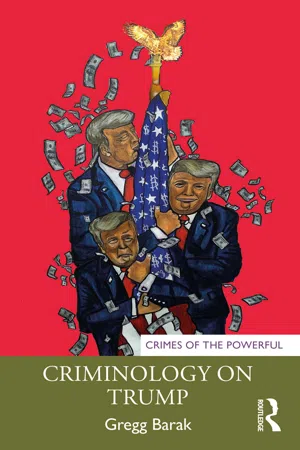
Criminology on Trump is a criminological investigation of the world's most successful outlaw, Donald J. Trump. Over the course of five decades, Donald Trump has been accused of sexual assault, tax evasion, money laundering, non-payment of employees, and the defrauding of tenants, customers, contractors, investors, bankers, and charities. Yet, he has continued to amass wealth and power. In this book, criminologist and social historian Gregg Barak asks why and how?
This book examines how the United States precariously maintains stability through conflict in which groups with competing interests and opposing visions struggle for power, negotiate rule breaking, and establish criminal justice. While primarily focused on Trump's developing character over three quarters of a century, it is also an inquiry into the changing cultural character and social structure of American society. It explores the ways in which both crime and crime control are socially constructed in relation to a changing political economy.
An accessible and compelling read, this book is essential for all those who seek a criminological understanding of Donald Trump's rise to power.
- 296 pages
- English
- ePUB (mobile friendly)
- Available on iOS & Android
eBook - ePub
Criminology on Trump
About this book
Information
PART ONE In advance of the presidency
1Family dynamics, privileged disadvantages, and coming of age
DOI: 10.4324/9781003221548-3
John Joseph Gotti, Jr. (1940–2002) and Benjamin Bugsy Siegel (1906–1947) are two of the more powerful bosses in the history of American organized crime. These bosses were feared not only for their ruthlessness, but also for their willingness to exert their influence on other people’s behavior. Gotti and Siegel were quite good at using other people’s money to get what they wanted. They were also judicious in preventing their fraudulent conduct from giving way to liability for damages done.1 Not only did these head honchos have close to absolute control over their extended “family” members, but their tentacles of power also spread across their interspheres of businesses, politics, and lawlessness. Yet, these 20th-century gangsters’ abilities to neutralize or corrupt government officials were almost non- existent when compared to Donald Trump.
As the CEO of the Trump Organization, Inc. and even more so as the Commander-in-Chief, Boss Trump was feared for his ruthlessness and for his willingness to use anyone as well as their resources to obtain any of his desired ends. With relatively little opposition or pushback from the Republican Party, Trump and his MAGA base steamrolled the GOP and took it over in less than 18 months. Within the Department of Justice, Trump and his allies, including Attorney General Bill Barr, had the FBI investigating bogus conspiracy theories about a fraudulent or stolen election several weeks after the recounting had concluded that Biden had won. Days before and running up to the insurrection, Trump’s last Acting Attorney General Jeffrey E. Rosen was resisting Donald’s efforts to overturn the election and was refusing to publicly cast doubt on the legitimacy of the election. Rosen was also unwilling to sign off on a letter to the Georgia state legislators asserting wrongly that they should void Mr. Biden’s victory.
Throughout his lame duck administration, Trump was working harder than ever trying to overturn an election so as not to have to attempt a coup d’état as the only means left to decertify the election of Joe Biden. While he was losing 60 lawsuits alleging fraudulent elections because there was absolutely no truth to the claims, Donald was personally harassing the Department of Justice. He was doing so daily with phone calls about all kinds of allegedly fraudulent activities for them to waste their time and money investigating. Trump was also on the phone intimidating election officials in Arizona and Georgia where he was falsely claiming victory and pressurizing them to find more votes for him or to simply overturn the election because it had been rigged. In the meanwhile, his political supporters were threatening election officials in all the closely contested states, forcing several of their own Republican officials because of death threats to resign from their polling positions or not to run for re-election.
One year after the failed coup attempt and through at least the 2022 midterm elections, Trump and company will continue their big lies about a stolen election, defend the January 6th rioters as patriots evidenced at the September 18, 2021 #JusticeForJ6 rally in Union Square, and castigate the Capitol police for their overzealous brutality. Besides being the POTUS, what most differentiates the former Mobster-in-Chief from all the other nonstate mob bosses like Gotti and Siegel is that Donald’s thousands of storm troopers are not per se on anybody’s payroll. All but a relatively few Trumpers “pay to play” one way or the other.
At the same time, the networks around Trump’s political attack dogs are paying the Donald to play. That’s the kind of power that other mobsters can only dream of. In terms of personal expenditures, more than 600 of Trump’s Capitol rioters will eventually have pleaded guilty to or been convicted of “obstruction of an official proceeding,” “entering a restricted building with a dangerous weapon,” “violent entry and disorderly conduct in the Capitol building,” and lesser offenses like “trespassing.” Only Stewart Rhodes of the Oath Keepers and 10 other members as of February 1, 2022 have been charged with “seditious conspiracy.” Few of the financial backers or Capitol organizers, if any, will be charged with having engaged in “a rising or rebellion of citizens against their government, usually manifested by acts of violence” or with “inciting, assisting, or engaging in such conduct against the United States,” including the former president who masterminded and orchestrated the January 6, 2021 insurrection. This state of affairs has reflected Trump’s unchecked power by the administration of criminal law, by the U.S. Senate, by the lockstep Republican Party, and by Democratic President Biden and his Attorney General Merrick Garland.
These internal domestic power relations of constitutional and criminal laws cannot be totally separated from Trump’s intertwining global tentacles of economic, political, and criminal power. Nor can these political and economic conditions be separated from the social reality that with the exceptions of the traditional elite media newspapers online and offline, Trump and his allies have dominated the dueling narratives on the social media platforms such as Twitter, Facebook, and YouTube. Trump fever has also been captured by FOX news and other alt-right media markets. In part, this has a lot to do with the psychodynamic energy or pleasure derived by millions of Americans from the fetishistic conspiracy theories juxtaposed with the cold and objective facts or the science. In part, it also has to do with a failure of the United States to have a well-funded public media system. Every other democratic country in the world does so and to varying degrees these nations have freed their mass media from corporate or state control.
Concurrently, both our mediated perceptions of Boss Trump and much of his modus operandi or transactional approach shared with other top gangsters are underappreciated. Gotti, the former boss of the Gambino crime family in New York, was also known as Black John, Crazy Horse, Johnny Boy, and Dapper Don. At the dawn of the age of “non-sticking” Teflon cookware and after being acquitted of several high-profile criminal cases in 1980, Gotti was renamed Teflon Don and that nickname stuck. When Salvatore “Sammy the Bull” Gravano, Gotti’s underboss, cut a deal and agreed to turn state’s evidence in 1992, Teflon Don was convicted of five murders, conspiracy to commit murder, racketeering, tax evasion, obstruction of justice, illegal gambling, extortion, and loansharking. Gotti spent the rest of his life in prison.
After his death in 2002, calling someone a Teflon Don became a derogatory term for persons that have managed to avoid responsibility for their actions. Internet searches revealed that shorty after Donald J. Trump announced his candidacy for the presidency in the late 2015, he was being referred to as Teflon Don. Beyond the shared nickname and the crimes of racketeering, tax evasion, and the obstruction of justice, Trump like Gotti has also been accused of committing numerous other crimes, including one of Donald’s most lucrative specializations, money laundering. The Houdini of White Collar Crime has yet to be criminally prosecuted for any of his lifelong and habitual patterns of injurious and harmful behavior.
Trump’s politics of “law-and-order” before, during, and after the presidency are at loggerheads to say the least with his life course of lawlessness that only escalated during his four-year occupation of the White House. Over the arc of Donald’s business and political verve, he has always sought out and worked with a variety of unsavory criminal offenders. These lawbreakers comprise violent felons, con artists, swindlers, as well as Mafia and Russian mobsters. Joseph Weichselbaum and Felix Henry Sater are two high-profile criminals that over several decades have had very close relationships with Trump. The international cocaine trafficker and three-time felon, Weichselbaum, was Trump’s personal helicopter pilot in the 1980s and more recently was a lessee of a luxury Manhattan apartment owned by Trump.2 Soviet-born Sater, a Russian Jewish émigré, is a real estate developer and mobster-businessman with five known aliases.
Felix is also a former managing director of Bayrock Group LLC, a real estate conglomerate based in New York City. In 1998, he copped a deal, pleaded guilty, and cooperated with the government’s case involving a $40 million stock fraud scheme orchestrated by the Russian mafia.3 Having been convicted of first-degree assault in 1993 for stabbing a man and serving one year in the county jail, and since avoiding prison for high stakes financial fraud five years later, Sater has led an unusual double life. He has worked as an informant for FBI investigations of organized crime, especially ones involving international money laundering.4 At the same time, in 2006 when the collaboration between the Trump Organization, Bayrock Group, and Tamir Sapir known as the Trump SoHo project began, Felix was a senior advisor to Donald and the Trump Organization. During the construction of the $450 million, 46-story, and 391-unit hotel condominium, he also played a major role in labor relations. In the middle of Trump’s 2016 campaign for the president, Sater was also busy working with Michael Cohen in pursuit of the elusive Trump Tower Moscow.5
Bugsy Siegel and Teflon Don Trump
Benjamin “Bugsy” Siegel and “Teflon” Donald Trump came from contrasting neighborhoods and socioeconomic backgrounds, lived in very different times, and yet they both became organizationally very powerful crooks. Using power in very similar ways, one controlled several vices and unions for less than two decades. The other has controlled numerous illegal business practices for more than 40 years and corrupt party politics since 2017. Benjamin Siegel was the son of poor Jewish immigrants raised in the crime-ridden tenement-lined streets of Brooklyn. Born into abject poverty at the turn of the 20th century, Benny was without capital of any kind. His sources of acquiring money and power were self-made. On the other side of the tracks, little Donny inherited social capital and he became the beneficiary of several trust funds very early in life. His paternal grandmother and father set up the trusts when he was three years old. By the age of eight, without lifting a proverbial finger, master Donny had become a millionaire.
During outlaw rises to the pinnacles of power, Siegel and Trump utilized mostly disparate forms and methods of racketeering. Even with their often differing though not mutually exclusive modus operandi and their dissimilar class backgrounds, these major fraudsters share many individual characteristics and attributes in common. Both men attained celebrity status and became social memes that captured the cultural imagination.6 Siegel had several nicknames, including the one he gave himself Bugsy for his volatile temper. Many nicknames have been bestowed on Donald Trump,7 including the one that he is most known for—the Donald. In the early 1980s, several years after Ivana Marie Trump, a Czech-American businesswoman relocated from Canada to become Trump’s first wife in 1977, her referencing of “the Donald” in conversation with other people caught on and stuck.
Like the real estate operator from New York City, the earlier underworld figure referred to himself as an investment broker. Bugsy made a sizeable contribution toward transforming the dusty little Nevadan town at the beck and call of cowboys, miners, and cross-country travelers looking for a handful of saloons, poker tables, and brothels into the Gambling Mecca of the World, the American Gomorrah known as Las Vegas. So, Siegel is, indeed, worthy of the investment broker moniker.8 Like Trump, Siegel had multiple public personas. Because of his affable manner, matinee-idol looks, and expensive haberdashery, Siegel was also regarded as an actor manqué, a sportsman, a playboy, and a womanizer. The ever-charismatic mobster also became one of the early front-page “big shot” gangsters. Both before and after nightly television, Bugsy Siegel like the Donald made for very good copy in newspapers, magazines, and books. After being dead for three quarters of a century, he still does as evidenced by several recent biographies, including the 2021 publication of Bugsy Siegel: The Dark Side of the American Dream written by best-selling journalist and contributing Vanity Fair editor Michael Shnayerson.
While their social histories and curriculum vitae are dissimilar, there are many extracurricular activities that these two men share. Bugsy reflects “old” school gangsters of physical intimidation and vice in transition to becoming syndicated or organizational criminals. Donald Trump has been “newer” school or reflective of the next generation of criminal enterprises with their legal and political fixers, Ivy League MBAs, familiar boards of directors, and non-disclosure agreements.9 There are similarities and many overlapping dimensions of organized traditional crime and corporate organizational crime, especially with respect to their expansive activities and abilities to avoid and escape criminalization. Legally, the main difference is that the former crimes are viewed as part and parcel of a criminal enterprise, while the la...
Table of contents
- Cover
- Half Title
- Series Page
- Title Page
- Copyright Page
- Dedication
- Table of Contents
- About the author
- Introduction
- Part One In advance of the presidency
- Part Two Squandering the presidency
- Part Three Following the presidency
- Epilogue
- A Trump bibliography
- Name index
- Subject index
Trusted by 375,005 students
Access to over 1.5 million titles for a fair monthly price.
Study more efficiently using our study tools.
Frequently asked questions
Yes, you can cancel anytime from the Subscription tab in your account settings on the Perlego website. Your subscription will stay active until the end of your current billing period. Learn how to cancel your subscription
No, books cannot be downloaded as external files, such as PDFs, for use outside of Perlego. However, you can download books within the Perlego app for offline reading on mobile or tablet. Learn how to download books offline
Perlego offers two plans: Essential and Complete
- Essential is ideal for learners and professionals who enjoy exploring a wide range of subjects. Access the Essential Library with 800,000+ trusted titles and best-sellers across business, personal growth, and the humanities. Includes unlimited reading time and Standard Read Aloud voice.
- Complete: Perfect for advanced learners and researchers needing full, unrestricted access. Unlock 1.5M+ books across hundreds of subjects, including academic and specialized titles. The Complete Plan also includes advanced features like Premium Read Aloud and Research Assistant.
We are an online textbook subscription service, where you can get access to an entire online library for less than the price of a single book per month. With over 1.5 million books across 990+ topics, we’ve got you covered! Learn about our mission
Look out for the read-aloud symbol on your next book to see if you can listen to it. The read-aloud tool reads text aloud for you, highlighting the text as it is being read. You can pause it, speed it up and slow it down. Learn more about Read Aloud
Yes! You can use the Perlego app on both iOS and Android devices to read anytime, anywhere — even offline. Perfect for commutes or when you’re on the go.
Please note we cannot support devices running on iOS 13 and Android 7 or earlier. Learn more about using the app
Please note we cannot support devices running on iOS 13 and Android 7 or earlier. Learn more about using the app
Yes, you can access Criminology on Trump by Gregg Barak in PDF and/or ePUB format, as well as other popular books in Social Sciences & Business Biographies. We have over 1.5 million books available in our catalogue for you to explore.