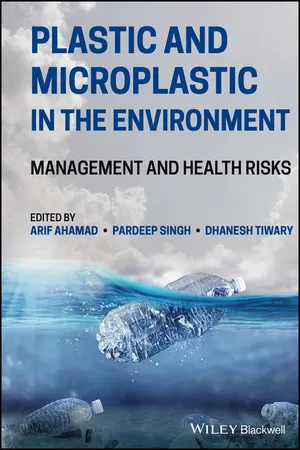
Plastic and Microplastic in the Environment
eBook - ePub

Plastic and Microplastic in the Environment

Management and Health Risks

  1. English
  2. ePUB (mobile friendly)
  3. Available on iOS & Android
eBook - ePub

Plastic and Microplastic in the Environment

Management and Health Risks

About this book

ORGANIC REACTIONS

Thought-provoking discussions of the challenges posed by—and potential solutions to—plastic and microplastic pollution

In Plastic and Microplastic in the Environment: Management and Health Risks, a team of distinguished environmental researchers delivers an up-to-date exploration of plastic and microplastic environmental contamination, conventional and advanced plastics management techniques, and the policies adopted across the globe to combat the phenomenon of plastics contamination.

Containing a balanced focus on both conventional plastics and microplastics, this book discusses the potential health issues related to plastic and microplastic infiltration in a variety of global environments and environmental media, including freshwater environments, oceanic environments, soil and sediment, and air. Insightful treatments of commercial and social issues, including the roles of corporate social responsibility initiatives and general education in the fight against plastic and microplastic pollution, are provided as well.

Plastic and Microplastic in the Environment also includes:

  • A thorough introduction to plastic debris in global environments, including its accumulation and disintegration
  • Comprehensive explorations of policies for strengthening recyclable markets around the world
  • Practical discussions of the prevalence of microplastics in the marine environment, air, soil, and other environmental media
  • In-depth examinations of wastewater treatment plants as a potential source point of microplastics, as well as conventional and advanced microplastic particle removal technologies

Perfect for academics, postgraduates and advanced undergraduates in fields related to environmental science and plastics, Plastic and Microplastic in the Environment: Management and Health Risks will also earn a place in the libraries of professionals working in the plastics industries and environmental policymakers.

Information

Year
2022
Print ISBN
9781119800781
Edition
1
eBook ISBN
9781119800880

1
Sources, Occurrence, and Analysis of Microplastics in Freshwater Environments: A Review

Anh Tuan Ta and Sandhya Babel
School of Biochemical Engineering and Technology, Sirindhorn International Institute of Technology, Thammasat University, Pathum Thani, Thailand

1.1 Introduction

Plastic products have benefited human life for one hundred years. Plastics are used in almost every sector including construction, packaging textiles, consumer products, transportation, electronics, industry, and medical applications. These products make our life more comfortable, convenient, and safe. The world plastics production in 2018 was about 360 million tonnes (PlasticsEurope 2018). However, due to poor management, about 10% of plastic wastes are discharged into aquatic environments (Cole et al. 2011). Recently, considerable attention is placed on the distribution of micro‐sized plastic particles, so‐called microplastics (MPs). The ubiquity of MPs has been widely documented in the marine environment, and their possible impact was investigated (Dris et al. 2018). MPs are frequently ingested by organisms, either from ingestion of other organisms containing MPs, or because they cannot distinguish MPs from prey (de Sá et al. 2015). This may cause physical harm for organisms including a disruption of the hormone balance or digestive system, reduced feeding, and impacting reproduction (Carr et al. 2012; Lusher et al. 2013). Another ecological risk relates to the interaction between MPs and toxic chemicals. The small plastic debris has a high surface area to volume ratio that can enhance the interaction of toxic chemicals onto their surface (de Sá et al. 2018). These chemicals may be carried by MPs over long distances and accumulate in organisms after being ingested (Bakir et al. 2016; Lee et al. 2014). Another potential risk is that MPs can be vectors of microorganisms that attach to their surfaces (Viršek et al. 2017). Human pathogens have been found to colonize on MP particles in marine environments (Foulon et al. 2016; Kirstein et al. 2016). However, the existence of MPs in aquatic environments is complex as they have different polymer types, morphologies, sizes, states of degradation, and contain different additives. Therefore, the evaluation of MPs toxicity is still hampered. Until now, most studies on MPs have been conducted on marine environments; while in contrast, the distribution of MPs in freshwater environments has been investigated less. To highlight this, a study by Blettler et al. (2018) found that 87% of MP studies were related to marine environments, while only 13% of the studies were on freshwater environments. A few studies reported that rivers can transport a huge amount of plastic and MPs into oceans; according to Schmidt et al. (2017), rivers contribute 88–95% of plastic wastes placed into the oceans. Methods for the identification of MPs have been developed by many researchers; however, these methods are not homogeneous and standardized, and this hampers the comparison between different studies (Li et al. 2018; Van Cauwenberghe et al. 2015).
This chapter reviews the current state of MPs in freshwater systems, and different techniques for sample collection, preparation, and analysis of MPs are summarized. Moreover, the potential sources, pathways, and occurrences of MPs into freshwater systems are discussed in the chapter.

1.2 Sources of Microplastic

MPs originate from various sources, but they are mainly sorted into primary and secondary sources. Primary MPs are produced in micro sizes, such as microbeads for personal care products and plastic resins. Secondary MPs are generated from the degradation of large plastics (Andrady 2011). Textile laundering facilities and sandblasting are other sources of MPs (Browne et al. 2011; Napper and Thompson 2016). The pollutants are washed down the drain along with wastewater and enters sewage systems, where they are too small to be removed by WWTPs and so end up in the river systems and finally in the oceans.

1.2.1 Primary Sources

1.2.1.1 Microplastics from Personal Care Products

Plastic materials have been utilized in the cosmetic industry for decades since the 1960s. The particles of plastic used in personal care products can be large enough to see with the naked eye (50–1000 μm), fine particles (lower μm‐range), or very fine particles (< 2.5 μm) (Leslie 2014). MPs used in the industry may be spherical or irregular morphol...

Table of contents

  1. Cover
  2. Table of Contents
  3. Title Page
  4. Copyright Page
  5. List of Contributors
  6. Preface
  7. 1 Sources, Occurrence, and Analysis of Microplastics in Freshwater Environments
  8. 2 Microplastics in Freshwater Environments – With Special Focus on the Indian Scenario
  9. 3 Microplastic Contamination in the Marine Food Web
  10. 4 Microplastic in the Aquatic Ecosystem and Human Health Implications
  11. 5 Interactions of Microplastics Toward an Ecological Risk in Soil Diversity
  12. 6 Microplastics in the Air and Their Associated Health Impacts
  13. 7 Plastic Marine Litter in the Southern and Eastern Mediterranean Sea
  14. 8 Advanced Detection Techniques for Microplastics in Different Environmental Media
  15. 9 Bio‐Based and Biodegradable Plastics as Alternatives to Conventional Plastics
  16. 10 Biodegradable Plastics
  17. 11 Current Trends, Challenges, and Opportunities for Plastic Recycling
  18. 12 Microbial Degradation of Micro‐Plastics
  19. 13 Life Cycle Assessment (LCA) of Plastics
  20. 14 Role of Education and Society in Dealing Plastic Pollution in the Future
  21. Index
  22. End User License Agreement

Trusted by 375,005 students

Access to over 1.5 million titles for a fair monthly price.

Study more efficiently using our study tools.

Frequently asked questions

Yes, you can cancel anytime from the Subscription tab in your account settings on the Perlego website. Your subscription will stay active until the end of your current billing period. Learn how to cancel your subscription
No, books cannot be downloaded as external files, such as PDFs, for use outside of Perlego. However, you can download books within the Perlego app for offline reading on mobile or tablet. Learn how to download books offline
Perlego offers two plans: Essential and Complete
  • Essential is ideal for learners and professionals who enjoy exploring a wide range of subjects. Access the Essential Library with 800,000+ trusted titles and best-sellers across business, personal growth, and the humanities. Includes unlimited reading time and Standard Read Aloud voice.
  • Complete: Perfect for advanced learners and researchers needing full, unrestricted access. Unlock 1.5M+ books across hundreds of subjects, including academic and specialized titles. The Complete Plan also includes advanced features like Premium Read Aloud and Research Assistant.
Both plans are available with monthly, semester, or annual billing cycles.
We are an online textbook subscription service, where you can get access to an entire online library for less than the price of a single book per month. With over 1.5 million books across 990+ topics, we’ve got you covered! Learn about our mission
Look out for the read-aloud symbol on your next book to see if you can listen to it. The read-aloud tool reads text aloud for you, highlighting the text as it is being read. You can pause it, speed it up and slow it down. Learn more about Read Aloud
Yes! You can use the Perlego app on both iOS and Android devices to read anytime, anywhere — even offline. Perfect for commutes or when you’re on the go.
Please note we cannot support devices running on iOS 13 and Android 7 or earlier. Learn more about using the app
Yes, you can access Plastic and Microplastic in the Environment by Arif Ahamad,Pardeep Singh,Dhanesh Tiwary in PDF and/or ePUB format, as well as other popular books in Politics & International Relations & Environment & Energy Policy. We have over 1.5 million books available in our catalogue for you to explore.