- 146 pages
- English
- ePUB (mobile friendly)
- Available on iOS & Android
eBook - ePub
About this book
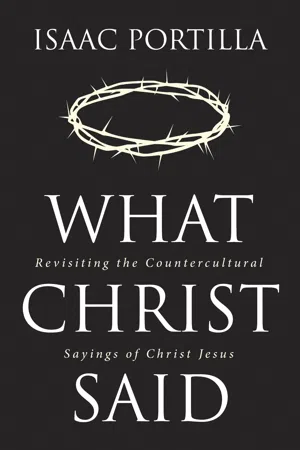
Relevant to nonconformist Christians, this book explores the transformative and often overlooked implications of Christ's teachings. The author shows the possibility to still be surprised by the sayings of Christ--to rediscover "the Way" as a liberating path toward freedom.
What Christ Said delivers an absorbing experience, rich in unexpected turns and insights to ponder and meditate into. Taking the New Testament text as the raw material, the author builds a coherent picture of Christ's Way in which themes such as Fire, Life, Light, and Consciousness take the central stage. This work also offers a very personal contribution to scholarship: a provocative hermeneutics focused on truth and freedom, echoing the efforts of the apostles, early Christians, the fathers, and the mystics to reconcile the sayings of Jesus with their own experience--mystical and worldly.
Infused with poetry and mysticism, yet without compromising theological and intellectual rigor, each chapter makes the reader a participant in explorations evocative of a Christ-like apprehension of life and reality. This inquiry reflects mental and emotional patterns that keep us bound, at the same time providing a path through which the Christian Way could be inspiring--in an original and sometimes radical manner.
Information
Topic
Theology & ReligionSubtopic
Biblical StudiesChapter 1
As I Have Loved You
The One Commandment
1. Love
Jesus said, “Love each other as I have loved you” (John 15:12, emphasis added). He did not say, “Love each other as you like,” nor “Love each other as you can.” No. He said, “Love each other as I have loved you.”
Hence: for much that we fail to see it, for much that we are afraid to say it, we can love like Christ. We can love like Christ not because we want to, out of some grandiose desire of ours—to be like the Son of God—but because he said so; he said we shall love like him. Thus, we will not be proud when we assert this possibility, but faithful—to him. By loving in such a way, we will be contributing to the emergence of a renewed Earth; an Earth crafted by those who are coherent with the teachings of Christ, by those who serve as conductors of the Spirit’s descent. To love as Christ is not just the way to be truthful to the words of Christ, it is Truth enabled. Such is the main sign of Christ carriers—of those who take the responsibility to be the Light in this world, of those who facilitate the transformation of the Earth.
2. Difficulty
Jesus said, “Love each other as I have loved you.”
The most striking implication of this statement is not the act of love—that is, to love one another—but the qualification of such love: that it shall be a Christ-like Love. Without this qualification of love, the one Christian commandment would be incomplete, thus ineffective. As for loving each other, Christ is not needed: Would we deny the existence of relational or fraternal love in the times before Christ, or in those who do not follow the Way of Christ? No, we cannot deny such love, neither in the times before the Light1 came to stay nor in those who have not committed to the Way of endurance in the Light of being. Anyone who has traveled the world or established friendships beyond their own Christian community knows it: relational and fraternal love were not brought by Christ; Christ-like Love was brought by Christ.
Yet, some Christians forget the last part of the one commandment—as if the statement “as I have loved you” no longer existed. Such forgetfulness results in the mistaken divinization of affectionate love, because the “commandment,” as they remember it, is to love each other. And so, certainly feeling affection for one another, they say among themselves: “We do love each other as Christ commanded us, don’t we?” But they forget: you do not need to follow the Way of Christ to love kindly, passionately, compassionately, or in a brotherly, motherly, or fatherly way, because these types of love and affection are not the Gift of Christ. Hence, erroneously assuming Love is a Christian given—presumed “to be there” if you are a Christian—some Christians pay attention to just doing “the right thing,” not giving enough consideration to the way they should love—as Christ did.
Of course, the commandment of Christ to love like him is much more difficult to contemplate than the accumulation of deeds sufficient to feel that one is “good enough” to be counted as the chosen sheep. But to love as Christ is not a Christian given. It cannot be bought by deeds, although it may be demonstrated in deeds; it cannot be thought of as affection, although it may be accompanied by affection. The command of Christ to love like him is difficult. It is difficult because it is inconvenient. It is inconvenient because it demands the questioning of our self and the transformation of our being. Even so, we should not allow the editing of Christ’s words in our minds and our hearts. We should not allow the exile from our consciousness of the last part of the one Christian commandment just because it is inconvenient for us. We cannot say that to love one another is the Christian commandment. Only the commandment to love as Christ is faithful to the words of Christ.
3. Denial
Jesus said, “Love each other as I have loved you.”
Without this qualification of love, Christ is denied. That is, if we reject the possibility to love as Christ, we are denying the Christ in us—we decide to not-know the Light of being, and to not-be his living witnesses in the world. Moreover, by denying the Christ in us, we are refusing to embody the Way of Christ: we are battling his call (to follow him), his teaching (to be the Light of the world), and his prayer—that the love with which the Father loved him may be in us, and that he (the Light through and of which things are made) may be in us.2 Even more, we are rejecting the fruit of his Sacrifice—the Atonement of our being for its participation in the Light of sentient creation, which is Christ himself, as Logos and Being.
Christ-like Love is dependent on Divine Light expressed in the context of human relationships. This Light is difficult to bear because it challenges our conceptions of “self” and “other” by calling us to perfection in Spirit, both as individuals and as a community. For this reason, many are those who misallocate Christian Love from the domain of divinized relationships to the context of superficial interactions, thus making it dependent not on Divine Light but on kindness. In these environments, Christ is imagined as a “sinless” Good Shepherd in whom the higher complexity of his mighty character—as Light, Life, and Truth—is absent. Accordingly, contemporary Christians emphasize kindness instead of Truth; politeness instead of Love. But Truth and not kindness, and Love and not politeness, is what Christ taught. Indeed, Christ was less kind than most well-minded Christians want to be and possibly are: Christ used the whip and turned over the tables of the money changers at the temple;3 Christ did not wait for his called ones to bury their relatives;4 Christ rejected brotherhood based on blood in front of his brothers and his mother;5 Christ publicly called the religious leaders of his time “hypocrites!” and “brood of vipers!”;6 and Christ told the fruitless fig tree to wither away.7 His power was not in his kindness but in the Father’s will and the Spirit. Christ demanded truthfulness, forgiveness, commitment, insight, wisdom, and, above all, Love of divine standards— standards set by him, supported by conditions set by him through his Office and Sacrifice. Without the qualification of Love to be as Christ’s—the standards set by the Son of God—Christ is denied as a matter of course.
On the other hand, by taking the responsibility of such Love, we will be ...
Table of contents
- Title Page
- Acknowledgements
- Chapter 1: As I Have Loved You
- Chapter 2: Why Do You Call Me Good?
- Chapter 3: Destroy This Temple
- Chapter 4: Let the Dead Bury Their Own Dead
- Chapter 5: Will Set You Free
- Chapter 6: God Is Spirit
- Chapter 7: They Will Inherit the Earth
- Chapter 8: Take What Is Yours and Go Your Way
- Chapter 9: How Can You Say, “Show Us the Father?”
- Chapter 10: I Will Not Leave You as Orphans
- Bibliography
Trusted by 375,005 students
Access to over 1.5 million titles for a fair monthly price.
Study more efficiently using our study tools.
Frequently asked questions
Yes, you can cancel anytime from the Subscription tab in your account settings on the Perlego website. Your subscription will stay active until the end of your current billing period. Learn how to cancel your subscription
No, books cannot be downloaded as external files, such as PDFs, for use outside of Perlego. However, you can download books within the Perlego app for offline reading on mobile or tablet. Learn how to download books offline
Perlego offers two plans: Essential and Complete
- Essential is ideal for learners and professionals who enjoy exploring a wide range of subjects. Access the Essential Library with 800,000+ trusted titles and best-sellers across business, personal growth, and the humanities. Includes unlimited reading time and Standard Read Aloud voice.
- Complete: Perfect for advanced learners and researchers needing full, unrestricted access. Unlock 1.5M+ books across hundreds of subjects, including academic and specialized titles. The Complete Plan also includes advanced features like Premium Read Aloud and Research Assistant.
We are an online textbook subscription service, where you can get access to an entire online library for less than the price of a single book per month. With over 1.5 million books across 990+ topics, we’ve got you covered! Learn about our mission
Look out for the read-aloud symbol on your next book to see if you can listen to it. The read-aloud tool reads text aloud for you, highlighting the text as it is being read. You can pause it, speed it up and slow it down. Learn more about Read Aloud
Yes! You can use the Perlego app on both iOS and Android devices to read anytime, anywhere — even offline. Perfect for commutes or when you’re on the go.
Please note we cannot support devices running on iOS 13 and Android 7 or earlier. Learn more about using the app
Please note we cannot support devices running on iOS 13 and Android 7 or earlier. Learn more about using the app
Yes, you can access What Christ Said by Isaac Portilla in PDF and/or ePUB format, as well as other popular books in Theology & Religion & Biblical Studies. We have over 1.5 million books available in our catalogue for you to explore.