- 210 pages
- English
- ePUB (mobile friendly)
- Available on iOS & Android
eBook - ePub
About this book
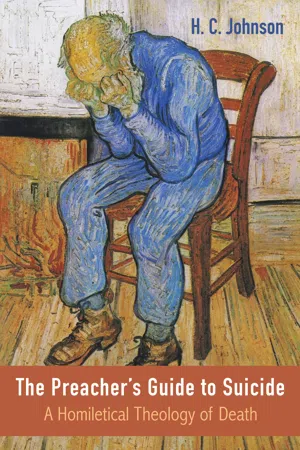
This book makes the startling claim that the pulpit is the appropriate place to address suicide. In A Preacher's Guide to Suicide Johnson chisels through the rusty prison bars of cultural pretense and the oppressive myths of suicide. Using history, the social and behavioral sciences, and biblical inquiry over the centuries of varied Christian voices, Johnson demonstrates that suicide is part of the very fabric of Christian identity. And to preach suicide awareness is to preach life into the very act of dying. While grappling with the contemporary understanding of neuroscience, psychopathology, societal values, and individualism, Johnson seeks to present suicide in a hopeful light as we all approach death in those daily moments of confession, forgiveness, and prayer. Johnson hopes to provoke further conversation within the Christian community about the richness of suicide within the Scriptures and seeks to be a source of inspiration for preachers.
Information
Topic
Theology & ReligionSubtopic
Christian Ministry1
Moving from Numbers to Words
The Trouble with Suicide Prevention
I heard a story once of a man who jumped from a forty-second-story apartment window. As he was falling, he thought, he wondered, he considered, and then when approaching the twenty-fourth story he said, “So far so good.” When I told this story at the family table, my eighteen-year-old daughter replied with snarky cynicism, “Life, liberty, and the pursuit of happiness.” I took her response as interpreting the falling man as one trapped in blind optimism, delusional, as he is headed to utter destruction. I recalled the words of the well-known song by the band R.E.M.,
Save yourself, serve yourself
World serves its own needs . . .
It’s the end of the word as we know it and I feel fine.1
A rather different response was registered by my eleven-year-old niece. Aghast, she looked at me and asked, “But the man is going to die, how is that good?” My daughter answered, “It’s good because he chose it.” I had originally misunderstood my daughter. She wasn’t being cynical, she was holding up human agency as the defining mark of a “good life,” even if that “good life” led to death. Indeed, the good life does lead to death; or better formulated, death leads to the good life, because after all, isn’t this what we preach? Christ crucified.
I do not know why Sara, my seventeen-year-old neighbor, bright, athletic, and outgoing, decided to die by suicide several years ago. She had friends; she had ambitions; she said she wanted to be a nurse and sail with Doctors Without Borders. And she had a family that attended church regularly including many extended relatives who lived in our same town, which made for a very busy and loud Christmas holiday. Sara had a good life, so why did she look towards death? Her mother Amy was haunted by the “text-book” answers that the school counselor provided as to why Sara chose death. There was no note, no red flags. Amy said that she was totally taken by surprise and left in utter shock. A decade later, Amy told me, with an air of embarrassment, that she was so desperate to understand Sara that she had attended multiple suicide prevention training events hosted by the local community college. Amy said she took notes and offered them to me as I wrote this book. But then she said, “My notes have lots of numbers and statistics . . . but . . . they won’t tell you anything about Sara.”
Like Amy, I too have attended suicide awareness and prevention seminars. But unlike Amy, I wasn’t attending specifically to learn about a unique individual. My intent was to learn about suicide in general. And that is what you get when you attend a seminar: suicide in general. Whenever I have participated in a suicide awareness seminar or training event, the instructor always begins with statistics demonstrating numerically just how damaging the situation of suicide is. Then the instructor moves to signs and risks of suicide ideation. Usually, the seminar will then provide phone numbers to call if you should happen to see the telltale signs of someone going beyond just thinking of suicide.2 Sometimes, after all the formal information is presented, the instructor will open the session up for role-play. These are those awkward moments when students have to partner up and one has to pretend to be suicidal while the other has to talk the suicidal person to the point where they make a promise or a plan not to hurt themselves until they can call that special number and get professional help. This template is typical for how a suicide awareness seminar goes. I have been to dozens and they follow pretty much the same layout, starting with numbers (statistics) and ending with numbers (phone helplines).3
After attending so many suicide seminars, I started noticing some discrepancies in the statistical information being presented. Maybe an instructor had older statistics, or maybe they got them from a different source, but it became very obvious that the stats were as varied as the humans who were collecting the data. Anyhow, if someone’s friend dies by suicide, no matter how much statistical data is thrown at the grieving, their friend will never be just a statistic to them. The deceased will never be just a number. They will only and ever be a friend, that unique individual who cannot count for just a number. I often wondered what a suicide seminar would be like if we cut out the stats and started with personal stories, with pictures of people, a variety and diversity of people, young and old, employed and unemployed, married and unmarried, healthy and sick, Asian and African, female and male, mothers and sons . . . yet, in suicide awareness seminars we usually start and end with numbers.
Social sciences regularly present statistical evidence as “awareness.” Unfortunately, numbers are not adequate “awareness.”4 I have watched educated adults sit through a seminar only to have their eyes glaze over with all the percentage signs and charts feeling a sense of relief when all one has to do is call a crisis information phone number. Seminars are really aimed more at crisis intervention than awareness and prevention. The so-called suicide “awareness” seminars often present statistical facts and then information on who to call when the crisis is in process, relaying the message that one needs to leave “crisis intervention” up to the professionals.
Many suicide “awareness” seminars offer very little or no time for conversation and discourse. And even when there has been time allotted for conversation, the material that was presented was not presented in a manner that solicited deep discussion. The seminar often ended with “Are there any questions?” about the statistical material presented. It is very challenging to have questions about statistical information and challenging for the instructor to have answers. For example, if the questions were—“Why is there a discrepancy between that one database and another database? Do these numbers represent only Coroner’s reports?5 How was the statistical information influenced by cultural norms of suicide?” These questions might seem impossible for the instructor to answer since they did not gather the data themselves but are simply reporting it from other sources.
Likewise, in suicide awareness seminars, the lecture usually begins with the behavior of the individual rather than with the collective. I have never attended a suicide awareness seminar where the opening lecture focused on larger cultural and communal issues like the decline of the church, the rise in firearms, the decline in marriage, or the rise of social media addiction. Sadly, “From the outside each death is merely death. It always looks the same and can be defined exactly by medicine and by law. When suicide is a description of behavior and defined as self-destruction . . . all suicides are just suicide. The individual person who has chosen this death has become ‘a suicide’.”6 Thus, suicide awareness seminars fail to give any attention to communal culpability. To do so, of course, would implicate everyone.
Ultimately, the real shortcoming of suicide awareness seminars is the consistent lack of any discussion7 on the complexity of suicide regarding definitions, contexts, and its place within a communal, ...
Table of contents
- Title Page
- Preface
- Acknowledgments
- Chapter 1: Moving from Numbers to Words
- Chapter 2: Suicide, Sickness, and Being Human
- Chapter 3: Theology
- Chapter 4: The Spectrum of Suicide
- Chapter 5: Ecclesiology and Suicide
- Chapter 6: Death
- Chapter 7: Suicide in Scripture
- Chapter 8: Suicide Ideation in the Scripture
- Chapter 9: Prayer and Suicide
- Chapter 10: Preaching and Suicide
- Chapter 11: Final Thoughts
- Bibliography
Trusted by 375,005 students
Access to over 1.5 million titles for a fair monthly price.
Study more efficiently using our study tools.
Frequently asked questions
Yes, you can cancel anytime from the Subscription tab in your account settings on the Perlego website. Your subscription will stay active until the end of your current billing period. Learn how to cancel your subscription
No, books cannot be downloaded as external files, such as PDFs, for use outside of Perlego. However, you can download books within the Perlego app for offline reading on mobile or tablet. Learn how to download books offline
We are an online textbook subscription service, where you can get access to an entire online library for less than the price of a single book per month. With over 1.5 million books across 990+ topics, we’ve got you covered! Learn about our mission
Look out for the read-aloud symbol on your next book to see if you can listen to it. The read-aloud tool reads text aloud for you, highlighting the text as it is being read. You can pause it, speed it up and slow it down. Learn more about Read Aloud
Yes! You can use the Perlego app on both iOS and Android devices to read anytime, anywhere — even offline. Perfect for commutes or when you’re on the go.
Please note we cannot support devices running on iOS 13 and Android 7 or earlier. Learn more about using the app
Please note we cannot support devices running on iOS 13 and Android 7 or earlier. Learn more about using the app
Yes, you can access The Preacher’s Guide to Suicide by H. C. Johnson in PDF and/or ePUB format, as well as other popular books in Theology & Religion & Christian Ministry. We have over 1.5 million books available in our catalogue for you to explore.