eBook - ePub
Prehistoric Warfare on the Great Plains
Skeletal Analysis of the Crow Creek Massacre Victims
- 234 pages
- English
- ePUB (mobile friendly)
- Available on iOS & Android
eBook - ePub
Prehistoric Warfare on the Great Plains
Skeletal Analysis of the Crow Creek Massacre Victims
About this book
First Published in 1991.This study is the product of the discovery, excavation, processing, data collection and analysis of nearly 500 human skeletons from the Crow Creek Massacre Project, South Dakota. In about 1325 AD nearly 500 American Indians were massacred, and their remains were discovered, excavated and cleaned in 1978. The general purpose of the Crow Creek osteological study were to describe the remains as fully as time permitted and compare these results with other samples. This volume presents information concerning the Crow Creek bone elements, paleodemography, cranial affiliations, mutilations and stature. It emphasizes the unique feature of the sample and compares the Crow Creek sample with other skeletal samples from the Plains.
Information
Chapter 1 Introduction
DOI: 10.4324/9781315057996-1
In 1978 nearly 500 Indian skeletons were found in the Crow Creek Site fortification ditch in central South Dakota. Remains of men, women, children, and infants were recovered, all indications suggesting they were the fourteenth century Initial Coalescent inhabitants of the Crow Creek Village. There is conclusive evidence that the people were killed and mutilated, their bodies exposed above ground and chewed by carnivores before being buried in a mass grave (Zimmerman et al. 1981).
The massacre victims from the Crow Creek Site have important implications for skeletal analyses on the Plains and elsewhere. The Crow Creek skeletons are also very important for reconstructing lifeways during the Initial Coalescent period. There are some relatively unique features about the Crow Creek sample and a number of ways in which the Crow Creek material will contribute to our understanding of the past. The unique aspects of the material are the size, period, location, and nature of the sample.
The Crow Creek massacre is the earliest large skeletal sample from the Middle Missouri Region. The massacre dates approximately 1325 AD, preceding other large skeletal samples from the region by about 300 years. It is the only large Initial Coalescent skeletal sample. The Initial Coalescent is the earliest phase in the Middle Missouri Region identified on cultural and osteological grounds as leading to the historic Arikara tribe. The Crow Creek skeletons are, then, important in understanding the origins of the Arikara.
Crow Creek is also the southern-most large skeletal sample in the Middle Missouri Region. The closest large sample is from the Sully Site located about 100 miles up-river.
Most importantly, the Crow Creek skeletons are the remains of the largest archaeologically recovered massacre in North America, if not the world. As such, it is valuable for indicating the magnitude of aboriginal warfare and presenting a large sample of victims from which types and frequencies of perimortem trauma can be observed.
From a population perspective, the remains are nearly unique among skeletal samples because all of the Crow Creek individuals were members of the same group, and all were alive at one point in time. Most other skeletal samples come from cemeteries and almost always include several archaeologically inseparable generations. Although several generations are probably present in the Crow Creek sample, unlike cemetery samples, they are separable by age at death. In short, the Crow Creek sample is a deme: a skeletal “population” frozen in time.
This analysis takes these unique features of the Crow Creek sample into consideration, emphasizing some of the major contributions the material has to make in the areas of element taphonomy, paleodemography, mutilations, craniometric distance, and stature. Each area is considered in a separate chapter in a traditional structure; each chapter has an introduction, methods employed, results found, a pertinent discussion, and summary. All chapters are descriptive, and most are comparative as well. The final chapter summarizes the information gleaned in the chronological order which it occurred. But before proceeding to the chapters dealing with the osteological data, it is necessary to review information on the archaeological site, context, and history of the bones.
Chapter 2 The Crow Creek Site and Excavation
DOI: 10.4324/9781315057996-2
The Crow Creek Site (39BF11) is a National Historic Landmark located in Buffalo County, central South Dakota, 11 miles north of Chamberlain. It is on the east bank of the Missouri River, immediately north of the mouth of Crow Creek, both of which are impounded by Ft. Randall Dam and are part of Lake Francis Case Reservoir. The site was partially excavated in the 1950’s and reported by Kivett and Jensen (1976). The background information concerning the site and excavations comes mostly from these authors, supplemented by Zimmerman et al. (1981).
The site is large, covering approximately 18 acres and rests on a prominent terrace (Fig. 1). The west boundary of the site is the steepest edge of the terrace which drops nearly vertically to the former Missouri River flood plain, now the lake, about 80 feet below the terrace surface. The southeast boundary is a less spectacular, but steep, bluff which drops to the old Crow Creek flood plain. The third and final boundary is formed by a well-marked, sinuous, 1250 foot-long fortification ditch. The site is in an excellent defensive position.
There are two components at the Crow Creek Site. The earlier component is from the Initial Middle Missouri Variant of the Middle Missouri Tradition and dates about 1100 to 1150 AD. The later component, the one of interest here, is from the Initial Coalescent Variant of the Coalescent Tradition. Based on radiocarbon dates, this component appears to date sometime between 1325 and 1450 AD, probably closer to the earlier date.
The remains of the Initial Coalescent component are impressive. There are at least 50 lodge depressions on the terrace. Two Initial Coalescent fortification ditches surround
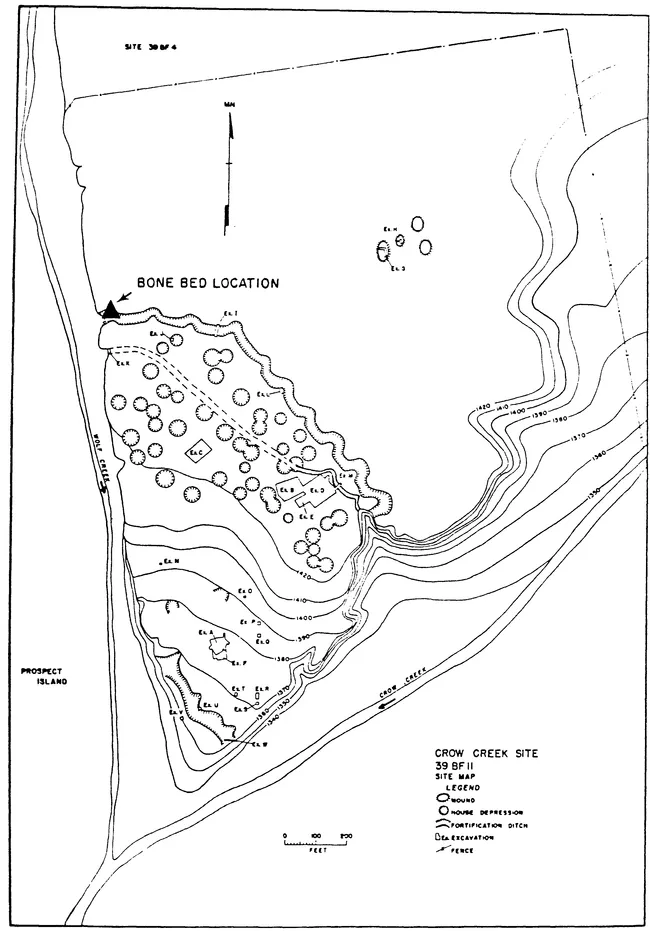
Figure 1. Map of the Crow Creek Site from Kivett and Jensen (1976:2, Fig. 1). Triangle indicates location of the bone bed.
the village on its most vulnerable side, the more prominent ditch marking the northeast and north village boundary.
The more prominent, outer ditch stretches from the Crow Creek edge of the terrace to the Missouri River side. It is 1250 feet long with 10 bristling bastions. As indicated by the single cross-section excavated, the ditch measured 6 feet deep, and more than 4 feet wide at the bottom and 12 feet wide at the top. No postholes indicating the presence of a stockade were found in a 10 by 5 foot test trench excavated on the inside of one bastion. Today the ditch is marked by a 2 or 3 foot depression and the greener, higher vegetation which grows there. It was at the extreme northwest end of this ditch where the massacre victims were discovered.
The less prominent inner ditch is visible only near the southeast corner of the village. It apparently has bastions, as the outer ditch. In contract to the outer ditch, the inner had much cultural debris plus a human mandible and cranium. These were found in the single, small excavation cross-sectioning the ditch. The inner ditch, also in contrast to the outer, has postholes, indicating an associated stockade. Six of the excavated postholes contained human skull fragments. As the outer, the inner ditch apparently dates to the Initial Coalescent occupation.
Some archaeologists have interpreted these facts as suggesting that the inner ditch was earlier than the outer ditch. As the village expanded beyond the inner ditch, according to this interpretation, it was used as a refuse dump. With increasing hostilities, fortification was again needed and so the impressive outer ditch was built to include the lodges outside the inner ditch. The skull fragments found in some of the postholes from the stockade of the inner ditch support the idea that the outer ditch had just been dug and that the stockade was being constructed in part with the posts from the inner ditch, leaving these postholes still open when the massacre happened. Evidence for this hypothesis also comes from the lack of postholes adjacent to at least part of the outer ditch and the relative lack of cultural debris in the outer ditch. In brief, the Crow Creek villagers may have been caught with their stockade down.
Formal archaeological excavations began at Crow Creek in 1954 and continued in 1955 under the direction of Marvin F. Kivett, former museum director of the Nebraska State Historical Society. Results of the excavations and analyses have been reported by Kivett and Jensen (1976). Their excavations exposed more than six structures and sectioned all of the ditches. More than 20 years after the excavations and two years after their report was published, attention was again focused on the site when human bones were discovered eroding from the outer fortification ditch in 1978. The principal logistic steps taken have been outlined in the Preface above, and additional details concerning the excavation are presented below.
Excavation of the bone bed, which is more fully described by Zimmerman et al. (1981), began with cleaning the end of the fortification ditch for inspection and superimposing a horizontal grid system over the ditch. The horizontal grid was divided into 1 meter squares, numbered in an east-west orientation and lettered north-south. Material collected was identified to the quarter of a meter square, for instance, the Northeast Quarter of Square 8B. In all, 18 meter squares or parts of meter squares (6 meters east-west, 3 meters north-south) were excavated.
Stratigraphically there were two bone beds in the deposit. Bed A was the higher and thinner of the two. Immediately above parts of Bed B was a clay and silt stratum which must have been deposited by humans because clay does not occur naturally on the terrace. The top of Bed B, the lower and much larger of the bone beds, was 1 to 2 feet below Bed A. Bed B was cone-shaped with the apex of the cone against the north wall of the fortification ditch. At the apex the bed was 4.5 feet thick. All of Bed A and the surface of Bed B were photographed and mapped. Articulated bones were given numbers and collected as units. In addition to the wealth of human bones, a few cultural and other specimens were found.
Although most of the cultural specimens from the ditch were not diagnostic, those which were (some ceramics, lithics, and a bone point) indicate all materials were from the Initial Coalescent component. There were no diagnostic Middle Missouri artifacts present.
In addition to the cultural materials in the ditch, there were some animal bones (dog?, bison, deer, and smaller mammals) and seeds of wild plants plus corn and sunflower. The over-whelming volume of material from the ditch was and the focus of this study is the human skeletal material.
Because the Crow Creek Village is so large and exceptionally well preserved and because of the attention focused on the site during excavation of the massacre victims, the site was considered for national monument status. Feasibility studies were conducted in the early 1980’s, but by the end of the decade, the movement was dead. It is unlikely, despite its archaeological importance, that the Crow Creek Site will become a national monument anytime in the foreseeable future.
Chapter 3 Count and Context of the Bone Element
DOI: 10.4324/9781315057996-3
The huge bone pile at Crow Creek (Fig. 2) and the shelved bone-filled boxes at the University of South Dakota were alternately an osteologist’s dream and nightmare. Any systematic study of the bones had to begin with an element inventory. Once the bone count was complete, more specialized studies could begin. Likewise it ...
Table of contents
- Cover
- Original Title
- Title
- Copyright
- Dedication
- Table of Contents
- List of Tables
- List of Figures
- Acknowledgement
- Abstract
- Preface
- 1990 Preface
- 1 Introduction
- 2. The Crow Creek Site and Excavations
- 3. Count and Context of the Bone Elements
- 4. Crow Creek Paleodemography
- 5. Crow Creek Cranial Affinities
- 6. Crow Creek Mutilations
- 7. Crow Creek Stature
- 8. Interpretation
- References Cited
Trusted by 375,005 students
Access to over 1.5 million titles for a fair monthly price.
Study more efficiently using our study tools.
Frequently asked questions
Yes, you can cancel anytime from the Subscription tab in your account settings on the Perlego website. Your subscription will stay active until the end of your current billing period. Learn how to cancel your subscription
No, books cannot be downloaded as external files, such as PDFs, for use outside of Perlego. However, you can download books within the Perlego app for offline reading on mobile or tablet. Learn how to download books offline
Perlego offers two plans: Essential and Complete
- Essential is ideal for learners and professionals who enjoy exploring a wide range of subjects. Access the Essential Library with 800,000+ trusted titles and best-sellers across business, personal growth, and the humanities. Includes unlimited reading time and Standard Read Aloud voice.
- Complete: Perfect for advanced learners and researchers needing full, unrestricted access. Unlock 1.5M+ books across hundreds of subjects, including academic and specialized titles. The Complete Plan also includes advanced features like Premium Read Aloud and Research Assistant.
We are an online textbook subscription service, where you can get access to an entire online library for less than the price of a single book per month. With over 1.5 million books across 990+ topics, we’ve got you covered! Learn about our mission
Look out for the read-aloud symbol on your next book to see if you can listen to it. The read-aloud tool reads text aloud for you, highlighting the text as it is being read. You can pause it, speed it up and slow it down. Learn more about Read Aloud
Yes! You can use the Perlego app on both iOS and Android devices to read anytime, anywhere — even offline. Perfect for commutes or when you’re on the go.
Please note we cannot support devices running on iOS 13 and Android 7 or earlier. Learn more about using the app
Please note we cannot support devices running on iOS 13 and Android 7 or earlier. Learn more about using the app
Yes, you can access Prehistoric Warfare on the Great Plains by P. Willey in PDF and/or ePUB format, as well as other popular books in Social Sciences & Anthropology. We have over 1.5 million books available in our catalogue for you to explore.