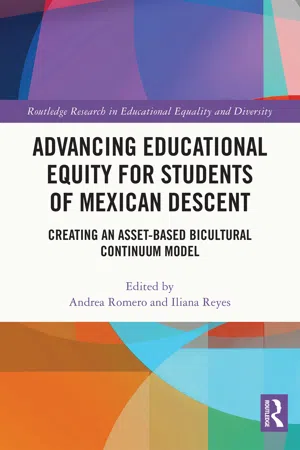
Drawing on participatory action research conducted with students, parents, families, and school staff in a Southwest community in the United States, this volume contests the interpretation of the achievement gap for students of Mexican descent in the American education system and highlights asset-based approaches that can facilitate students' academic success.
By presenting the Asset-Based Bicultural Continuum Model (ABC) and demonstrating the applications in a variety of family, school, and community-based initiatives, this volume demonstrates how community and cultural wealth can be harnessed to increase educational opportunities for Latino students. The ABC model offers new strategies which capitalize on the bicultural and linguistic assets rooted in local communities and offers place-based strategies driven by communities themselves in order to be tailored to students' strengths. The text makes a significant contribution to understanding the social ecology of Latinx students' experiences and offers a new direction for effective and evidence-based academic and health programs across the United States.
This book will be a valuable resource for researchers and academics with an interest in the sociology of education, multicultural education, urban education, and bilingual education. It will be of particular interest to those with a focus on Hispanic and Latino studies.
Trusted by 375,005 students
Access to over 1.5 million titles for a fair monthly price.
Part I What Do Students, Parents, Teachers, Counselors, Administrators and Community Leaders Feel Is Necessary for Excellent Education for All Children in Their Community?
1 Children and Communities with Promise1A Place-Based Approach to an Asset-Based Bicultural Continuum Model
Andrea Romero and Iliana Reyes
DOI: 10.4324/9780367808327-2
This book is about believing in the promise of education to transform communities in poverty, as well as believing in the promise, or potential, of Mexican descent bilingual students. We describe the hope found within one community that was viewed by outsiders as a place known mainly for poverty and crime. Educational success is intricately tied to future income and economic stability for families in the United States; however, too often, inner-city urban communities in poverty have underperforming public schools and minimal resources to encourage children to go to college (Sanchez, 1996; Sleeter & Grant, 1999; Valencia, 2010). The educational system has failed children of color living in poverty (Cammarota & Fine, 2010; Valenzuela, 1999); in order to transform this reality, new strategies are necessary that are driven by the community themselves and rooted in their cultural and linguistic assets. In this book, we present the four years of work building La Zona de Promesa (The Promise Zone) which was led by a coalition of students, parents and families, school staff, and community leaders using participatory action research strategies in schools and community agencies.
Fundamental to the vision of La Zona de Promesa was believing in the promise of the people in the City of South Tucson (CoST) because for so long this community had been given up on by the local public educational system. The meaning of promise for La Zona de Promesa was twofold. One dimension was the connotation of promise as a commitment to action, and your word, as a community member, as a promise. The other dimension was that promise indicated potential; in particular, it indicated not only the educational potential of the students, but also the positive potential of the South Tucson community. The guiding metaphor for this project was rooted in the internationally renowned artistic mosaics that are on every corner of this Southwest city (Portillo Jr., 2014). Mosaics are a unified whole work of art that is created from broken shards of glass and pottery that may have otherwise been thrown away but are placed strategically and creatively together to form a whole image. Our goal was to create a unified promise zone for children that would require artfully bringing together multiple systems to holistically nurture a child’s potential across their educational continuum from grades pK to 20. This strategy required the alignment of multiple pK-20 public schools that served this city, as well as the students and their families, public service agencies, community-based organizations, local government, and community leaders. At the center of this alignment of systems was the concept of promesa por promesa (promise for promise); in other words, the commitment of the community to believe and take action in the promise inherent in all children. The repeated emphasis on all children emphasizes the normalization and socialization that all children in the community could be successful, not only a select sample of high achieving students who had to leave their family and neighborhood in order to be successful.
This approach further embedded the perspective of the strength of bicultural and bilingual strengths of children, families, and the community, rather than the assumptions that too often divide high achievers from the cultural and linguistic characteristics of the community that they come from. Despite so many odds against them, this community worked with a collective commitment to leverage existing resources in order to tip the scales in favor of the children’s educational opportunities. There are many strengths identified within children from immigrant families (García Coll et al., 1996); they are more likely to be born healthy, live with both parents, have a strong work ethic, high education aspirations, as well as a strong sense of family obligations and ethnic pride (Shields & Behrman, 2004). Academically, immigrant children and children of immigrants tend to spend more time doing homework, have higher grades and higher math scores, and do better in school through middle school (Shields & Behrman, 2004). However, they also face many challenges, including discrimination/racism (Romero & Roberts, 2003; Schwartz et al., 2015), poverty, and a lack of educational support (Rogalsky, 2009).
Overview of La Zona de Promesa
Underlying La Zona de Promesa is the belief that all children, youth, and families can achieve their dreams and live successfully if a place-based and high-functioning set of partnerships between local agencies and community members is developed, expanded, and sustained through overarching solutions. The theory of action was based on an adaptation of the Participatory Action Research framework (Lave, Wenger, & Wenger, 1991; Wenger, 1998) in order to show how each partner can contribute to the goals by bringing their own assets and expertise to create a continuum of solutions to build the education pipeline from birth to college through career. This framework acknowledges the equality of each partner and the central use of research that can lead to action. Using a participatory action research approach, a cycle of research and feedback is utilized ensuring that all members are equal participants in the decision-making process (James, Milenkiewicz, & Bucknam, 2008). Community members led the decisions about what issues to prioritize, how to conduct research, collection of data, preparation of reports, and presentation of findings to the community (Oetting et al., 1995). The main goal of participatory action research is to engage participants actively and move research findings to action within the community. We discuss how we worked collaboratively with residents, students, and schools to share findings to guide our discussion (see Figure 1.1).
Figure1.1 Cycle of Participatory Action Research.
Participatory action research principles were central to how we integrated research, stakeholder interests, and linked our findings to solutions through an iterative spiral of activities that leads to action (Cousins & Earl, 1992; McIntyre, 2008). Participatory action research is marked by the following aspects:
Collective commitment to the issue,
Self and collective reflection to gain clarity,
Joint decision-making to engage in action that will lead to a useful decision that benefits people involved,
Building of alliances between researchers and participants in planning, implementation, and dissemination of research, and
Balance between technical rigor and stakeholder needs (Cousins & Earl, 1992). The participatory action research approach helped increase the capacity of stakeholders to understand the educational context and the key factors their community needed to build a college-going culture across the educational continuum.
The participatory action research projects were most often led by youth in the k-12 schools in collaboration with university students. Youth participatory action research is uniquely defined by the key role of youth in leading the projects through the cycle of research, reflection, and action (Cammarota & Fine, 2010). It ensured that youth voice was central and that their vision for how to improve schools and community efforts was at the forefront. In addition, community members as well as parents and family members were key in action research as they integrated the important voice of immigrant Spanish-speaking parents, which has too often been marginalized in the literature on educational equity. The specific projects implemented utilized a participatory action research method to equally engage all sectors of the community and collectively work toward creating a culture of academic success for students of Mexican descent. Essential to the participatory action research method is to work in partnership with youth and community members to collect data and to use the research findings to lead to action, creating change in community efforts, and policy change (James et al., 2008; McIntyre, 2008).
Based on our four years of coalition-building and participatory action research, we present findings from personal testimonies of the families, participatory action research with teachers and students, and community efforts at the implementation of the continuum model. Our findings tap into the educational realities of Mexican descent students living in poverty, with a particular focus on family experiences of immigration. Community members’ (students, parents, teachers, principals, and community leaders) voices give direct insight and voice to the beauty and challenges that exist in the education of Mexican descent students in the United States today.
Asset-Based Bicultural Continuum (ABC) Model
The Asset-Based Bicultural Continuum (ABC) model was developed based on our participatory action research with key stakeholders; Chapter 5 describes the model in detail, and how it was derived from the data collected from multiple stakeholders within the community during the first phase of La Zona de Promesa project and thus addresses multiple socioecological system levels at the individual, family, neighborhood, school, city, and societal levels. We take a strengths-based approach that challenges deficit-based models because it was voiced by community members who were struggling economically, but who also dreamt and actively fought for a better life for their children. In this book, we identify aspects of community and cultural wealth that are not necessarily based on income or middle-class values, but that are essential for minority communities, and which include aspirational capital, social capital, navigational capital, resistance capital, linguistic capital, funds of knowledge, and familial capital (González, Moll, & Amanti, 2005; Yosso, 2005). In this way, this book demonstrates how students, families, and low-income immigrant communities overcome and transform structural limitations of poverty, policy, and inequities in the public educational system.
Key factors in the ABC model are as follows:
Equitable educational solutions are based on existing assets within the schools, families, students, community, and government;
Mexican descent students find strength in bicultural and bilingual contexts that they navigate between home, school, and community daily;
Alignment of the educational continuum with consistent support from all sectors (family, school, and community) facilitates student academic success.
The continuum approach of the ABC model is that it can help us move beyond a pipeline analogy where individual students proceed through an educational system that is out of context with the student’s community and home environments. We argue that a continuum analogy supports the student navigating through multiple contexts, and this analogy ultimately encourages transformation in the surrounding contexts of the students to support their success. Additi...
Table of contents
Cover Page
Half Title page
Series Page
Title Page
Copyright Page
Dedication
Contents
List of Illustrations
Foreword
Preface
About the Authors and Contributors
Part I What Do Students, Parents, Teachers, Counselors, Administrators and Community Leaders Feel Is Necessary for Excellent Education for All Children in Their Community?
Part II How One Community Engaged with Education to Create an Asset-Based Bicultural Continuum
Index
Frequently asked questions
Yes, you can cancel anytime from the Subscription tab in your account settings on the Perlego website. Your subscription will stay active until the end of your current billing period. Learn how to cancel your subscription
No, books cannot be downloaded as external files, such as PDFs, for use outside of Perlego. However, you can download books within the Perlego app for offline reading on mobile or tablet. Learn how to download books offline
Perlego offers two plans: Essential and Complete
Essential is ideal for learners and professionals who enjoy exploring a wide range of subjects. Access the Essential Library with 800,000+ trusted titles and best-sellers across business, personal growth, and the humanities. Includes unlimited reading time and Standard Read Aloud voice.
Complete: Perfect for advanced learners and researchers needing full, unrestricted access. Unlock 1.5M+ books across hundreds of subjects, including academic and specialized titles. The Complete Plan also includes advanced features like Premium Read Aloud and Research Assistant.
Both plans are available with monthly, semester, or annual billing cycles.
We are an online textbook subscription service, where you can get access to an entire online library for less than the price of a single book per month. With over 1.5 million books across 990+ topics, we’ve got you covered! Learn about our mission
Look out for the read-aloud symbol on your next book to see if you can listen to it. The read-aloud tool reads text aloud for you, highlighting the text as it is being read. You can pause it, speed it up and slow it down. Learn more about Read Aloud
Yes! You can use the Perlego app on both iOS and Android devices to read anytime, anywhere — even offline. Perfect for commutes or when you’re on the go. Please note we cannot support devices running on iOS 13 and Android 7 or earlier. Learn more about using the app
Yes, you can access Advancing Educational Equity for Students of Mexican Descent by Andrea Romero, Iliana Reyes, Andrea Romero,Iliana Reyes in PDF and/or ePUB format, as well as other popular books in Education & Education General. We have over 1.5 million books available in our catalogue for you to explore.