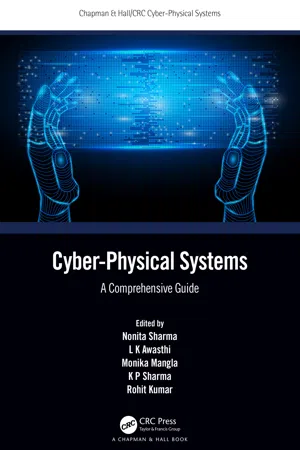
Cyber-Physical Systems: A Comprehensive Guide explores the complete sys-tem perspective, underlying theories, modelling, and the applications of Cyber Physical Systems (CPS). It aims to cover all topics ranging from discussion of ru-diments of the system, efficient management, to recent research challenges and issues. Editors aim to present the book in a self-sufficient manner and to achieve this, the book has been edited to include all the aspects of CPS. The book fo-cuses on the concept map of CPS including latest technological interventions; issues, challenges, and the integration of CPS with IoT & Big Data Analytics. This aims to bring together unique contributions on cyber-physical systems research and education with applications in industrial, agriculture, and medical domains. The main aim of the book is to provide a roadmap to the latest advancements to provide optimal solutions in the field of CPS.
Features
• Coverage of rudiments of the subject • Discussion of recent advancements in the associated field • Considers an audience of diverse domains • Suitable for students (both UG and PG level) and researchers in the field of CPS
This book aims to present the emergence of Cyber Physical Systems in response to revolutionary advancements in IoT. While discussing the associated challenges, it also endeavors to devise efficient models which are competent to address these challenges. This book aims to cater to researchers and academicians working in the related field of CPS.
1 Applications of Artificial Intelligence in Cyber-Physical Systems
R. Sharma and N. Sharma
Dr. B.R. Ambedkar National Institute of Technology Jalandhar, Punjab, India
DOI: 10.1201/9781003202752-1
1.1 Introduction
Helen Gill of the National Science Foundation coined the term “Cyber Physical System (CPS)” in 2006 [1]. “CPS contains communicating digital, analog, physical, and human elements designed for operation by integrated physics and logic,” according to Griffor [2]. One may infer from the above description that CPS is an intersection of the physical and cyber worlds, where physical refers to a real-world object, and cyber refers to the network connections that link all physical entities and enable them to interact. These technologies will support our critical infrastructure, act as the foundation for future intelligent networks, and enhance our quality of life in several ways. For example, traffic flow control, health services, and emergency response will all benefit from CPS. It is a novel digital system that integrates the physical and cyber worlds [3]. It is a combination of communication, control, computation, and the physical world. CPS has two main functional components: CPS system has high-speed connectivity for data gathering from the real world and cyberspace to provide the result by analyzing the data [4]. In addition, CPS aims to improve the system's functionality, reliability, usability, and safety.
The industry is now witnessing the fourth Industrial Revolution in CPS [5]. These are industrial automation systems that allow a wide range of innovative functionalities through networking and virtual world access, significantly altering our everyday lives [6]. Different new and advanced technologies such as smart homes, driverless cars, smart cities, Internet of Things (IoT), renewable energy, and 3D printing now exist [7,8]. The devices can be adapted to automate traffic management, precision robotic surgery, smart manufacturing, perform in hazardous or impossible conditions, autonomous search and rescue systems, large-scale distributed coordination (e.g., supporting technologies), and ubiquitous monitoring and deployment in health care [9]. Other than advancement in technology in CPS, these devices work without human intervention and can communicate with each other and produce huge amounts of data. This data is analysed and different services are provided to the user.
CPS is also called an industrial application of IoT that can control physical objects with the help of cyberspace [10]. The concept of industrial IoT has emerged with CPS that provides machine-to-machine communication without human intervention. With this automation, a machine can work with its full potential and also offer optimized services. Different sensors and actuators are used in these systems to make them autonomous.
As CPS systems become more commonly utilised, the number and quality of attacks is increasing. Protecting these systems from different attacks is challenging in a human-free environment [11,12]. If proper security measures are not taken into consideration, it is easy to attack the system. So, it is a concern of prime importance to secure the design and provide a good service simultaneously.
This chapter demonstrates the application of artificial intelligence (AI) in CPS. The following section introduces the concept of CPS to readers, followed by the introduction of AI, and the application of AI in CPS.
1.2 Cyber-Physical System
CPS is an interconnection of a physical entity with communication and computation infrastructure [6,13]. CPS focuses on networking several embedded devices so that they can work together. There are different embedded systems such as smartphones, cars, and other devices; without these devices, we cannot imagine our modern life. All of these devices cannot be accessed remotely. With the help of CPS, these devices can be integrated and communicate with each other and can be accessed remotely. Connected car technology is an example of CPS; these days, most cars come with this technology and it helps us remotely turn on and off the car engine, check the location of the vehicle, and turn on the air conditioning before we reach the car. It'd be perfect if one could switch on the home air conditioning on the way back from work, bringing the indoor room temperature back to normal. Or an electric kettle could start making tea while the person is still in bed in the morning. System monitoring may also benefit from remote access to process data. The details obtained from remote diagnostics assists service members in bringing the appropriate instrument and replacement component. The device will order replacement parts on its own, using the corresponding network infrastructure. Also, now, there are many areas of use for CPS, such as surgical devices, driving machines, etc.
Figure 1.1 represents a structure of a CPS, which is mainly composed of the physical world, access layer, and cyber world [14]. Wireless or wired communication may connect CPS to cyber-level systems such as control centers to physical components. The computing and control portion, which also sends control commands and receives sensed data, contains the intelligence. Sensors that track physical components and actuators that control them connect CPS to the real world [15]. A CPS is made up of a control panel, which usually consists of microcontroller(s) that control the actuators and sensors required to communicate with the other entity and process the data received [16]. These systems need a networking interface to share data with other embedded systems or the cloud. The most critical aspect of a CPS is data exchange, which allows data to be exchanged. The Internet-enabled CPS is often referred to as the IoT. In other words, a CPS is a network-capable integrated device that can send and receive data [6].
Figure1.1 Cyber-Physical System Structure [14].
1.3 Artificial Intelligence
According to John McCarthy [17], the father of AI, “artificial intelligence is the science and engineering of creating intelligent machines, brilliant computer programs.” AI is a field of computer science that deals with creating programs that exhibit “intelligence.” There are two forms of AI: narrow and universal AI. Many of the features of human intelligence would be present in ubiquitous AI, such as the ability to comprehend words, distinguish between objects and sounds, erudition, and problem solving. On the other hand, narrow AI shows certain aspects of human intelligence and can perform certain functions exceptionally well but lacks in other fields. A software that can recognize photographs but not anything else is an example of narrow AI.
To achieve the idea of AI, different algorithms and models are used. These learning algorithms and models are called machine learning (ML). ML is a learning process that is used to make a machine intelligent. Different learning methods are used to make machines intelligent, and they are broadly classified into three categories: unsupervised, supervised, and reinforcement learning. Supervised learning is learning where a device is provided with the label data means the machine knows for a specific input and its output during the training phase. In the testing phase, the machine is given data where the label is provided only on input data and it tries to predict the output label.
On the other hand, in unsupervised learning, there is no label on output data during any phase, machine try to find out hidden features in the data. Reinforcement learning works on the concept of agent and environment where agents learn from the surrounding environment and try to improve their performance. On the basis of learning, there are different techniques that are not limited to: decision tree, K-nearest neighbour (KNN), random forest, support vector machine (SVM), logistics regression, and artificial neural network (ANN). ANN is the technique that is inspired by the human neural system. In the human neural system, there are millions of neurons that work together to tmke a decision in same manner when we use a number of artificial neural networks to make an intelligent machine is called deep neural network and a new term to come into the picture is known as deep learning (DL). DL is an extension of ML that has the same task to make a machine intelligent, but in DL, the number of artificial neurons are very large. Recurrent neural network and convolution neural network are some of the most popular DL models. Applications of AI are used in different domains to improve their performances and user experiences: web search engine, spam detector, image recognition, voice recognition, and sensory data analysis are some of the applications in which tremendous improvement has been done with AI.
A CPS uses computer-aided algorithms to track and manipulate physical elements that are capable of manipulating and reacting to their physical environment, using a mixture of machine sensor...
Table of contents
Cover
Half Title
Series Page
Title Page
Copyright Page
Contents
Preface
Editors
Contributors
1 Applications of Artificial Intelligence in Cyber Physical System
2 Enhancement of the Healthcare Sector and the Medical Cyber-Physical System with the Help of Blockchain Technology
3 Applications of Cyber Physical Systems for Industry 4.0: A Comprehensive Review
4 A Theoretical Framework for Deep Neural Networks over CPS: Vision, Application, Challenges
5 Hybrid Model for Software Fault Prediction
6 I-ACTIVE: A Low-Cost Efficient End-to-End Cyber-Physical System for Ubiquitous Real-Time Human Activity Recognition
7 Efficient Compression Algorithms for Bandwidth and Memory Constrained Cyber-Physical Systems
8 Novel Encryption Framework: HEA for IoT and Fog Network Data Transmission
9 Security Issues & Challenges for Cyber-Physical System
10 Security Vulnerabilities of Cyber-physical Systems: Autonomous Vehicles Perspective
11 Employment of Cyber-Physical Systems Towards Smart Healthcare Assistance
12 A Roadmap Towards Industrial Transformation Using Cyber-Physical System
13 UAV-Based Cyber-Physical Systems: Concepts, Applications and Issues
14 An AI-Based Cyber-Physical System for 21st-Century-Based Intelligent Healthcare
Index
Trusted by 375,005 students
Access to over 1.5 million titles for a fair monthly price.
Study more efficiently using our study tools.
Frequently asked questions
Yes, you can cancel anytime from the Subscription tab in your account settings on the Perlego website. Your subscription will stay active until the end of your current billing period. Learn how to cancel your subscription
No, books cannot be downloaded as external files, such as PDFs, for use outside of Perlego. However, you can download books within the Perlego app for offline reading on mobile or tablet. Learn how to download books offline
Perlego offers two plans: Essential and Complete
Essential is ideal for learners and professionals who enjoy exploring a wide range of subjects. Access the Essential Library with 800,000+ trusted titles and best-sellers across business, personal growth, and the humanities. Includes unlimited reading time and Standard Read Aloud voice.
Complete: Perfect for advanced learners and researchers needing full, unrestricted access. Unlock 1.5M+ books across hundreds of subjects, including academic and specialized titles. The Complete Plan also includes advanced features like Premium Read Aloud and Research Assistant.
Both plans are available with monthly, semester, or annual billing cycles.
We are an online textbook subscription service, where you can get access to an entire online library for less than the price of a single book per month. With over 1.5 million books across 990+ topics, we’ve got you covered! Learn about our mission
Look out for the read-aloud symbol on your next book to see if you can listen to it. The read-aloud tool reads text aloud for you, highlighting the text as it is being read. You can pause it, speed it up and slow it down. Learn more about Read Aloud
Yes! You can use the Perlego app on both iOS and Android devices to read anytime, anywhere — even offline. Perfect for commutes or when you’re on the go. Please note we cannot support devices running on iOS 13 and Android 7 or earlier. Learn more about using the app
Yes, you can access Cyber-Physical Systems by Nonita Sharma, L K Awasthi, Monika Mangla, K P Sharma, Rohit Kumar, Nonita Sharma,L K Awasthi,Monika Mangla,K P Sharma,Rohit Kumar in PDF and/or ePUB format, as well as other popular books in Computer Science & Cloud Computing. We have over 1.5 million books available in our catalogue for you to explore.