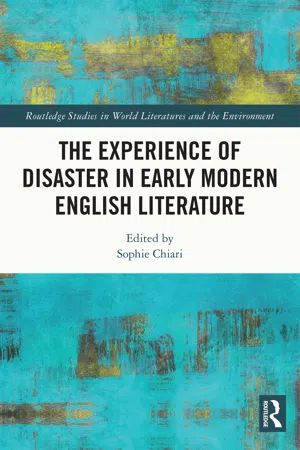
This book addresses the concept of 'disaster' through a variety of literary texts dating back to the early modern period. While Shakespeare's age, which was an era of colonisation, certainly marked a turning point in men and women's relations with nature, the present times seem to announce the advent of environmental justice in spite of the massive ecological destructions that have contributed to reshape our planet. Between then and now, a whole history of climatic disasters and of their artistic depictions needs to be traced. The literary representations of eco-catastrophes, in particular, have consistently fashioned the English identity and led to the progress of science and the 'advancement of learning'. They have also obliged us to adapt, recycle and innovate. How could the destructive process entailed by ecological disasters be represented on the page and thereby transformed into a creative process encouraging meditation, preservation and resilience in the sixteenth and seventeenth centuries? To this question, this book offers nuanced, contextualised and perceptive answers. Divided into three main sections 'Extreme Conditions', 'Tempestuous Skies', and 'Biblical Calamities,' it deals with the major environmental issues of our time through the prism of early modern culture and literature.
- 184 pages
- English
- ePUB (mobile friendly)
- Available on iOS & Android
eBook - ePub
The Experience of Disaster in Early Modern English Literature
About this book
Information
Part I Extreme Conditions
1 Shakespeare, Natural Disaster and Atmospheric Phenomena
Geraldo U. de Sousa
DOI: 10.4324/9781003273134-3
The word ‘disaster’, borrowed from the French désastre, implies ‘an event or occurrence of a ruinous or very distressing nature’, a calamity, ‘a sudden accident or natural catastrophe that causes great damage and loss of life’ (OED 1.a).1 ‘Extreme weather’ refers to record-breaking anomalies; but as Christopher C. Burt writes, they ‘nonetheless may help indicate whether or not the climate is becoming more extreme’ (Burt 2007, 12). Anomalies include extremely warm or cold periods, unusually high rain or snowfall and hailstorms, severe droughts, intense thunderstorms, tornadoes and waterspouts, windstorms and fog, hurricanes and so forth. From an early modern perspective, the definition of ‘natural disaster’ poses additional challenges, because what we may consider ‘natural’, without supernatural or providential agency, was often perceived as ‘unnatural’, an aberration from the customary order of things. In this chapter, I will use the phrase ‘natural disaster’ in a general sense, but I will also tease out the tension between natural and unnatural in a coincidence of opposites. Natural or unnatural disasters evoke fear, expose human vulnerability and raise questions about survival and our exposure to forces unknown or beyond human control. Gaston Bachelard suggests that a dialectics of inside and outside hinges on such moments (Bachelard 1994, 211–12).2 Our bodies, our homes, our properties and our daily habits of life are thrust into uncertainty or disarray.
Shakespeare represents meteorological phenomena as ‘natural’, explainable according to the meteorological theories of his time;3 but weather anomalies, for Shakespeare, also function as portals or passageways to something unpredictable and wild. These passageways connect to and momentarily bring into view parallel realms of darkness and shadows. For him, extreme weather represents forces that disturb and destabilise the natural, empirical boundaries of reality. In fact, Yi-Fu Tuan argues that ‘evil persons’ were often blamed for ‘bad weather’ not only in Europe but elsewhere in the world (Tuan 1979, 110).4 Extreme weather suggests supernatural possibility, coincidence of opposites and mystery. Momentarily, we peek into the dark corners of the natural world, the recesses of nature and nature’s hiding places. Shakespeare’s references to weather anomalies occur in such plays as 1 Henry VI, A Midsummer Night’s Dream, King Lear, Othello, Macbeth and The Tempest.5 I will, however, narrow down my discussion to A Midsummer Night’s Dream and The Tempest, a play also examined by Danièle Berton-Charrière – though from a different perspective – later on in the book, in order to demonstrate that when disasters happen, intensely psychological and cultural states of fear emerge.
1.1 Little Ice Age (c. 1300–1850)
Climatologists and historians have documented a hemispheric, perhaps global cooling of the earth, a period known as the Little Ice Age, extending from 1300 to around 1850. The earth’s cooling has been attributed to various causes such as volcanic activity, cyclical lows in solar radiation, variations of the earth’s orbit and axial tilt. Major volcanic activities – the eruptions of the Taal Volcano on the Island of Luzon, Philippines, in 1572 and from 1605 to 1611, the Nevado del Ruiz in Colombia in 1595, the Huaynaputina, Peru, in 1600 – affected the earth’s climate globally, as documented regionally and locally by contemporary accounts, studies of tree rings, sediment strata and volcanic particle deposits in layers of polar ice. The Huaynaputina eruption in Peru in 1600, for example, was ‘the largest volcanic eruption in South America spanning the past 2000 years’ (Fei, Zhang, and Lee 2016, 2). Glaciers advanced, the Arctic ice caps became thicker, snowfall intensified, summers cooled down, rainfall increased and crops failed. Earthquakes, believed in Shakespeare’s time to be caused by winds trapped in the bowels of the earth, caused considerable damage in the Straits of Dover in 1580 and in Frankfurt, Germany, in 1600.6 Curiously, John Florio defines earthquake as ‘any terrible noise heard in the air like unto howling bellowings’ (Florio 1598, sig. Ciiiv). Not all weather anomalies led to disaster, of course. The River Thames froze over, for example, in 1565, 1595 and 1608. In 1608, the frozen river served as the site for the first so-called frost fair, a festive occasion for bowling, dancing, playing football on ice and, of course, shopping at the improvised shops set up on the frozen surface of the river.7
Regional disasters, weather anomalies and their effects on life and property in the sixteenth and early seventeenth centuries serve as a backdrop for Shakespeare’s references to and representation of extreme weather in various plays. These disasters include coastal flooding, severe thunderstorms and cloudbursts, tornadoes and destructive winds, lightning strikes and monstrous extra-tropical cyclonic activity in the North Atlantic. A rich record of responses to these events has survived, including the All Saints’ Flood on the Dutch Coast of 1570, the violent storms that hit Bungay and Norwich in 1577, London’s great snowstorm of 1597 when 24 inches of snow fell on a single day, and destructive coastal flooding in Somerset, Southwest England and Norfolk in East Anglia in 1607 (Burt 2007, 88). In his edition of Certain Wonderful Overflowings of Water in Somerset, Norfolk, & Other Parts of England, Ernest Baker writes: ‘There can be little doubt that the account of these floods, and of the great loss of life and property caused thereby, contained in this tract is truthful’ (Baker 1884, 3).8 In 1555, a powerful tornado or waterspout, possibly caused by a hurricane, caused considerable destruction to the Grand Harbour of Malta and four galleys anchored in the harbour were destroyed (Abela 2021, n.p.).9 Some years were notoriously without summer, such as 1601 and, of course much later on, in 1816, when Lord Byron, Percy Shelley, Mary Shelley and others took up residence on the shores of Lake Geneva (Hunter 2012, x–xi).10 During this unusual summer, Mary Shelley wrote Frankenstein. Official weather records, dating back to 1870, show, for example, that
[i]n Europe, France and Great Britain experience damaging tornadoes annually though they rarely, if ever, reach the viciousness of the North American variety. Great Britain averages 30 to 35 weak tornadoes per year. Most strike an area that runs from the North Midlands southwards towards Kent.(Burt 2007, 18)
Likewise, as Burt adds, ‘[t]he most destructive storms throughout European history have been monstrous extra-tropical cyclones that have blown in from the Atlantic during the winter months’ (Burt 2007, 246). In King Lear,11 Shakespeare seems to carefully represent such an extra-tropical cyclone:
The storm resembles the hurricanes or tropical storms that form off the coast of Africa, course through the Caribbean, develop a rotation pattern, wreak havoc in North America or in Bermuda, and then, moving in a northeasterly-easterly direction and being recharged by the warm waters of the Gulf Stream, still retain gale force winds when they make landfall in England.12(de Sousa 2010, 52)
These destructive weather phenomena cause high sea waves, coastal flooding, cyclones, thunderstorms, gale-force winds and high rainfall.
1.2 Extreme Weather in A Midsummer Night’s Dream
Scholars argue that A Midsummer Night’s Dream contains references to the weather anomalies that we now associate with the Little Ice Age.13 In real life, Shakespeare’s contemporaries attributed extreme weather events to daemonic agency, witchcraft, and providential punishment for sin.14 In A Midsummer Night’s Dream, however, Shakespeare associates such phenomena with violations of boundaries caused by the fairies. Oberon’s power is somewhat similar to Prospero’s ‘so potent art’ (5.1.50) and Puck’s role resembles that of Ariel in The Tempest; however, in the later play, a human magician controls and manipulates the spirits. In the earlier play, the supernatural beings deploy supernatural forces and extra-human agencies to intervene in human affairs. Obviously, in the earlier comedy, Shakespeare mines the interaction between fairies and humans for slapstick and humour through a series of symbolic inversions and reversals.15 These violations of boundaries, which cannot easily be dismissed as a matter of dream, raise questions about human agency and free will. Puck, misunderstanding Oberon’s order, messes with the lives of Lysander and Demetrius, and Hermia and Helena, as well as Nick Bottom and his fellow Athenian workers. These human characters are thrust into an in-between space, a place of experimentation and confusion, where the boundaries between human and animal, the natural and the supernatural, reason and emotion, dreaming and being awake, threaten to collapse. The fairies can appear out of nowhere, make themselves invisible, toy with the lives of humans and then vanish into regions unknown, creating a passageway and opportunity for extreme weather.
Shakespeare’s fairies have powers similar to those of witches. In The Discoverie of Witchcraft (1584), Reginald Scot argues that superstitions about Robin Goodfellow, a spirit or Incubus, are preposterous; he speculates that Robin is no other than some lecherous friar who takes advantage of ignorant people (Bullough 1961, 1:396–7). Yet in A Midsummer Night’s Dream, Shakespeare gives credence to such beliefs. Like witches, the fairies can create extreme weather phenomena, at least when Oberon and Titania are engaged in a ‘brawl’ (2.1.87):
Therefore the winds, piping to us in vain,As in revenge, have sucked up from the seaContagious fogs which, falling in the land,Hath every pelting river made so proudThat they have overborne their continents.(2.1.88–91)
They bring about climate change with disastrous consequences to humans: crops have failed (despite the ploughman’s labour, ‘the green corn / Hath rotted ere his youth attained a beard’, 2.1.94–5); pastures lie under water; crows feed on the carcasses of sheep and cattle killed by ‘murrion’ [murrain];16 ‘hoary-headed frosts’ occur out of season; and the seasons are out of balance (see 2.1.93–117) – phenomena that have been associated with the Little Ice Age. Shakespeare’s fairies make their abode in nature and are intimately intertwined with the world of nature. They live outdoors, caught up in the wonders of nature, exploring nature’s secrets. They also function as a bridge between the mortals and nature, and between the natural and the supernatural world. They also claim credit for protecting humans from supernatural evil forces; hence, their ability to produce calm or tempestuous weather.
1.3 Extreme Weather in The Tempest
Extreme weather also raises questions of survival, as Danièle Berton-Charrière demonstrates in Chapter 4. In The SAS Survival Handbook, John Wiseman advises against letting go, giving up, succumbing to self-pity or to denial in a disaster or assuming that ‘this is a bad dream that will soon pass’ (Wiseman 1986, 36).17 Wiseman cautions that a defeatist attitude can make a bad situation worse and that ‘only positive action can save you’ (Wiseman 1986, 36). According to another guide, one should look for...
Table of contents
- Cover Page
- Half Title page
- Series Page
- Title Page
- Copyright Page
- Dedication
- Contents
- List of figures
- List of Contributors
- Acknowledgements
- General Introduction
- Part I Extreme Conditions
- Part II Tempestuous Skies
- Part III Biblical Calamities
- Coda Climate Change and the Postsecular in Paul Schrader’s First Reformed
- Bibliography
- Index
Trusted by 375,005 students
Access to over 1.5 million titles for a fair monthly price.
Study more efficiently using our study tools.
Frequently asked questions
Yes, you can cancel anytime from the Subscription tab in your account settings on the Perlego website. Your subscription will stay active until the end of your current billing period. Learn how to cancel your subscription
No, books cannot be downloaded as external files, such as PDFs, for use outside of Perlego. However, you can download books within the Perlego app for offline reading on mobile or tablet. Learn how to download books offline
Perlego offers two plans: Essential and Complete
- Essential is ideal for learners and professionals who enjoy exploring a wide range of subjects. Access the Essential Library with 800,000+ trusted titles and best-sellers across business, personal growth, and the humanities. Includes unlimited reading time and Standard Read Aloud voice.
- Complete: Perfect for advanced learners and researchers needing full, unrestricted access. Unlock 1.5M+ books across hundreds of subjects, including academic and specialized titles. The Complete Plan also includes advanced features like Premium Read Aloud and Research Assistant.
We are an online textbook subscription service, where you can get access to an entire online library for less than the price of a single book per month. With over 1.5 million books across 990+ topics, we’ve got you covered! Learn about our mission
Look out for the read-aloud symbol on your next book to see if you can listen to it. The read-aloud tool reads text aloud for you, highlighting the text as it is being read. You can pause it, speed it up and slow it down. Learn more about Read Aloud
Yes! You can use the Perlego app on both iOS and Android devices to read anytime, anywhere — even offline. Perfect for commutes or when you’re on the go.
Please note we cannot support devices running on iOS 13 and Android 7 or earlier. Learn more about using the app
Please note we cannot support devices running on iOS 13 and Android 7 or earlier. Learn more about using the app
Yes, you can access The Experience of Disaster in Early Modern English Literature by Sophie Chiari in PDF and/or ePUB format, as well as other popular books in Literature & Literary Criticism. We have over 1.5 million books available in our catalogue for you to explore.