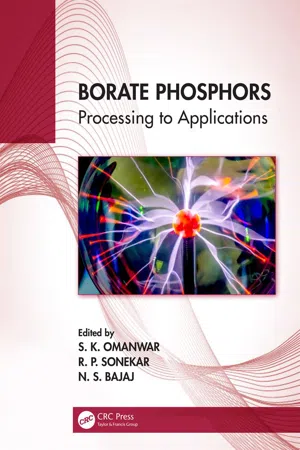
Borate Phosphors
eBook - ePub

Borate Phosphors

Processing to Applications

  1. 308 pages
  2. English
  3. ePUB (mobile friendly)
  4. Available on iOS & Android
eBook - ePub

About this book

Borate-based phosphors have attracted much attention, due to their high optical stability, low-cost synthesis via conventional and non-conventional methods and resulting technology to be environmentally friendly. This book discusses the structural and chemical parameters of borates as a phosphor including suitable synthesis methods and proper characterization of materials. Further, it includes applications of borate materials such as photoluminescence, UV application, UVU application, photo therapy application and radiological applications.

Features:

  • Provides information on borate phosphors and their structure.
  • Aids selection of proper structural and functional borates used in applications based on phosphor technology.
  • Discloses the modification in properties of borate functional group upon mixing or substitution with other metallic functional groups.
  • Discusses biological applications such as photo-thermal heating-based therapy, temperature sensors, imaging, and diagnosis.
  • Includes current trends and innovations, limitations and challenges, prospects, and scope in each chapter.

This book is aimed at researchers and graduate students in inorganic materials, luminescent/optical materials, materials science/engineering, and physics.

Tools to learn more effectively

Saving Books

Saving Books

Keyword Search

Keyword Search

Annotating Text

Annotating Text

Listen to it instead

Listen to it instead

1 Introduction to Borate Phosphors

P. K. Tawalare and A. B. Gawande
DOI: 10.1201/9781003207757-1
CONTENTS
  1. 1.1 Introduction
  2. 1.2 Phosphors
  3. 1.3 Applications of Phosphors
  4. 1.3.1 Luminescence Phenomenon
  5. 1.3.1.1 Principle
  6. 1.3.1.2 Excitation
  7. 1.3.1.3 Emission
  8. 1.3.1.4 Decay Characteristics
  9. 1.3.1.5 Mechanism
  10. 1.4 Borate-Based Phosphors
  11. 1.4.1 Classification of Borates
  12. 1.4.1.1 Classification of Borates Based on Chemical Formula
  13. 1.4.1.2 Classification of Borates Based on Crystal Structure
  14. 1.4.2 Crystal Chemistry of Borates
  15. 1.4.3 Applications of Borate Host Materials as Phosphors
  16. 1.4.3.1 Inorganic Borate as NLO and LASER Material
  17. 1.4.3.2 Inorganic Borate as Phosphor Material
  18. 1.4.4 Mixed Borate Phosphors
  19. References

1.1 Introduction

The varied aspects of luminescence and the complex processes involved in the origin of light emission, offer interesting challenges for researchers in this field. This is one of the research fields, wherein diverse application area exists, which range from radiation monitoring for health and safety, phosphors for lamps and display purposes to X-ray imaging and other means of medical diagnostics.
Luminescence is a well-established field of scientific research. In 1652, Zechi made an important contribution to the understanding of photoluminescence. It is the emission of light, which persists after the excitation agency, is removed (luminescence). Moreover; he proved experimentally that the color of the phosphorescence light in a material is independent of the color of the exciting light and also clearly distinguished the phenomenon from scattering. About 200 years later, Stoke showed that the incident and emitted light differed in color and enunciated his well-known Stoke's law regarding the increase in wavelength, which accompanies photoluminescence. In 1867, E. Bequerel distinguished two types of phosphorescence or after-glow, which were attributed respectively to monomolecular and to bimolecular decay mechanism.
The last few decades have witnessed dramatic changes in research on luminescence. There has been a phenomenal growth in the subject, and a significant progress has been made in the field of luminescence research. Recent research is characterized by strong interaction among other branches of solid-state physics and between different areas of luminescence using inorganic and organic materials. Both experimental as well as theoretical approaches have been made.
Luminescent materials are called phosphors. The first systematic study of luminescent crystals was made by Lenard [1] and his school, at the beginning of the 20th century. The phosphors they studied are called ‘Lenard Phosphors’. The practical interest in luminescent materials for use in efficient cathode ray screens, and eventually for luminescent lamps, which were then developed in 1930s, stimulated the study of crystal luminescence in a very substantial way.

1.2 Phosphors

Phosphors are solid, luminescent materials that emit photons when excited by an external energy source, such as an electron beam (cathodoluminescence) or ultraviolet light (photoluminescence). Phosphors are composed of an inert host lattice, which is transparent to the excitation radiation and an activator, typically a 3d or 4f electron metal, which is excited under energy bombardment. The process of luminescence occurs by adsorption of energy at the activator site, relaxation, and subsequent emission of a photon and a return to the ground state. The efficiency of a phosphor depends on the amount of relaxation that occurs during the activation and emission. Relaxation is the process in which energy is lost to the lattice as heat; it needs to be minimized in order to extract the highest luminous efficiency. The luminous efficiency is defined as the ratio of the energy emitted to the energy absorbed.

1.3 Applications of Phosphors

The substantial advances in understanding luminescent phenomena and the discoveries of unusual luminescent processes, for example, up-conversion and quantum splitting, present unusual opportunities for the applications of luminescence. In some instances, these possible applications depend on improvements in efficiencies and stabilities of inorganic luminescent materials; in other instances, on the problems of adapting the available scientific understa...

Table of contents

  1. Cover
  2. Half Title
  3. Title Page
  4. Copyright Page
  5. Contents
  6. Preface
  7. Editors’ Biographies
  8. List of Contributors
  9. Chapter 1 Introduction to Borate Phosphors
  10. Chapter 2 Borate Phosphor: Synthesis and Characterization
  11. Chapter 3 Borate Phosphors: Lamp Phosphors
  12. Chapter 4 Borate Phosphors for Solid-State Lighting
  13. Chapter 5 Borate Phosphor for Phototherapy Application
  14. Chapter 6 Borate Phosphor: PDP Phosphor
  15. Chapter 7 Borate Phosphors for Radiation Dosimetery
  16. Chapter 8 Borate Phosphors: NIR Quantum Cutting Phosphors
  17. Chapter 9 Borate Phosphor: Mechanoluminescence and Lyoluminescence Phosphors
  18. Chapter 10 Borate Phosphors for Neutron Radiography
  19. Index

Frequently asked questions

Yes, you can cancel anytime from the Subscription tab in your account settings on the Perlego website. Your subscription will stay active until the end of your current billing period. Learn how to cancel your subscription
No, books cannot be downloaded as external files, such as PDFs, for use outside of Perlego. However, you can download books within the Perlego app for offline reading on mobile or tablet. Learn how to download books offline
Perlego offers two plans: Essential and Complete
  • Essential is ideal for learners and professionals who enjoy exploring a wide range of subjects. Access the Essential Library with 800,000+ trusted titles and best-sellers across business, personal growth, and the humanities. Includes unlimited reading time and Standard Read Aloud voice.
  • Complete: Perfect for advanced learners and researchers needing full, unrestricted access. Unlock 1.4M+ books across hundreds of subjects, including academic and specialized titles. The Complete Plan also includes advanced features like Premium Read Aloud and Research Assistant.
Both plans are available with monthly, semester, or annual billing cycles.
We are an online textbook subscription service, where you can get access to an entire online library for less than the price of a single book per month. With over 1 million books across 990+ topics, we’ve got you covered! Learn about our mission
Look out for the read-aloud symbol on your next book to see if you can listen to it. The read-aloud tool reads text aloud for you, highlighting the text as it is being read. You can pause it, speed it up and slow it down. Learn more about Read Aloud
Yes! You can use the Perlego app on both iOS and Android devices to read anytime, anywhere — even offline. Perfect for commutes or when you’re on the go.
Please note we cannot support devices running on iOS 13 and Android 7 or earlier. Learn more about using the app
Yes, you can access Borate Phosphors by S. K. Omanwar, R. P. Sonekar, N. S. Bajaj, S. K. Omanwar,R. P. Sonekar,N. S. Bajaj in PDF and/or ePUB format, as well as other popular books in Physical Sciences & Electrical Engineering & Telecommunications. We have over one million books available in our catalogue for you to explore.