Polymeric Foams: Innovations in Technologies and Environmentally FriendlyMaterials offers the latest in technology and environmental innovations within the field of polymeric foams. It outlines how application-focused research in polymeric foam can continue to improve living quality and enhance social responsibility.
This book:
Addresses technological innovations including those in bead foams, foam injection molding, foams in tissue engineering, foams in insulation, and silicon rubber foam
Discusses environmentally friendly innovations in PET foam, degradable and renewable foam, and physical blowing agents
Describes principles as well as applications from internationally recognized foam experts
This work is aimed at researchers and industry professionals across chemical, mechanical, materials, polymer engineering, and anyone else developing and applying these advanced polymeric materials.
Trusted by 375,005 students
Access to over 1.5 million titles for a fair monthly price.
1.4.1 Cooling Design Progression for Foam Extrusion
1.4.2 Pressure Mold Foaming for Engineered Polymers
1.5 Summary
References
1.1 Introduction
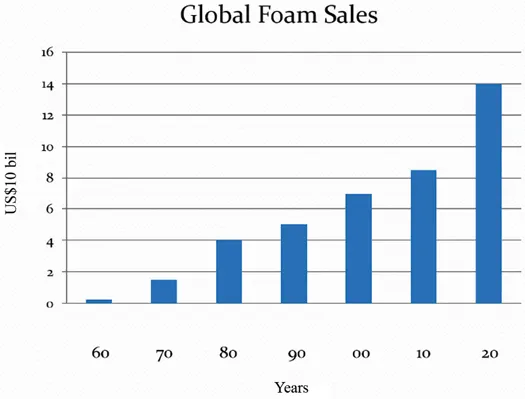
Polymeric foams began its footprints in the 1930s in Europe. World War II greatly fueled technology advancements in machinery design, benefitting polymeric foam production. After the War, technology transfer to civilian applications along with significant research into the mysterious polymeric foam development made tremendous strides in the technology advancement [1,2]. Since then, business began to find in-roads into applications to improve living quality [3]. Figure 1.1 shows a photo of polystyrene (PS) foam log taken in 1949. In the 1960s, foam was recognized in the US and EU markets as a useful product for protection and packaging. The living standard improved. It drew R&D supports from industrial partners to excel manufacturing technology for sustainable business growth. A vivid business model was established. Meanwhile, Japan also joined the methodology development force, which became fruitful in the 1970s and thereafter [4]. The Microcellular technology and the Montreal Protocol to regulate emissions of halogenated hydrocarbon known as chlorofluorocarbon (CFC) were the major events in the 1980s [5,6 and 7]. The former simply opened the academic R&D gate to work closely with industrial R&D not only for business growth but social accountability. For plastics industry, recycle/reuse became a top concern in the 1990s, which was a tougher issue for foam, since it generally required a tighter processing window. When climate change drew global attention in the beginning of the twenty-first century, more pressure was laid on the plastic industry. Foam in food and beverage packaging has been switched to paper-based alternatives. At the same time, foam’s role began to change from visible core product to invisible supportive specialty material. Its consumption continues to increase as illustrated in Figure 1.2 [8]. A quick summary of the foam technology/business development for the last 90 years is provided in Table 1.1.
FIGURE1.1 A woman holds a Styrofoam® log in this 1949 photo. (Courtesy of Science History Institute.)
TABLE1.1A Brief Summary of Technology/Business Development in Last 90 Years
Years
Technology
Product
Attribute
Application
1930
Reactive foaming
PU
Light & rigidity
Military
1940
Mold foaming
PS, PE
Shock absorption
Flotation
1950
Extrusion
PS
Thermoforming
Food, packaging
1960
X-linking, injection mold
PE
Soft & formable
Automotive
1970
Bead foaming
PS, c-PP
Irregular shape
Cup, packaging
1980
Microcellular
PS
Inorganic blowing agent
Food
1990
Extrusion
PET, PP
Branched polymer
Food, box
2000
Extrusion, molding
PLA
Renewable source
Food
2010
Nanocellular
PMMA
Low conductivity
Insulation- to be proved
2020
Mold foaming
TPU
Elasticity
Sports
In fact, polymer consumption for low-density foam—expansion over 15 times—is less than 10% by weight. Yet its expansion over 15 times—more areas over 20 times due to precision technology—makes it the most visible in the eyes of the consumer and in the waste management chain. The technology focus was turned from how to increase performance/weight ratio before the 1980s to how to reduce its life recycle and carbon footprint in the twenty-first century. From the trend, it is evident that the driving force began with technology optimization up to 1980, then business practice till 2000, and now to customer satisfaction. Innovative and socially accountable operation became the focal point. The merging between Exxon and Mobil in the 1990s and Dow and Dupont in 2016 are good illustrations. Innovation trends are simply turned from technical front to novel applications [9,10]. There is no doubt that innovation and environment are the main thrusts in the existing and new business development for foam. The encouraging part is that foam is not just for density reduction in the commodity markets, but its high internal surface area could be a useful characteristic in the sports, health care, medical, electronics, and cosmetics. Although foam may not be the core technology to promote other peripheral techniques into a solid platform to lead the society forward, transformation into the critical supportive role is crucial for foam to keep a sustainable growth.
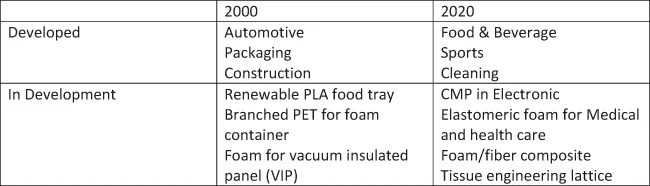
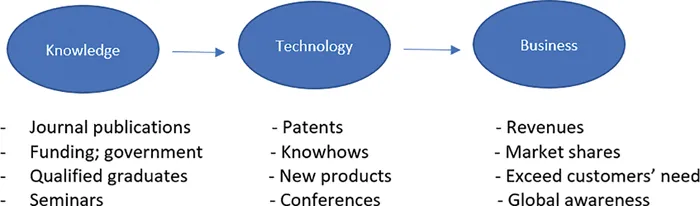
By the end of the twentieth century, most foam technologies, such as foam extrusion, injection molding, bead foam, and x-linked foam, had a very solid foundation. There is not a question that innovative application and environmental merits became the main driver to make the foam product not only a performance material but with a social image in it. This chapter is to address the change in the last decade, when there are incremental improvement in foaming technology and expansion in the application spectrum. Figure 1.3 shows the application comparison between 2000 and 2020. Obviously, customers’ voice played a critical role two decades ago, yet mainly to benefit customers. Now social awareness becomes increasingly important. Social accountability simply raised the bar. The fundamental flow chart as illustrated in Figure 1.4 is the same, but global wellness and awareness continue to drive the demand.
FIGURE1.3 Selected application items for performance foam between 2000 and 2020.
FIGURE1.4 A simplified mapping of Knowledge-Technology-Business development with its characteristics.
1.2 Innovations
1.2.1 Polypropylene Foam Sheet
PS foam has been known for its wide processing window, high expansion, very good modulus, and excellent thermoformability. It dominated beverage cups, food container, and packaging industries for several decades. The annual consumption reached 120 thousand metric tons in the 1980s. It can be imagined that after 30 times expansion; it became the most visible foam product in the society. Since its decomposition by ultraviolet (UV) was so slow, when combined with its bulkiness, it became an easy target for the environmental group in the early 1990s. Request for alternatives began. Development of high-melt-strength polypropylene a...
Table of contents
Cover
Half Title
Series Page
Title Page
Copyright Page
Dedication Page
Table of Contents
Preface
Biography
Contributors
Chapter 1 Introduction
Chapter 2 Modification of Rheological Responses under Elongational Flow
Chapter 3 Bead Foams
Chapter 4 Foam Injection Molding
Chapter 5 High-Pressure Foam Injection Molding of Polylactide/Nano-Fibril Composites with Mold Opening
Chapter 6 Foams in Tissue Engineering
Chapter 7 Foam in Insulation
Chapter 8 Advancements in Foam Injection Molding
Chapter 9 Silicone Foams: A World Different from Other Foams
Chapter 10 Lab Analysis of Melt-Foaming Behaviors of Long-Chain Branched Polyethylene Terephthalate Using Supercritical CO2 as Blowing Agent
Chapter 11 Extrusion Foam of Polylactic Acid Using Stereocomplex Crystals
Chapter 12 Nanocellular Polymers
Index
Frequently asked questions
Yes, you can cancel anytime from the Subscription tab in your account settings on the Perlego website. Your subscription will stay active until the end of your current billing period. Learn how to cancel your subscription
No, books cannot be downloaded as external files, such as PDFs, for use outside of Perlego. However, you can download books within the Perlego app for offline reading on mobile or tablet. Learn how to download books offline
Perlego offers two plans: Essential and Complete
Essential is ideal for learners and professionals who enjoy exploring a wide range of subjects. Access the Essential Library with 800,000+ trusted titles and best-sellers across business, personal growth, and the humanities. Includes unlimited reading time and Standard Read Aloud voice.
Complete: Perfect for advanced learners and researchers needing full, unrestricted access. Unlock 1.5M+ books across hundreds of subjects, including academic and specialized titles. The Complete Plan also includes advanced features like Premium Read Aloud and Research Assistant.
Both plans are available with monthly, semester, or annual billing cycles.
We are an online textbook subscription service, where you can get access to an entire online library for less than the price of a single book per month. With over 1.5 million books across 990+ topics, we’ve got you covered! Learn about our mission
Look out for the read-aloud symbol on your next book to see if you can listen to it. The read-aloud tool reads text aloud for you, highlighting the text as it is being read. You can pause it, speed it up and slow it down. Learn more about Read Aloud
Yes! You can use the Perlego app on both iOS and Android devices to read anytime, anywhere — even offline. Perfect for commutes or when you’re on the go. Please note we cannot support devices running on iOS 13 and Android 7 or earlier. Learn more about using the app
Yes, you can access Polymeric Foams by S.-T. Lee in PDF and/or ePUB format, as well as other popular books in Technology & Engineering & Chemical & Biochemical Engineering. We have over 1.5 million books available in our catalogue for you to explore.