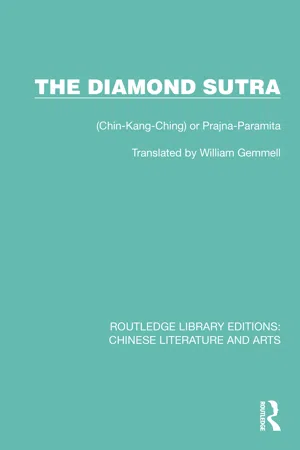
The Diamond Sutra
eBook - ePub

The Diamond Sutra

(Chin-Kang-Ching) or Prajna-Paramita

  1. 148 pages
  2. English
  3. ePUB (mobile friendly)
  4. Available on iOS & Android
eBook - ePub

The Diamond Sutra

(Chin-Kang-Ching) or Prajna-Paramita

About this book

This book, first published in 1912, is an English translation of The Diamond Sutra from the Chinese text of Kumarajiva, one of the most metaphysical of the works ascribed to Buddha. With parallel passages and numerous annotations, this is a classic translation of the one of the most important texts in Chinese Buddhism.
Trusted by 375,005 students

Access to over 1.5 million titles for a fair monthly price.

Study more efficiently using our study tools.

Information

Publisher
Routledge
Year
2022
Print ISBN
9781032248523
eBook ISBN
9781000583151

The Diamond Sutra

THUS have I heard1 concerning our Lord Buddha :—
Upon a memorable occasion, the Lord Buddha2 sojourned in the kingdom of Shravasti,1 lodging in the grove of Jeta,2 a park within the imperial domain, which Jeta, the heir-apparent, bestowed upon Sutana,3 a benevolent Minister of State, renowned for his charities and benefactions.
1 It is generally supposed that the familiar introductory phrase, “Thus have I heard,” was adopted by the writers or editors of Buddhist Sutras in order that their scriptures might assume the same high degree of authority as the Brahmanas and the Mantras, “as forming the ‘S’ruti ‘ or sacred revelation of the followers of the Vedas.” (Compare Max Müller’s History of Sanscrit Literature and the valuable note in Beal’s Kin-Kong-King,) 2 “The term (Buddha) means ‘every intelligent being who has thrown off the bondage of sense perception and self, knows the utter unreality of all phenomena, and is ready to enter Nirvana.’” Handbook of Chinese Buddhism. Eitel. 1 Shravasti is variously described as the city (or kingdom) of philosophy, of good doctrine, of abundant virtue, and as the abode of immortals. It was situated on the north bank of the Ganges, about 200 miles above Benares. Much interesting information regarding the sacred city Shravasti, is fortunately preserved in the instructive records of the distinguished Chinese pilgrims, Fa-Hien and Hiuen-Tsang. 2 “Prasenajit, the king of Shravasti, was very favourable to the Buddhist religion. It was his minister who bought the garden of Jeta from the prince of that name, and erected in it a residence for Buddha (see Julien’s Memoirs sur les Contrées Occidentales). Many of the Sutras attributed to Buddha are said to have been delivered here. Hiuen-Tsang observed the remains of the monastery formerly standing on the site of the garden of Jeta, 2 miles below the city.”—Chinese Buddhism. Edkins. 3 “A person of extraordinary piety and goodness. One of the former Djatakas of Sakyamuni when he was a prince, and forfeited the throne by liberality in almsgiving.” —Handbook of Chinese Buddhism. Eitel.
With the Lord Buddha, there were assembled together twelve hundred and fifty mendicant disciples,1 all of whom had attained to eminent degrees of spiritual wisdom.
As it approached the hour for the morning meal, Lord Buddha, Honoured of the Worlds,2 attired himself in a mendicant’s robe,3 and bearing an alms-bowl in his hands, walked towards the great city of Shravasti, which he entered to beg for food.1 Within the city he proceeded from door to door,2 and received such donations as the good people severally bestowed.3 Concluding this religious exercise, the Lord Buddha returned to the grove of Jeta, and partook of the frugal meal4 received as alms. Thereafter he divested himself of his mendicants robe, laid aside the venerated alms-bowl,1 bathed his sacred feet, and accepted the honoured seat reserved for him by his disciples.
1 The Chinese text is ta-pi-ku— greater disciples. Our Chinese editor of The Diamond Sutra suggests that there are different grades of discipleship. The “lesser disciples” are those who have abandoned every form of vice, and are striving after virtue. The “greater disciples” are those to whom virtue has become spontaneous, and who have ceased to strive after its attainment. 2 A title conferred by Chinese Buddhists upon the founder of their faith, believing him to be a Teacher and Saviour whose merit is acclaimed in worlds beyond our own. 3 Having taken vows of poverty, a robe is one of the following eight articles which Buddhist monks are permitted to possess : three garments of different descriptions, a girdle for the loins, an alms-bowl, a razor, a needle, and a water-strainer. 1 Buddha has said, “the wise priest never asks for anything ; he disdains to beg ; it is a proper thing for which he carries the alms-bowl ; and this is his only mode of solicitation. But when he is sick, he is permitted to ask for any medicine that he may require, without being guilty of any transgression.”—Eastern Monachism. Spence Hardy. 2 Concerning the manner of begging an alms: “As a bee, injuring not the flower, or its colour, or its scent, flies away, taking the nectar, so let a sage go through the village.” —Questions of King Milinda. T. W. Rhys Davids. 3 “By many of the Buddhists it is considered to be an act of great merit to make a vow never to partake of food without giving a portion to the priests.”—Eastern Monachism. Spence Hardy. 4 “The fifth of the twelve sacred observances of the Chinese is called in Sanscrit Khaloupas’ Waddhaktinka, and is said to enjoin that the food obtained by the mendicant is to be divided into three portions : one to be given to any person whom he sees to be suffering from hunger, and a second to be carried to some quiet place in the forest, and placed upon a stone for the birds and beasts. If he does not meet with any one who is in want, he is not to eat the whole of the food that he has received, but two-thirds only. By this means his body will be lighter and more active. . . . He will be able readily to enter upon the practice of all good works. When any one eats too greedily . . . nothing is more harmful to the development of reason.” (Quotation from Remusat’s Relation des Royaumes BuddhiqueSy in Spence Hardy’s Eastern Monachism.) 1 “The alms-bowl which Sakyamuni used is considered a sacred relic, and to be used by each of the hundred Buddhas of the present kalpa. It was first preserved in Vais’ali, whence its emigrations began to Gandhara, to Persia, to China, to Ceylon, to Madhyadesa, up into the heaven Tuchita, and down to the bottom of the ocean, where it is to await (in the palace of Sagara) the advent of Meitreya Buddha.” — Handbook of Chinese Buddhism. Eitel.
Upon that occasion, the venerable Subhuti1 occupied a place in the midst of the assembly. Rising from his seat, with cloak arranged in such manner that his right shoulder was disclosed, Subhuti knelt upon his right knee, then pressing together the palms of his hands, he respectfully raised them towards Lord Buddha, saying: “Thou art of transcendent wisdom, Honoured of the Worlds! With wonderful solicitude, Thou dost preserve in the faith, and instruct in the Law, this illustrious assembly of enlightened disciples.2
1 ‘ ‘A famous dialectician noted for the subtilty of his intellect. He was a native of Shravasti, a contemporary of Sakyamuni, and figures as the principal interlocutor in the Prajna-Paramita”—Handbook of Chinese Buddhism. Eitel. 2Pu-Sa or Bodhisattva, literally he whose essence (Sattva) has become intelligence (Bodhi). A being that has only once more to pass through human existence before it attains to Buddhaship. The third class of Buddhistic saints comprehending all who are candidates for Buddhaship as well as those Buddhas who are not yet perfected by entrance into Nirvana. They are also styled Mahasattvas (Mo - Ho - Sa). The state of a Bodhisattva is considered as one of the three means of conveyance to Nirvana.”—Handbook of Chinese Buddhism. Eitel.
Honoured of the Worlds ! if a good disciple, whether man or woman,1 seeks to obtain supreme spiritual wisdom,2 what immutable Law shall sustain the mind of that disciple, and bring into subjection every inordinate desire?”1
1 “Women began to ask and received permission to take the vows. They were called in India Bikshuni. ... Ni is the Sanscrit feminine termination of Bikshu. These female mendicants were subject to the same code of regulations as the males.”—Chinese Buddhism. Edkins. 2ho-ru-to-lo-san-mao-san-pu-ti(Anuttara Samyak Sambodhi), literally unexcelled perfect intelligence. Another more painstaking but arbitrary explanation is untarnished and unparalleled (Nuttara) correct view (Sam) and complete wisdom (Myak) with complete possession of the highest sentiments (Sambodhi). This term, one of the sacred phrases of most frequent occurrence, signifies the characteristics which every Buddha possesses.” —Handbook of Chinese Buddhism. Eitel.
“The unsurpassed, just, and enlightened heart. “—Kin-Kong-King....

Table of contents

  1. Cover
  2. Half Title
  3. Title Page
  4. Copyright Page
  5. Original Title Page
  6. Original Copyright Page
  7. Preface
  8. Introduction
  9. The Diamond Sutra
  10. Index

Frequently asked questions

Yes, you can cancel anytime from the Subscription tab in your account settings on the Perlego website. Your subscription will stay active until the end of your current billing period. Learn how to cancel your subscription
No, books cannot be downloaded as external files, such as PDFs, for use outside of Perlego. However, you can download books within the Perlego app for offline reading on mobile or tablet. Learn how to download books offline
Perlego offers two plans: Essential and Complete
  • Essential is ideal for learners and professionals who enjoy exploring a wide range of subjects. Access the Essential Library with 800,000+ trusted titles and best-sellers across business, personal growth, and the humanities. Includes unlimited reading time and Standard Read Aloud voice.
  • Complete: Perfect for advanced learners and researchers needing full, unrestricted access. Unlock 1.5M+ books across hundreds of subjects, including academic and specialized titles. The Complete Plan also includes advanced features like Premium Read Aloud and Research Assistant.
Both plans are available with monthly, semester, or annual billing cycles.
We are an online textbook subscription service, where you can get access to an entire online library for less than the price of a single book per month. With over 1.5 million books across 990+ topics, we’ve got you covered! Learn about our mission
Look out for the read-aloud symbol on your next book to see if you can listen to it. The read-aloud tool reads text aloud for you, highlighting the text as it is being read. You can pause it, speed it up and slow it down. Learn more about Read Aloud
Yes! You can use the Perlego app on both iOS and Android devices to read anytime, anywhere — even offline. Perfect for commutes or when you’re on the go.
Please note we cannot support devices running on iOS 13 and Android 7 or earlier. Learn more about using the app
Yes, you can access The Diamond Sutra by William Gemmell in PDF and/or ePUB format, as well as other popular books in Social Sciences & Regional Studies. We have over 1.5 million books available in our catalogue for you to explore.