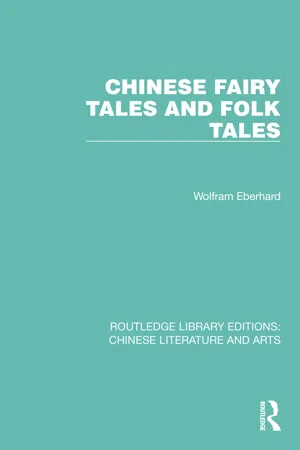
This book, first published in 1937, collects together traditional Chinese fairy tales, taken down word for word as they were related to the author by one of China's foremost scholars.
- 316 pages
- English
- ePUB (mobile friendly)
- Available on iOS & Android
eBook - ePub
Chinese Fairy Tales and Folk Tales
About this book
Information
PART I FAIRY TALES
1. The Great Flood
IN a mountain village lived a woman and her son. She was more than fifty years old, and her son, Chou Ch’eng, exactly nineteen. They were very poor and earned their living by collecting firewood.
Every morning Chou Ch’eng hung his axe on his carrying pole and went into the mountains. By midday he had collected a large load of firewood, which he took into the town to sell. With the money he received he bought rice and went home, where his mother had dinner ready for him. He put down his stick, and while he ate the meal he told his mother all that had happened during the day. By the time he had finished it was nightfall and time to go to bed. The next morning he would go out for firewood as usual, and his mother cooked the rice bought the day before, ate some of it, and kept the rest for her son. In this manner the days went by.
One day Chou went to the hills as usual. His mother had finished dinner and was mending his clothes, when she heard the loud clang of a gong ceaselessly beating outside. Putting down the clothes, she went to the door to see what it was, and there she found an old beggar monk. She said to him: ‘We are poor people and have no spare rice. You must go elsewhere.’ ‘Lord Buddha! I am so hungry!’ said the monk. ‘Please give me the remains of the rice in the pot.’ The woman was frightened when she heard this, because the rice-pot was standing in the house and he could not know what was in it. Fearing he might be a saint, she said to him: ‘The rice in the pot is really for my son. But if you are very hungry I will give you half of it. Please wait a moment.’ She went back into the house, put half the rice into a bowl, and brought it out to the monk. While he was eating he said to her: ‘I still have something important to say to you. When your son Chou Ch’eng comes home, tell him to return to the town and buy some sheets of paper and some flour, prepare some paste, and then stick some straw and the paper together and make a boat. When the eyes of the two lions in front of the big temple in the village become red, you must both get into the boat, because the land here will disappear and the town will be covered by a large lake. But remember this: if you see sparrows, ants, or snakes swimming in the water, you may save them; men or wolves, however, you must on no account assist. Do you understand?’ Then he went away.
The woman looked up at the sun, and calculating from its place in the sky that her son would soon return, she went into the house, poured the rest of the rice into a bowl, and then went out again to watch for his coming. As there was no sign of him, she went in again and tidied up the clothes that she had mended, and then when he still did not come, she went and stood at the door.
The sun was slowly sinking behind the hills in the west. The birds, who had already retired to their nests, were singing their bedtime songs. She became quite tired from standing by the door, and was worried and anxious about her son. Only when it was almost dark did she see him coming, and she felt as if a load had been lifted off her heart. She saw that he had a bag on his stick and was pleased that he was bringing the rice. ‘Hurry up!’ she called out. ‘Why are you so late to-day? After dinner I have some news for you.’ ‘I have already eaten,’ answered the son. ‘As I was coming home from the hills to-day, I met an old man who wanted to buy all my wood. He didn’t ask the price, but wanted me to carry it back to his house, which was over thirty li away. As I put down the load, I saw a delicious-looking meal standing on the table, which the old man invited me to partake of. At first I refused, but he insisted on my eating, and being very hungry, I did take some. Afterwards, I was afraid he would give me no money, but in the end he gave me twice as much as I ordinarily receive, and when I told him that I had to go into the town to buy rice, he suggested that I should buy a bushel from him, and gave me much more than usual,’ and Chou Ch’eng pointed to his bag. While they were talking, they went into the house, and after putting down the bag, he asked his mother what had happened to her.
She told him all about the beggar monk who had urged them to make a boat of straw and paper, but her son was sceptical and asked her: ‘How can a paper ship carry people?’ ‘That’s not our business,’ replied the mother. ‘This monk was really a saint, because otherwise how could he know you were called Chou Ch’eng and that there was still some rice in the pot?’ Usually Chou agreed with his mother, but this evening he thought she was wrong.
Next morning, Chou went into the town to buy the things and then came home to stick the ship together. Meanwhile, his mother washed the rice and cooked one pot full, and then another to serve as provisions on the boat. By midday the boat was ready and Chou ran off to the temple to look at the lions’ eyes, but seeing them as white as usual he went home. Then he went again, but still there was nothing to see. He returned again and again, until his mother said to him: ‘It is now too late to-day for them to become red. Wait until tomorrow.’
During the night, neither could sleep long and they got up before the sun. Chou rubbed his eyes and ran off to the temple, while his mother packed the clothes and put them into the boat together with the rice, a pot, a bowl, a basin, and a sieve, not forgetting even the old bed.
Again and again the son went to the temple, but the eyes were still not red. In the evening, as he was running there again, people asked him why he continually went there, and Chou called out to them, as he hurried by, that he was going to see if the lions’ eyes were red. Two young wags heard him say this, and thought to themselves: ‘What a fool Chou is! How can the lions’ eyes become red? Let us, though, paint them ourselves and see what he does then.’
When Chou Ch’eng came once more and saw that the eyes were red, he rushed home to tell his mother the news, helped her into the ship, and then went on board himself. Scarcely were they inside, when they heard an appalling crash, and on opening their eyes again, they saw nothing but water all round. Their craft, however, was floating on the water just like a real ship, perhaps even quieter. Only it had no rudder and went wherever it wished.
Chou was so horrified that he could barely utter a word. But his mother kept on murmuring: ‘So many people have met their death! What a disaster! The saint told me that if we saw a sparrow, a snake or an ant swimming about, we could save them, but not a man nor a wolf.’ Just as she spoke, a swarm of ants came by, and when they were near enough, she fished them out with the sieve. Then a snake appeared and Chou rescued it and put it in the boat. It was nearly evening, but although it was near autumn, it was not at all cold. So they sat in the boat and looked into the water and up at the sky. Then they saw a sparrow fly up and prepare to settle on the boat, but seeing people on board, it became frightened and flew up and down without daring to descend. Chou called out: ‘Sparrow! come down and I will save you!’ But the sparrow only flew up higher, on and on, until it became exhausted and fell into the sea. But it fell not far away, and Chou was able to reach it with his hand and fish it out.
Suddenly the ship began to shake, and Chou, looking round, saw a white wolf clutching on to the side and preparing to jump over. Chou wanted to knock it off and began to beat it, but the wolf kept on jumping up, till at last his mother called out: ‘Let it come in, my son. Poor wolf; after all, it is also a living thing.’ Chou ceased to hit the wolf and it sprang into the boat. After a while, a man came swimming by, quite exhausted, and Chou asked his mother what he should do. ‘Of course save him,’ she said. ‘As we have saved a wolf, we can’t very well let a man drown.’ The ship moved in the direction of the man, and Chou put out his arms and pulled him into the boat. He soon recovered enough to thank Chou for saving his life, and he asked his name and the name of his mother, saying at the same time that he was called Wu Yi, and that out of his family of five people, all except he, who could swim, had been drowned. ‘Don’t talk so much, Chou,’ his mother called out. ‘Give him an old coat to change into and then come and eat.’ While they were eating, Wu Yi continued: ‘I cannot thank you enough for rescuing me, and as a small recognition, I should like to call you “Elder brother,” but I don’t know if this idea would please you.’ Before Chou had time to answer, his mother said: ‘That is a good idea. As Chou is much younger than you, he must call you “Elder Brother.“ ’ So Wu Yi knelt down before the mother and Chou accepted him as his blood brother, and they found so many things to talk about that they quite forgot their desperate plight.
It had become dark, and on all sides the sea stretched out to the horizon. There was no wind, but the ship sailed along without the three people feeling any danger. Chou fed the animals they had saved, and then they went to bed. Next morning, when they woke up, the sun was high in the sky and the boat was lying on the shore. Chou jumped ashore and looked around, but there was no sign of men, nothing but mountains and hills. He fetched his mother, and Wu Yi helped him to take off their belongings. The animals ran off, but the wolf ran backwards and forwards, as if he wanted to remain with his rescuers.
They chose a nice spot on the island and built themselves a house of straw and stone to live in. They still had a little rice, so they did not suffer from hunger, and then Chou discovered that there was a town thirty miles away. He and Wu collected firewood, which they took into the town and sold, thereby gaining enough for their livelihood.
One day, when Chou had just felled a large tree, a thick black cloud came up from the north-west. Chou thought to himself: ‘In fairy tales such black clouds are always evil spirits. I will give it a blow with my axe,’ and as the cloud came roaring and blustering by, with all his might he hurled his axe into the air, and when it fell down again, it was covered with blood. The cloud sped away towards the south-east and Chou pursued it with his weapon. After chasing it for about five miles, he saw it disappear under a stone, which, he found on going nearer, was concealing something. With a great effort, he managed to lift it up, and underneath he saw a dark hole stretching into the earth. He carefully replaced the cover, and after marking the spot, took up his axe and returned to where he had left Wu Yi. ‘I have been searching everywhere for you,’ said Wu. ‘Where have you been?’ ‘I was right about the dark wind cloud,’ answered Chou. ‘There was a spirit in it whom I wounded with my axe. Look! There is still some blood on it.’ ‘Oh, don’t bother about that,’ said Wu Yi. ‘It is almost dark and we must be getting home. Mother will be waiting at the door.’ Noticing that his brother was in an ill-humour, Chou said no more, but stuck his axe in his belt and took the load of wood. As it was already so late, they went straight home without going into the town. When they got near, Chou was surprised not to see his mother standing at the door, and when he looked closer he saw the wolf eating something. Yes, the wolf he had rescued from the water had killed and eaten his mother. With a roar, he raised his axe and dashed out the wolf’s brains, but his mother was dead. They both wept. Wu Yi was the first to recover himself and say: ‘Don’t weep, brother. She is dead and all our tears won’t bring her to life again. Let us carry her into the house, and to-morrow we can sell our wood and buy a coffin with the proceeds to bury her.’ Chou wiped his eyes and they both carried the body into the house. They began to weep again, and went to bed without eating anything.
The next day, Chou stayed with the body, while Wu Yi went into the town, sold the wood, and bought a miserable cheap coffin. They placed the body in it and buried it in a beautiful spot. Then they began to collect firewood again.
One day Chou went to town to sell wood. At the town gate he put down his load and rested a while. A crowd of people were standing in front of a red notice on the gate, and being unable to read, Chou asked an old man what it was all about. The old man answered: ‘On such and such a day, the daughter of His Excellency Wang was carried off from the garden by an evil cloud spirit. The man who finds her will receive 10,000 ounces of gold, and if he is over twenty and under thirty, she will become his wife.’ When he heard this, Chou remembered his experience a few days before, but before saying anything, he wanted to go home to ask his brother’s advice. He took his load, went into the town, found a purchaser for the wood, and then went home. He told Wu Yi the contents of the red notice, and asked him if he would accompany him and climb down into the spirit’s cave. ‘Of course I will go with you,’ Wu said. ‘If we don’t find her, we are no worse off: If we do find her, we shall become rich and have a wife.’ Next morning, Chou went into the town, and when he had found the house of Excellency Wang, he said to the doorkeepers, ‘Please tell His Excellency that I am here. I know where his daughter is hidden. I want to fetch her.’ The doorkeepers informed their master that a man had come who claimed to know where his daughter was hidden, and Excellency Wang sent for him at once, and asked him his name, where he came from, and what he knew about his daughter. Chou told him his name and said: ‘One day while I was collecting wood in the Eastern Hill, a dark storm cloud came up from the north-west. As I had always heard that dark clouds were evil spirits, I decided to try and wound it with my axe, and when the axe fell down again, it was all bloody. I pursued the cloud to a hole in the hills that was covered by a stone. All this occurred on the same day that your daughter was stolen away.’ ‘Then she is lost beyond hope, if you are telling the truth,’ said Excellency Wang in despair; but he became more cheerful when Chou said he would climb down the hole and look for her. ‘Go there at once. Do you need soldiers or weapons?’ he asked. ‘No!’ said Chou, ‘only a basket and a long chain and a few bearers with a chair to bring your daughter back.’ Excellency Wang ordered everything to be prepared, and Chou sent a messenger to his house to tell Wu Yi all that had happened. Then he thrust his axe into his belt and set forth. Outside were gathered fifty or sixty people sent by Wang, and a large crowd of sightseers. Chou and Wu led the way, followed by the whole crowd. Spurred on by their excitement, they soon arrived at the spot. Chou said to Wu: ‘Brother! Fasten the chain to the basket, and tie the bell to the other end. I will then get into the basket and you must let me down. If I pull the chain, the bell will ring and you must pull the basket up again at once.’ Then Chou tightened his belt, grasped his axe, took off the stone cover, got into the basket, and was let down into the hole. The farther down he went, the broader the hole became, until, about thirty or forty feet down, he touched ground. As he was coming down, everything was dark below and bright above; now everything was bright below and dark above. He sprang out of the basket, and looked around. The place was just like a garden; beautiful trees and flowers such as he had never seen before were growing everywhere. The ground was covered with such perfectly mown grass that he hardly dared to walk on it. To the west, he could see an artificial mountain. Although it was light, there was no sun in the sky. Chou did not waste time looking at all these wonders, but grasping his axe, he set off in the direction of the artificial mountain. From there he would be able to see everything, but before he reached it he heard a terrible noise, and turning round, he saw a stone house among the trees. With great care, he peeped through the door, and there he saw a spirit asleep in a chair. He had a grey-blue face, red hair and a red beard, and huge lips, through which two great tusks protruded from his mouth. He was wearing a long, old-fashioned black robe and black trousers, beneath which could be seen a black foot covered with golden hair with a great bleeding ulcer. A bowl of hot water stood on the ground beside him, and on his left sat a beautiful young maiden, with a pale and tragic face, who was continually wiping the ulcer with a sponge of hot water.
Chou coughed slightly, until the maiden heard him. She motioned him to go a little to the side so that the spirit should not see him, and then she went out to him. Chou asked her: ‘Are you not the daughter of Excellency Wang?’ ‘Yes,’ she said, ‘but why have you come here?’ ‘I am looking for you,’ he replied. ‘Oh!’ she sighed, ‘the spirit is so dangerous. He has seven heads, and if one is cut off another grows at once. A few days ago he was wounded in the foot by a woodcutter, and I have to wash the wound. At the moment he is sleeping,’ but just then, there was a rumbling sound and the spirit awoke. She signed to Chou to hide in the wood, and returning to the spirit, she continued to wash his wound with the sponge. The spirit rolled his eyes and roared: ‘I smell human flesh.’ ‘But, Master,’ replied the maiden, ‘I have not been here long. Perhaps I still smell of human flesh.’ Satisfied by this the spirit went to sleep again. Chou silently ran back to the entrance, tugged the chain to have the basket let down, and then got into it and was rapidly pulled up. ‘The maiden is there,’ he told the excited people, ‘but the spirit is very dangerous. He has seven heads, but I will find a way to dispose of him.’ Then he said to Wu: ‘If I have killed the spirit I shall send the maiden up first, and come up myself.’ Wu nodded, but already an evil plan was forming in his mind. Chou, however, suspected nothing and let himself down once more. Having arrived at the bottom, he grasped his axe, crept through the wood to the door, and listened until he was sure the spirit was asleep. Miss Wang was still washing his leg with hot water. When she glanced up, he showed her the axe and she nodded assent. He crept up behind the spirit and cut off one head, but immediately a new one grew, which he also cut off, but only after the last head had fallen was there any blood. ‘Now he is dead,’ said the maiden, ‘but why did you take such risks for me?’ Chou told her everything, and she said to him: ‘As one never knows what may happen to one, I will give you a token,’ and taking a golden clasp from her hair, she broke it in half and gave Chou one of the pieces. ‘This is your token,’ she continued, ‘and three years is the appointed time, after which it is no more good.’ Chou hid the clasp in his clothes, and leading the maiden to the basket, he shook the chain. Wu knew that the maiden would come up now and quickly pulled up the chain. Yes, she was very beautiful. The maid-servants that Wang had sent led her to the litter and stood round her.
Then Wu called out: ‘Quickly, shut the hole. The spirit is coming.’ The people had turned to look at the maiden, and did not remember that someone was still in the hole. Now they all ran up and helped Wu to fill up the hole, and then, amidst rejoicing, they returned to Wang’s house. But Wang had no sooner seen Wu than he said: ‘This is not Chou Ch’eng. He was at most twenty years old, and you are over thirty. How dare you pretend to be Chou?’ Then Wu answered: ‘Chou asked me to come instead of him, but I will fetch him,’ and he went out, wondering to himself what he could do, and whether he would have to go out and collect firewood again.
Chou was waiting for the basket to descend again, when suddenly a shower of sand and stones poured down and nearly killed him. The shower stopped, but there was no sign of the chain, and he saw that the hole had been shut. Sighing, he thought to himself that his end was near, because nowhere could he find another exit from the cavern. ‘Whether the hole has been shut or not does not matter, because I cannot get out without a basket and chain. I can only await my death.’ He wandered aimlessly about, until suddenly he saw a little white dragon sitting on a pedestal, swishing its tail. Seeing it fastened with a nail, he went up and pulled the nail out to let the dragon get down, saying: ‘We are com...
Table of contents
- Cover
- Half Title
- Title Page
- Copyright Page
- Original Title Page
- Original Copyright Page
- Table of Contents
- Introduction
- Part I Fairy Tales
- Part II Legends, Myths, Jokes, Anecdotes
- Notes
Trusted by 375,005 students
Access to over 1.5 million titles for a fair monthly price.
Study more efficiently using our study tools.
Frequently asked questions
Yes, you can cancel anytime from the Subscription tab in your account settings on the Perlego website. Your subscription will stay active until the end of your current billing period. Learn how to cancel your subscription
No, books cannot be downloaded as external files, such as PDFs, for use outside of Perlego. However, you can download books within the Perlego app for offline reading on mobile or tablet. Learn how to download books offline
Perlego offers two plans: Essential and Complete
- Essential is ideal for learners and professionals who enjoy exploring a wide range of subjects. Access the Essential Library with 800,000+ trusted titles and best-sellers across business, personal growth, and the humanities. Includes unlimited reading time and Standard Read Aloud voice.
- Complete: Perfect for advanced learners and researchers needing full, unrestricted access. Unlock 1.5M+ books across hundreds of subjects, including academic and specialized titles. The Complete Plan also includes advanced features like Premium Read Aloud and Research Assistant.
We are an online textbook subscription service, where you can get access to an entire online library for less than the price of a single book per month. With over 1.5 million books across 990+ topics, we’ve got you covered! Learn about our mission
Look out for the read-aloud symbol on your next book to see if you can listen to it. The read-aloud tool reads text aloud for you, highlighting the text as it is being read. You can pause it, speed it up and slow it down. Learn more about Read Aloud
Yes! You can use the Perlego app on both iOS and Android devices to read anytime, anywhere — even offline. Perfect for commutes or when you’re on the go.
Please note we cannot support devices running on iOS 13 and Android 7 or earlier. Learn more about using the app
Please note we cannot support devices running on iOS 13 and Android 7 or earlier. Learn more about using the app
Yes, you can access Chinese Fairy Tales and Folk Tales by Wolfram Eberhard in PDF and/or ePUB format, as well as other popular books in Social Sciences & Regional Studies. We have over 1.5 million books available in our catalogue for you to explore.