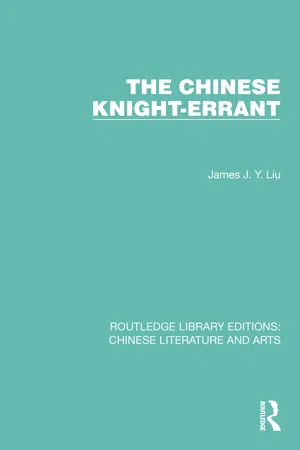
This book, first published in 1967, is a comprehensive study of knight-errantry in Chinese history and literature from the fourth century BC to the twentieth century. After discussing the social and intellectual backgrounds of knight-errantry, it gives examples of historical knights and describes the development of the theme of knight-errantry in poetry, fiction and drama. Many biographies, anecdotes, poems and tales are translated in full, while long prose romances and dramatic works are summarized and discussed. As background to these, sketches of the developments of Chinese fiction and drama are provided. In a final chapter, comparisons are made between Chinese and European knights, and between Chinese and Western chivalric literature.
- 254 pages
- English
- ePUB (mobile friendly)
- Available on iOS & Android
eBook - ePub
The Chinese Knight-Errant
About this book
Information
4 The Knight-Errant in the Theatre
Nature of Traditional Chinese Drama
Before discussing the role played by the knight-errant in the Chinese theatre we have to realize the nature of traditional Chinese drama and know some of the conventions of the major schools of drama. At the outset, it should be emphasized that traditional Chinese drama, though it involves singing, is not ‘opera’, as it is sometimes called. Chinese drama differs from Western opera in several significant ways. First, in Chinese drama the music is not specially composed for each piece as in Western opera, but taken from an existing repertoire of tunes. Plays belonging to the same school often employ practically identical tunes. It is obvious, then, that what makes one play different from another is not the music but the language and dramatic action. In other words, music is not the primary medium of expression but only one of several elements of Chinese drama. Secondly, while one does not normally read the libretto of an opera as literature, Chinese theatrical texts of the Yuan, Ming, and early Ch’ing periods were and are habitually read and enjoyed as literature, contrary to what some Western scholars think.1 Many plays which are no longer performed because the music is lost exist purely as literature now, and even when they were performed, they were admired as much for their literary qualities as for their music. A possible indication of the relative importance of language and music in Yuan and Ming drama is the fact that generally the names of the authors of the texts are known, but those of the composers of the music are not. Moreover, whereas libretti of operas to not constitute a literary genre, Chinese drama of the Yuan and Ming periods represent the final development of traditional literary forms prior to the impact of Western literature, and occupy a place in Chinese literary history which no one would dream of claiming for libretti of operas or lyrics of musical comedies in the history of Western literature. Therefore, we are not only justified but obliged to regard traditional Chinese theatre not as opera but as drama.1
Chinese drama is of course by no means unique in its use of music. Music is also used in such diverse dramas as Japanese Nō and Kabuki, Sanskrit drama, and Greek drama. But Chinese drama is less ritualistic than any of these, and of all non-Chinese dramas it is the Elizabethan that has most in common with the Chinese. Similarities between the two have often been remarked upon; for instance, A. E. Zucker pointed out resemblances between the physical and social conditions of the Chinese theatre and those of the Elizabethan,2 and the present writer compared the Elizabethan and the Yuan theatres with regard to the use of verse, the interplay of prose and verse, the use of monologue, aside, and direct address, and the use of prologue, induction, and epilogue.3 What is more, Chinese drama and Elizabethan drama not only resemble each other in technique but also in basic conception. To the Chinese, as to the Elizabethans, drama is not what the realists called a ‘sober imitation’ or ‘faithful reproduction of the surfaces of life’,4 but an art of expression in language and movement (with the addition of music in the case of the Chinese). The aim of the Chinese dramatist (and of the Elizabethan) is not to create an illusion of reality on the stage but to make his audience imagine a human experience in terms of fictitious persons and events and to respond to it emotionally. This has always been taken for granted by Chinese dramatists, actors, and audiences, while in Elizabethan England the point was made explicit by defenders of the theatre: Sir Richard Baker (1568–1645) asserted that plays were acted ‘not to Deceive others, but to make others Conceive’,1 and Sir Philip Sidney asked, ‘What childe is there, that comming to a Play, and seeing Thebes written in great Letters vpon an olde doore, doth beleeue that it is Thebes?’2 Indeed, Shakespeare’s injunction to his audience to exert their imagination might have been written for the Chinese theatre:
Into a thousand parts divide one man,And make imaginary puissance;Think, when we talk of horses, that you see them,Printing their proud hoofs i’ th’ receiving earth;For ‘tis your thoughts that now must deck our kings,Carry them here and there, jumping o’er times,Turning the accomplish of many yearsInto an hour glass ;3
Since the Chinese dramatist, like his Elizabethan colleague, is not concerned with producing an illusion of real life on the stage, he does not try to make his audience believe that the words spoken or sung by the actors are the actual speech of the characters in the play. Just as ‘the Elizabethan dramatist used language to affect his audience without attempting to disguise the fact that the language was his’,4 so did the Chinese dramatist. The main difference between the two is that the former only occasionally made use of music while the latter habitually did so. This is not as great a difference as it may seem to be, because the Elizabethan actor employed a style of acting derived from mediaeval rhetorical delivery,5 which differed from singing only in that the rise and fall of the voice was not regulated by the musical scale.6 Apart from this, both the Elizabethan and the Chinese dramatists used poetic means to achieve dramatic ends. Therefore, to estimate the dramatic value of a given passage or line in poetic drama, we should not ask whether this is what such a person in such a situation would actually say in real life, but whether it enables us to imagine, in the dramatist’s own terms, the particular experience embodied in such a character and such a situation, and whether it affects our response not only to this situation but to the play as a whole. Unless we adopt this attitude of mind, we would find many long passages in Chinese drama irrelevant or undramatic.
Major Schools of Chinese Drama
Various forms of entertainment—singing, dancing, story-telling, puppetry, buffoonery, acrobatics—contributed, to a greater or lesser extent, to the formation of drama in China. But here we cannot go into the early beginnings of Chinese drama, for to do so would take up too much space and would not be strictly relevant to our present purpose—to gain enough knowledge and understanding of Chinese drama in order to appreciate the role played by the knight-errant in it. Suffice it to describe briefly the main schools of drama that have developed since full-fledged drama first came into being in China.
1. Sung and Yuan Southern Drama (c. 1150–1368)
‘Southern Drama’ refers to the drama that arose some time during the Southern Sung period (1127–1279) in Chekiang province (traditionally regarded as part of the South, though it would be more accurate to call it the South-east). It was then known by several different names, but since Ming times it has generally been called Southern Drama (nan-hsi) or Dramatic Writings (hsi-wen). It originated from tunes employed in Lyric Metres (tz’ǔ)1 of the T’ang and Sung periods, Court music and variety shows of the Northern Sung period (960–1126), local folk songs, and a kind of story-telling combined with singing known as chu-kung-tiao (‘in various keys and modes’, so called because tunes in different keys and modes were used)2 which first appeared under the Tartar Chin dynasty (1115–1234) in North China. These ingredients were integrated into performances that combined dramatic narrative in verse and prose with music and acting.
During the Yuan period, Southern Drama failed to compete with Northern Drama for popularity. But at the end of the period it enjoyed a revival. However, later it absorbed elements of Northern Drama and developed into the Dramatic Romance of the Ming period, which will be described below.
As literature, Southern Drama is inferior to Northern Drama, though some plays are quite moving. The literary style is generally plain and natural, less poetic than Yuan Northern Drama and less sophisticated than Ming drama, but not without its own charms.
The conventions of Southern Drama will be described later, in comparison with Northern Drama.
2. Yuan Northern Drama (1280–1368)
Northern Drama, commonly called Mixed Plays (tsa-chü), developed in North China, with Peking (then called Ta-tu, ‘The Grand Capital’) as its centre, from sources similar to those of Southern Drama. It reached the status of genuine drama at the beginning of the Yuan dynasty and soon blossomed forth into one of the brightest flowers of Chinese literature. It flourished throughout the Yuan period but declined after the early years of the Ming. Later dramatists continued to write Northern plays, but they seldom observed all the conventions of Yuan Northern Drama, and their plays were inten...
Table of contents
- Cover
- Half Title
- Title Page
- Copyright Page
- Original Title Page
- Original Copyright Page
- Table of Contents
- Dynastic Table
- Introduction
- The Historical Knight-Errant
- The Knight-Errant in Poetry
- From Fact to Fiction
- 4 The Knight-Errant in the Theatre
- 5 Some Conclusions and Comparisons
- Additional Notes
- Bibliography
- Sources and References
- Glossary
- Index
Trusted by 375,005 students
Access to over 1.5 million titles for a fair monthly price.
Study more efficiently using our study tools.
Frequently asked questions
Yes, you can cancel anytime from the Subscription tab in your account settings on the Perlego website. Your subscription will stay active until the end of your current billing period. Learn how to cancel your subscription
No, books cannot be downloaded as external files, such as PDFs, for use outside of Perlego. However, you can download books within the Perlego app for offline reading on mobile or tablet. Learn how to download books offline
Perlego offers two plans: Essential and Complete
- Essential is ideal for learners and professionals who enjoy exploring a wide range of subjects. Access the Essential Library with 800,000+ trusted titles and best-sellers across business, personal growth, and the humanities. Includes unlimited reading time and Standard Read Aloud voice.
- Complete: Perfect for advanced learners and researchers needing full, unrestricted access. Unlock 1.5M+ books across hundreds of subjects, including academic and specialized titles. The Complete Plan also includes advanced features like Premium Read Aloud and Research Assistant.
We are an online textbook subscription service, where you can get access to an entire online library for less than the price of a single book per month. With over 1.5 million books across 990+ topics, we’ve got you covered! Learn about our mission
Look out for the read-aloud symbol on your next book to see if you can listen to it. The read-aloud tool reads text aloud for you, highlighting the text as it is being read. You can pause it, speed it up and slow it down. Learn more about Read Aloud
Yes! You can use the Perlego app on both iOS and Android devices to read anytime, anywhere — even offline. Perfect for commutes or when you’re on the go.
Please note we cannot support devices running on iOS 13 and Android 7 or earlier. Learn more about using the app
Please note we cannot support devices running on iOS 13 and Android 7 or earlier. Learn more about using the app
Yes, you can access The Chinese Knight-Errant by James J.Y. Liu in PDF and/or ePUB format, as well as other popular books in Social Sciences & Regional Studies. We have over 1.5 million books available in our catalogue for you to explore.