In the course of the early modern period, the capacity of European states to raise finances, wage wars, subject their own and far away populations, and exert bureaucratic power over a variety of areas of social life increased dramatically. Nevertheless, these changes were far less absolute and definitive than the literature on the rise of the "modern state" once held. While war pushed the boundaries of the emerging fiscal military states of the seventeenth and eighteenth centuries, rulers remained highly dependent on negotiations with competing elite groups and the private networks of contractors and financial intermediaries. Attempts to increase control over subjects often resulted in popular resistance, that in their turn set limits to and influenced the direction of the development of state institutions. Written in honour of the leading historian of war and state formation in the early modern Low Countries, Marjolein 't Hart, the chapters gathered in this volume examine the main drivers, beneficiaries and discontents of state formation across and beyond Europe in the early modern period.
eBook - ePub
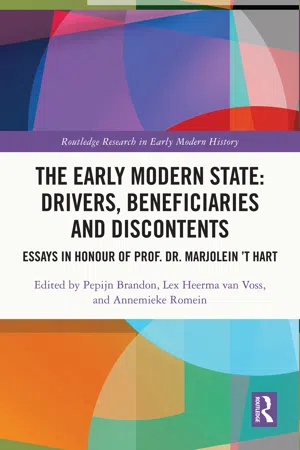
The Early Modern State: Drivers, Beneficiaries and Discontents
Essays in Honour of Prof. Dr. Marjolein 't Hart
- 310 pages
- English
- ePUB (mobile friendly)
- Available on iOS & Android
eBook - ePub
The Early Modern State: Drivers, Beneficiaries and Discontents
Essays in Honour of Prof. Dr. Marjolein 't Hart
Section IIIFinance and Contracts
5 The States' Army of Flanders and the English Roads, 1577–c.16101
DOI: 10.4324/9781003089421-9
Marjolein ’t Hart's ground-breaking work on early modern conflict, state finance, and state formation – especially in the context of the Netherlands – has been widely influential. This chapter extends her agenda-setting analysis of war, state finance, and the international and economic contexts of the Eighty Years’ War. I highlight some under-acknowledged aspects of the state financing of the Dutch Revolt, though I am not concerned here with state formation; a subject ’t Hart has examined both theoretically and empirically.2 Instead, I seek to bring out the complex inter-relationship of state finance, religious zeal, and troop quality in producing military effectiveness – a complexity to which scholars less careful than ’t Hart have not always done justice. I also stress the role of confessional factors, especially of Protestant internationalism, which leads me to nuance ’t Hart's characterization of the Revolt as the “Dutch Wars of Independence”.3 Her later work has developed a trend in recent years of seeing the Eighty Years’ War as an international, rather than solely Dutch, conflict; but on the other hand, as not primarily a religious war. During the period examined in this chapter, while the wars in the Netherlands were becoming increasingly about the independence of the northern provinces, they also need to be conceived as part of an international war of religion.
5.1 Terminology and historiography
Imitation is said to be the sincerest form of flattery, and I am not the first to take the title of Geoffrey Parker's The Army of Flanders and the Spanish Road and use it for other purposes: it even inspired the title of an essay on the supply of Elizabeth I's army in Ireland, so that now there is also a putative “Irish Road”.4 My use of the title reflects a genuine debt to a book that inspired me as an undergraduate, and which is still a major source for all scholars who work on the early modern period (and not only on Spain or the Netherlands).
Nevertheless, as well as play on words, my title also has a serious significance. First, it indicates my subject matter reasonably specifically, for I use both “Flanders” and “roads” advisedly. In early modern England, as indeed in Spain, “Flanders” was used to denote not only the province controlled by Bruges, Ghent, and Ypres, but also the Netherlands as a whole.5 Accordingly, when I speak of an “army of Flanders”, as Parker and other scholars have done in writing about the Spanish forces in the Netherlands,6 I refer to an army operating across the whole (or much of) the Low Countries, albeit in my case that in the service of the States General of the United Provinces.7 However, in addition, I do consider the role of the province of Flanders in the conflict during the 1570s and 1580s, as this was of considerable significance in financial terms. With regard to “English roads”, I use “roads” in a specific sense: roads and “roadstead” are both terms (to use the definition of the Oxford English Dictionary) for “a partly sheltered piece of water near the shore in which ships can ride at anchor”. The sea was Spain's preferred route to the Netherlands, until the ascendancy in the “narrow seas” of Protestant privateers (English and French, as well as Dutch),8 reflecting the fact that water routes were a more efficient means of communication in medieval and early modern society than the terrestrial “roads” that today monopolize our understanding of the term. It was because England had a maritime, rather than a land, frontier with the Netherlands that it could provide the assistance without which the Revolt of the Netherlands might well have ended in defeat.
Marjolein ’t Hart's characterization of the Eighty Years’ War as the “Dutch Wars of Independence” appears to provide a potentially neat solution to the problem of what to call the great, decades-long conflict. Its locus was in the Low Countries, but it was deeply intertwined, initially with the French wars of religion (1562–1598) and then the Anglo-Spanish war (1585–1604), before subsequently becoming “part of the general conflagration of the Thirty Years War”.9 Terminology has been a vexed issue, because different titles connote different explanations of the conflict's underlying causes and nature. While “Eighty Years’ War” (or Tachtigjarige Oorlog, though this term was not used until the eighteenth century) seems neutral, it implies continuity from the original conflict in the Netherlands through to the end of the Thirty Years’ War. Yet what was being fought for by the 1590s was already different to what had been at stake in 1568, and in the 1620s and 1630s, the nature of the conflict evolved further. Thus, even Tachtigjarige Oorlog is weighed down with ideological assumptions about continuity, which must prompt questions as to its aptness.10 There are, of course, the venerable and still serviceable cognate terms “Revolt of the Netherlands”, “Dutch Revolt”, and “de opstand”,11 but these could be taken as describing the confessional, political, and social upheavals, rather than the actual campaigns and combats that were both precipitated by and enabled rebellious or revolutionary action.
In fact, the neologism of “Dutch wars of independence” can be seen as the culmination of an historiographical trajectory. As Henk van Nierop observes, “three motives of freedom, religion and commerce dominated” in the “historiography until about 1960”. During the last 50–60 years, many established verities have been subverted. Nationalist interpretations, focused on the rise of the territory of the modern Kingdom of the Netherlands, were downplayed at the expense of regional and local ones, while, since the 1970s, Geoffrey Parker's work has brought out clearly that the Revolt was just one part of a much larger international conflict. However, although this conflict was about religion, confessional factors were also increasingly downplayed as a factor.12 More recently, Jonathan Israel “reverted to the older point of view that there were after all fundamental differences between the southern and the northern provinces” well before 1572, with the results thereafter partly reflecting the pre-existing “duality”.13 By this account, the story of the eight decades after 1568 is best understood as the story of a revolt of Holland and the North, not as a revolt of the Netherlands as a whole. This was reinforced by a separate yet complementary historiographical development: detailed exploration, particularly in substantial bodies of work by James Tracy and Marjolein ’t Hart, of the financing of war and the relationship of the economy to state finance. Tracy begins in the Habsburg period and takes his analysis – which is heavily focused on Holland – through to the point at which the United Provinces might be deemed to be standing on their own feet.14 By contrast, ’t Hart begins in the first half of the Revolt, but takes her analysis through to 1648 and in some cases beyond; and while Holland features prominently in it, she takes a broader view.15 Chronologically, Tracy's centre of gravity is in the mid to late sixteenth century; ’t Hart's in the early to mid-seventeenth. Between them, however, they provide an overview of state finance, politics, and economics in the northern provinces of the Netherlands (particularly Holland) over a century and a half.
The concept of “Dutch wars of independence” could be seen as a natural culmination of these trajectories in scholarship, and in a sense, as a return to the earlier model that concerned the independence of Holland and its attendant provinces, with less attention paid to the southern Netherlands. It is not that I substantially demur with regard to the historiographical trends, but I do want to suggest that they need to be nuanced in some ways, especially for the earlier part of the Revolt of the Netherlands. While “Dutch wars of independence” is apposite for the seventeenth-century decades of the Tachtigjarige Oorlog, it does not fully reflect the nature of the conflict during what, in 1609, was already being called a Forty Years’ War.16 After the outbreak in 1572 of what Parker terms the second revolt,17 Holland was itself divided and thus was not the driving force behind William of Orange. To be sure, in 1577 the Netherlands largely united in revolt against Philip II, in what Parker terms the “third revolt”.18 Patriotic Dutchmen later celebrated the Pacification of Ghent of November 1576, as well as the Union of Brussels to which it gave rise in January 1577, in ornate Latin verse as the “rebirth of liberty in Belgia” from the “Iberian perfidy”19 – language that is redolent of the view of the Revolt as one for liberty or independence. Yet as we will see, many of the soldiers who fought for the Revolt after 1577 were from outside the Netherlands and had strong confessional loyalties; they showed little interest in the cause of Dutch independence except insofar as it allowed the Reformed Church to flourish. In 1578, the States General rejected Spanish (though not yet Habsburg) sovereignty, and in 1581 the North declared independence; but the war up to c.1590 was not yet chiefly about the independence of the northern Netherlands, much less of Holland, and though that would come to characterize the conflict, it would be anachronistic to transpose this view to the earlier epoch.
The term “Dutch wars of independence” does not do justice to what was a transnational confessional conflict for thirty years or so after the start of the second revolt in 1572, and it is striking that confessional factors continue to be downplayed. Van Nierop's characterization of the role of religion is fine, as far as it goes: “The Calvinists interpreted the struggle for religion as one in which the monopoly of the Catholic church would be replaced by that of the reformed Church. The Calvinists, however, were a minority. Most Netherlanders initially wanted to go no further than to permit a certain degree of freedom to that minority”. Later, however, when experience seemed to show that different confessions were unable, in practice, to “co-exist peacefully, many [Netherlanders] chose a ‘reformed’ church, broadly defined, within which many tendencies could feel at ease. That was, however, not the sort of church for which the principled [and, one might add, the principal] Calvinists had fought”.20 Yet such a view is too limited, for it ignores the crucial role played by “principled Calvinists” as the motor of resistance, driving the decades of conflict. Also, as I will argue, it ignores the importance of Calvinist internationalism in generating vital support for the Revolt outside the Netherlands.
This brings us to a final point about the historiography of the Revolt: its internationalization is highly limited and certainly does not take account of international Protestantism. It arose out of the seminal work of Geoffrey Parker, and so has been largely about the international entanglements of the Spanish Monarchy. Not only did Parker brilliantly set out the Spanish side of the story of the Eighty Years War; he also, compellingly, connected success and defeat in the conflict to the availability of funds from the Spanish Monarchy. The end result is that while the Revolt is now recognized as “only […] part of a much larger international conflict”,21 it is really the Spanish side that is seen in an international context – and the Revolt has come to be seen as a story of Spanish defeat rather than of Dutch victory. Because we now understand so well just why Spain did not achieve victory, the eventual success of the Dutch Republic has come, almost by default, to be seen as a Spanish failure, attributable essentially to Spanish weakness (I return to this point in Section 5.5). If an alternative view is now emerging, one of Dutch strength, it is that propounded by Tracy and ’t Hart, of robust financial institutions – but located chiefly or only in Holland. The counter-narrative thus reduces the Revolt of the Netherlands down to a war made by Holland (on behalf of the other northern provinces) for independence, and to state-financial terms. B...
Table of contents
- Cover Page
- Half-Title Page
- Series Page
- Title Page
- Copyright Page
- Contents
- List of figures
- List of tables
- Acknowledgements
- List of contributors
- Introduction: The Early Modern State: Drivers, Beneficiaries, and Discontents
- Section I War, Economy, Representation
- Section II Institutions and Law
- Section III Finance and Contracts
- Section IV Transnational Agents
- Section V Labour and Contention
- Selective Bibliography
- Index
Trusted by 375,005 students
Access to over 1.5 million titles for a fair monthly price.
Study more efficiently using our study tools.
Frequently asked questions
Yes, you can cancel anytime from the Subscription tab in your account settings on the Perlego website. Your subscription will stay active until the end of your current billing period. Learn how to cancel your subscription
No, books cannot be downloaded as external files, such as PDFs, for use outside of Perlego. However, you can download books within the Perlego app for offline reading on mobile or tablet. Learn how to download books offline
Perlego offers two plans: Essential and Complete
- Essential is ideal for learners and professionals who enjoy exploring a wide range of subjects. Access the Essential Library with 800,000+ trusted titles and best-sellers across business, personal growth, and the humanities. Includes unlimited reading time and Standard Read Aloud voice.
- Complete: Perfect for advanced learners and researchers needing full, unrestricted access. Unlock 1.5M+ books across hundreds of subjects, including academic and specialized titles. The Complete Plan also includes advanced features like Premium Read Aloud and Research Assistant.
We are an online textbook subscription service, where you can get access to an entire online library for less than the price of a single book per month. With over 1.5 million books across 990+ topics, we’ve got you covered! Learn about our mission
Look out for the read-aloud symbol on your next book to see if you can listen to it. The read-aloud tool reads text aloud for you, highlighting the text as it is being read. You can pause it, speed it up and slow it down. Learn more about Read Aloud
Yes! You can use the Perlego app on both iOS and Android devices to read anytime, anywhere — even offline. Perfect for commutes or when you’re on the go.
Please note we cannot support devices running on iOS 13 and Android 7 or earlier. Learn more about using the app
Please note we cannot support devices running on iOS 13 and Android 7 or earlier. Learn more about using the app
Yes, you can access The Early Modern State: Drivers, Beneficiaries and Discontents by Pepijn Brandon, Lex Heerma van Voss, Annemieke Romein, Pepijn Brandon,Lex Heerma van Voss,Annemieke Romein in PDF and/or ePUB format, as well as other popular books in History & World History. We have over 1.5 million books available in our catalogue for you to explore.