This book traces the origins of a financial institution, the modern corporation, in Genoa and reconstructs its diffusion in England, the Netherlands, and France. At its inception, the Casa di San Giorgio (1407–1805) was entrusted with managing the public debt in Genoa. Over time, it took on powers we now ascribe to banks and states, accruing financial characteristics and fiscal, political, and territorial powers. As one of the earliest central banks, it ruled territories and local populations for almost a century. It controlled strategic Genoese possessions near and far, including the island of Corsica, the city of Famagusta (in Cyprus), and trading posts in Crimea, the Black Sea, the Lunigiana in northern Tuscany, and various towns in Liguria. In the early sixteenth century, in his Florentine Histories (Book VIII, Chapter 29), Niccolò Machiavelli was the first to analyze the relationship between the Casa di San Giorgio 's financial and territorial powers, declaring its possession of territories as the basis of its ascendancy. Later, the founders of some of the earliest corporations, including the Dutch East India Company (1602), the Bank of England (1694), and John Law's Mississippi Company (1720) in France, referenced the model of the Casa di San Giorgio.
eBook - ePub
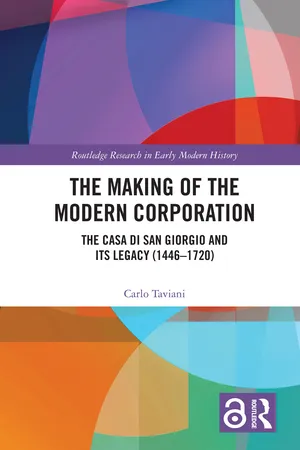
The Making of the Modern Corporation
The Casa di San Giorgio and its Legacy (1446-1720)
- 312 pages
- English
- ePUB (mobile friendly)
- Available on iOS & Android
eBook - ePub
The Making of the Modern Corporation
The Casa di San Giorgio and its Legacy (1446-1720)
About this book
Part I Finance and Organization of the Casa di San Giorgio (1407–1518)
1Origins and Foundation of San Giorgio
DOI: 10.4324/9781003261360-3
San Giorgio was created as an office of the Commune of Genoa. The Commune arose in the eleventh and twelfth centuries and by the fifteenth century was the institution with the most extensive territory in Liguria. After political reform in 1528, the term “Commune” was replaced by the term “Repubblica.” When one analyzes the relationship between the Commune and San Giorgio, it is helpful to remember that the studies dealing with the two institutions have different traditions. During the nineteenth century, the concept of “state” was applied to medieval and early modern territorial powers, in a backward projection of a nineteenth-century concept of the state. In recent decades, scholars have abandoned this approach and revised earlier historiography: the history of the Commune of Genoa is part of this revision. Unlike the historiography of the state, however, a revision of financial institutions has yet to be undertaken.1 It now seems appropriate for scholars to apply a similar perspective to the study of public debt, banks, and corporations.
The territorial power of the Commune of Genoa traditionally extended from Capo Corvo, on the east coast close to present-day Tuscany, toward Monaco (the present-day Principality of Monaco) on the west coast. The Commune had various offices: the Officium Antianorum (Office of the Senators); the Officium Monetae (Office of Money); the Officium Mercantiae (Office of Goods); the Officium Gazaria (dominions called Gazaria); the Officium Misericordiae (Charity); the Officium Rupti or Rotti (bankruptcies); and other temporary offices. As we will see, the Compere di San Giorgio was also an office of the Commune. The most important officeholder, the doge, governed the Commune together with the 12 anziani (of the Officium Antianorum); the Officium Monetae drew up the budget and dealt with the Commune’s expenses; the Officium Mercantiae dealt with issues related to merchants and trade; the Officium Gazaria administered the territories in the east; the Officium Rupti dealt with bankruptcies; and the Officium Misericordia administered donations for charity work. The charges of the offices were regulated through a mechanism of elections and lotteries (drawing lots). All the male citizens—nobles and populares (people, merchants, and artisans)—could vote. Election rules changed continually during the fifteenth century. The laws (regulae) of the Commune were updated in 1413 and 1443.2 Among the Commune’s various offices, San Giorgio became the most autonomous, with its power growing so much that some decades after its foundation it was identified— as be shown in Chapter 7—as powerful enough to compete with the Commune.
Before the foundation of San Giorgio, there were various forms of debts of private shareholders of the Commune in Genoa. Some of them were short-term loans, extraordinary contributions that were time limited; others lasted longer. The Compere and the maone lasted longer; they also involved the largest sums. San Giorgio slowly went on to absorb all the maone’s capital, privileges, structures, organization systems, archives, and rules.
1.1. The Comperae and the Sea Ventures
In Genoa, the maritime commercial enterprises were similar to the systems of loans made to the Commune by private individuals and citizens. Merchants needed huge resources to arm new ships, acquire goods, and move them abroad. Since a single merchant could rarely afford these expenses, from the twelfth century onward, a system of investment arose involving multiple capital investors. In exchange for a sum of money, these investors received shares. The shares could be traded during the voyage, and once the ship was back in port, gains were divided among the shareholders.3
Shares were virtual representations of parts of the ship and its cargo and were called loca (places), a term we see later in documents related to the contracting of levies and taxes.4 From the early years of the thirteenth century on, the term locum (pl. loca) was used for the smallest part of a share of the Commune that could be traded in exchange for money. A set of these loca was called a compera. It is still unclear if the term was borrowed from the sea ventures, but it may be that the debt of the Commune was divided into portions following the model of naval capital investment. It is hard to know if the financial system set up for maritime enterprises influenced the terrestrial debt in Genoa, both because sources are scant and because the maritime and terrestrial systems developed simultaneously. In Genoa, private citizens helped the Commune with cash flow from the first half of the eleventh century on via forced loans created for extraordinary situations such as military defense. From them the compere were derived—that is, the acquisition of the Commune’s rights on a gabella, the levy that up to then had pertained to the Commune. Initially this was a temporary process; later it became permanent. The earliest examples were called Compere Capituli (from the name of the Capital of the Cathedral, where the registers of these Compere were preserved);5 then came funding for the Compera Venetorum, the Compera Corsicae, the Compera Magna Pacis, the Compera Finarii, Compera Gazariae, Compera S. Pauli, and so on. A compera was named for the reason it was established—for example, the war against the Venetians, the war in Corsica, and so on.6 Over time, since the compere were numerous, the debts were consolidated. In 1332, for instance, the compere were united into the Gran Compera Pacis (Large Compera of Peace) of 6,668 loca.7
1.2. The Maona
1.2.1. The Puzzle of the Maona
The word maona has hitherto been associated mainly with an institution that was solely Genoese. The research presented here, however, shows that this word is attested to in other cities on the Italian peninsula, including Florence, Messina, Venice, and Lucca—and also on the Iberian Peninsula. Features, tasks, and functions of different maone varied over time, and this research has located several previously unknown and understudied cases that have different characteristics than those found in Genoa.
The more cases that are identified, the wider the definition becomes. Various institutions called maona existed over time and engaged in different activities in different locations. To make it possible to group them together, I will outline scholars’ interpretations of the maona. The maona has usually been defined as a group of investors joined together to form an organization that performed one or more economic activities. The majority of the maone identified by this research often, though not always, replaced the role of the state—that is, of a commune or a republic. Even this wide definition, however, does not account for all institutions called maona. My research has thus developed a model that takes into consideration those maone with different roles or purposes.
The scholarly model of maona has tended to consider only the Genoese cases—primarily those in fourteenth-century Chios. This limited model is problematic, however, and I will examine it more closely so I can open new research avenues.
The first known usage of the term maona is found in Genoese sources in the context of an expedition to defend Ceuta, in the Maghreb, in 1235; other Genoese maone were created later in Chios (1346), Cyprus (1373), and Corsica (1378). In 1235, the Genoese sent a fleet to Ceuta to force the local sultan to compensate the Genoese who had suffered losses at the hands of the Saracens in previous years.8 The Genoese had invested in Ceuta, but in 1234 there had been a serious conflict with the Saracens. After the expedition, the Commune attached taxes (gabelle) to a set of shares of public debt (the compera) in order to reimburse the investors.9 Genoese citizens traded these credits in the following decades and centuries.10 The first time...
Table of contents
- Cover
- Half Title
- Series
- Title
- Copyright
- Contents
- Preface
- Acknowledgements
- List of Abbreviations
- Introductory Chapter. Debating the Origins of Business Corporations
- Part I Finance and Organization of the Casa di San Giorgio (1407–1518)
- Part II The Casa di San Giorgio’s Territories (1407–1518)
- Part III Genoa’s Two Seats of Power: The Commune and San Giorgio (1453–66)
- Part IV The Casa di San Giorgio’s Model (1518–1791)
- Appendix 1
- Appendix 2
- Appendix 3
- Appendix 4
- Bibliography
- Index
Trusted by 375,005 students
Access to over 1.5 million titles for a fair monthly price.
Study more efficiently using our study tools.
Frequently asked questions
Yes, you can cancel anytime from the Subscription tab in your account settings on the Perlego website. Your subscription will stay active until the end of your current billing period. Learn how to cancel your subscription
No, books cannot be downloaded as external files, such as PDFs, for use outside of Perlego. However, you can download books within the Perlego app for offline reading on mobile or tablet. Learn how to download books offline
Perlego offers two plans: Essential and Complete
- Essential is ideal for learners and professionals who enjoy exploring a wide range of subjects. Access the Essential Library with 800,000+ trusted titles and best-sellers across business, personal growth, and the humanities. Includes unlimited reading time and Standard Read Aloud voice.
- Complete: Perfect for advanced learners and researchers needing full, unrestricted access. Unlock 1.5M+ books across hundreds of subjects, including academic and specialized titles. The Complete Plan also includes advanced features like Premium Read Aloud and Research Assistant.
We are an online textbook subscription service, where you can get access to an entire online library for less than the price of a single book per month. With over 1.5 million books across 990+ topics, we’ve got you covered! Learn about our mission
Look out for the read-aloud symbol on your next book to see if you can listen to it. The read-aloud tool reads text aloud for you, highlighting the text as it is being read. You can pause it, speed it up and slow it down. Learn more about Read Aloud
Yes! You can use the Perlego app on both iOS and Android devices to read anytime, anywhere — even offline. Perfect for commutes or when you’re on the go.
Please note we cannot support devices running on iOS 13 and Android 7 or earlier. Learn more about using the app
Please note we cannot support devices running on iOS 13 and Android 7 or earlier. Learn more about using the app
Yes, you can access The Making of the Modern Corporation by Carlo Taviani in PDF and/or ePUB format, as well as other popular books in History & World History. We have over 1.5 million books available in our catalogue for you to explore.